
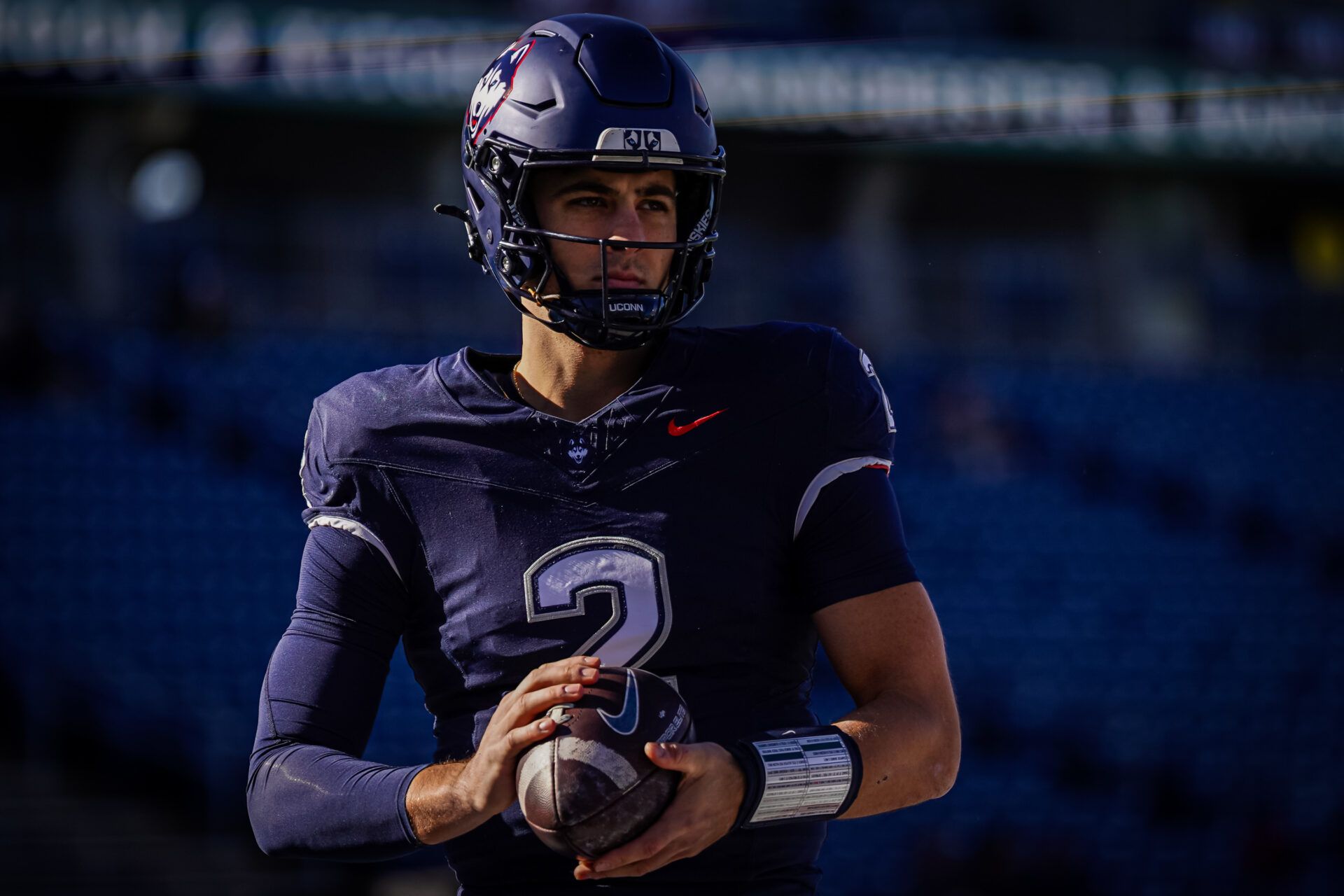
Joe Fagnano didn’t just have a good season; he quietly authored one of the most efficient and productive quarterback campaigns in all of college football. Week after week, he demonstrated poise, precision, and consistency, turning in performances that flew under the national radar despite their impact. Combining sharp decision-making with an ability to elevate his teammates, Fagnano emerged as a reliable leader and an offensive force capable of keeping defenses off balance from start to finish.
Shrine Bowl Puts Spotlight on QB Joe Fagnano
While national attention focused on Power Four contenders and NFL pipeline programs, Fagnano was busy leading UConn to a 9-3 record and a bowl berth for the second consecutive year, helping solidify the Huskies as a legitimate football program rather than a punchline or a basketball-only school.
His performance earned him New England Gold Helmet Player of the Year and Gridiron Club of Greater Boston Offensive Player of the Year honors, but even those accolades don’t fully capture how impressive his 2025 season was.
Fagnano started all 12 games, becoming the first UConn quarterback to do so since 2018, a testament to both his durability and command of the offense. He consistently stood tall in the pocket, absorbed contact, and maintained rhythm throughout the season.
Statistically, his numbers rank among the nation’s best. Fagnano completed 285 of 413 passes for 3,448 yards, throwing 28 touchdowns against just one interception and finishing with an impressive 161.03 passer efficiency rating.
That lone interception across 413 attempts highlights his exceptional decision-making and ball security. He recorded six 300-yard passing games and closed the season with a career-high performance against Florida Atlantic, throwing for 446 yards in a statement outing that showcased both his confidence and command.
The growth of UConn’s offense under Fagnano was undeniable. According to PFSN’s Offensive Impact Metric, the Huskies jumped from a 68.4 in 2024 to a 75.4 in 2025, reflecting a dramatic leap in overall effectiveness. UConn finished 16th nationally in yards per play (6.7) and 15th in points per game (35.3), numbers that place them firmly among the most efficient offenses in the country.
Protection and quarterback play went hand in hand. The Huskies posted a remarkably low 3.5% sack rate, a figure that reflects not only offensive line improvement but Fagnano’s ability to set protections, play within structure, and avoid holding the ball unnecessarily. He consistently kept the offense on schedule and in rhythm.
Having an elite weapon certainly helped. Wide receiver Skyler Bell was one of the most productive pass-catchers in the nation, finishing second nationally with 101 receptions and second in receiving yards with 1,276. Bell deserves every ounce of praise he receives, but his production doesn’t happen without a quarterback willing to trust tight windows and repeatedly look his way. Fagnano’s arm talent, timing, and confidence were essential in unlocking Bell’s dominance on the perimeter.
This brings evaluators to the central question surrounding Fagnano as he heads into the Shrine Bowl spotlight: Why did the breakout come so late?
After seven years in college football, teams will be weighing projection versus production. Fagnano has the size, arm strength, and pocket toughness to stand out during Shrine Bowl practices, but scouts will debate whether he fits the mold of a late bloomer, similar to Tyler Shough, with starter-level traits, or if he profiles best as a high-end developmental quarterback, camp arm, and reliable depth piece.
What’s no longer debatable is the tape. The production is real. The efficiency is elite. And at the Shrine Bowl, Fagnano finally gets a national stage to prove that his rise wasn’t a fluke; it was simply overlooked.
