
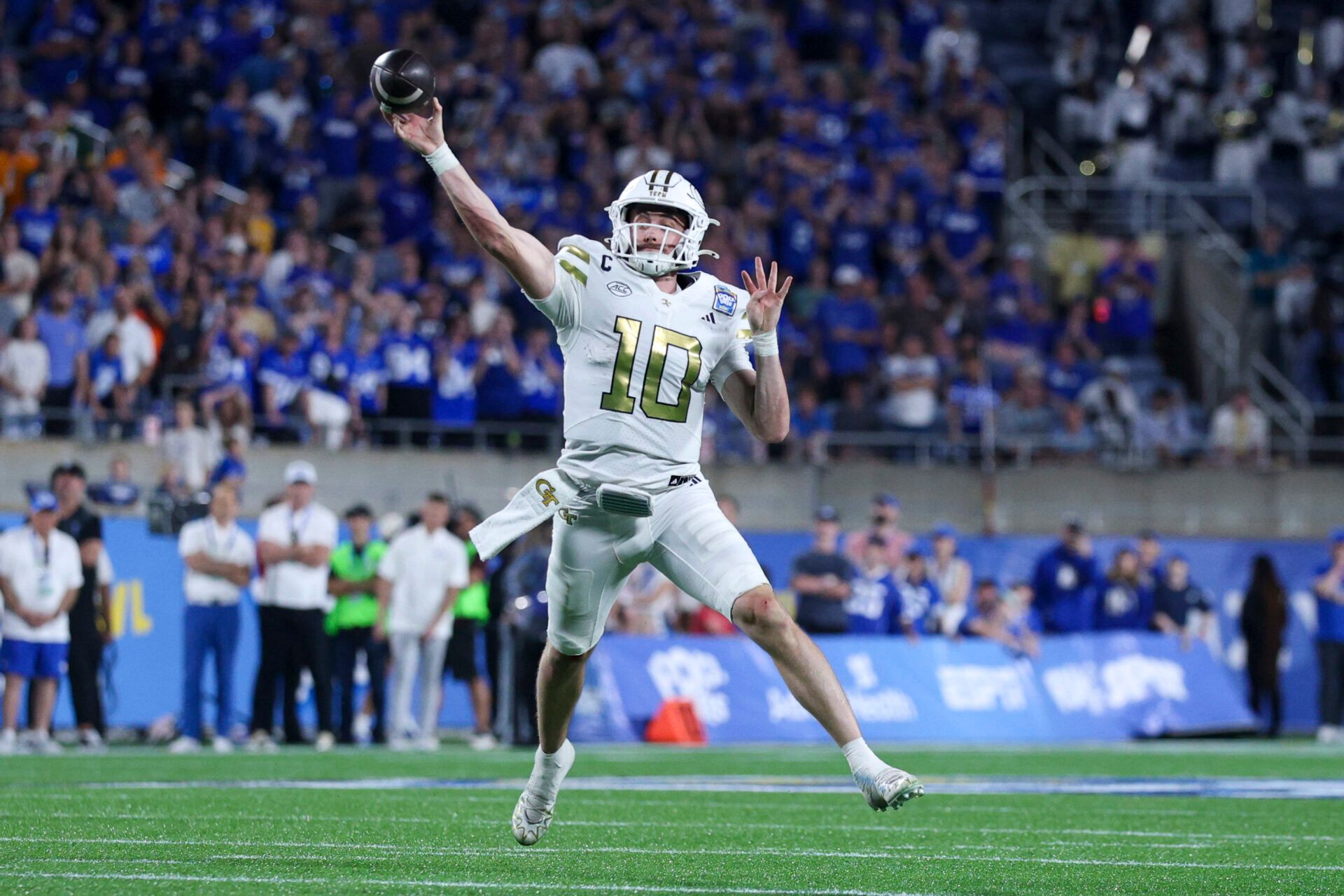
Few quarterbacks in college football embody toughness and competitiveness quite like Haynes King. Throughout the 2025 season, King became one of the sport’s most compelling stories, a relentless competitor who refused to let games slip away. Nicknamed the “Cardiac King,” he earned that label by consistently giving Georgia Tech a chance to win, no matter the circumstance, week after week.
Georgia Tech’s Star Aims To Turn Heads at the Shrine Bowl
King’s road to this point was anything but linear. A highly touted recruit out of high school, he began his college career at Texas A&M with the expectation of becoming the long-term answer at quarterback.
Injuries, however, stalled both his development and momentum, ultimately leading him to seek a fresh start through the transfer portal. That opportunity came in 2023 under Georgia Tech head coach Brent Key, and it proved to be the turning point many believed King was capable of reaching all along.
At Georgia Tech, King’s game took a significant leap. He became the engine of an offense that surged into national relevance and came agonizingly close to an ACC Championship Game appearance and a College Football Playoff berth.
The numbers backed his impact: King posted a PFSN CFB QB Impact Grade of 81.5 in 2024 (13th nationally) and elevated that mark to 86.4 in 2025, placing him among the top 20 quarterbacks in the country. He remained firmly in the Heisman conversation deep into the season before late losses cooled that push, losses that were not the result of King’s play.
True to his leadership style, King never deflected blame or pointed fingers. But the tape and context tell the story. Georgia Tech’s defense ranked 78th nationally in PFSN CFB Defensive Impact grade, repeatedly putting the offense in difficult positions.
Week after week, King was forced to dig the Yellow Jackets out of holes just to keep them afloat. That the team reached the heights it did is a testament to King’s value, resilience, and leadership.
King’s running ability remains the defining trait of his game. He runs with power, fearlessness, and a competitive edge that sets the tone for the entire offense. But 2025 also marked real progress as a passer. His completion percentage jumped to an impressive 71.7%, and ball security, long a strength, continued to stand out. He showed improved command, decision-making, and efficiency within the offense’s structure.
As he heads to the Shrine Bowl and toward the NFL, the evaluation is clear. At 25 years old, entering his rookie season, King must prove his throwing mechanics are repeatable and that he can consistently win from the pocket. Scouts already know he can run through contact and absorb punishment; now they want refinement, timing, and consistency as a passer.
There are elements of Jalen Hurts to King’s game, particularly in play style, toughness, and run-first physicality, though the comparison is not one-to-one. King ultimately profiles as an intriguing late-round flier with legitimate backup-plus upside, the kind of quarterback teams trust to stabilize an offense and compete when called upon.
King’s journey, from high expectations at Texas A&M, through adversity and reinvention at Georgia Tech, to the Shrine Bowl, is a testament to perseverance. And for evaluators searching for toughness, leadership, and competitive fire, King has already proven he belongs in the conversation.
