
As the college football season comes to a close, longtime fan favorites begin turning the page to the next chapter of their careers: the NFL Draft. With postseason draft events and all-star games approaching, evaluators finally get a controlled environment to compare prospects head-to-head.
The first major stop on that circuit is the Shrine Bowl, and the 2026 edition features one of the deepest quarterback groups the event has seen in years. Talent on both sides of the ball is plentiful, but quarterbacks will always command the spotlight.
Below is a ranking of the attending Shrine Bowl quarterbacks, what each can prove during the week of practice and the game itself, and how their overall NFL draft outlook currently stacks up.

Shrine Bowl QB Rankings
- Cade Klubnik, Clemson
- Behren Morton, Texas Tech
- Joe Fagnano, UConn
- Jalon Daniels, Kansas
- Haynes King, Georgia Tech
- Miller Moss, Louisville
- Mark Gronowski, Iowa
- Kyron Drones, Virginia Tech
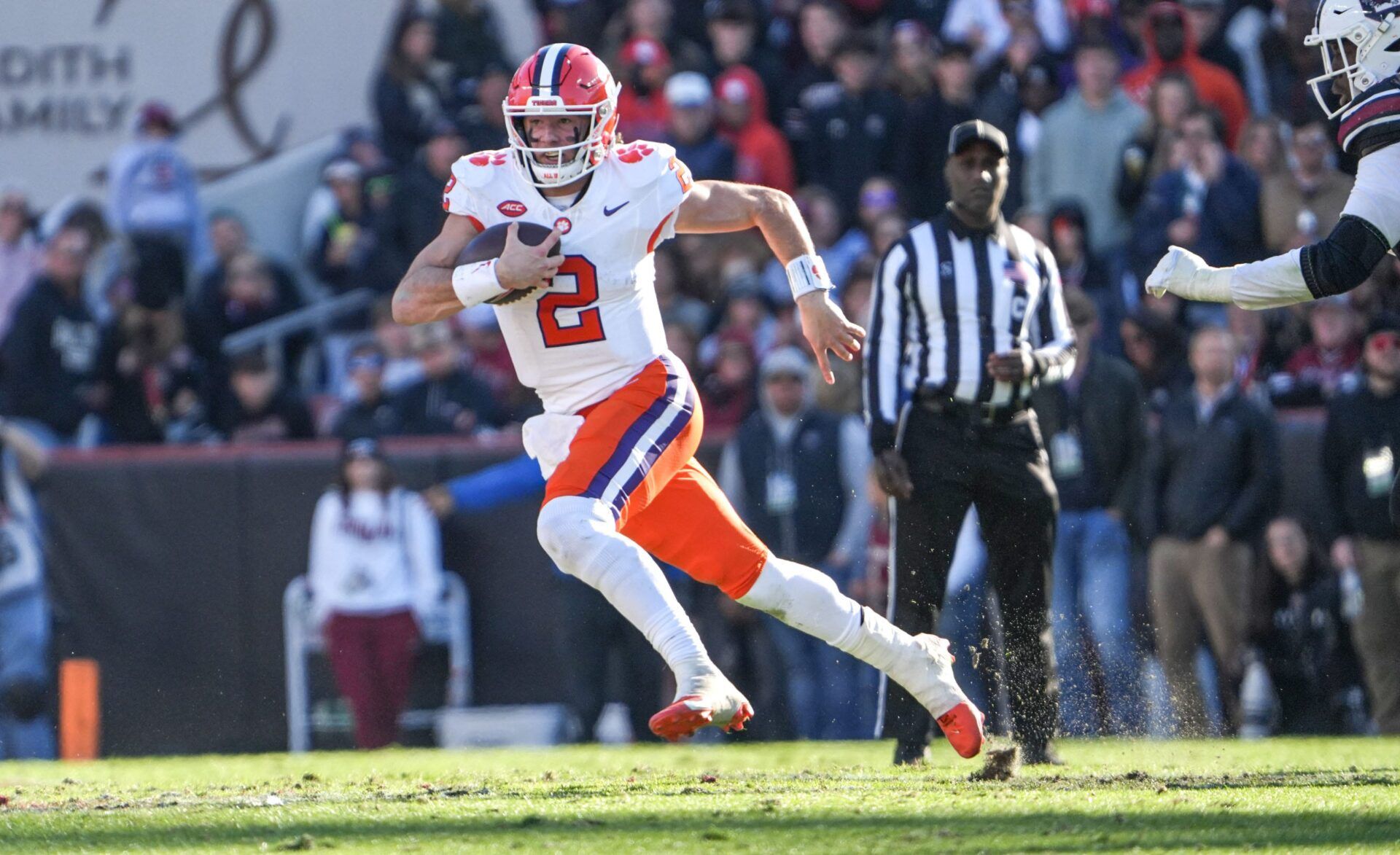
Cade Klubnik, Clemson
Cade Klubnik entered the 2025 season viewed by many as a potential first-round quarterback. After being widely projected as an early Day 2 pick, with fringe late Round 1 buzz, in the previous draft cycle, Klubnik opted to return to Clemson for his senior season to continue developing and prove he belonged among the elite.
That plan didn’t go as expected.
A former five-star recruit and historic high school producer, Klubnik had established himself as one of the more prolific passers in college football. However, his senior campaign marked a notable regression, particularly in processing speed, consistency as a field general, and down-to-down decision-making.
At 6’2”, 210 pounds, Klubnik doesn’t possess the overwhelming size or arm strength of the prototypical early-round NFL passer, but his talent is undeniable. The issue isn’t ability, it’s the degree and suddenness of the regression from 2024 to 2025, which raised legitimate concerns for evaluators.
Currently viewed as QB9 and the No. 180 overall prospect on the PFSN consensus big board, Klubnik enters the Shrine Bowl with plenty to prove. A strong week of practices showcasing leadership, command, and confidence in a game-like setting could go a long way toward rebuilding scouts’ belief.
Behren Morton, Texas Tech
The Shrine Bowl presents a massive opportunity for Behren Morton to reset the narrative surrounding his evaluation.
His final impression, a disappointing CFP performance against Oregon, left much to be desired, as Morton finished 18-of-32 for 137 yards with no touchdowns and two interceptions in a Texas Tech loss. That performance overshadowed what was otherwise an impressive season.
Morton battled injuries throughout the 2025 campaign, yet continued to play, a testament to his toughness and commitment to the Red Raiders, especially with backup Will Hammond also sidelined. Despite not always being at full strength, Morton led Texas Tech to an 11-win regular season, a Big 12 Championship, and a top-four seed in the CFP.
He posted a PFSN CFB QB Impact Grade of 81.3, ranking 53rd nationally. Still, as an older prospect who will enter the league at 24 years old, Morton must show that his success wasn’t simply the result of elite defensive support and a conservative, mistake-free offensive approach.
At the Shrine Bowl, scouts will want to see playmaking ability, aggression, and the capacity to elevate an offense, not just manage it.
Joe Fagnano, UConn
Joe Fagnano quietly put together one of the most productive seasons in college football.
He led UConn to a 9–3 record and a bowl berth for the second straight season, earning both New England Gold Helmet Player of the Year and Gridiron Club of Greater Boston Offensive Player of the Year honors.
Starting all 12 games, he became the first Huskies quarterback to do so since 2018. Statistically, Fagnano was outstanding, completing 285 of 413 passes for 3,448 yards with 28 touchdowns and just one interception, finishing with an impressive 161.03 passer efficiency rating.
He recorded six 300-yard games and closed the season with a career-best performance against Florida Atlantic, throwing for 446 yards.
The question isn’t about production; it’s about context. After seven years in college, why did the breakout come so late? Fagnano has the size and arm talent to stand out during Shrine Bowl practices, but evaluators will be debating whether he’s a Tyler Shough-type late bloomer with starter traits or simply a high-end depth quarterback and camp arm.
Jalon Daniels, Kansas
Jalon Daniels is one of the more intriguing quarterbacks in this group due to his athletic profile and potential system fit.
Though undersized at roughly 6’0”, 215–220 pounds, Daniels consistently stretches defenses vertically and possesses legitimate arm talent. He’s also a dangerous runner capable of ripping off long touchdown runs when given space.
Concerns remain, however. Daniels has an extensive injury history and struggles at times to consistently win from the pocket. Some of that inconsistency stems from height limitations and difficulty seeing throwing lanes, while other issues come from a tendency to play hero ball when simpler solutions, checkdowns, or throwaways are available.
His PFSN CFB QB Impact Grades have remained solid throughout his career, with the last four years never dropping below 77.8, peaking at 89.9 in 2022, the second-best mark among all quarterbacks nationally that season.
The Shrine Bowl will be a key test of whether Daniels can show controlled, on-time pocket passing to complement his athleticism.
Haynes King, Georgia Tech
Few quarterbacks embody toughness and competitiveness like Haynes King.
King was the engine behind a Georgia Tech team that came agonizingly close to an ACC Championship Game appearance and CFP berth. He has posted PFSN CFB QB Impact Grades of 81.5 in 2024 (13th nationally) and 86.4 in 2025 (top 20), remaining in the Heisman conversation until late-season losses derailed that push.
His running ability is the highlight of his game, but King made clear strides as a passer in 2025. His completion percentage jumped to 71.7%, and ball security has consistently been a strength throughout his career.
Georgia Tech’s defensive struggles, ranked 78th in PFSN CFB Defensive Impact Grade, underscore just how valuable King was, as he carried the offense weekly.
At 25 years old, entering his rookie season, King must prove his throwing mechanics are repeatable and that he can win consistently from the pocket. Scouts already know he can run through contact; now they want refinement. He profiles as an intriguing late-round flier with clear backup-plus potential.
Miller Moss, Louisville
Miller Moss is one of the more polished passers in the Shrine Bowl field. He features a quick release, strong pocket presence, and a willingness to stand in against pressure. Moss delivers the ball on time, excels in play-action, and boasts some of the cleanest throwing mechanics in the class. His football IQ should stand out in meetings and on the practice field.
However, Moss is limited outside of structure. He rarely creates when plays break down, which can be both a positive and a negative; he stays within the system, but lacks improvisational flair.
Physically, Moss is listed at 6’2”, but his frame is thin, and he will need to add strength to survive NFL punishment. After learning under Jeff Brohm and earlier under Lincoln Riley, Moss enters the league at 24 years old, leaving little room for projection. For scouts, he is largely a “what you see is what you get” evaluation.
Mark Gronowski, Iowa
Winning matters, and Mark Gronowski has done more of it than almost anyone in college football history.
After dominating at the FCS level with South Dakota State, Gronowski carried that winning pedigree to Iowa, finishing the season 9–4 despite battling injuries. However, his role shifted significantly. Instead of airing it out as he had previously, with 23 and 29 passing touchdowns in prior seasons, Gronkowski threw just 10 touchdowns with seven interceptions, while rushing for 16 scores.
At 6’2”, 235 pounds, he has the ideal size and solid arm strength. The big question is whether the passing dip was a product of Iowa’s run-heavy system and QB development issues, or a sign that his earlier production doesn’t fully translate to the FBS and NFL level.
The Shrine Bowl offers evaluators a rare neutral environment to find that answer.
Kyron Drones, Virginia Tech
Kyron Drones may have the widest range of outcomes among the Shrine Bowl quarterbacks. He possesses a compact release, keeps his eyes downfield under pressure, and has the athleticism to extend plays. At 6’2”, 235 pounds, he has the build teams look for, along with a legitimately strong arm.
The issue is refinement. Drones have the tools, but the mental side of the game hasn’t consistently kept pace with their physical traits. Accuracy, timing, and processing all need improvement.
He’s a classic boom-or-bust prospect, someone who could sneak into the late rounds with a strong week of practice, or slide into UDFA territory. If he can show command, consistency, and chemistry with higher-level talent, his stock could rise quickly.
