
With the 2025 season in the rearview mirror, we can take some time and look at who the clear hits and misses were. As always, there’s plenty of dumb luck involved, so when debating these awards, I tried to stay away from purely injury-based shortcomings, such as Malik Nabers or Jayden Daniels.
So, below are my picks for the best and worst picks at every position and why for the 2025 season.
Best QB Pick: Drake Maye
Drake Maye’s stock started rising before the draft, so we didn’t quite get him at a complete bargain in Superflex. Regardless, getting him at all proved to be the difference at QB this season.
Maye finished as the QB2 overall behind only Josh Allen and QB3 in points per game behind Allen and Brock Purdy. For his ~QB16 status, he lapped the competition, helping the Patriots finish 5th in PFSN’s Offensive Impact Metric.
Capping that performance off with three straight 20+ games in the fantasy playoffs and a 32-point bomb in Championship week meant that his returns only got better as the season went on. Maye was a league winner in Superflex and a massive boon in 1QB.
Worst QB Pick: Lamar Jackson
It was hard to avoid injury at QB, as many fell victim this year: Jackson, Daniels, Joe Burrow, Patrick Mahomes, Kyler Murray, etc. What made it harder for Lamar’s managers is that he started the season off vintage, only to get hurt off and on and trail off in performance when on the field.
Jackson finished as QB20, just behind Bryce Young. He had a three-week stretch from Weeks 11-13 with less than 10 points in each game, was hurt in the semi-finals week, and missed the Championship week. His 16.2 points per game were his lowest since his rookie year. Managers who held on through the season had a bumpy ride with no payoff, which may have cost you the season or a playoff game.
Best RB Pick: Christian McCaffrey
To Christian McCaffrey, or not to McCaffrey, that is the question. Managers have either been frontrunners for a championship or the toilet bowl, purely based on which year you selected him. It just so happened to be an on year.
What made this year different was that McCaffrey went near the end of the first round as RB5 in drafts, giving most teams the opportunity to select him. Whether you reached for him or he fell to you, you were rewarded greatly.
McCaffrey sprinted past the other contenders, scoring nearly 50 more points in PPR than RB3 Jonathan Taylor and 40 more than RB2 Bijan Robinson. Healthy CMC remains a cheat code.
Worst RB Pick: Ashton Jeanty
Saquon Barkley was a very close contender here. In fact, Ashton Jeanty and Barkley would finish right next to each other in the final standings, RB13/14, with 14.5 points per game apiece. Surely that would make Barkley the pick here, right?
Well, for those picking atop the draft, there really wasn’t much consideration for who RB1 would be. Even if Barkley were to regress from his 2024 outing, he could still easily be a top-three RB. Of course he wouldn’t finish as such, but at the time taking anyone else in that spot would’ve been bold.
Selecting Jeanty meant most may have passed on McCaffrey or Derrick Henry in that spot. That decision would be the difference between a championship and a toilet bowl.
Jeanty’s averages were also less reliable. He had seven games with fewer than 10 PPR points, three of which came in the final four weeks of the fantasy season. That means there’s a very likely chance that most benched him in the playoffs against Houston, when he broke out with 31 points. Barkley at least gave you solid returns in the first two weeks of the postseason.
Best WR Pick: Puka Nacua
Again, this was a very close competition between Puka Nacua and Jaxon Smith-Njigba. It’s fair to give this award to JSN instead, whose WR2 finish came at a better value for his ADP, going nearly a full round later than Nacua’s, and their final finishes being neck and neck.
However, Nacua ended up with slightly more points per game by missing a game, yet still keeping up with JSN in totals. Moreover, Smith-Njigba cooled down slightly for playoff games, scoring 18.3, 23.6, and 16.2 during those weeks. Perfectly sound totals that helped plenty of managers, but Nacua’s atomic Week 16 score of 46.5 was a ticket to the Finals for his managers.
He continued with 27.9 and 15.7 in the other playoff weeks, but his 35.7 in Week 14 ensured his managers made the playoffs if they were on the fringe. His postseason domination gives him the slight edge over Seattle’s breakout receiver.
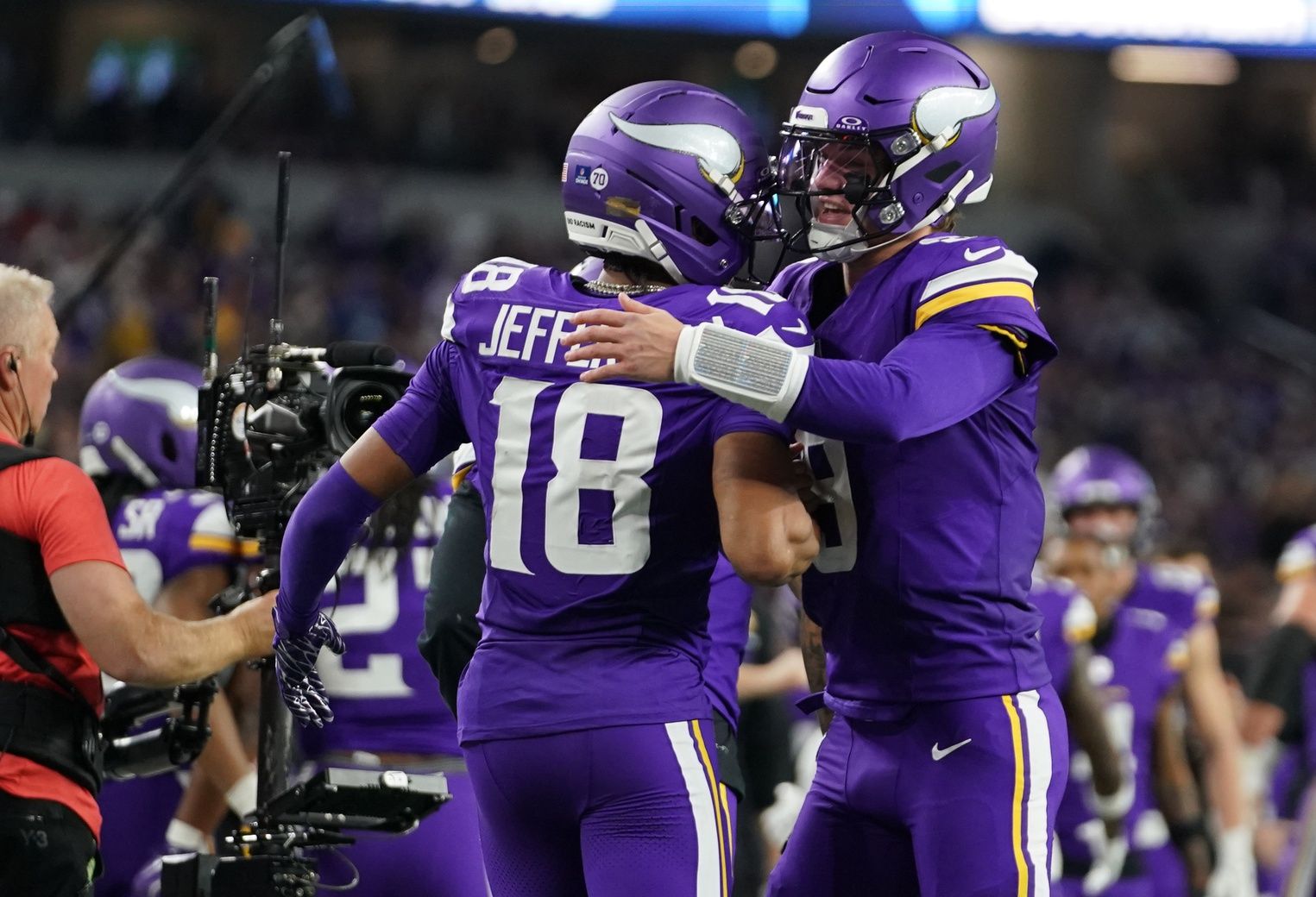
Worst WR Pick: Justin Jefferson
The Vikings pulled the wool over fantasy players’ eyes everywhere in 2025. If you were out in Minnesota in 2024 because they had a seemingly bad QB, you may have bought into Justin Jefferson as a QB-proof asset in 2025. Instead, the QB play was so bad this year that it wiped Jefferson away from any relevance.
Despite a healthy season with 16 games and 130 targets, Jefferson finished as just the WR26 after being the consensus WR2 in drafts. He finished with 20+ points just once and under 10 six times. From Weeks 12-15, he combined for only 18.5 PPR points.
His 11.4 points per game are by far a career low, even totaling 20 fewer points than he did in 2023 when he missed seven games. He had nearly half the totals and averages that he had in 2022.
It was a season from Hell for Jefferson, whose unstoppable career pace was halted in its tracks.
Best TE Pick: Trey McBride
There’s no competition in this race. While plenty of mid to late-round TEs proved to be a strong value, such as Kyle Pitts, Dallas Goedert, and Harold Fannin, none would be the difference maker that Trey McBride would be.
The difference between McBride and TE2 would be the same difference between Kyle Pitts (TE2) and Dawson Knox (TE30).
George Kittle, Tucker Kraft, and Brock Bowers all had similar success in limited sample sizes, yet McBride still paced past the competition with 18.9 points per game, 6.5 more than second-place Kittle.
Worst TE Pick: Brock Bowers
Sadly, Bowers couldn’t return his value of TE1. His incredible rookie season made him an expensive acquisition in drafts, going around the same place as valuable WRs and RBs like Drake London, De’Von Achane, and Chase Brown. That value would have been hard to capture, but his injury and surrounding circumstances guaranteed he’d fall well short.
A mismanaged Week 1 injury haunted Bowers throughout the season, hindering him until he was finally shut down for four weeks midseason. While glimpses of what he was capable of shone through a horrific offense, his 43.3-point Week 9 does a lot of heavy lifting for his averages.
High-value TEs are a risky proposition, and Bowers is a clear example of why.
