
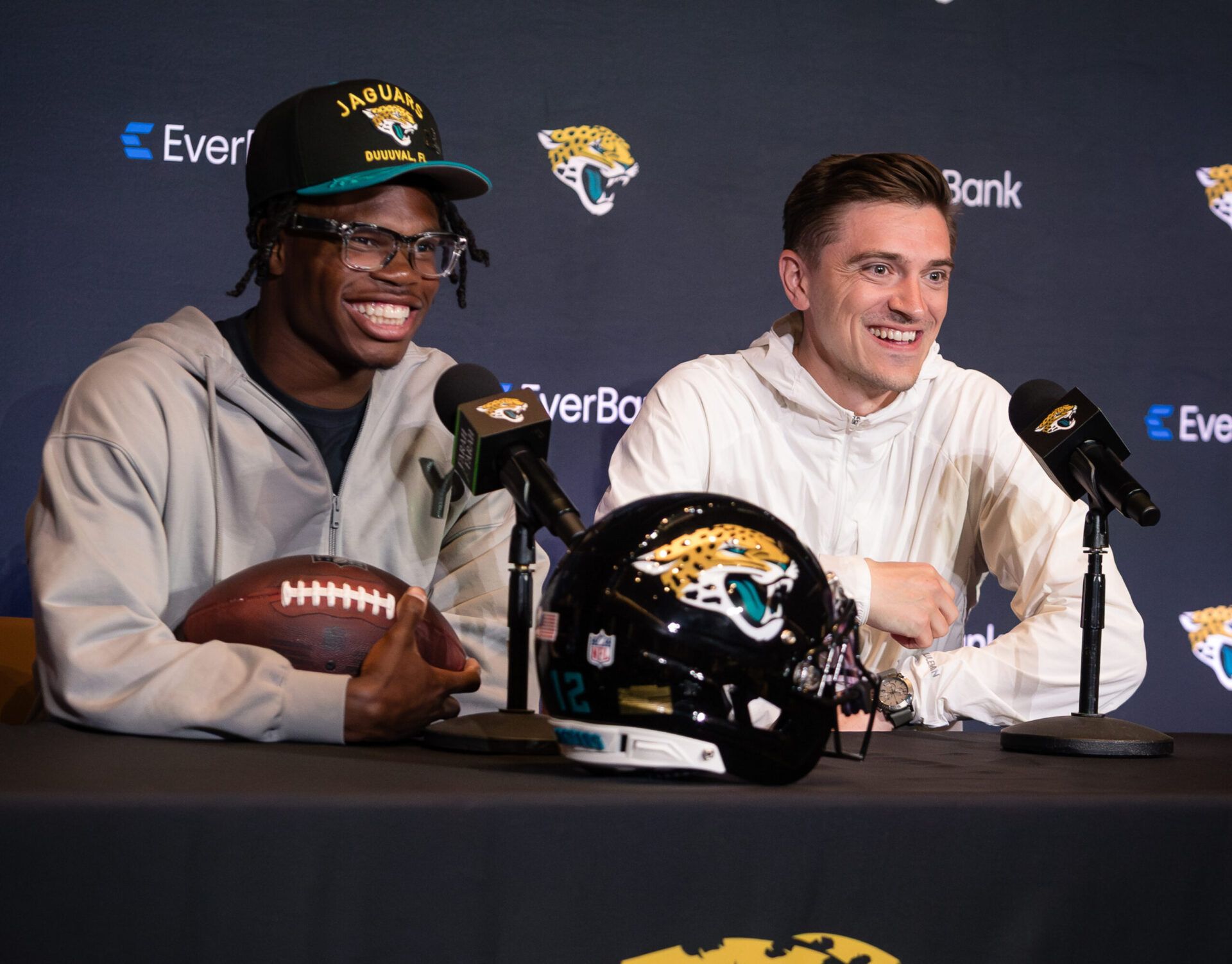
The Jacksonville Jaguars entered the season with excitement surrounding James Gladstone’s first draft class. The rookie general manager took an aggressive approach, highlighted by a blockbuster trade to move into the top two.
Expectations were high, and several players showed early promise, but injuries and limited availability have shaped the class in unexpected ways. With the midseason point now passed, it is clear that this group has long-term potential, but the immediate results have been uneven.
High Risk, High Reward Gamble at the Top
Gladstone’s boldest decision came when he packaged the 5th pick, the 36th, and Jacksonville’s 2026 first-round selection to move up to 2 for Travis Hunter. The rookie quickly demonstrated why the Jaguars viewed him as a franchise-altering talent. His versatility, explosiveness, and ability to impact both sides of the ball gave Jacksonville a player with rare upside.
Hunter’s progress made the trade appear justified until his season ended with a non-contact knee injury. Losing him was a major blow, especially as the Browns have already turned the traded picks into productive players in Mason Graham and Quinshon Judkins. Hunter remains the kind of prospect who can become one of the best players in the league, but his injury leaves the Jaguars without their top rookie for the remainder of the year. The long-term benefits may still outweigh the cost, but the short-term payoff has been lost.
Rookies Lost Before the Season Began
The Jaguars hoped their second and sixth-round defensive additions would play immediate roles, but both were sidelined before week 1. Safety Caleb Ransaw, drafted 88th, suffered a non-contact foot injury in training camp and was placed on season-ending IR. His speed and coverage ability were expected to boost the secondary, but missing his entire rookie season was a massive blow to both his development and Jacksonville’s secondary.
Jalen McLeod, selected 194th overall, faced a similar setback with a lower-body injury that also placed him on injured reserve. He has been eligible to return, but remains sidelined through ten weeks. Both players carried clear roles and upside entering the season, but neither has taken a snap, leaving the defense without two rookies who were expected to contribute early.
Limited Opportunities and Developmental Progress
Offensive lineman Wyatt Milum, chosen with the 89th pick, entered the league as a projected long-term starter at guard after playing left tackle throughout his college career. Injuries have restricted him to just eight offensive snaps through ten games, though. His power, frame, and technique still provide optimism, but his impact in his first year has been minimal.
Linebacker Jack Kiser has faced a similar situation. Taken 107th overall, he has dealt with minor injuries and has been buried behind Devin Lloyd, Foye Oluokun, Dennis Gardeck, and Ventrell Miller in the linebacker rotation. Kiser has found a role on special teams, but has logged only eleven defensive snaps. Both players remain long-term projects the team still believes in, but their early contributions have been disappointing.
Production From the Rookie Backfield
Bhayshul Tuten, selected 104th, has been one of the biggest bright spots of the class. Even as Travis Etienne’s backup, he has delivered consistent value with his blend of burst, strength, and balance. His best outing came last week against the Chargers, where he ran for 74 yards and a touchdown while providing physical, efficient work in key situations. Overall, Tuten has been the 23rd-best running back in the entire league according to PFSN’s RB Impact Rankings.
LeQuint Allen, drafted 236th, has earned a pivotal role as a pass protector. His ability to neutralize blitzers and maintain clean pockets has made him arguably the most dependable blocking running back in the league. Although his touches have been limited, his value to the offense is clear. Both rookies offer depth and long-term stability to the Jaguars’ backfield to the point that Gladstone may feel comfortable letting Etienne walk this offseason.
Late Round Contributors Showing Promise
Safety Rayuan Lane III, drafted 200th overall, has been one of the best surprises of the group. He has quickly become an elite gunner on special teams, consistently pinning opponents deep and delivering physical tackles that swing field position. His effort and consistency make him a standout late-round pick.
READ MORE: Can the Jaguars Realistically Overtake the Colts as AFC South Champions?
Center Jonah Monheim, selected 221st, has also impressed. When Robert Hainsey went down, Monheim stepped in and handled his responsibilities with poise and strong technique. Finding an offensive lineman you’re comfortable starting any given week in the seventh round gives this class meaningful value.
Class With Immediate Setbacks but Real Long-Term Potential
The midseason outlook on Gladstone’s first draft is defined by injuries more than performance. Five players have missed significant time, and the class is currently among the worst around the league in terms of short-term production.
Even so, the long-term projection remains encouraging. Hunter has superstar potential, Ransaw and Milum possess great upside, and the rookie running backs, along with Lane and Monheim, have already proven they can help Jacksonville win games.
The class is far from a finished product. While frustrating now, the foundation for future success remains intact and could pay off significantly in the coming seasons.
