
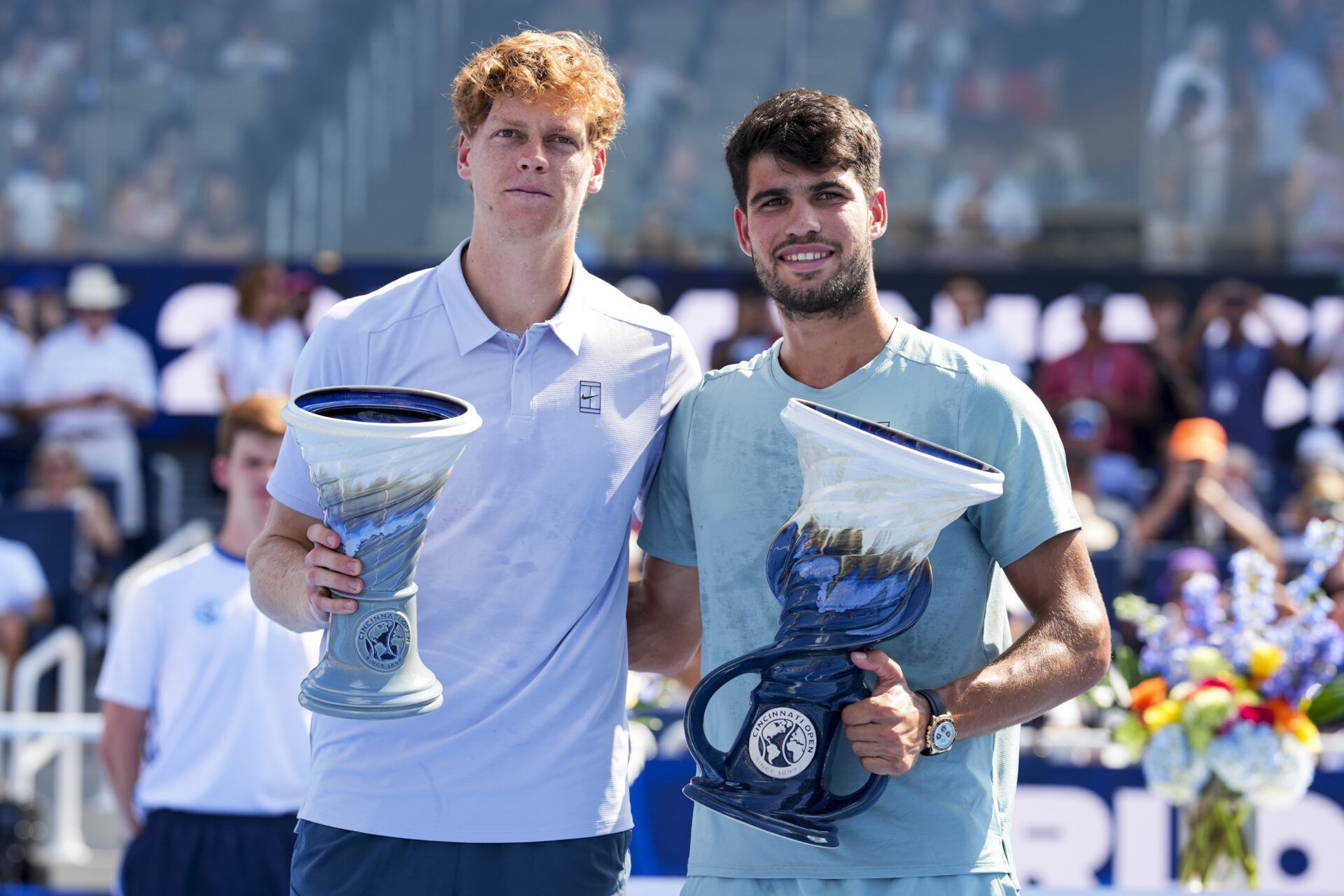
In a major organizational decision, the Cincinnati Open has shifted its final from Monday to Sunday, with the change effective from the competition’s next edition in 2026. This decision comes in the light of the anticlimactic finish to this year’s men’s singles final between the top two players in the world, Carlos Alcaraz and Jannik Sinner, which lasted all but 23 minutes as the Italian had to retire from the match.

The Cincinnati Open Tested the Players Brutally
The Cincinnati Open this year saw oppressive heat with temperatures soaring to 88 degrees Fahrenheit. Several players were affected by the harsh conditions, including a match in which Arthur Rinderknech collapsed during his third-round encounter against Felix Auger-Aliassime.
Two scheduling mishaps were instrumental in ruining a marquee men’s singles final between Alcaraz and Sinner. First, the match was scheduled on a Monday, when people would find it challenging to make their way to the stadium, as it is the first working day of the week. Moreover, the final was set for 3:00 p.m. (local time), when the heat was presumably at its peak.
The conditions were too much for Sinner to handle, who has struggled with heat issues in the past, as seen in his match against Holger Rune at the Australian Open this year. The Italian was far from his best against Alcaraz, who raced to a 5-0 lead in the first set, after which Sinner pulled the plug, retiring from the match in an anticlimactic fashion.
Cincinnati Open Brings Change to Improve Fan Engagement
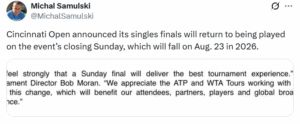
In a recent turn of events, Bob Moran, the tournament director for the Cincinnati Open, announced a shift in the event’s final to Sunday, from Monday. Speaking about the change, Moran said, “We feel strongly that a Sunday final will deliver the best tournament experience. We appreciate the ATP and WTA Tours working with us to make this change, which will benefit attendees, partners, players and global broadcast audience”.
As far as the timing is concerned, it can only be expected that there would be a shift to the evening when temperatures would have cooled off, given what happened this time around in the final.
The tournament should also have flexible scheduling, which would protect the players from the severe conditions, and could implement a heat policy to ensure player safety.
