
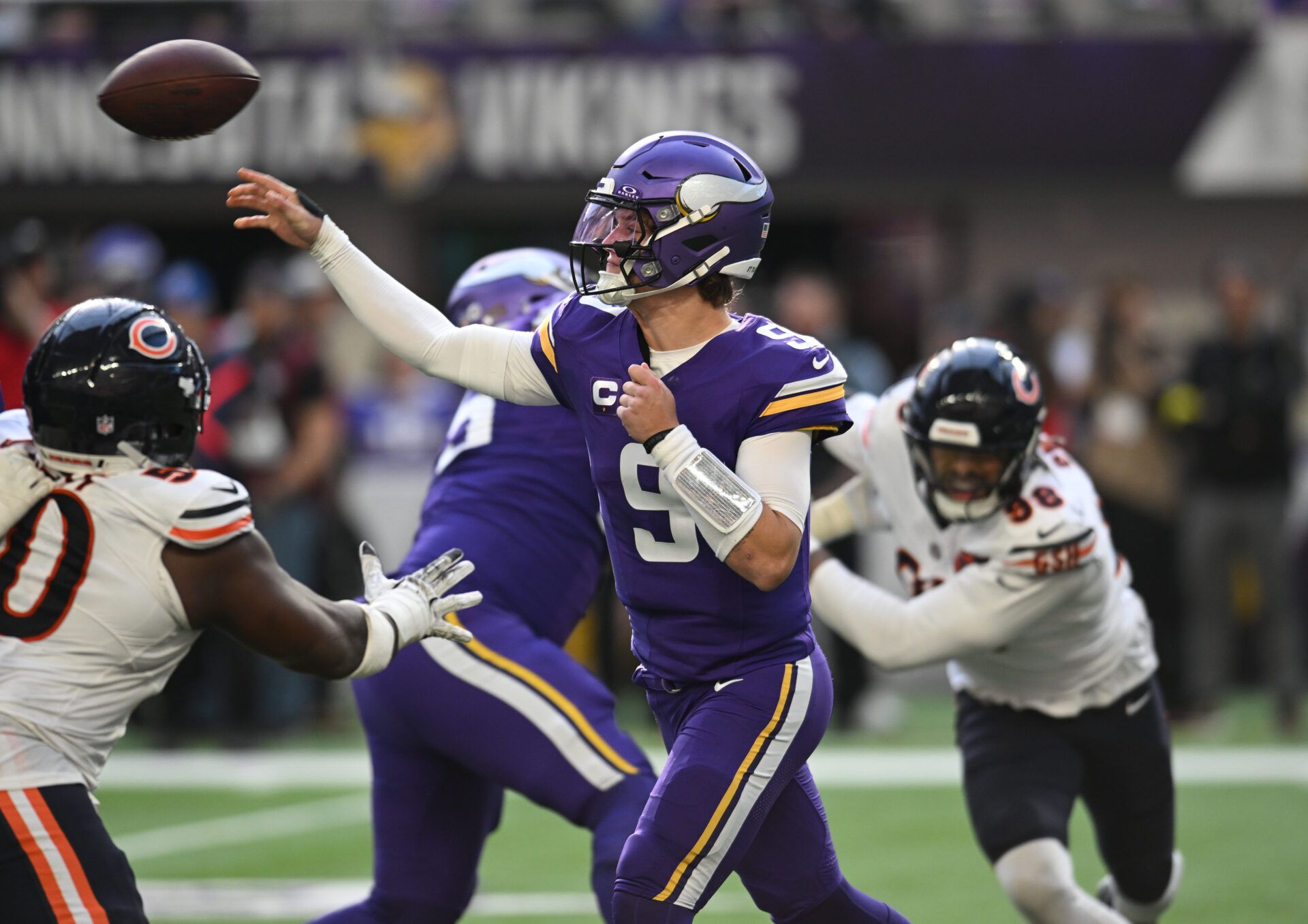
The Vikings were seconds away from stealing a game they had spent most of the afternoon chasing. J.J. McCarthy finally strung together a composed touchdown drive to give Minnesota a late 17 to 16 lead, offering a chance to erase an afternoon filled with misses and offensive breakdowns. Instead, a 56-yard kickoff return on the ensuing play handed the Bears a walk-off field goal opportunity and sent the Vikings to a loss that reflected the issues that showed up long before the final minute.
1. Vikings QB J.J. McCarthy Is Missing Routine Throws
McCarthy’s fifth start was his most uneven. The problems surfaced immediately. On the second series, he missed Jordan Addison on a third-and-7 throw over the middle. Two drives later, he overthrew Justin Jefferson down the right sideline despite a clean pocket and a simple placement read. Soon after, he missed T.J. Hockenson on a leak concept up the left sideline that should have produced a chunk gain. These were not high-degree-of-difficulty throws. They were basic NFL completions.
The second quarter was where the game tilted. With nine minutes left in the half, McCarthy climbed too aggressively into the pocket and floated a ball that Bears safety Kevin Byard III intercepted. Three minutes later, he threw another interception on a hurry-up possession, this time undercut by former Vikings cornerback Nahshon Wright in the end zone. Both throws came out late. Both reflected a quarterback who is still learning to play with rhythm, balance, and anticipation.
The most damaging sequence arrived late in the third quarter. On second and 2 from the Minnesota 29, a play-action design produced Addison running free up the sideline and Jefferson crossing underneath. McCarthy bounced in the pocket instead of releasing on time, and by the time he began his motion, Will Fries had been driven backward by Grady Jarrett. McCarthy’s throwing arm clipped Fries’ helmet and the ball wobbled into traffic, nearly becoming his third interception. On the next play, he missed Jefferson again, prompting a visible flash of frustration from the star receiver.
For most of the second half, McCarthy did not complete a pass. He entered the final drive with 95 passing yards. To his credit, he played with real poise when Minnesota needed it most, going 6 for 8 and finishing the series with a 15-yard touchdown to Addison. But everything surrounding that drive underscored the larger problem. McCarthy finished 16 for 32 for 150 yards, one touchdown and two interceptions. Minnesota built its offensive plan around protecting him instead of empowering him. The missed routine throws remain the central challenge of this season.
2. The Vikings Offense Makes Too Many Mistakes
McCarthy’s struggles were significant, but the players around him made the situation worse. Drops stalled drives, disrupted rhythm, and denied Minnesota chances to flip the momentum. Addison dropped a third-and-7 throw on the second possession and later dropped a ball in the flat in the third quarter. Hockenson let a catchable pass slip through his hands. Adam Thielen could not secure a ball over the middle. Jefferson had to contort his body repeatedly to adjust to off-target throws. In total, Minnesota had five drops, and several came in favorable situations.
Protection inconsistencies contributed as well. Chicago’s front did not dominate, but its pressures came at inopportune times. On McCarthy’s first interception, the protection forced him to drift. Late in the third quarter, Fries lost to Jarrett on the near-interception play. On other snaps, pocket firmness dissolved just enough to push McCarthy off his spot, amplifying his tendency to rush through reads or drift into trouble.
The Vikings also struggled to produce consistently on early downs. In the first half, Minnesota repeatedly put itself behind schedule. Incomplete passes, negative plays, and penalties erased the rhythm O’Connell spent all week trying to establish. The run game eventually came alive, particularly with Jordan Mason’s 16-yard touchdown early in the fourth quarter, but it could not fully offset the volatility in the passing game.
By the third quarter, O’Connell shifted heavily toward the ground attack, calling four straight runs to begin the half and limiting McCarthy’s attempts until the final minutes. This was not a tactical preference. It was recognition that the passing game could not be relied upon to sustain drives. As has been the case all year. Minnesota entered Sunday ranked 25th in PFSN’s OFFi. For a team built around its offensive personnel, that limitation remains the core issue holding them back.
3. Special Teams Failed Late
Special teams had a hand in both the comeback and the collapse. Early in the fourth quarter, rookie returner Myles Price gave Minnesota a spark with a 43-yard punt return that set up Mason’s touchdown. It was one of the few moments where stadium energy shifted.
READ MORE: PFSN’s 2025 NFL Midseason Awards: Predicting the MVP, DPOY, OPOY, Coach of the Year, and More
But the unit’s defining moment came after Addison’s go-ahead touchdown. With 50 seconds remaining, Devin Duvernay fielded the kickoff and cut between Tavierre Thomas and Tyler Batty. The lane was wide, the coverage was late to react, and the return stretched 56 yards, the longest allowed by Minnesota since 2022. Chicago needed only one first down after that. Cairo Santos drilled the 48-yard winner with no resistance.
Coverage inconsistencies showed up throughout the afternoon. Minnesota lost field-position battles on multiple drives. They also failed to flip the field when given chances to pin the Bears deep. In a game where Minnesota could not create offensive separation or force a takeaway, those special teams lapses became decisive.
