
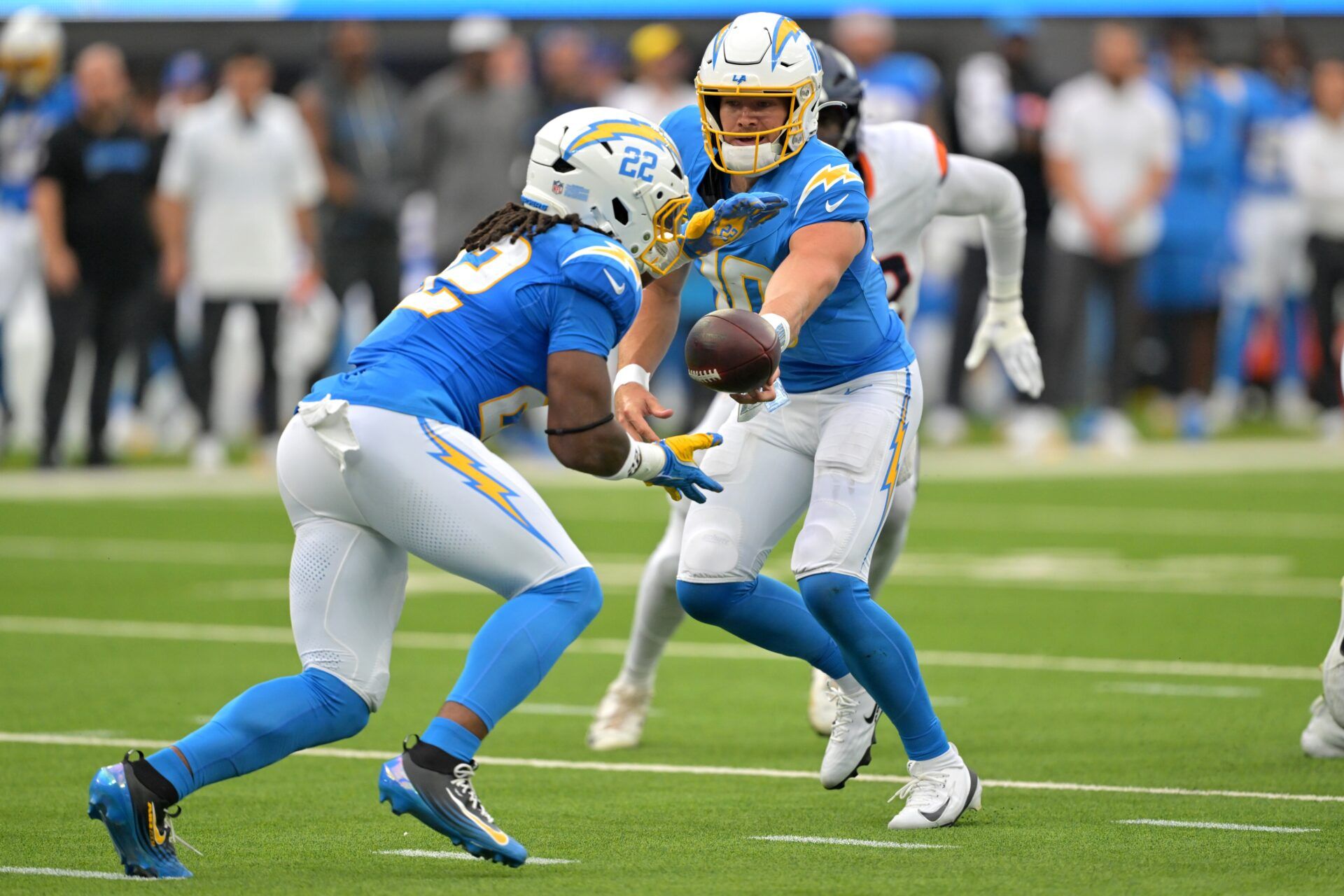
Los Angeles Chargers running back Najee Harris suffered a season-ending Achilles tear in the second quarter of Sunday’s 23-20 win over the Denver Broncos in Week 3. Injuring one of their most reliable offensive weapons is a significant setback for the team.
Now, former Chargers defensive tackle Breiden Fehoko has made a significant claim for the reason behind the injury to an unusually durable Harris.

Breiden Fehoko Blames Turf For Najee Harris’ Achilles Injury
Harris, a first-round pick by the Pittsburgh Steelers during the 2021 NFL Draft, was signed on a one-year deal as a free agent by the Chargers in March this year. Among many reasons for the 27-year-old’s signing, one was that he came with a reputation of never missing an NFL game in his four seasons with the Steelers.
He also played in the first three games of 2025 before facing the injury setback on Sunday. Reacting to the news of Harris’ season-ending injury, Fehoko pointed to the turf surface at SoFi Stadium as a significant contributing factor and called for a ban on turf in football.
“Went from playing on grass his whole NFL career in Pittsburgh to playing on turf at SoFi. The body overtime starts to adjust to what it likes,” Fehoko wrote on X. “Until they ban turf you will see more ACLs and Achilles. Turf has no give in although you run faster your tendons have no protection.”
Went from playing on grass his whole NFL career in Pittsburgh to playing on turf at SoFi. The body overtime starts to adjust to what it likes. Until they ban turf you will see more ACLs and Achilles. Turf has no give in although you run faster your tendons have no protection. https://t.co/IuZGg2NH0X
— Breiden Fehoko (@BreidenFehoko) September 23, 2025
Fehoko’s comments have reignited the ongoing debate about player safety on artificial surfaces. Multiple NFL players have suffered lower-body injuries over the years on turf that might have been less likely on grass.
Why Grass Is Safer Than Turf In NFL Games?
The debate about natural grass versus artificial synthetic turf used in the NFL is not new. Playing on artificial turf surfaces has been linked to higher rates of lower-body injuries than grass.
Former NFLPA President JC Tretter has also highlighted the issue, saying that turf is “less forgiving”, forcing players’ feet, ankles, and knees to absorb more force during cuts, pivots, and sudden stops.
Grass, on the other hand, naturally helps release stress before the impact reaches tendons and ligaments. However, that is not the case with turf, as its rigidity increases the risk of ACL, Achilles, and ankle-related injuries.
Data from NFL games and practices also backs the concern over turf. Between 2012 and 2018, players experienced a 28% higher rate of non-contact lower-extremity injuries on turf, including a 32% higher rate of knee injuries and a 69% higher rate of foot or ankle injuries, according to Tretter.
He emphasized that while efforts are underway to make turf safer, no artificial surface matches grass’s protective qualities. He noted that teams across all climates, including indoor stadiums, can maintain natural grass, making it the preferred choice for player safety.
What’s Next For Harris And Chargers?
While Harris will miss his first-ever NFL game, his season-ending injury opens up a golden opportunity for rookie Omarion Hampton, who brings versatility as a runner and a receiver.
Quarterback Justin Herbert relied on Hampton heavily in the passing game to counter Denver’s fierce pass rush, and the rookie delivered with six catches for 59 yards, including a key 22-yard gain on the game-winning drive.
After a 0-3 start to the campaign, the Chargers next travel to MetLife Stadium to face the winless New York Giants. The Week 4 matchup will be played on Sunday, September 28, 2025, starting at 1 p.m. ET.
