
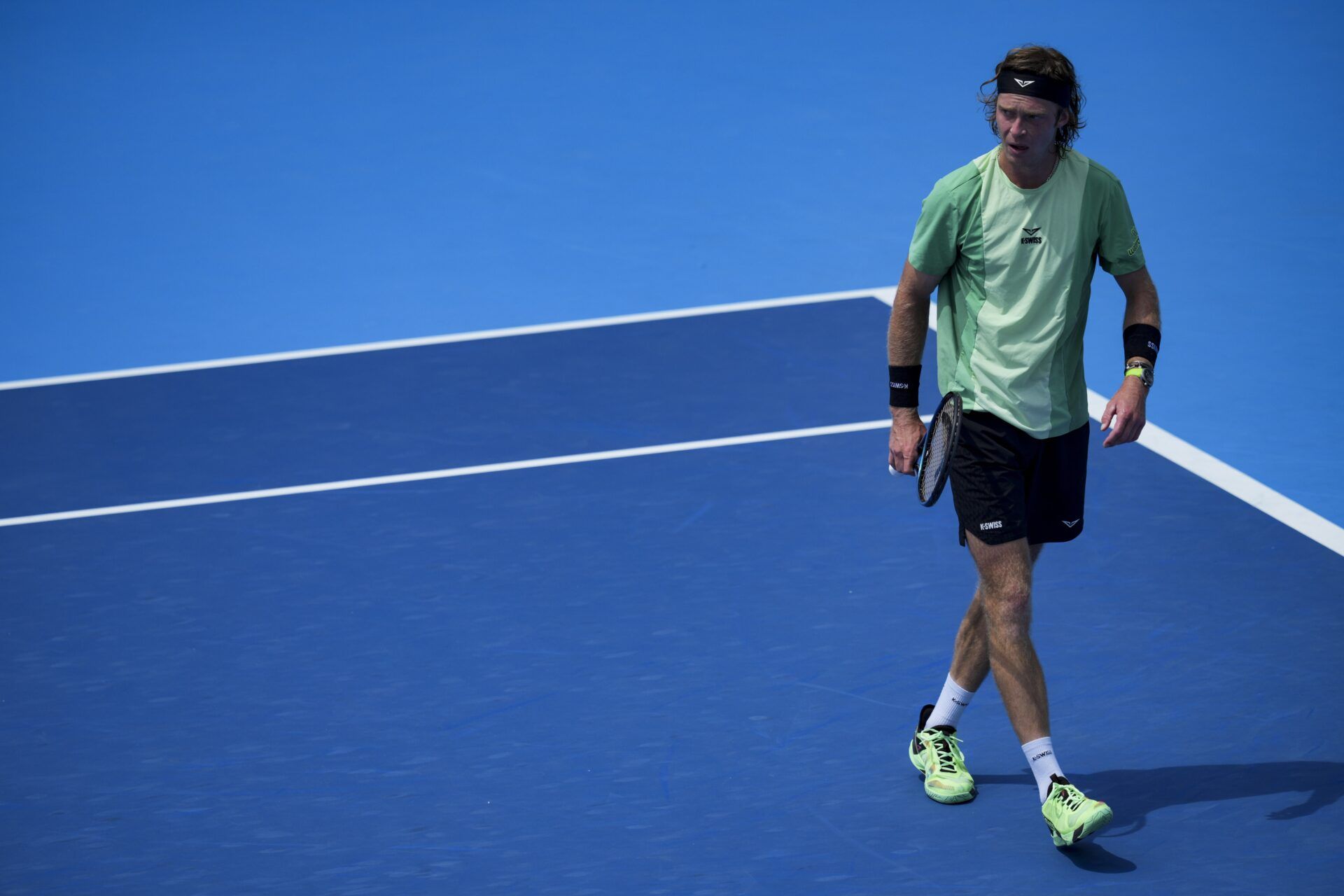
Tennis players constantly battle the clock along with their opponents, but sometimes the biggest fight happens with the rules themselves. When Andrey Rublev stepped onto the court against World No. 2 Carlos Alcaraz in the 2025 Cincinnati Open quarterfinals, he found himself caught between sweltering heat, towel logistics, and an unforgiving shot clock that waits for no one.
How Did Andrey Rublev’s Shot Clock Complaint Spark Tennis Rule Debate?
Rublev fiercely challenged Alcaraz in the Cincinnati quarterfinals but ultimately fell short. However, the Russian made headlines for his gritty showing and exchange with chair umpire Mohamed Lahyani over the shot clock rule.
The ATP’s shot clock, designed to limit time between points, is set at 25 seconds. Since it takes approximately three seconds to activate, players have an effective 28-second window to get ready for the next point. Rublev’s discussion with Lahyani centered on handling the shot clock rule under the scorching heat.
During the first set, Rublev complained that reaching his towel after almost every point in the intense heat made it difficult to stay within the serve clock’s time frame. Lahyani offered practical advice, suggesting Rublev limit his movement to the baseline rather than walking the full court, which could gain him nearly 10 seconds.
“But you have to short the preparation. What I can suggest to you, now you did. Don’t go the whole way. Stay at the baseline, you saved 10 seconds. You always do that Andrey, you have four seconds you are ready,” Lahyani responded.
Mohamed Lahyani becomes the first umpire ever to offer a satisfactory answer to a complaining Rublev
byu/Large\_banana\_hammock intennis
Lahyani later clarified that the three-second serve clock delay is automatic and beyond his control, but he acknowledged that Rublev had handled the timing effectively.
What Does Christopher Eubanks Say About the Tennis Shot Clock Rules?
Following the incident, American tennis player and former World No. 29 Christopher Eubanks shared his perspective online. He highlighted how difficult it can be for players to reset under the shot clock after every point, particularly in sweltering conditions.
Eubanks responded to fan questions on social media about bringing back ball kids for towels while responding on social media. The American noted that the 2024 rule changes, including the automatic three-second shot clock and ball kids providing towels, were introduced to accelerate the pace of play in tennis.
“Last year, tennis as a whole decided they wanted to speed up pace of play. Shot clocks now start automatically 3 seconds after the point ends and is no longer up to the chair umpire’s discretion. Having the ballkids help with the towels helps to keep pace of play moving faster,” he wrote on Threads.
View on Threads
The ATP reinstated ball kids to hand towels to players in 2024, after the practice was suspended during COVID. The organization stated this helps maintain the pace of play alongside the shot clock rule.
Eubanks provided context for why these changes matter, explaining the physical reality players face on court. He noted that on larger courts, completing a point at the net, retrieving a towel, and returning within the 25-28 second shot clock is nearly impossible.
“It’s almost impossible to finish a point at the net, walk back to the towel, and be ready for the next point in 25-28 seconds (especially on larger courts). I just wanted to give some context as to why the rule changed,” he added.
Despite being a standard part of the ATP’s rules, the shot clock has frequently been questioned by players, particularly under sweltering conditions.
Why Has Carlos Alcaraz Also Criticized the Shot Clock System?
Alcaraz has also expressed concerns about the shot clock on several occasions. In his second-round encounter against Jaume Munar at the Queen’s Club Championships, the Spaniard was involved in a heated exchange with the chair umpire over the rule.
Munar shared his displeasure with the shot clock and joined Alcaraz in seeking clarification from the chair umpire. After the match, Alcaraz explained that extreme heat and long rallies left him constantly pressed for time.
🗣️ Carlos Alcaraz voices his frustration over a time violation call at Queen’s #HSBCChampionships pic.twitter.com/vMLG7SqOjE
— Tennis Channel (@TennisChannel) June 19, 2025
Alcaraz’s outburst was unusual, given his normally calm and collected presence on the court. Earlier during the Miami Open, Alcaraz expressed his frustration with the shot clock, explaining that he found serving within the 25-second limit challenging, particularly after finishing points at the net.
