
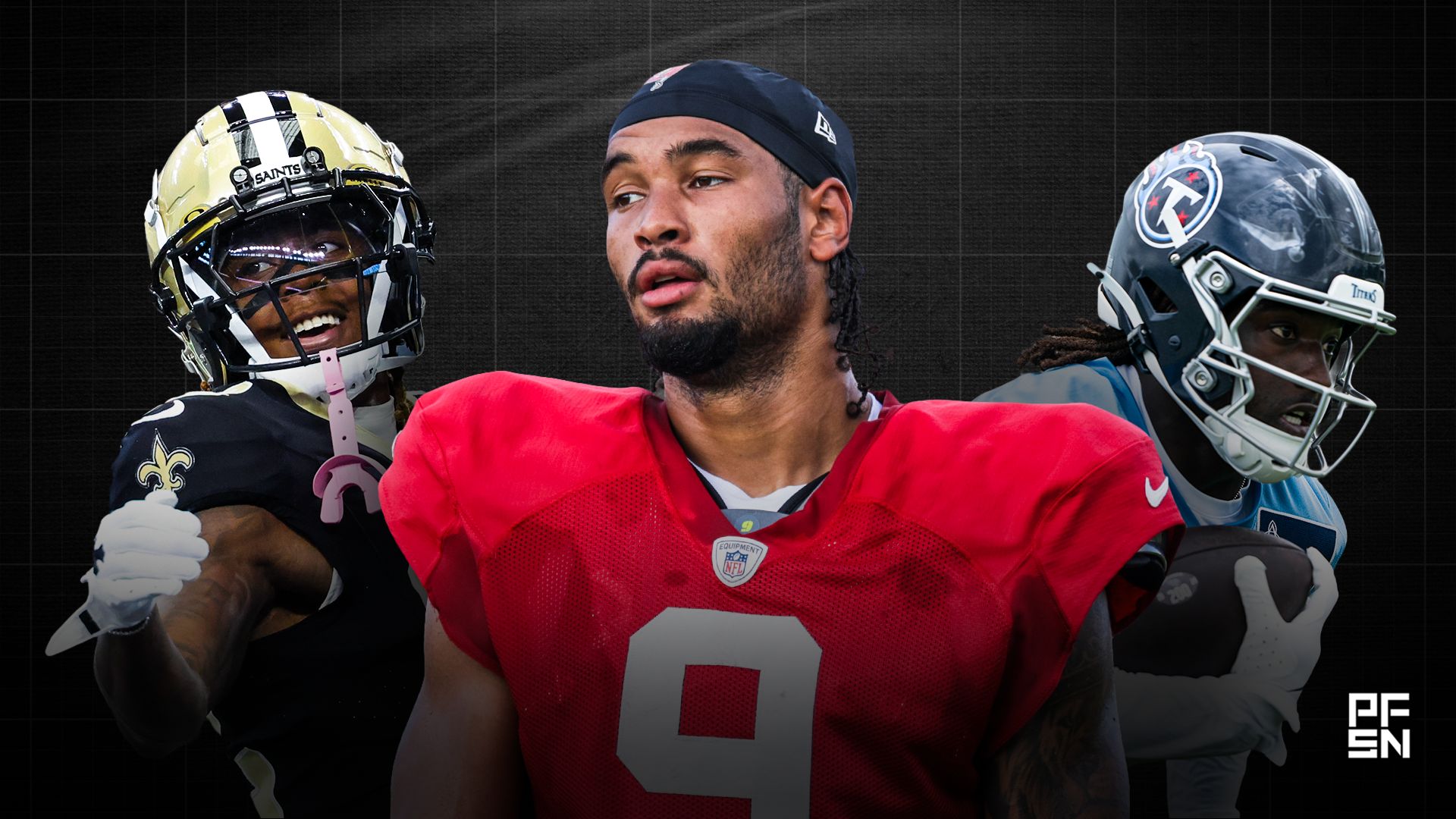
Every fantasy football season, injuries happen. It’s not a matter of if — it’s when. Smart managers don’t just draft starters; they draft the players who will step into those roles when the music stops. These aren’t your boring flex plays. These are league-winning lottery tickets disguised as backup running backs.
The Elite Handcuffs: Your Top-Tier Insurance
Jordan Mason, Minnesota Vikings
Jordan Mason isn’t just Aaron Jones’ backup. He’s a proven commodity who dominated when given the chance in San Francisco. When Christian McCaffrey went down last season, Mason averaged 22.75 carries and 111.75 rushing yards over four weeks, posting 18.6 fantasy points per game.
it’s been awhile since the Vikings had a big, dynamic running back like Jordan Mason. pic.twitter.com/xyz123
— Krauser (@Krauserrific) March 16, 2025
The Vikings traded for him specifically because they know what they’re getting: a workhorse who can handle 20-plus touches without breaking a sweat. If 30-year-old Jones misses time, Mason slides seamlessly into a bell-cow role and could realistically replace 80% to 85% of Jones’ production. This is handcuff gold.
Zach Charbonnet, Seattle Seahawks
Kenneth Walker’s injury history makes Zach Charbonnet one of the most valuable handcuffs in football. When Walker missed six games last season, Charbonnet thrived, averaging 19.2 fantasy points in games where he played 75% of snaps. That’s RB1 territory, folks.
OH HELLO, @zachcharbon! pic.twitter.com/xyz123
— Seattle Seahawks (@Seahawks) September 8, 2024
The former UCLA bruiser has the complete skill set to handle Seattle’s offensive load, including pass-catching duties, with 75 receptions over two seasons. If Walker goes down, Charbonnet becomes an instant RB1 and could match 90% of Walker’s production. Bank on it.
JK Dobbins, Denver Broncos
Denver’s backfield situation is murkier than expected, but that works in J.K. Dobbins’ favor. The former Charger is coming off his best season as a pro with 1,058 combined yards and nine touchdowns in just 13 games. His 5.2 career yards per carry ranks second among all backs with at least 452 attempts.
While he’s technically behind second-round pick RJ Harvey on the depth chart, Dobbins has the experience and proven durability to seize control. If Harvey struggles or gets hurt, Dobbins becomes the lead back and could deliver at least 70% of what you’d expect from a Denver starter.
Ray Davis, Buffalo Bills
Ray Davis spent his rookie season as James Cook’s primary backup, but don’t mistake limited touches for limited ability. The fourth-round pick averaged 24% of Buffalo’s offensive snaps while showing he can handle early-down work in one of the league’s most explosive offenses. Cook has never been a true workhorse, making Davis’ handcuff value immense.
We already saw what happens if Cook misses time. Davis played 61% of the snaps and handled 23 opportunities in the lone game Cook did not play last season.
What a night for Ray Davis! @Ray_Davis07 · @BuffaloBills pic.twitter.com/xyz123
— NFL (@NFL) October 15, 2024
Davis steps into a role that could easily produce 15-plus touches per game in Buffalo’s high-octane attack. He can be 100% of Cook if given the starting role.
Isaac Guerendo, San Francisco 49ers
The 49ers’ system has turned backup running backs into fantasy gold for years, and Isaac Guerendo is next in line. Guerendo showed flashes when given chances, and San Francisco’s zone-blocking scheme is tailor-made for his skill set.
Jordan Mason’s departure only solidifies Guerendo’s role as the clear handcuff. If McCaffrey goes down, Guerendo slides into one of the most fantasy-friendly situations in football and could realistically replace 75% of McCaffrey’s production. That’s championship-level upside.
Trey Benson, Arizona Cardinals
Trey Benson remains locked in as James Conner’s primary backup, and that’s exactly where you want him. The third-round pick from Florida State has the size and skill set to handle Arizona’s rushing attack if Conner goes down.
Trey Benson this season: — 53 Carries — 234 Yards — 1 Touchdown Playing his role GREAT this season. pic.twitter.com/xyz123
— Cardinals Muse (@CardsMuse) November 25, 2024
While his rookie season was limited due to injury, Benson showed enough with his 4.6 yards per carry to prove he can produce when healthy. Conner’s history of missing games makes Benson a valuable stash. If the starter goes down, expect Benson to step into a workhorse role and deliver 70% to 75% of Conner’s production in a Cardinals offense that loves to run the ball.
Tyler Allgeier, Atlanta Falcons
Here’s your handcuff holy grail. Tyler Allgeier has posted a 91.2 rushing grade over three seasons, ranking seventh among all running backs. His 3.4 yards after contact per attempt ranks third among backs with at least 475 carries. The scary part? Bijan Robinson has never missed a game — but when that streak ends, Allgeier becomes an instant RB1 in Atlanta’s run-heavy attack.
The Falcons’ zone-blocking scheme is perfect for his bruising style, and he’d immediately step into 20-plus touches per game. Conservative estimate: 70% of Robinson’s production.
The Wild Cards: High Upside, Higher Risk
Will Shipley, Philadelphia Eagles
While I don’t subscribe to the theory that 400-plus touches is a death sentence, Saquon Barkley’s 480-plus touches last season were a lot. With Kenneth Gainwell now in Pittsburgh, Will Shipley becomes the presumptive handcuff.
The former Clemson star has the speed and receiving chops to thrive in Philadelphia’s system. However, AJ Dillon’s presence complicates things, and we’re not certain Shipley would immediately command a workhorse role. His upside is massive if Barkley breaks down, but there’s legitimate committee risk. Think 60% to 65% of Barkley’s production in a best-case scenario. But he might have to share touches.
Kareem Hunt, Kansas City Chiefs
Kareem Hunt’s return to Kansas City creates an interesting dynamic behind Isiah Pacheco. The veteran proved he could still produce when Pacheco was injured, but this backfield might trend toward committee usage.
Hunt’s goal-line prowess and pass-catching ability give him standalone value, but he’s not a lock to dominate touches if Pacheco misses time. His ceiling is capped by Kansas City’s pass-heavy approach, but his floor is safer than most handcuffs. Expect 50% to 60% of Pacheco’s workload in a timeshare situation where both Elijah Mitchell and rookie Brashard Smith could mix in.
Braelon Allen, New York Jets
Barelon Allen showed flashes as a rookie with his bruising style, but the Jets’ backfield hierarchy remains unclear. While he’s officially Breece Hall’s backup, Allen’s 3.6 yards per carry and limited receiving role create concerns about his ceiling.
His best-case scenario involves taking over short-yardage and goal-line work while splitting carries with Isaiah Davis. Don’t expect him to immediately replace Hall’s production. He’s probably in a full-blown committee if Hall misses time.
Rico Dowdle, Carolina Panthers
Last season’s breakout with Dallas (RB24 in PPR points per game) makes Rico Dowdle intriguing behind Chuba Hubbard. He averaged 19.9 touches and 95.1 total yards from Weeks 9-18, proving he can handle a feature role. The concern? Carolina’s offense is significantly worse than Dallas’, and Hubbard has shown he can carry a full workload.
If Hubbard goes down, Dowdle could see 70% of the touches. He could also end up behind rookie Trevor Etienne.
MarShawn Lloyd, Green Bay Packers
MarShawn Lloyd’s profile is strong: 4.4 speed, excellent receiving skills and impressive contact balance. The problem? He’s buried behind Josh Jacobs, who’s proven incredibly durable and dominant.
Lloyd’s rookie season was derailed by multiple injuries, making his reliability questionable. His upside is legitimate if Jacobs goes down, but we’re not convinced he’d avoid a committee situation. Think 60% to 65% of Jacobs’ workload split with other backs, limiting his weekly ceiling significantly.
DJ Giddens, Indianapolis Colts
Jonathan Taylor’s injury history makes DJ Giddens an intriguing lottery ticket, but he’s completely unproven at the NFL level. The rookie has the size and college production to suggest he could handle a feature role, but Indianapolis might lean on a committee approach if Taylor misses time. His ceiling is massive in the Colts’ rushing attack, but his floor is practically non-existent. Best case: 65% to 70% of Taylor’s production. Worst case: he’s buried behind veterans and becomes irrelevant.
Jaylen Wright, Miami Dolphins
Jaylen Wright’s 4.4 speed makes him the perfect backup to De’Von Achane, but that also creates role overlap. Miami’s offensive line struggles and Tua Tagovailoa’s injury concerns limit the entire backfield’s ceiling.
Wright has shown flashes, but he’s never handled significant volume, and Miami might lean on a committee if Achane goes down. His speed gives him big-play upside, but expect 55% to 60% of Achane’s touches in a situation that caps his weekly ceiling.
Nick Chubb, Houston Texans
Don’t let the name fool you: Nick Chubb is now a handcuff behind Joe Mixon. The former Browns star is trying to prove he’s recovered from his devastating knee injury, but his receiving limitations and Houston’s struggling offensive line create concerns.
If Mixon goes down — or stays down — Chubb could see significant touches, but his ceiling is capped by his inability to contribute in the passing game and his waning ability. He would likely cede the passing-game role to someone else, probably Woody Marks, and fantasy managers would have to hope he scores enough to be usable.
