
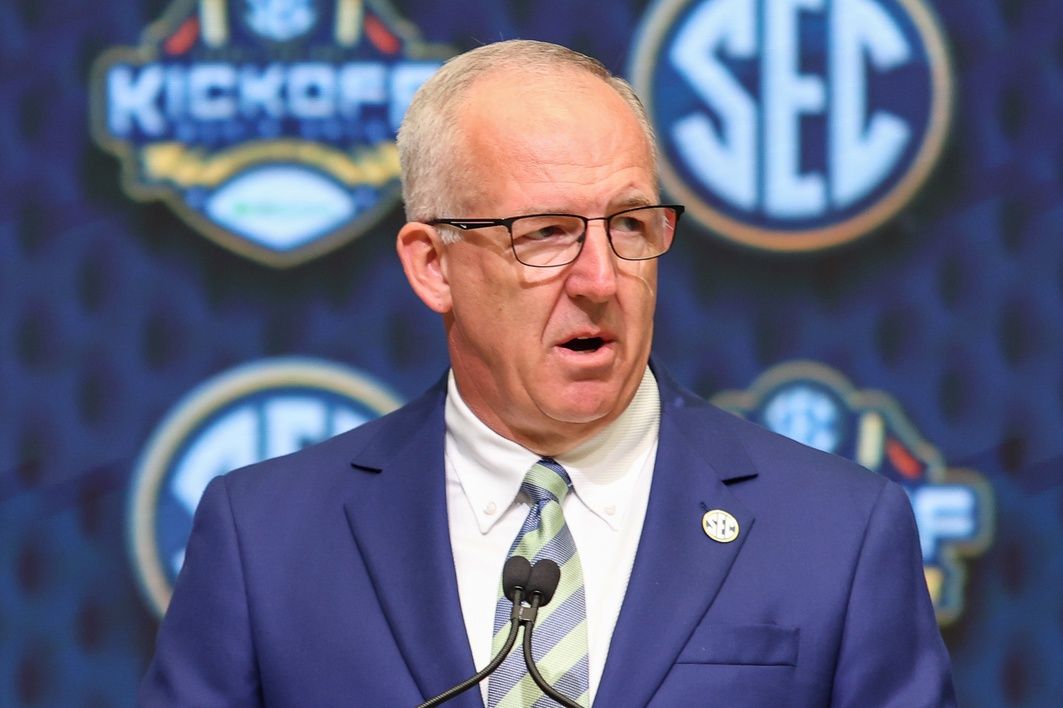
Greg Sankey stepped to the podium at SEC Media Days with a message he thought would calm the storm. Instead, his defense of college athletics as “strained” but not “broken” has unleashed a wave of fan fury that shows just how deep the frustration runs.
When even Georgia’s Kirby Smart is taking public shots at you, maybe it’s time to listen.
Why Are Fans So Angry With Greg Sankey’s “Strained” Defense?
At SEC Media Days on July 14, conference commissioner Greg Sankey addressed everything from College Football Playoff expansion to the SEC’s conference schedule.
He emphasized the SEC’s strength, calling it a “super conference” with “common sense geography,” and expressed confidence in its competitive edge, whether playing an eight- or nine-game schedule.
But his assertion that college athletics is merely “strained” rather than “broken” struck a nerve with fans on X. The backlash was swift and brutal.
“Let me be clear — college athletics is not broken. But it is strained. Those of us in higher education and within college athletics will continue to adapt as we provide life-impacting opportunities and create lifelong memories for young people across our nation.”#SECMD25
— Greg Sankey (@GregSankey) July 14, 2025
One fan captured the sentiment perfectly, writing, “I used to live for the approach of college football season. Now it is low on the radar, akin to Minor League Baseball.”
The criticism didn’t stop there. Another fan directly accused the SEC, saying, “As your conference continues to be the one to strain it, you are going to create a class system,” pointing to the growing influence of money in roster-building.
This fan discontent reflects a broader frustration with the sport’s direction. “College sports is completely broken,” one user wrote, highlighting losing connection to teams due to player turnover and the ability to “buy” championships.
The harshest criticism came from a fan who accused Sankey of “leading the charge” to transform the SEC into a “mini NFL.” These reactions all point to fans feeling that college football’s traditions and accessibility are eroding under the weight of commercialization.
What Did Kirby Smart Say That Started This Feud?
Notably, Sankey is facing a battle on two fronts. While he has to defend the SEC against criticism from other conferences, the conference’s coaches can be just as critical. Sankey’s comments follow a public jab from Georgia coach Kirby Smart, who criticized the commissioner during the SEC Championship trophy presentation last December.
After Georgia’s win over Texas secured a No. 2 seed and a bye in the College Football Playoff, Smart remarked, “It means rest for a team that Greg Sankey and his staff sent on the road all year long.”
The comment, made with Sankey standing nearby, drew criticism from ESPN’s Paul Finebaum, who called it “below the belt.” Finebaum noted that while Smart’s frustration with Georgia’s grueling road schedule was understandable, targeting Sankey personally was unnecessary, as the commissioner doesn’t directly set schedules.
Still, this argument is related to the issue of the number of conference games, which has been debated across college football’s major conferences. Some, like the Big Ten, typically have more conference games than the SEC year after year.
How Does Sankey View College Sports’ Future?
During the SEC Media Days, Sankey acknowledged the “messy” state of college athletics, noting that the system is in the midst of “historic, transformational change.” He remains optimistic, advocating for expanded playoff and basketball tournament formats and continued dialogue with Congress to ensure “clarity and fairness” for student-athletes.
However, his vision clashes with fans who feel the sport’s soul is slipping away. The debate over an eight- or nine-game SEC schedule remains unresolved, adding to the uncertainty. Meanwhile, concerns about further playoff expansion continue to fuel the fire.
The disconnect between Sankey’s measured optimism and fan frustration shows no signs of narrowing. While he sees adaptation and opportunity, fans see a sport losing its identity in pursuit of profit.
