
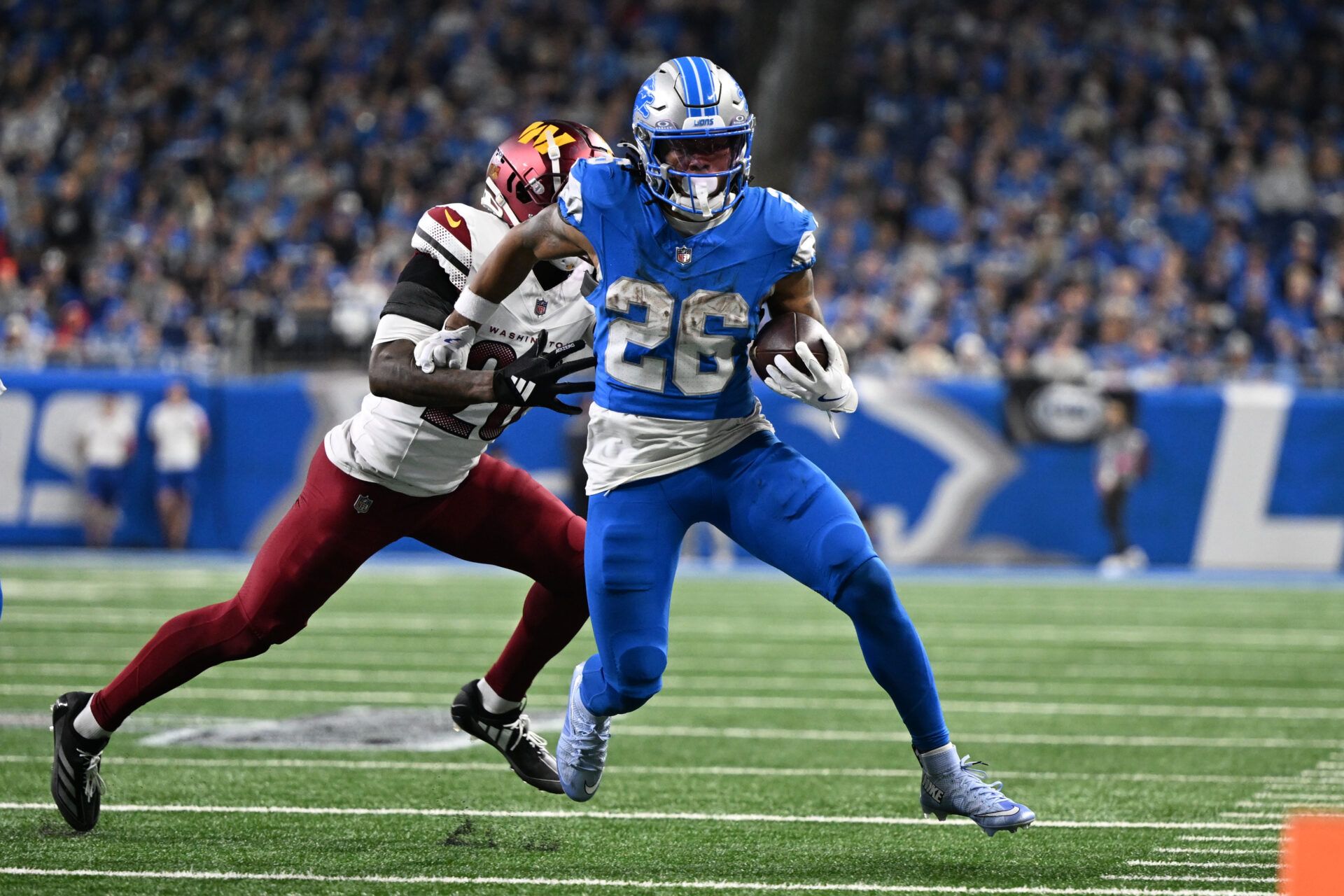
The Detroit Lions’ backfield has become fantasy football’s most coveted commodity, and Jahmyr Gibbs stands at the center of that revolution. With elite production metrics and unprecedented trade demand, the third-year running back has transformed from promising rookie to must-have fantasy asset. The numbers tell a compelling story about why savvy fantasy managers are willing to pay premium prices for Detroit’s dynamic tailback.

Jahmyr Gibbs’ Elite Company and Historic Production
Gibbs has achieved something remarkable in his brief NFL career, joining an exclusive club of running backs who combine volume, efficiency, and fantasy relevance at the highest level.
During his two seasons in Detroit, only four running backs have managed to finish a campaign with 175+ carries while maintaining a 39% PFSN Elusive Rating and averaging over 1.0 PPR points per touch. That elite quartet includes Christian McCaffrey in 2023, Raheem Mostert in 2023, and Gibbs in both 2023 and 2024.
This statistical achievement places Gibbs alongside McCaffrey, widely considered the gold standard for fantasy running backs when healthy. The fact that Gibbs accomplished this feat in consecutive seasons, including his rookie year, demonstrates a level of consistency that typically takes years to develop.
The comparison to McCaffrey carries particular weight given the Panthers star’s injury history and age concerns. While McCaffrey remains a premier talent, his durability questions have opened the door for younger backs like Gibbs to assume the mantle of fantasy’s most reliable RB1 options.
Mostert’s inclusion in this group, despite his age-defying 2023 campaign, further emphasizes how rare this level of sustained production truly is.
JAHMYR GIBBS. 4 TDs TONIGHT. 20th ON THE SEASON.
📺: #MINvsDET on NBC/Peacock
📱: Stream on #NFLPlus pic.twitter.com/9vhlt49d7T— NFL (@NFL) January 6, 2025
Market Demand Reflects Elite Status
Fantasy managers have taken notice of Gibbs’ exceptional production, creating unprecedented demand in the trade market. The Detroit back has been acquired in 58.9% of deals involving him this offseason, representing the third-highest acquisition rate among all players.
More significantly, he leads all first-round ADP players in this metric, indicating that fantasy managers view him as worth his premium draft cost.
This acquisition rate suggests that Gibbs managers from 2024 are reluctant to move him, while managers who missed out are aggressively pursuing him through trades. The willingness to pay first-round prices for Gibbs reflects confidence in his ability to repeat his elite production within Detroit’s explosive offense.
When fantasy managers consistently choose to acquire rather than trade away a player at his price point, it signals genuine belief in sustained excellence.
The trade market dynamics also reveal how Gibbs has separated himself from other young running backs. While many second-year backs face questions about sophomore slumps or increased defensive attention, Gibbs has generated the opposite reaction.
His combination of proven production and youth creates a rare profile that appeals to both win-now and rebuilding fantasy teams.
Durability Concerns Dismissed
One persistent question surrounding high-usage running backs involves their ability to maintain production late in seasons.
Gibbs emphatically answered those concerns during the final stretch of 2024, posting three consecutive games with at least 18 carries and four catches over the season’s final three weeks. This streak matched the longest such run since Dalvin Cook accomplished the feat in 2020, demonstrating Gibbs’ capacity to handle increased workloads when games matter most.
The significance of this late-season surge extends beyond raw statistics. December and January represent the most crucial period for fantasy championships, and Gibbs proved he could deliver elite volume and production when managers needed him most. His ability to maintain both rushing and receiving involvement during this stretch showcases the versatility that makes him particularly valuable in PPR formats.
Cook’s 2020 comparison provides additional context for Gibbs’ achievement. That season represented one of Cook’s healthiest and most productive campaigns, suggesting that Gibbs’ late-season workload indicates durability rather than overuse.
The fact that Detroit felt comfortable leaning heavily on Gibbs during playoff positioning games demonstrates the coaching staff’s confidence in his ability to handle feature-back responsibilities. It establishes that if David Montgomery were to miss time, Gibbs would absorb the entire backfield, rather than share with someone else.
The convergence of elite production metrics, unprecedented trade demand, and proven late-season durability has established Gibbs as fantasy football’s most compelling running back asset. His unique combination of youth, proven performance, and market confidence suggests that his premium price tag reflects genuine value rather than speculative hype.
