Day 3 of the Panini Senior Bowl has passed, and there’s plenty to discuss regarding the 2026 NFL Draft skill position prospects present at the event. Which running backs, wide receivers, and tight ends stood out on the final day?
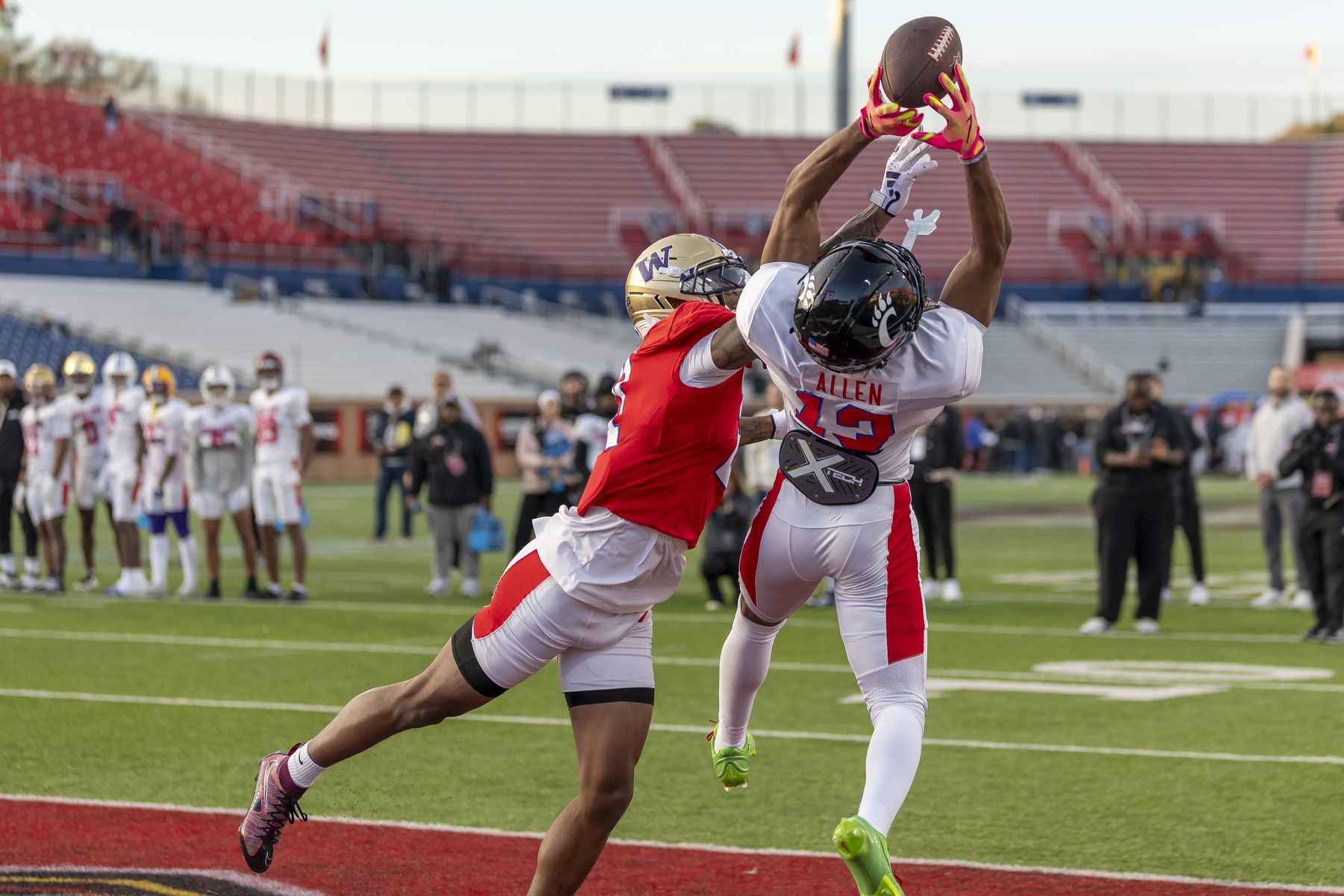
Kaytron Allen, RB, National
Kaytron Allen checked every box at the Senior Bowl. On Day 1, he stood out immediately with his quick-working vision, spatial instincts, and cutting flexibility at his size. On Day 2, he flashed promise working out of the backfield as a safety blanket in the flats. And on Day 3, his steady base and active footwork aided him in pass protection drills.
Allen had a few miscues here and there, most notably drops in the passing phase when attempting to transition for RAC. But overall, Allen boosted his stock in Mobile and stands as one of the more compelling volume backs in the 2026 NFL Draft.
Kaelon Black, RB, American
Kaelon Black was exceptional all week in Mobile, and that didn’t change on Day 3. In 1-on-1s, Black remained elusive at route stems, with impressive foot speed, stemming IQ, and cutting flexibility working against linebackers. More than once, he created massive separation on quick outs and secured tough catches by the sideline.
Meanwhile, in team drills, Black came up big in the red zone, taking a toss outside and charging to the pylon with energetic leg drive and relentless urgency. Black’s passion for the game and overall versatility were clear in Mobile, and he’ll likely be on many teams’ short list early on Day 3.
Rahsul Faison, RB, American
Rahsul Faison had a fairly quiet final day at the Senior Bowl. The raw tools continue to flash, and he’s proven his receiving ability out of the backfield. That said, there’s a clear difference in vision and footwork efficiency when comparing him with other backs.
Faison’s projection likely remains similar to what it was before the Senior Bowl. As a 26-year-old rookie, he’ll have a truncated prime, and his ceiling as a volume runner is somewhat limited, but he can function as a dynamic change-of-pace back with pass-catching value.
Seth McGowan, RB, National
Seth McGowan came into the Senior Bowl as an RB without much buzz at all. He’ll leave as a trendy Day 3 sleeper for draft analysts across the landscape, and he’ll have his fans in the NFL as well.
At 5’11 5/8″ and 215 pounds, McGowan passes the eye test with flying colors. He’s fast, fleet-footed, and fluid in his hips, with excellent tempo freedom, corrective athleticism, and speed through creases. And when he has to process instinctively in congested areas, he’s shown he can sense out gaps and flow to space with urgent, energetic strides.
McGowan produced as a runner on all three days, and he consistently displayed his receiving upside as well. On Days 1 and 2, he separated with angle and dug routes out of the backfield, and on Day 3, he made a high-difficulty catch in the back of the end zone in 1-on-1s, tracking the ball over his shoulder with a defender on his heels.
It’s been a long time since McGowan was dismissed from Oklahoma after his freshman season, but the Kentucky RB has evolved since then. He’s matured, he’s focused only on business, and his business is to make plays with his dynamism in Mobile, much like it will be in the pros.
Jaydn Ott, RB, American
Jaydn Ott’s raw talent is clear; that’s the takeaway after his week at the Senior Bowl. He stood out as a visibly dynamic runner with natural weaving mobility through crowds. He executed route breaks with impressive efficiency and flexibility against linebackers, and he even competed admirably in pass protection drills.
That said, Ott’s 2025 season and short, ill-fated stint with the Oklahoma Sooners are massive question marks regarding his stock, questions he’ll have to continue answering for teams when he speaks with coaches and officials. That uncertainty is still there, but someone will take a chance on Ott, and his buy-in at the Senior Bowl will be one reason for that.
Kejon Owens, RB, National
Kejon Owens was reasonably productive in his final Senior Bowl action. The lean, well-leveraged back distinguished himself early on with his dynamic acceleration, and on Day 3, he put that trait to use multiple times as a short-range pass-catcher out of the backfield.
Owens doesn’t quite have the size or mass to scrape through scrums, and if lanes are congested, he can struggle to break through. But when he has enough space to operate, Owens’ quick feet and effortless burst shine through. He put himself on the radar this week.
Adam Randall, RB, American
Adam Randall’s final day at the Senior Bowl was essentially an echo of his previous two. His best moments came when he was able to catch the ball in space as a screen or swing threat and use his speed to get upfield. But in 1-on-1s, Randall’s hands were inconsistent against physicality, and and wasn’t as decisive or as malleable as other runners in teams.
That inconsistent vision isn’t a surprise with Randall, who’s still just one year into his career as an RB. He’ll be a project of sorts at the next level, but his size-speed combination and the receiving upside make him a very compelling late-round gamble.
Nick Singleton, RB, National
Nick Singleton’s final day of practice was unfortunately cut short by an injury that was later revealed to be a broken foot. Singleton will now turn to the recovery process in the months leading up to the 2026 NFL Draft. The hope is that he’ll achieve a full recovery well before the 2026 season.
It’s unclear at the moment how this will affect Singleton’s stock. An updated medical check will take place at the NFL Combine, and teams will have more timely information there. If he’s on track to a full recovery, mid-round capital is still on the table.
J’Mari Taylor, RB, National
J’Mari Taylor flourished in select short-yardage roles on Day 3, at one point churning his legs and operating as a drill bit to slug out tough yards in the red zone. He also made himself available as a pass catcher out of the backfield on occasion, but he visibly lacks the explosiveness to make the most of fleeting spaces like others can.
Taylor might not have the athletic profile to secure early capital, and his pass protection still incites concern, but on late Day 3, he’ll assuredly have suitors as a physical and fairly instinctive back with a clear-cut niche waiting for him.
Mike Washington Jr., RB, American
Mike Washington Jr. was the best running back in Mobile. That was clear to some capacity very early on, but Washington only built on his momentum throughout the week and put together quality reps in both phases of the game, while also displaying a high-level physical tools pallet at 6’0 1/2″ and 228 pounds.
Early on, Washington enamored onlookers with his size-defying foot speed and vertical explosion, as well as his sharp vision, processing, and stem IQ. He secured the highest speed among all players through two days, with a max pace of over 21 MPH, and on Day 3, he decisively beat Owen Heinecke on a sudden, explosive wheel route.
Washington has the size, quickness, hip fluidity, and vision of a true volume back, and his pass-game production in Mobile was just as enticing. He entered the event as a Top 5 RB on my board, but even that may now be too low.
Cyrus Allen, WR, American
Cyrus Allen wasn’t talked about much before his Senior Bowl showing. That won’t be the case anymore. Allen was a solid performer all week, but particularly turned things on for Day 3’s practice, dominating defenders both as a separator and a catch-point artist.
Allen’s highlight was a steely late-hands catch in the corner of the end zone, where Allen expertly played timing and positioning to nullify Ephesians Prysock’s length. That play drew eyes, but just as impressive was Allen’s separation. Each day, he won at least once with his twitched-up athleticism, sink and explosion, retraction ability, and bend.
At just 180 pounds, Alen can experience lapses against physicality, but his separation profile proved near-impossible to combat in Mobile, and he’s proven he can work the catch point, too. Once a late-round sleeper, he should be trending toward mid-round territory.
Aaron Anderson, WR, American
Once again, Aaron Anderson distinguished himself as one of the shiftier pass-catchers in Mobile on Day 3. He’s quick-footed, sudden in and out of his cuts, and he has the hip fluidity to bend through breaks and sustain acceleration through transitions.
His size visibly limited his authority in more congested situations, but his separation profile is sure to earn interest in the middle rounds.
Vinny Anthony II, WR, National
Vinny Anthony II was one of the most silently consistent pass-catchers in Mobile. His first outing was solid, his Day 2 was stellar, and his Day 3 was exceptional, as he routinely showcased the necessary intangibles to create separation 1-on-1 and convert in claustrophobic catch-point situations.
Anthony won’t test as an elite athlete in Indianapolis, but his functional route-running athleticism flies under the radar, and it is verifiably high-quality. More than once on Day 3, he stemmed up his man and forced them to hesitate with tight and urgent feet, then surged through breaks and swerved into easy separation with bend and efficiency.
Turn on Anthony’s film at Wisconsin, and you’ll see a lot of what you saw at the Senior Bowl. He’s an exceptionally solid three-down and two-phase WR, who was at times overlooked because of Wisconsin’s anemic passing attack. He proved that to evaluators this week.
Lewis Bond, WR, American
Chalk Lewis Bond up as another wide receiver who didn’t draw the cameras with any highlight plays, but simply separated over and over again in Mobile.
READ MORE: Top 100 2026 NFL Free Agent Rankings
Bond’s separation profile was a strong suit on his college film, and in Mobile, he distinguished himself quickly as an expert route runner. He’s not as explosive or as dynamic as other smaller WRs, but he wins with understated suddenness, fluid hips, and a true technician’s grasp of stem angles and DB manipulation.
Bond did have one bad drop on the final day of practices, but other than that, he was consistent both as a separator and a convertor at the catch, and he no doubt boosted his stock as a future power slot WR.
Barion Brown, WR, American
Barion Brown’s Day 3 was up-and-down, much like the rest of his week. He went back and forth with Collin Wright in 1-on-1s, first winning with his twitch and speed, then getting re-routed by physicality. Brown’s catching also proved inconsistent at times in team drills, when faced with overlapping contact threats.
Brown undoubtedly made his share of plays in Mobile, but his chief appeal as a prospect will first come as a dynamic return specialist, then as a rotational WR with sparkplug value.
Josh Cameron, WR, National
Josh Cameron, at times, enamored onlookers with his play strength and wingspan through Days 1 and 2, snaring high passes with rare composure and coordination when pressed against the boundary. He also flashed upside as a separator in spurts, but his Day 3 was much less consistent.
On Day 3, Cameron dropped several passes that he’d normally haul in, and his coordination faltered on farther-reaching plays as well. Additionally, for the first time, he appeared visibly hamstrung by his hip stiffness. On double-move routes, he struggled to stack quick transitions or hip leverage adjustments, and DBs were able to stick to him as a result.
Cameron will remain polarizing heading out of Mobile. He’s not as explosive as other WRs, nor is he as versatile a separator. But while his route tree is confined, it can extend to the short and intermediate levels, and his strong hands should serve him well.
Kevin Coleman Jr., WR, American
Full disclosure: I’ve been bullish on Kevin Coleman Jr. for a while; he was my 66th overall player heading into the Senior Bowl, when a lot of other boards had him well outside the Top 100. His production at the Senior Bowl wasn’t at all surprising, and it’s a premonition of what’s to come for the Missouri product.
Despite suffering from poor QB play in 2025, Coleman logged a strong 81.6 PFSN WR Impact grade. And per TruMedia, he registered a quality 2.55 yards per route run figure, a catch rate over expectation of 13.11%, and a measly 2.5% drop rate. Simply put: He separates, and he catches the ball, both at a high level. We saw that in Mobile.
While other WRs were more flashy, Coleman was the most consistent WR at the Senior Bowl, in ways that are fully translatable on Sundays. He beat DBs in press with lightning-fast feet and lateral displacement, he stemmed up defenders working off the line and capitalized on missteps, and he used late hands and composure to control the catch point, despite his lack of size.
Coleman will remain in my Top 75, and his Senior Bowl showing was just validation of that standing. He profiles as a dynamic hybrid slot at the next level, with incredible inherent separation ability, and by extension, availability for his QB.
Caleb Douglas, WR, National
Caleb Douglas never quite reclaimed the proficiency that captured his game on Day 1, but Day 3 was another solid outing from an underrated WR who improved his standing in Mobile.
In 1-on-1s, Douglas’ best rep came against TJ Hall, when he used a delayed speed release and a crisp stop-and-go move to induce a pause from Hall, and he also converted a first-down on a smooth speed out in team drills.
Douglas’ consistency is still coming along, but the route-running building blocks are there, and his 6’3″ frame grants him a wide catch radius and immediate blocking utility.
Chris Hilton Jr., WR, LSU
At the very least, Chris Hilton Jr.’s late addition to the Senior Bowl roster wasn’t for naught. His speed stood out amongst his peers, as he was able to stack defenders out of second-level stems time and time again. His quickness also proved paramount for offsetting and gaining angle advantages.
Having said all this, Hilton still has room to improve. He struggled to fully sink and re-channel acceleration through transitions at times, and he also experienced a focus drop during his break in 1-on-1s and struggled to convert against tighter coverage.
Malachi Fields, WR, American
Malachi Fields’ Day 2 was a tough act to follow up, and he wasn’t able to replicate his acrobatic deep conversion on Thursday. That said, Fields had another decent day, at the very least showing off the requisite foot speed and lateral agility to offset defenders working against press-man.
At 6’4″, 218 pounds, Fields’ athletic and separation profile will be enigmatic. He assuredly has enough build-up speed to threaten deep, but he at times appears labored out of transitions, and he too often resorts to extraneous physicality because he can’t sink consistently on curls and comebacks.
My stance is that Fields fits a distinct role as a potential high-end WR3 or WR4. His questions as a separator weren’t completely quelled in Mobile, but he showed off his rare catch-point ability, and his blocking passes the test.
There will be some early-round, and perhaps even some Top 50 hype for Fields down the stretch. He remains graded as a Day 3 prospect for me, but he can provide great value in that range.
Jordan Hudson, WR, National
Jordan Hudson didn’t get a ton of fanfare through the week at the Senior Bowl, but he was one of the more quietly steady pass-catchers of the group.
While Hudson wasn’t one of the most proficient WRs at controlling the catch point and drawing the highlight plays, he did show plus catch-point composure on a corner-endzone play. Multiple times on Day 3, he won in 1-on-1s with his crisp deceleration and hip sink.
Hudson’s style isn’t flashy, and he isn’t likely to break the clock at the NFL Combine, but his approach to success is translatable, and that will count for something down the line as long as he stays willing to play utility roles.
Ted Hurst, WR, American
Ted Hurst led off the week with his most notable play: His one-handed grab against Julian Neal in the back of the end zone. Nothing he did from that point onward was as eye-catching, but he still put together a solid Day 3.
One reassuring trait that Hurst displayed in his final day of action was his footwork efficiency on releases in 1-on-1s. Some bigger receivers feel the need to take extra steps because they aren’t quite as shifty, but Hurst was methodical, measured, and angle-sound with his work at the first level.
Working against press coverage was a weakness for Hurst at times in college, so proving he could separate against Senior Bowl competition was a plus, even if he doesn’t have elite hip sink or deceleration on routes breaking back to the ball.
Tyren Montgomery, WR, National
Tyren Montgomery’s final day was a bit rockier than the rest of his week. He didn’t separate as cleanly, had a bad drop early on, was more easily contested at the catch point, and at times appeared imbalanced. But he made such a strong impression on the first two days that it won’t matter much.
A former walk-on basketball player at LSU, who didn’t play football until 2022, Montgomery could’ve fooled everyone into thinking he’d been playing for ten years in Mobile. Dotted across the first two days were reps of him off-setting defenders with wicked crossovers and diamond releases, or cutting absurdly acute angles and rapidly decelerating at stems
Montgomery’s top highlights came against top competition, too. He elevated for a high-flying boundary grab against Thaddeus Dixon on Day 1, and he beat premier playmaker Chris Johnson at the catch in a 1-on-1 on Day 2, using smooth body control and sharp timing.
At his best, he was the best WR in Mobile, and this is likely just the start of his 2026 NFL Draft ascent.
Ja’Kobi Lane, WR, American
Ja’Kobi Lane didn’t look quite as sharp as one would’ve expected a potential Top 50 pick to look at the Senior Bowl. There were indeed glimpses of what he can be at his peak performance.
On Thursday, he engineered a wicked in-breaking route in team drills at one point, displaying uncanny hip flexibility and bend for a 6’4″ WR. But other times, his pacing proves inconsistent, and his feet uncoordinated, and he experiences inexplicable focus drops that contrast with his spidery high-point plays.
Lane’s prime appeal is as an unnaturally fluid big-bodied pass catcher; that’s what he showed in Mobile. But at a certain level of capital, he might also generate pause with his vertical limitations and occasional inconsistency as a converter.
Caullin Lacy, WR, National
Caullin Lacy was up-and-down across the first two days, as he expectedly struggled with physicality at times and experienced focus drops during breaks. But credit is due for the Louisville and South Alabama product, as he ended the week with his best day yet.
On Thursday, Lacy was as crisp and efficient as he’s been with his footwork and throttle control working in and out of second-level stems, and his sheer quickness, suddenness, and snappy redirection got the best of several defenders in 1-on-1s.
With fairly inconsistent hands and a lacking catch radius, Lacy is unlikely to contend for a long-term starting role in the slot, but at the Senior Bowl, he reaffirmed his value as a rotational WR and return specialist.
Reggie Virgil, WR, National
Reggie Virgil showed out across the first two days, but his third day was nothing short of a disaster. Virgil didn’t look nearly as fluid or coordinated on his route breaks, and he dropped almost every pass that came his way. Even in warm-ups, it was clear he was out of sorts.
This might be a day that evaluators decide to “burn the tape” on for Virgil. He’s shown he can play at a high level before, but Thursday was a bad day for him, and it snowballed when he lost his composure early. He accomplished enough on Days 1 and 2 to stabilize his stock, but he needs to maintain that standard.
Devin Voisin, WR, American
Devin Voisin flashed the potential energy to break out as a riser over the first two days of practice, and then that potential energy was released in a volcanic explosion on Day 3. Voisin was one of the best WRs in attendance on the final day, making plays in team drills and 1-on-1s.
In 1-on-1s, Voisin was almost impossible to guard with his twitchy short-area freedom, effortless hip sink, and bend working through breaks, and he stole multiple sets of ankles. And in team drills, he registered a highlight with an acrobatic body-control grab working against his momentum on an intermediate crosser.
Voisin’s Day 3 showing at his hometown team’s stadium will assuredly send his stock up as we enter February.
Nate Boerkircher, TE, National
Nate Boerkircher had a strong grab through contact on Wednesday, and while he didn’t replicate that catch-point production, he still flashed receiving upside on the final day of practices.
For his size, Boerkircher’s fluidity and seam-stretching explosiveness stood out time and time again in Mobile. His Texas A&M film shows there’s still room to refine his skill set on that foundation, but his athleticism alone is an essential part of an NFL tight end’s skill set.
Boerkircher has the timed speed and functional flexibility as a route-running project, and his blocking utility is ready-made for NFL action. If anything, his time in Mobile will sell scouts on what he can be.
Josh Cuevas, TE, American
Josh Cuevas was consistent and dependable throughout Senior Bowl week, culminating in a Thursday showing in which he again separated and made tough catches in 1-on-1s, as well as fulfilled utility roles in team drills.
Cuevas might not test as an elite athlete in any one area, and he is a bit undersized, but his compact mass profile played well in contested situations this week, and his nuance as a route runner is an extremely underrated part of his game.
John Michael Gyllenborg, TE, American
John Michael Gyllenborg finished strong in Mobile, and as many came to expect, it was his receiving ability that won big on Day 3. The encouraging part is this: Gyllenborg was less reliant on his functional athleticism and more reliant on targeted physicality.
On one 1-on-1 rep in the red zone, working against a safety, Gyllenborg used his fleet-footed athleticism and stemming IQ to bait his defender outside, then leaned into the defender’s frame with his own and surged back inside off of the lean, displacing and generating displacement all in one go.
On another occasion, this time against Michael Taaffe, Gyllenborg led with the speed release, pried through Taaffe with an inside rip, then decelerated and reduced to gain availability on the comeback. Gyllenborg’s athleticism stood out amongst high-end competition, and his application proved competent as well.
Matthew Hibner, TE, National
A lot of tight ends made quality one-off plays in Mobile, but there’s an argument to make that no TE was more consistent at getting open and making catches in compromising situations than SMU’s Matthew Hibner.
Hibner was a late addition to the Senior Bowl roster after going for 31 catches for 436 yards and four touchdowns in his final season. The 6’5″, 252-pound TE wasn’t one of the most well-known names heading in, but he forced evaluators to respect and heed his film with his day-over-day consistency.
At his size, Hibner clearly passes the desired athletic threshold. He’s fleet-footed, fluid in his hips, and malleable on breaks, with the sink and shin angles to propel out of transitions and gain separation through zones. His best play was an explosive seam-splicing display on Thursday, where he used his hand-eye coordination to snare a pass over the middle.
As if Hibner’s receiving utility wasn’t enough, he also had an excellent block as a sixth blocker in pass protection during team drills on Wednesday. His early-down and in-line blocking still stands to improve, but as a receiver, Hibner might be one of the most fluid and most polished in the class.
Justin Joly, TE, National
Justin Joly had a good week overall in Mobile, but there were opportunities left on the table at times. On Day 3, he fared well in 1-on-1s, using his strong frame to work through contact at stems while snaring passes with precise hand technique.
However, in team drills, Joly wasn’t as consistent working over the middle of the field with contact threats closing from greater depth. In the most glaring instance of this, he was walloped by Kyle Louis on a short sit route and dropped a pass before he could gather.
Will Kacmarek, TE, American
It was a productive final day and week for Will Kacmarek, but he didn’t go beyond what was known in his profile. He fared well in blocking drills and flashed solid route-running nuance on shorter concepts, but proved inconsistent as a receiving threat. Late in team drills, he dropped a wide-open pass in the flats, with room to run.
Kacmarek will likely profile as an ideal TE3 with a plus blocking profile in the late-round or PFA range. That’s not a bad thing; those kinds of players can stick around in the league for a long time.
Tanner Koziol, TE, National
Tanner Koziol’s Day 3 was an extension of what’s been his outlook for much of the week at the Senior Bowl. A taller, leaner target with nimble foot speed, Koziol had his highlights in 1-on-1s and team drills, and in particular shone with a high-flying extension grab in red zone drills.
Having said this, Koziol’s consistency was lacking at times. He’s tall, and he plays tall, which means more physical defenders can get inside his frame and disrupt his rhythm at the stem. That’s something he’ll need to counteract with better-targeted physicality in the future, because his blocking upside is capped by his build.
DJ Rogers, TE, National
DJ Rogers had a solid, if unspectacular, final day at the Senior Bowl. He was less consistent as a separator in 1-on-1s, particularly when attempting to stack counters off his initial stem work. On one rep, DeShon Singleton was able to gather him and stall his momentum entirely, and Rogers didn’t have an answer.
That said, on simple one-cut routes and vertical stem plays, Rogers still appeared capable, and his stolid hand-eye coordination is an asset working out of breaks. There are still some limitations in his profile, but he has made progress in Mobile.
Sam Roush, TE, American
Sam Roush left the Senior Bowl as he came in: With a lukewarm endorsement on my 2026 NFL Draft board. He’s a medium-quality all-around TE who, at times, flashed plus separation athleticism in 1-on-1s and held up his end as a blocking presence.
Having established Roush’s floor, however, he’s still somewhat inconsistent with his stem work and hand technique. His athletic floor and size profile, combined with his physicality, ensure he’ll have no trouble seeing the field, but a lack of high-end down-to-down technical consistency may limit his maximum upside.
Dan Villari, TE, American
Dan Villari had trouble stringing together quality reps throughout the week, but he ended with his best practice on Thursday. Early in 1-on-1s, he dropped a pass working out of a break, but his natural separation ability still stood out. And in red-zone team drills later on, he rose up to the moment.
Working in scoring territory, Villari functioned as an essential coverage-carving knife, first scoring a touchdown on a flat route to the pylon, then again on an in-breaker across the back of the end zone.
Villari is a bit undersized at 6’4″, 245 pounds, and that shows up with his contact resilience and blocking ability at times, but the positive trade-offs are also present: He’s a truly elite separator at the TE position, with rare quickness, hip fluidity, and angle freedom on breaks.