
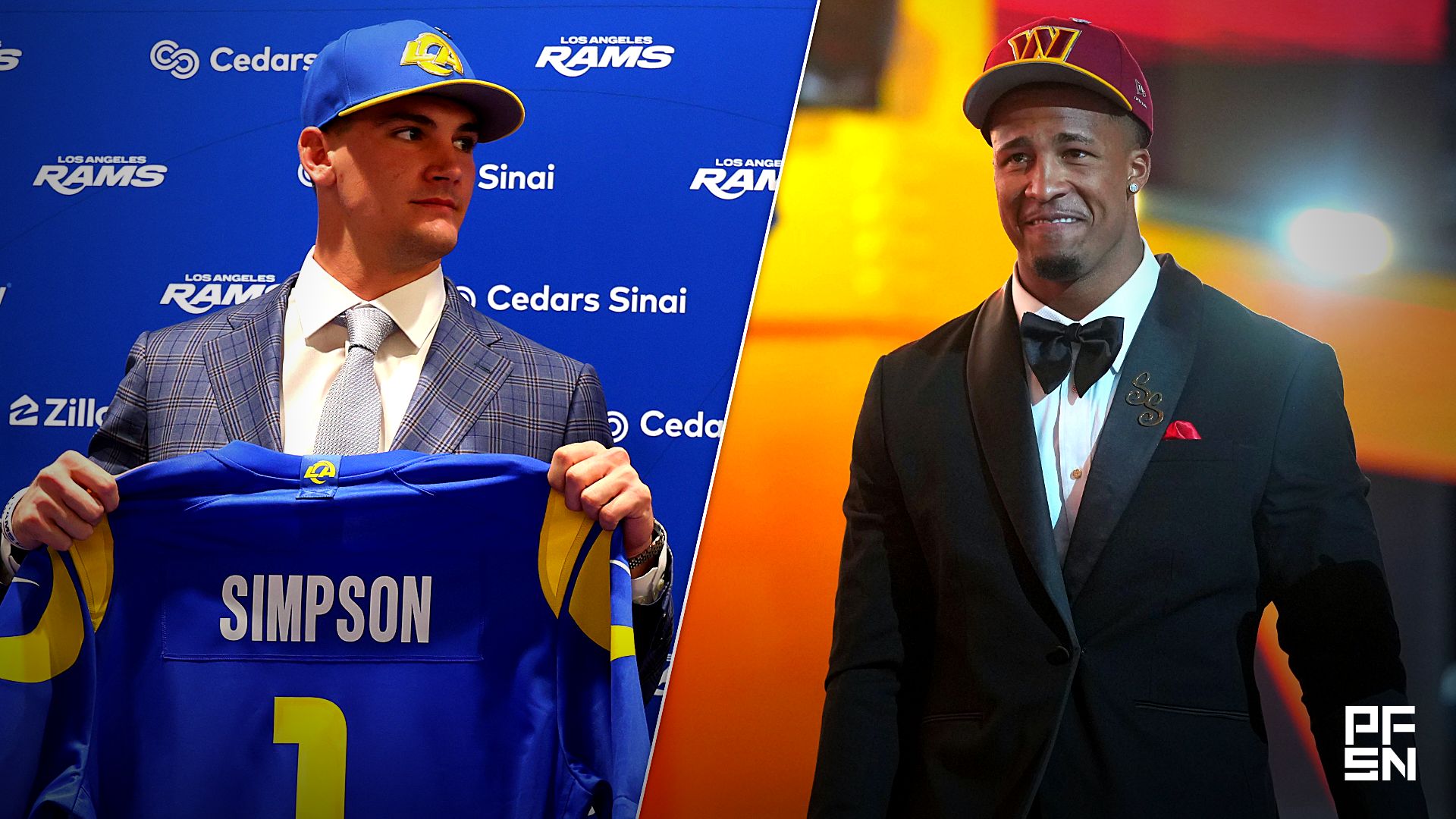
The 2026 NFL Draft is in the books, and there were plenty of surprises. From the Los Angeles Rams taking Ty Simpson at No. 13 overall to the Arizona Cardinals shocking everyone by selecting Carson Beck as their potential quarterback of the future, the draft had no shortage of wild moments across all three days.
PFSN graded each selection in our NFL Draft HQ and reacted to every single pick on our live 2026 NFL Draft Show, but let’s evaluate which teams emerged as the biggest winners and losers of the event based on finding values, addressing team needs, and landing the best talent.
While the 2026 NFL Draft is over, undrafted free agency is just getting started! Follow along to every UDFA signing with PFSN’s 2026 UDFA Tracker!
Winners of the 2026 NFL Draft
Washington Commanders, A+
- LB Sonny Styles, A | No. 7
- WR Antonio Williams, A+ | No. 71
- EDGE Joshua Josephs, A+ | No. 147
- RB Kaytron Allen, B+ | No. 187
- OC Matt Gulbin, B+ | No. 209
- QB Athan Kaliakmanis, C- | No. 223
PFSN’s Ian Cummings: “Look, they didn’t have an excess of draft capital, so the margin for error was extremely thin, especially for a team that made headway in free agency by adding a few high-ticket names. But they really needed to capitalize on the draft capital they had, and they did, getting my first overall prospect in Sonny Styles at seventh overall, getting my 33rd overall prospect Antonio Williams at 71st overall, getting a two of my top-100 guys outside of the top 150 in Joshua Josephs and Kaytron Allen, and then getting a starting center, in my opinion, in Matt Gulbin with the 209th pick.
“Athan Kaliakmanis is not the pick that I would have made in the later rounds, but I can see why they did it, just solidifying the QB position. The fact of the matter is I think they got, at the very least, two high-level rotational prospects and two, maybe three starters at the end of the day. I think they filled a lot of holes for this team to get back to contention. The Commanders got the most bang for their buck with just six selections.”
At 6’5″, 243 pounds, with over 33″ arms, Sonny Styles’ size and length, combined with his explosiveness, quickness, and playmaking range, can take over in both phases, and he’s an incredibly intelligent defender with elite read-and-react skills. With his safety background, he’s an incredibly natural coverage defender who can manage short and intermediate zones, but he’s also a combative block attacker, a shrewd gap invader, and a dynamic pass-rushing presence with bend and burst. Positional value will naturally come up in conversations regarding Styles, but he’s a blue-chip LB prospect with his raw grade, and has All-Pro potential as a MIKE or WILL in the NFL.
Antonio Williams is the ideal WR prospect for evaluators who marry film and analytical indicators. He was an immediate breakout as a true freshman, accounting for almost 20% of his team’s receiving output. In 2024, he accounted for over 23% of Clemson’s receiving volume, and nearly one-third of the team’s total passing touchdowns. And in 2025, he remained productive amidst a stark downturn for the Tigers’ offensive efficiency as a whole. As his high volume would imply, the 5’11”, 190-pound Williams is a natural-born separator with rare throttle and angle freedom as a mover, and his lightning-level twitch aids him both as a route technician and a RAC weapon. Durability is an ongoing concern, but Williams’ dual-sided separation and RAC framework is tried and true at the NFL level.
At around 6’3″, 234 pounds, Joshua Josephs is underweight, and he’ll need to add more mass at the next level. Nevertheless, he’s able to contend in run defense and stack blocks with his over-34″ arms, and he also has a great feel for acquiring leverage and loading his base. Josephs’ high floor in run defense defies expectation, and his pass-rushing framework is theoretically sound. Josephs is explosive, agile, and fluid at his size, with a clear understanding of upper-lower synergy, timing, and precision working the arc. He keeps tackles on their toes with his unique blend of athleticism and length, and he’s a threat to generate momentum-changing plays on money downs. That said, his pass-rush production didn’t match up with his tools in college. Josephs doesn’t channel power consistently with his upper-tier explosiveness and length, and his suspect raw strength makes him susceptible to snatches and forceful strikes against larger opponents. With his run defense profile, raw tools, and natural leveraging, he projects as a quality rotational presence with serviceable starting appeal in odd-front schemes, but he needs to improve his power element before he can reach his ceiling as a quality two-phase starter.
Kaytron Allen was often viewed as the “Robin” to Nicholas Singleton’s “Batman” in the Penn State backfield leading into 2025, but Allen emerged as the comfortably superior prospect in 2025, and excelled as the most stable presence in the Nittany Lions’ entire offensive arsenal. Allen rushed for a career-high 1,303 yards and 15 touchdowns, at an extremely healthy 6.5 yards per carry in an extremely predictable Penn State offense, and he also logged the eighth-highest PFSN RB Impact score of the year at 89.8. Singleton has a much more compelling north-south athletic profile, but for teams in search of physical volume backs with ingrained running instincts, Allen is the favorable selection. The 5’10”, 220-pound Allen is built with a thick midsection and thicker quads, and he possesses surprising cutting flexibility and angle freedom for his build. More than that, he’s a swift processor who can work off angle fluctuations early in reps, navigate congestion, and finish downhill. He’s delivers punishment at contact, but his 2.43 yards before contact per rush (TruMedia) corroborates his vision, efficient footwork, and cutting ease. Combine all this with Allen’s willingness as a pass protector and lead blocker, and he’s an ideal if non-explosive volume back who’ll see the field early and often.
Matt Gulbin finished his collegiate career with double-digit starts at center, left guard, and right guard — insulating his value as an immediate depth piece in an offensive line room. That said, he has legitimate starting appeal as an NFL center, and earned an elite PFSN OL Impact grade of 92.1 in 2025. Though Gulbin isn’t quite the athlete that other early-round centers in the 2026 class are, he still brings great initial explosion off the line, and has good range climbing to the second level. In the run game, his exceptional leverage acquisition and pad level management skills define his game, though he also boasts elite core strength when latched, and can use this to keep defenders inside his frame while driving lower-body power. Meanwhile, in pass protection, Gulbin excels at playing square to rushers, using carefully-timed punches and a suffocating anchor to limit opposing power output. Gulbin can still gain more experience identifying stunts and blitzes at the fulcrum, but he plays with patience and discipline, and isn’t afraid to torque defenders off-balance and finish when given the opportunity. A high-floor player with translatable leveraging, hand power, and functional strength, Gulbin could be a steal.
Atlanta Falcons, A+
- CB Avieon Terrell, A+ | No. 48
- WR Zachariah Branch, A | No. 79
- LB Kendal Davis, C | No. 134
- DT Anterio Thompson, C- | No. 208
- LB Harold Perkins Jr., B+ | No. 215
- OG Ethan Onianwa, C- | No. 231
PFSN’s Cam Mellor: “The Atlanta Falcons didn’t have a first-round pick after trading it to the Los Angeles Rams last year, but they drafted Avieon Terrell (A+ grade) in the second round and Zachariah Branch (A grade) in the third round, and they got good value with both picks.”
Avieon Terrell and A.J. Terrell may actually be the biggest winners of the NFL Draft, as they are now teammates in the Falcons’ secondary. Avieon carved out his own place as a stalwart for Clemson, recording 2 interceptions, 8 forced fumbles, and 21 pass breakups over his final two seasons. The younger Terrell doesn’t quite have the same size-speed combination as his brother, but he is one of the most technically and schematically-versatile CBs in the class. With his fast feet, fluid mobility, recovery burst, and sound technique, he can play press-man, flawlessly orient to WRs in off-man and toggle through techniques, or manage route relationships in zone. Terrell also has actionable slot-boundary versatility on Day 1, and he’s a true two-phase playmaker with ball skills against the pass and unique turnover-generating potential in run defense. An up-and-coming young player with an unnaturally high floor, Terrell has instant impact starter ability.
MORE: 2026 NFL Undrafted Free Agent Tracker
At 5’10”, 180 pounds, Zachariah Branch boasts game-breaking speed, as he showed in high school while winning state titles in the 100-meter dash, 200-meter dash, and long jump. He’s an ultra-dynamic return presence with a future as a special teams weapon, but the 2025 season saw him take a noticeable leap in development as a WR. Branch remains relatively raw as an intermediate separator, but his rare burst and open-field talent give him unguardable upside if he can continue refining his craft. In spite of his size, he’s a tough and steely convertor at the catch point, with exceptional body control and focus, and he logged the third-highest PFSN WR Impact grade in the entire nation (85.6). Branch will have value right away as a potentially devastating weapon on designed touches and as a return man, and his quickness, speed, and recalibrative athleticism underscore additional upside as a route runner and vertical threat.
Kendal Daniels was one of the most intriguing projected Day 3 prospects in the 2026 NFL Draft. Originally a four-star and Top 50 safety recruit, Daniels played his first four seasons at Oklahoma State, earning Big 12 Defensive Freshman of the Year honors in 2022. After a 2024 campaign that saw him amass 10.5 tackles for loss, 5.5 sacks, and 7 pass breakups, he transferred up to the Oklahoma Sooners in the SEC, and played a hybrid nickel and dime linebacker role in Brent Venables’ scheme. In his lone season in Norman, he registered 53 tackles, 9 TFLs, and 3 PBUs, earning an invite to the Senior Bowl. At 6’5″, 242 pounds, Daniels has near-elite size at LB, and yet he moves with rare quickness and fluidity. He’s extremely nuanced in off-man and zone coverage, with easy sink and redirection for his size, and while he doesn’t have high-end long speed, he has the explosiveness and half-field range to close downhill, erase gaps in half-field pursuit, and drape middle-field receiving threats. Daniels’ tackling needs work; he’s very inconsistent with his form and his breakdown angles. That said, Daniels is a superb coverage presence with alignment versatility, he’s a relentless contact engager in the box with quick-firing reaction, extremely willing physicality, and elite power capacity when stacking blocks, and he flashes pass-rush upside in spurts. His player archetype is a unique one that will demand the proper fit, but Daniels has the potential to be a quality role player and eventual quality starter, with projected special teams value.
Harold Perkins Jr. has a complicated 2026 NFL Draft evaluation, but there’s no denying his status as a bona fide CFB star. He was a consensus five-star recruit before joining up with the LSU Tigers, and across his first two campaigns, he racked up 13 sacks, 26 TFLs, 2 INTs, 7 PBUs, and 7 forced fumbles. He was set to have another big year in 2024, but tore his ACL just four games into the season. In 2025, Perkins returned as the hybrid STAR defender in LSU’s defensive scheme. It’s a position-less designation that compounds a lack of clarity with his NFL projection, but Perkins nonetheless acquitted himself well, amassing 56 tackles, 8 TFLs, 4 sacks, and 3 INTs. He’s an electric pass-rusher and pursuit threat, with some range and playmaking ability in zone coverage, but he might be too small to play traditional early-down LB roles, and he needs to improve his man coverage technique to exist as a hybrid in the NFL. His best fit might come in a role similar to Josh Metellus: A hybrid overhang or dime linebacker who can attack downhill, serve as a pass-rush catalyst, run-and-chase in pursuit situations, and drop into short and intermediate zones.
Carolina Panthers, A
- OT Monroe Freeling, A | No. 19
- DT Lee Hunter, A+ | No. 49
- WR Chris Brazzell II, A+ | No. 83
- CB Will Lee III, B+ | No. 129
- OC Sam Hecht, A+ | No. 144
- S Zakee Wheatley, B+ | No. 151
- LB Jackson Kuwatch, C- | No. 227
A former highly-touted recruit, Monroe Freeling towers at almost 6’7″, 315 pounds, with an overwhelming 84″ wingspan, and he distinguishes himself as an excellent athlete at that size, with menacing power capacity. He’s extremely quick off the ball, with exceptional overall proportions, a stable center of gravity, and logic-defying flexibility and leverage acquisition skills at his size. His hand usage pallet is still fairly basic at this stage; he can win more often than not with his sheer athleticism and reach. Still, Freeling has an incredibly strong foundation of inherent athleticism and soft skills, he’s angle-sound and disciplined in the run game, and in time, he can grow to become an impact starter across both phases.
Lee Hunter will be a 24-year old rookie, so he may have fallen outside some teams’ age thresholds, but he nonetheless profiles as arguably the most complete nose tackle prospect in the 2026 NFL Draft, and an instant impact interior defensive lineman. Hunter logged 4 sacks and 20.5 tackles for loss at UCF through 2023 and 2024, and upon transferring to Texas Tech, he maintained his high-end production, with 2.5 sacks, 8.5 TFLs, and a strong PFSN DT Impact grade of 81.9. At around 6’4″, 325 pounds, Hunter has excellent natural leverage and mass to go along with good proportional length. He’s an explosive, energized mover at his size who flashes devastating power output 1-on-1. He has the anchor and latch strength to absorb combo blocks and double teams, and his motor ensures that he’s always around the ball.
Chris Brazzell II had early-round buzz after transferring from Tulane to Tennessee, but his first year with the Volunteers was a “mulligan” of sorts, as Brazzell struggled to secure consistent playing time behind future NFL Draft pick Dont’e Thornton. In 2025, however, Brazzell climbed back up the depth chart and took full advantage of his opportunity. At 6’5″, 200 pounds, Brazzell has all of the catch-point skills you’d expect. He can create vertical separation and box out DBs with his frame, and he can snare high passes with steely focus and gravity-defying body control. Those elite catch-point traits translated to elite catch-point production in 2025; per TruMedia, he boasted a low 3.4% drop rate and an incredible 16.5% catch rate over expectation. That said, he’s also a promising vertical route runner and mover for his size, with the smooth, gliding explosiveness and the effortless flexibility to create and capitalize on angle advantages. Brazzell isn’t as efficient as a RAC presence, and he also has multiple driving violations on his record that will force teams to do due diligence. Nevertheless, if his off-field evaluation checks out, he has tantalizing upside as an explosive vertical-stressing WR2.
Will Lee III began his collegiate career at the JUCO level, and built his way up to the SEC, where he grew into an all-conference defender at the highest stage. He produced two interceptions and 10 pass breakups in 2024, and while 2025 was a slight step in the wrong direction, Lee still put quality reps on tape, particularly in press-man. Lee thrives as a domineering physical presence. At 6’1″, with arms near 32″ long, his disruptive radius is a definite strength, and at his size, he’s quick-firing and surprisingly fluid, with venerable short-area twitch, reactive athleticism, and coil on redirections. There’s still room for Lee to keep refining his technique, particularly with his footwork and positioning in press and on his pedal. And without elite long-track explosiveness and vertical speed, Lee’s technical margin for error is somewhat slimmer. Nevertheless, he’s the kind of size-adjusted mover and competitor who has lockdown potential with his fluidity, fast recalibration, and competitive zeal. His plus processing ensures that he can react quickly in the mirror-motor phase, or manage route combinations and execute crisp speed turns in zone. He’s sound and tenacious in support, and he’s a consistent playmaking threat. His technical consistency will define his ceiling, as Lee’s profile invites a level of inherent volatility, but he’s nonetheless a starting talent with three-down respectability.
Sam Hecht first joined the Kansas State Wildcats as a preferred walk-on in 2021, then grew to become a two-year starter and a potential early-round 2026 NFL Draft prospect at center. At a lean 6’4″, 300 pounds, Hecht doesn’t have domineering size or power, but instead wins with hyper-elite athleticism, positioning, and flexibility. In the run game, Hecht has the fleet-footed, explosive range to effortlessly traverse gaps and reach landmarks, and he has the hip flexibility to flip around and seal while keeping control. Meanwhile, in pass protection, Hecht is balanced, well-leveraged, patient, and synergetic, with the ability to play square and keep positioning, as well as pick up stunts. His hand strength is below-average, and he can be outreached by longer defenders, but he compensates with quality leverage game and effective anchor footwork. Hecht projects best in zone schemes where he can operate on the move and out in space, but he has the angle IQ, intelligence, and athleticism to fulfill different roles, and he has impact starter upside if he can up his play strength.
Zakee Wheatley joined Penn State as an unheralded three-star recruit and redshirted in 2021, but took on more rotational resposibilities in 2022 following Jaquan Brisker’s departure. Wheatley snagged two interceptions in his redshirt freshman season, flashing his playmaking potential, but his best play came in 2024 working in relief of Kevin Winston Jr. That year, Wheatley started all 16 games, amassing 96 tackles, 2.5 TFLs, a sack, three interceptions, and four pass breakups, earning a strong PFSN Safety Impact grade of 84.2. And amid a downturn for the entire Penn State program in 2025, Wheatley was one of the team’s most consistent defenders, and backed up his play with a strong Senior Bowl showing. At almost 6’3″, 201 pounds, Wheatley is a long and lean defensive back with elite explosive athleticism and impressive propulsive hip sink for his size. He’s capable of managing space and hovering overtop route concepts in two-high looks, and serves as a high-quality run support presence in the box with his quick processing, closing speed, and sure tackling. As a playmaker, Wheatley is more consistent working top-down as an interception threat than he is as a deflection producer, and he maxes out in space over longer stretches. But as a split-field strong safety, Wheatley has the size, explosion, processing, half-field range, and support utility to be a quality starter.
Losers of the 2026 NFL Draft
Seattle Seahawks, D+
- RB Jadarian Price, D- | No. 32
- S Bud Clark, D | No. 64
- CB Julian Neal, B+ | No. 99
- OG Beau Stephens, C | No. 148
- WR Emmanuel Henderson Jr., C- | No. 199
- CB Andre Fuller, B+ | No. 236
- DT Deven Eastern, C- | No. 242
- CB Michael Dansby, B | No. 255
Jadarian Price naturally got overlooked at times in the shadow of Heisman finalist and likely first-round pick Jeremiyah Love, but make no mistake: Price is a compelling NFL Draft prospect in his own right. Price might be a bit smaller and leaner than Love, but his utility as a creator and an explosive vertical threat should translate on Sundays. Price has a great blend of vision, spatial instincts, foot speed, smooth fluidity, and cutting range, and he goes 0-to-100 in a blink when he has a runway to attack. Price never proved himself at a high volume as a receiving threat, but he has actionable value as a pass protector, and his athletic talents suggest he has more to show as a RAC weapon. In addition to his immediate value as a change-of-pace back, he also doubles as an elite kick return weapon with his speed and spatial instinct; he housed two kick returns in his final collegiate season.
Bud Clark played six years at TCU, after joining the Horned Frogs as a four-star recruit in 2020. An injury limited him to just four games in 2021, but he went on to start over 40 games total in his career, while serving as a multi-year team captain. In particular, Clark distinguished himself as an elite catch-point playmaker and turnover threat, compiling 15 interceptions and 21 pass breakups in his final four seasons. In 2025, Clark achieved an elite PFSN Safety Impact grade of 91.8, and he compounded that momentum with an excellent Senior Bowl showing. A lean, long-limbed defender, Clark has an ideal coverage mobility profile in split-field looks with his corrective agility, swivel fluidity, hip sink, and closing burst, and he magnifies his appeal working in space with his quick route processing, reaction-to-stimulus, and ball-hawking ability. But as he reaffirmed at the Senior Bowl, he also has the ability to match and delay releases in press-man with his twitchy short-area athleticism and spatial discipline, and his length makes him a sprawling disruptive threat at the catch. Clark doesn’t quite have an elite athletic component, and his physicality can be a double-edged sword at times, increasing his penalty risk at stems. Additionally, Clark needs more consistency with block take-on and tackling conversion in support. Best in two-high looks, Clark can be a quality starter with inbuilt role versatility and playmaking gravity.
Julian Neal was one of the more notable risers of the 2025 regular season. At 6’2″, 208 pounds, Neal has the desired size-athleticism combo among NFL teams, and he’s quietly a very complete prospect past the physical profile. Even at his size, Neal has eye-catching explosiveness, reactive athleticism, and coil, and he can weaponize his quickness and hip fluidity to mirror WRs in press and off-man, as well as match route concepts in zone. He’s an effective playmaker at the catch point, and he’s ultra-reliable in run support, with keen instincts for resetting his base, engaging blocks, and securing stops as a solo tackler. He might not have elite vertical speed or swivel fluidity, and his plant-and-drive footwork still stands to improve — all of which leave him somewhat susceptible to big plays at times when his recovery fails him — but aside from that, there aren’t many holes to poke in his game. As a long and quick cover man with technical variability and rock-solid support chops, Neal has quality starter potential.
Beau Stephens was a central part of the Iowa Hawkeyes’ Joe Moore Award-winning offensive line, and also boasts PFSN’s highest individual OL Impact score of the 2025 season, with a grade of 94.1. At around 6’5″, 315 pounds, Stephens has above-average size and mass, and is a solid athlete for his size, with very good burst off the line and even better range in space when he’s able to open up his strides. Stephens is ultra-physical and tenacious in the run game, and technically sound in pass protection, with very good footwork efficiency, synergetic feel, and awareness. Stephens’ sub-32″ arms can be a limitation at times; he’s powerful in spite of that measurement, but he can be baited into over-reaching and lurching, and his latches aren’t as strong against longer opponents. Additionally, in pass protection, Stephens still has room to improve his play strength and anchor footwork, and his balance at engagement is inconsistent. Nevertheless, Stephens passes the desired athletic and intangible thresholds, he’s a gnarly competitor who relishes contact, and his flexibility is a surprising trump card that enables him to acquire leverage and engage his base consistently. He projects as an instant depth piece and future starter.
San Francisco 49ers, D+
- WR De’Zhaun Stribling, D- | No. 33
- EDGE Romello Height, D- | No. 70
- RB Kaelon Black, C- | No. 90
- DT Gracen Halton, A+ | No. 107
- OT Carver Willis, C- | No. 127
- CB Ephesians Prysock, B+ | No. 139
- LB Jaden Dugger, C- | No. 154
- OT Enrique Cruz Jr., C- | No. 179
De’Zhaun Stribling was widely regarded as a Day 3 WR prospect, but San Francisco took him early in Round 2. He has an intriguing blend of size, athleticism, and every-down utility. Originally a three-star recruit from Hawaii, Stribling began his career with the Washington State Cougars and broke out as a true freshman. Across his first two collegiate seasons, he totaled 95 catches for 1,073 yards and 10 touchdowns, then transferred to Oklahoma State. He missed all but four games to a hand injury in his first season with the Cowboys, then went 52-882-6 in 2024, before closing out his career with a 55-811-6 campaign at Ole Miss. Along the way, Stribling earned a solid 78 PFSN WR Impact score, and the analytics paint an even better picture. Per TruMedia, Stribling boasted a meager 2% drop rate with the Rebels, as well as a near-10% catch rate over expectation, and 2.29 RAC yards over expectation per catch. Stribling produced from the get-go in college, and that early breakout tracks with his high-level tools. At 6’2″, 207 pounds, with near-32″ arms and sub-4.4 speed, Stribling has a tantalizing size-speed profile on the vertical plane, as well as the combined catch radius and body control to make impressive high-difficulty catches at multiple ranges. Stribling’s route tree needs more development, but his non-elite hip fluidity and bend slightly reduces his ceiling in that department, and that could confine him to a rotational role at his maximum. Having said all this, Stribling has clear utility as a combined vertical and RAC threat with his speed, vision, physicality, and catch-point conversion, and he’s an excellent blocker as well. While he may never be a full-time starter, Stribling has a high-floor as a quality WR3 and rotational presence with niche receiving value and multi-phase utility.
Romello Height’s collegiate career spanned across six years and four schools, kicking off at Auburn in 2020. He joined the Tigers as a four-star recruit, and transferred to USC in 2022. After missing most of his first year at USC due to a shoulder injury, Height rebounded in 2023, and echoed that production at Georgia Tech in 2024. Height’s best season, however, came at Texas Tech in 2025. Working alongside David Bailey, Lee Hunter, and A.J. Holmes, Height earned 10 sacks, 11.5 tackles for loss, a PFSN EDGE Impact score of 82.4, and a glowing PFF pressure rate of 17.4%. Height’s final campaign was a realization of the upside that’s been readily apparent since his high school days, and he now populates the middle rounds as an exciting pass-rush specialist. At 6’3″, 239 pounds, with 32″ arms, Height is undersized, but he compensates with bristling explosiveness, hyperactive quickness, arc-running speed, and cornering bend. He presents a deadly challenge for tackles simply aiming to match him on an island, and he has the angle IQ, counter quickness, and flexibility to off-set, induce pauses, and capitalize with a variety of chops, swipes, swims, and dip combos. Height’s power element is visibly lacking, even with the aid of speed off the edge, and he can be re-routed by larger blockers. That same size deficiency limits his edge-setting capacity against the run, but Height nonetheless has inbuilt value as a wide-alignment designated pass-rusher with a relentless, unyielding motor.
Kaelon Black was instrumental during Indiana’s Big Ten Championship and national title run in 2025, and distinguished his talents on a quick turnaround at the Panini Senior Bowl in late January. Black will be flagged for his advanced age (he’ll turn 25 years old in October) and his spotty injury history, but if his medicals check out at the NFL Combine and during Top 30 visits, he stands out as one of the most compelling mid-round talents at the RB position. At around 5’10”, 208 pounds, Black is lean and well-leveraged, with elite north-south explosiveness, fast-striding acceleration, and foot speed in close quarters, and while he can at times be more controlled while pressing alongside gaps, he gets upfield with efficiency and excels at splicing through corridors. He’s more of a north-south attacker than a true creator, but he’s quick to gain ground and efficient with his pacing, and he’s a willing pass protector who also flashes legitimate first-level separation skills and RAC value, despite a limited sample size as a pass-catcher. Overall, Black projects as a high-quality rotational back with multi-phase appeal and an elite explosive element as a change-of-pace catalyst.
Gracen Halton first joined the Sooners as a four-star recruit in the 2022 cycle, and quickly entered the defensive rotation. In 2023, he flashed promise with 3.5 tackles for loss, and in 2024, he achieved a career-high five sacks. Halton’s pass-rush conversion was a bit less consistent in 2025, but Halton nonetheless earned a stellar 82.9 PFSN DT Impact grade, and per TruMedia, he logged a pressure rate over 11%, and averaged just 1.3 yards allowed per run stop. Halton’s exceptional Senior Bowl showing, however, has been the most powerful catalyst for his rise in the 2026 NFL Draft. At 6’2 1/2″ and 293 pounds, Halton has a picture-perfect leverage and lean mass profile, and in spite of his middling size and length, he has a strong, long-limbed lower body and elite explosive capacity. Halton can reset the line, prevent displacement, and penetrate gaps quickly, and while his somewhat stiff high-cut frame impacts his counter flexibility at times, there are bright flashes of pass-rush execution on film, underscoring his impact starter upside as a disruptive 3-tech.
Carver Willis is a potential OL sleeper in the 2026 NFL Draft, with predominant experience at tackle but also projected positional flexibility. Willis began his career as a three-star signee at Kansas State in 2020. After playing scarcely from 2020 through 2022, Willis started his first seven games in 2023, and was a full-time starter at right tackle in 2024. In 2025, he transferred to Washington and manned the left tackle position, starting 10 games at the blindside. Willis’ play earned him invites to the Senior Bowl, where he distinguished himself as one of the most consistent blockers at the event and took reps at center and guard, and to the NFL Combine, where he logged an impressive 5.11 40-yard dash and a 9′ broad jump. At around 6’5″ and over 300 pounds, with just under 33″ arms, Willis is close to average size for an OT, but his size profile holds up much better when projecting inside. He has the requisite experience to be a swing OT right away, but his explosive athleticism, lower-body power and drive, nuanced footwork and hands, and two-phase awareness project well at both guard and center. Additionally, Willis has the flexibility to aid in leverage acquisition and power absorption early in reps, and he’s a physical, tenacious finisher. In the run game, Willis functions better with a runway to gear up and align his base on wide zone runs and gap-to-gap pulls, and in pass protection, he can still attain more consistency with his anchor footwork and pad level maintenance. Nevertheless, Willis can function as a high-quality, position-diverse depth piece right away, and he has mid-level starting upside, most likely at guard or center in wide zone schemes.
Ephesians Prysock is a resident size-speed freak in the 2026 NFL Draft CB class. Originally a four-star recruit, Prysock began his career at Arizona, and broke out as a starter in his sophomore season with one interception and seven pass breakups. In 2024, he transferred to Washington, following head coach Jedd Fisch, and reprised his role as a starter. He carried that mantle through 2025, totaling 13 pass deflections and an INT in two seasons with the Huskies. Prysock played opposite another size-speed specimen in teammate Tacario Davis, and is the less refined of the two, but his upside is tantalizing, nonetheless. At 6’3″, 196 pounds, Prysock has over 33″ arms and a wingspan over 80″, and he also boasts 4.45 speed and elite explosiveness when trending vertical or clamping down overtop routes. Additionally, he has spindly quickness for his size, and flashes surprising fluidity for his height. There are still times where Prysock drifts too tall in off-man and zone coverage, inducing delays in reduction and plant-and-drive efficiency. In a similar lens, Prysock’s technique and targeted physicality remains a sore area in press-man and at stems, and he’s not as consistent as desired at tracking and impacting the ball with his length. All this considered, Prysock has a create-a-player mix of speed, quickness, fluidity, and length. He’s flashed the ability to play inside and out, he processes well in space, and he can attack blocks with his length. Prysock’s floor as a starter is lower than average, but his scheme-versatile ceiling is compelling if he can tighten down his technique in contact and catch-point situations.
Los Angeles Rams, D+
- QB Ty Simpson, D- | No. 13
- TE Max Klare, C | No. 61
- OT Keagen Trost, C- | No. 93
- WR CJ Daniels, C+ | No. 197
- DT Tim Keenan III, B+ | No. 232
PFSN’s Jacob Infante: “Maybe this is wrong of me to be like, ‘Oh, I’m doubting what Sean McVay and Les Snead did, but I thought Ty Simpson was a reach at No. 13; it was a D- grade. Max Klare, I mean, is not some bad value at No. 61 overall. I just don’t know if the positional focus is all that great, especially after you draft Terrance Ferguson in the second round last season. You’re bringing a tight end into that already crowded room. I liked Keagen Trost. Tim Keenan III was a good pick. CJ Daniels is not bad as just a depth wide receiver. I just don’t know how much of an impact you’re going to get out of this rookie class this year. You were a game away from the Super Bowl this past season, and I don’t think you added a single impact player for 2026.”
Ty Simpson’s sample size remains frustratingly small, but the Alabama passer still went No. 13 overall to the Rams. One of Simpson’s best traits is his mechanical profile; he has some of the cleanest throwing form in the class, with consistent sync and hip torque across situations. And in his best moments, he’s shown he can quickly discern coverage voids pre-snap and anticipate over the middle. That said, his post-snap processing and trigger run hot-and-cold, his situational precision falters too often in spite of his solid mechanics, and his non-elite arm strength shows up when attempting to drive passes downfield. With his general freneticism, Simpson could’ve benefitted from returning to school, but in a scarce QB class, he’s the best positioned to benefit. He resembles Marc Bulger with his talent profile and good-not-great operational skill set, and while he may never elevate a team to Super Bowl contention, a quality starting career is on the table.
Max Klare took his talents from West Lafayette to Columbus this year, suiting up for the Ohio State Buckeyes after a standout 2024 season with Purdue. It took him a few weeks to get a rhythm, but Klare eventually delivered a quality year at Ohio State, catching 43 passes for 448 yards and two scores. Klare’s production naturally inspires confidence, and his tape generates further NFL Draft excitement. At 6’4″, 240 pounds, Klare is an instinctive receiving threat with the burst, quickness, flexibility, and spatial IQ to separate independently. He has smooth body control as a catcher, and is an aggressive RAC threat who uses overwhelming leg churn and lower-body action to drive through would-be tackles. Klare’s pass-catching profile is extremely appealing, and his immediate blocking versatility and utility upside further magnifies that appeal. While Klare has room to add on more mass at the NFL level, he’s a versatile run-game asset who can block in-line, acquire leverage, drive his legs, keep gap integrity, and fulfill his assignments with reliability.
Keagen Trost is a seventh-year senior who will be a 25-year old rookie after a collegiate career that spanned across four schools and featured 42 starts, all at tackle. Trost capped off his career at Missouri in 2025, where he produced the highest individual PFSN individual OL Impact grade in the entire FBS, with a score of 99.9. Working against SEC competition, Trost allowed a measly 1.7% true pressure rate, and he distinguished himself as a consistent, assignment-sound run blocker as well. At around 6’5″, 311 pounds, with sub-33″ arms, Trost will receive looks as a tackle-to-guard convert, and at the very least, he profiles as a position-diverse depth piece with an impressively sound foundation. He’s a good athlete with functional quickness, flexibility, and range, and while he’s not overly powerful, he can at least drive lower-body power with leg churn and contend with his latch and anchor strength. In pass protection, he’s incredibly natural at playing square to rushers with sharp upper-lower sync and knee bend, and he picks up stunts with ease. In the run game, he’s unflinchingly assignment-sound, angle-sound, and has a finisher’s edge in space. In both phases, he adheres to consistent leveraging, base load, and pad level maintenance. He’s older, with raw power capacity limitations, but Trost has clear mid-level starter utility.
CJ Daniels’s path at the collegiate level was a winding one. A sixth-year senior, Daniels originally began his career at Liberty. As a true freshman in 2020, Daniels flashed promise with 220 yards and three TDs on just 11 catches, averaging 20 yards per catch. He’d expand his playmaking imprint in 2021, and after an injury-shortened 2022 season, he eclipsed 1,000 yards and 10 TDs in 2023. Daniels transferred to LSU for his first Power conference opportunity in 2024, but a stacked depth chart contributed to his transfer again in 2025, to the Miami Hurricanes. At Miami, Daniels thrived, catching 46 passes for 495 yards and seven scores. At 6’2″, 205 pounds, Daniels is a long-limbed, acrobatic catch-point presence whom passers unequivocally trust, but he also has the route running nuance and vertical ability to support role versatility. His age, injury history, and non-elite production will likely temper his stock, but in the mid-to-late Day 3 range, he’s a quality target with immediate rotational appeal.