
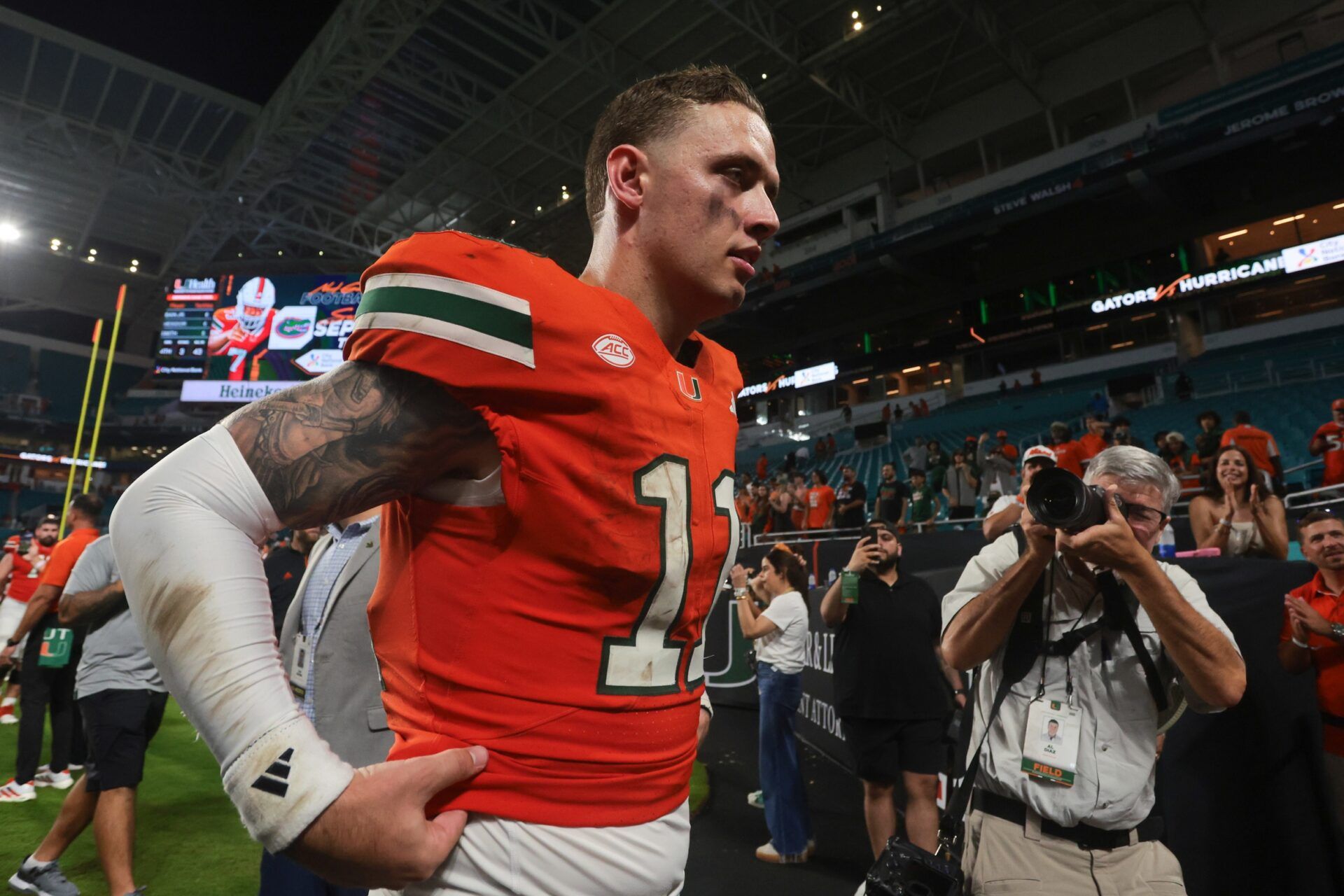
With more than 200 days left until the 2026 NFL Draft, players like Arch Manning are trending in the wrong direction, which has caused their draft stock to take a significant hit. Meanwhile, players like Carson Beck have taken steps in the right direction, improving their draft stock.
Here’s a look at the players whose draft stock has risen and fallen since the start of the college football season:
2026 NFL Draft Risers
Carson Beck and Garrett Nussmeier
The upperclassmen QBs who’ve come out of the early stretch with arguably the best marks? LSU’s Garrett Nussmeier and Miami’s Carson Beck. Beck is slinging it again with confidence, and he’s helped lead Miami to two ranked wins. But he’s also been insulated by an elite offensive line and a fearsome defense, and bailed out at times by his WRs – namely CJ Daniels – on toss-up 50-50 balls.
Nussmeier, meanwhile, has also led his team to two statement wins against Power opponents. His numbers haven’t jumped off the page, but he’s been a true field general for an LSU offense that’s operated swimmingly with him at the helm.
Nussmeier’s profile in particular will be polarizing because the NFL-level operational traits are absolutely there. He can read pre-snap and command an offense, he can process fluctuating windows post-snap, he has exceptional pocket management skills, and he’s a tough, fearless competitor.
But he’s also below-average size, with durability concerns and a talent profile closer to average than elite. And even with his high-end processing, he’s prone to lapses in situational precision and poor decisions – his cross-body interception against Florida a prime example.
Dante Moore and Aidan Chiles
Two other prospects adjacent to these preseason favorites are embarking on their own ascents: Dante Moore of Oregon and Aidan Chiles of Michigan State.
A better term for Moore’s 2025 campaign thus far might be a “resurgence”. He saw action as a true freshman at UCLA, but was inconsistent and flamed out in Southern California. He then transferred to Oregon in 2024 and sat behind eventual third-round pick Dillon Gabriel. Now the decision to patiently wait his turn has seemingly paid off, as he’s been one of the best QBs in college football through September.
Through three games, Moore has completed almost 80% of his passes for 657 yards, seven TDs, and just one INT. He diced up an Oklahoma State defense in disarray and was similarly efficient against Northwestern.
Moore, like most, hasn’t been tested much yet this year – but from a diagnostic standpoint, he bears some similarity to first-round pick and Pro Bowl passer CJ Stroud. At 6’3”, 206 pounds, their size profiles are similar. Like Stroud, Moore has good functional mobility but doesn’t rely on it. Both QBs have easy, effortless velocity generation and layering ability, and Moore’s accuracy has been his calling card three games in.
Chiles, a former four-star recruit who followed head coach Jonathan Smith from Oregon State to Michigan State, Chiles took his lumps as a first-year starter in 2024. At times, it was unclear whether he’d keep the job long-term. Instead, that early experience has helped catalyze a visible step forward in 2025.
There were glimpses of NFL-level traits and throws from Chiles in 2024 – taking reps under center and moving play-action mesh points, as well as firing outside-the-numbers drive balls into tight windows against Cover 2 looks – but he’s taken those flashes and built around them with added maturity and readiness in 2025.
Chiles’ comeback victory against Boston College was perhaps the best example yet, and one of the few times so far this year where a 2026 QB prospect has been truly tested by their game situation.
Michigan State was down at the half to the Eagles, and Chiles would go on to throw for four TDs and rush for a fifth, steering the Spartans to an overtime triumph with his arms, his legs, and his mind – earning a strong 82.8 PFSN QBi score in the process.
Some happenings of the 2025 college football season have not been expected. Others have been. One such occurrence is the success of likely first-round prospects – early summer scouting studs who are standing on business as they traverse through the autumn months preceding the NFL Draft circuit.
Jordyn Tyson
Tyson, who is PFSN’s preseason WR1 in the 2026 NFL Draft, has been incredible as the Sun Devils’ top option, with 24 catches for 314 yards and 4 TDs in his first three games. He earned acclaim in the preseason months with his vertical ability on film, but he’s re-emphasized his merit as a truly complete three-level threat in the month of September.
At his size, he’s a fluid and fleet-footed separator, a clutch catch-point converter, and an instinctive RAC threat with fantastic footwork on RAC transitions, body control, and fluidity weaving through crowds.
The advanced numbers back up Tyson’s game – particularly as a RAC weapon. He’s generating 5.9 yards after catch per reception, and almost a full yard of RAC per catch over expectation. But in truth, the metrics are glowing across the board.
He’s posting a catch rate over expectation of 5.33%. He’s averaging a flummoxing 3.17 yards per route run, a strong 0.59 EPA per target, and he has an on-field target percentage of 36.40%. That is to say, when he’s on the field, he gets the ball more than a third of the time.
Even more simply put: Tyson is good good. And he’s making a strong case for WR1.
Rueben Bain Jr.
On the other side of the ball, Miami edge rusher Rueben Bain Jr. has been the first-round stud most effectively backing up his standing.
He has 1.5 sacks, 3 tackles for loss, a pass breakup, and a forced fumble in three games, and those numbers don’t come close to communicating just how dominant he’s been week after week. He was particularly convincing in Week 1 against a Notre Dame offensive line with fringe NFL talent, outclassing them in every way.
I was apprehensive to give Bain a Top 10 grade heading into the season only because he was coming off a calf injury that severely limited his availability and on-field effectiveness in 2024. I was eager to see if he’d return to 100% and peak form with an offseason of rest, but I needed to see it for myself. Now we have, and it’s even better than we thought it would be.
A healthy Bain has a rocket-propelled first step and a unique long-strider gait that helps him both chew up ground as an arc-runner and generate powerful momentum en route to the contact point when aligning or stunting inside.
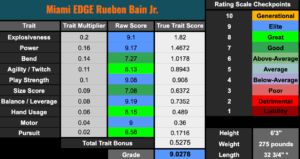
While he doesn’t have the longest wingspan, his 6’3” frame insulates a truly elite leverage game. He wins the pad level battle almost without fail and is a gap destroyer in the run game, but he also has the hand nuance and flexibility to win consistently as a pressure-generator on passing downs.
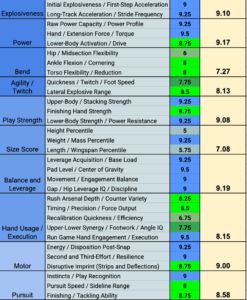
Especially in a modern NFL that’s shifting more toward ball control and run-heavy offenses, a defender like Bain – who can win 1-on-1 in the pass game with neutral or positive game-scripts and sledge run blocks with his strength, leverage, and burst – is worth his weight in gold. It’s why he’s a blue-chip prospect on my board, my EDGE1, and a Top 5 player in the MDS.
Ohio State Safety Caleb Downs
It’s between Caleb Downs and Peter Woods for the top overall prospect on my board at the moment, and while Woods has been solid – better than Clemson’s record indicates – Downs has been playing on another level.
While Downs is around average size, few safeties to come out over the past few years have his level of football intelligence, role versatility, range both on the attack and in zone coverage, and scraping ability against blocks. On top of it all, he’s maybe the most consistent tackler you’ll ever see – a true safety blanket and a blue-chip player. He proved it against Texas.
LSU CB Mansoor Delane
Mansoor Delane was PFSN’s CFB Defensive Player of the Week for his Week 3 performance against the Florida Gators. Delane allowed just two receptions for 11 yards on six targets, snagged an interception, and scored a 90.1 PFSN CBi grade.
The 5’11”, 190-pound Delane has been a revelation this year after a strong three-year career at Virginia Tech. There’s an argument to make he’s been the best CB in CFB, and his skills are translatable.
He’s a mirror-motor machine in man coverage, a smooth operator in zone, a versatile nickel-boundary joker, and a playmaker at the catch point. And his updated grade reflects all this. He’s my CB2 only behind Jermod McCoy, and McCoy’s availability could make it a tighter race.
Auburn EDGE Keldric Faulk
Keldric Faulk hasn’t been as productive as expected for a projected early first-round prospect, but for some players, you have to go past the stat sheet and to the tape. Faulk’s most notable film thus far – his game against Baylor in Week 1 – was full of “dirty work” plays where Faulk obliterated blocking looks and helped his teammates make plays.
Standing around 6’6”, 285 pounds, Faulk has the explosiveness and power profile to take reps inside or outside. But not only that, he has the leverage IQ and hand engagement to dominate blocks in the run game. From an archetypal standpoint, he’s not dissimilar to 2025 first-round pick Mykel Williams as an elite run defender with pass-rush upside, but Faulk arguably has more twitch and bend to mold.
Oregon TE Kenyon Sadiq
There were premonitions of Kenyon Sadiq as a potential TE1 candidate in the summer, but those premonitions came when Sadiq was just 240 pounds and had only accrued 29 career catches across his first two seasons. Now, Sadiq has beefed up to over 250 pounds. He hasn’t lost any of his explosiveness, and he’s playing at another level as a run blocker.
Early-round TE prospects need to be able to survive on early downs, and Sadiq does more than that: He dominates with his range, leverage, power, and physicality. And while the volume is still coming along as a receiving threat, his hip flexibility, foot speed, and stem IQ were all too clear on his touchdown catch against Northwestern.
Ohio State LB Arvell Reese
You might not have expected to see Arvell Reese here, because he hasn’t been mentioned in the first-round conversation as often as those above him. But Reese grades as a first-round prospect for me, and I could easily see him crack the Top 25 if he continues on his current trajectory. 6’4”, 240-pound off-ball linebackers with his raw power and stack-and-shed ability don’t come often, and he’s a weapon in the pass-rush phase with his explosiveness, range, and finishing ability.
2026 NFL Draft Fallers
Texas QB Arch Manning
Manning, the former five-star recruit who was perhaps prematurely anointed as a future first-round pick. We originally had Manning in the first-round range in the MDS due to projection: “He is draft eligible, and if he plays as well as he can play with his support in Austin, this is where he can go.”
At the time, it seemed a safe assumption to at least expect a step forward developmentally, and a worthwhile exercise for users trying to get a feel for the 2026 QB class as a whole. Manning has an experienced offensive mind as his head coach in Steve Sarkisian, as well as a strong offensive line and weapons core on paper.
Fast forward to today, and by any and every measure, Manning has been poor to start the year. His Week 1 showing against Ohio State put his poor mechanics, accuracy, and field vision under the spotlight, and those issues have only festered and materialized further through three weeks.
He hasn’t secured a PFSN QBi score higher than 72.6 in a given week, with middling EPA per clean dropback numbers and negative EPA per pressured dropback numbers in each game.
Barring a drastic turnaround, 2026 is more than likely not his declaration year. On film, assuming he’s healthy, he looks at least two years away from being ready for an NFL Draft ascent. SEC play should only reinforce this truth.
Cade Klubnik
In the preseason, I only had two QB prospects on the first-round fringe: Indiana QB Fernando Mendoza and Clemson QB Cade Klubnik.
I’ll eat crow on Klubnik’s preseason evaluation: I projected based on some elements of processing that I saw positive development with in 2024. Down the stretch in 2024, his leverage IQ and ability to manipulate middle-field defenders seemed to be blossoming. And in an ideal scenario, he could theoretically develop into a dynamic point guard-style passer in the mold of Bo Nix. He has the athleticism, arm elasticity, off-platform freedom, and touch.
The book isn’t closed on Klubnik, but the early 2025 returns have been subpar to put it mildly. Whatever growth he showed as a processor in 2024, he’s starkly regressed. He isn’t seeing the field well, he isn’t throwing with consistent accuracy, he’s turning the ball over, and he’s relying on his athleticism to a fault in pressure situations.
To be fair to Klubnik, his situation in Death Valley has not been ideal. Clemson’s offensive scheme is uninspired, the offensive line has underperformed, and injuries have impacted the group. But at a certain point, the onus has to fall on Klubnik to elevate his unit; first-round QBs are expected to do this. He simply hasn’t. Right now, his profile is that of a Day 3 QB.
Fernando Mendoza and Drew Allar
Mendoza was one of my Top 2 QBs out of summer scouting, and Drew Allar also carried a Day 2 grade. Both fit the prototypical NFL QB build, with size, athleticism, and elite arm strength.
Mendoza is considerably more accurate and polished with his mechanics, and quicker as an athlete, but Allar has very underrated pre-snap control and post-snap processing, and his best anticipation throws are right up there with the best of the class.
Allar’s the exact kind of prospect who’ll win the allure of GMs, coaches, and coordinators dreaming of an alien QB, even if he’s not quite that alien, or not close to perfect yet. In limited action against subpar competition, Mendoza has been excellent, and Allar has been acceptable.
LaNorris Sellers
The early-season stretch has been kinder to other 2026 QBs, but we still don’t have the answers we want. LaNorris Sellers still looks underdeveloped as a progression-reader, and a head injury has thrown his status into question. Drew Allar has been decently productive, but his accuracy remains a concern even in games against Group of 5 competition.
I won’t give a concrete ranking right now, but if I had 100 poker chips to bet on the current 2026 QBs to secure Round 1 capital? Here’s how I’d break it up:
- 20% – Fernando Mendoza
- 20% – Dante Moore
- 15% – Drew Allar
- 15% – Aidan Chiles
- 10% – Garrett Nussmeier
- 7% – LaNorris Sellers
- 5% – Carson Beck
- 5% – Behren Morton
- 1% – Taylen Green
- 1% – John Mateer
- 0.33% – Cade Klubnik, Sawyer Robertson, The Field
Risers to Watch in Conference Play
Washington OT Drew Azzopardi
According to PFSN College Insights, Drew Azzopardi is the sixth-highest graded OT in CFB through three weeks – and it’s easy to see why on film. The 6’7”, 315-pound blocker moves incredibly well for his size, and is rangy and assignment-sound in the run game.
Meanwhile, in the passing phase, he can use his lateral quickness and range to wall off stunts, and he excels at playing square 1-on-1. I’m comfortable going on the record saying he has first-round tools in this weak OT class – if he can prove it in Big Ten play.
Wake Forest DT Mateen Ibirogba
Mateen Ibirogba had modest stats on the box score versus NC State, but he was a certified game-wrecker on the All-22 film. The 6’3”, 296-pound defender did it all: Penetrated 1-on-1 as a pass rusher with his explosiveness and prying strength, walked back multiple NC State linemen with his raw power, forcing the QB out of the pocket, and resisted combo blocks in the run game with knee drop technique.
A former Georgetown EDGE, Ibirogba has bulked up and looks right at home as a versatile 3-tech. With his instant explosiveness, proportional length, power, leverage game, and alignment versatility, early-round upside is visible.
Oklahoma OG Febechi Nwaiwu
The Oklahoma offensive line has been one of the best in CFB through three weeks, with a 90.26 OL+ grade good for eighth in the nation. Perhaps the biggest part of that success has been guard Febechi Nwaiwu. At 6’4”, 325 pounds, Nwaiwu has the size, strength, and leverage to hold strong in a phone booth, and he proved his mettle against Michigan’s Rayshaun Benny.
Nwaiwu’s ability to match laterally, anchor, and provide help in pass protection is superb, but he also shows off imposing range and power as a puller in the run game. I have a mid-round grade on Nwaiwu, but could see him crack the Top 100.
California CB Hezekiah Masses
The 6’1”, 185-pound Hezekiah Masses leads the nation in forced incompletions through three weeks with seven, and is looking like a true early-round riser on the Golden Bears’ squad. While he’s a little light, it rarely shows in his press coverage tape. He has the combined quickness and length to dictate releases with discipline, and he’s a high-level playmaker at the catch.
Oregon OT Alex Harkey
The entire Oregon offensive line is worth watching – Isaiah World has early-round upside, Iapani Laloulu is a potential NFL starter at the fulcrum, and Emmanuel Pregnon has been exceptional in the early weeks – but Texas State transfer addition Alex Harkey might have the most riser potential.
At around 6’6”, 330 pounds, Harkey boasts overwhelming size and mass, and yet, he’s arguably the line’s most rangy and nimble mover on pulls and second-level climbs. Big Ten play will be key, but his athletic tools pop off the film.
Duke EDGE Vincent Anthony Jr.
Vincent Anthony Jr. terrorized the Illinois offensive line with a three-sack performance in Week 2. He’s 6’5”, 255 pounds, with 34” arms, but it was his angle-winning burst, bend, and finesse that helped him outlast tackles on the edge. While you’d like him to play with more consistent power at times for his size, Anthony’s pass-rush production against a quality opponent in Illinois bodes well for his continued rise in ACC play.
Tennessee EDGE Joshua Josephs
Joshua Josephs has been one of the biggest risers so far this season on the edge. Against Georgia, he was consistently disruptive in both phases, and notched a strip-sack in a key moment in the fourth quarter – using a crafty forklift, two-hand swipe, and rip combo to get to the QB.
Despite being undersized at around 6’2” and 250 pounds, Josephs has over 34” arms, which he can use to outreach blockers while winning the leverage battle. Combine that with his burst and bend, and it’s easy to see an early-round profile.
BYU RB LJ Martin
Per PFSN Insights, LJ Martin leads the nation’s qualifying running backs in yards after contact with an average of 7.5. The 6’2”, 220-pound back no doubt has the powerful leg churn and contact balance you’d expect at his size, but he’s also an amped-up runner with the foot speed and twitch to supplement cuts and gap transitions. He’s a fast-rising back who, in my opinion, has Top 5 positional potential and Top 100 upside overall.
Miami OGs Anez Cooper, Samson Okunlola
The Hurricanes’ offensive line has been terrific to start the year, and has been a prime reason for the renewed success of Carson Beck. Francis Mauigoa has been as advertised outside, and Markel Bell has been respectable on the other side – but the interior guard duo of Anez Cooper and Samson Okunlola has been particularly eye-catching.
Cooper is a long-term starter with overwhelming size and hand power, weaponized by keen precision and anchor footwork, while Okunlola is a former five-star with an elite blend of mass, mobility, and displacement force.