
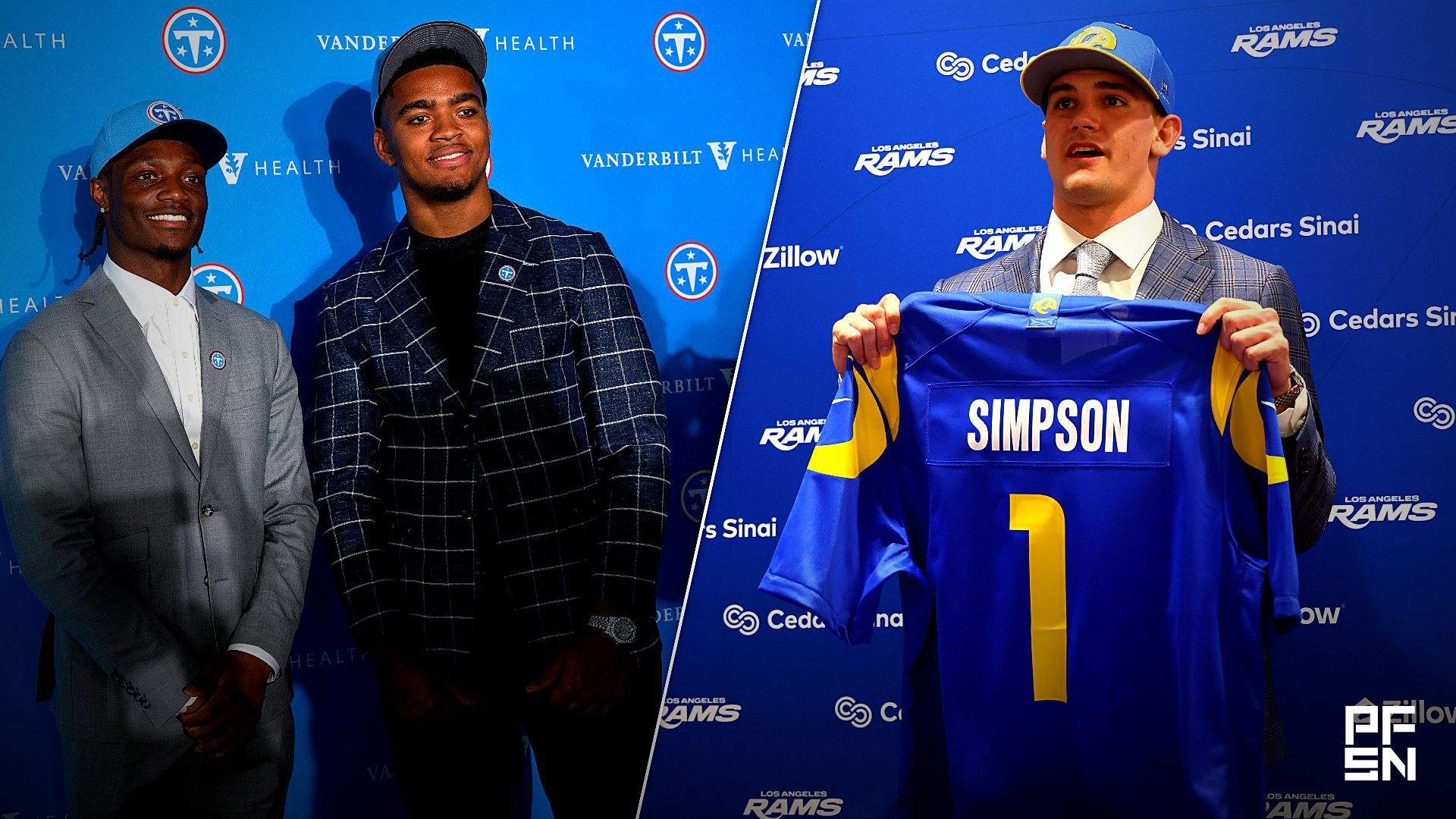
Day 2 of the 2026 NFL Draft is in the books, and there were plenty of surprises!
From the San Francisco 49ers reaching on WR De’Zhaun Stribling early in Round 2 to the Arizona Cardinals shocking everyone by selecting Carson Beck as their potential QB of the future, there was no shortage of wild moments in the second and third round.
There’s still one day left — and plenty of talented players still on the board — but who are the biggest winners and losers through the first two days of the draft? Let’s break down the teams with the best and worst grades thus far on PFSN’s live 2026 NFL Draft Show.

2026 NFL Draft Winners Through Day 2
Indianapolis Colts, A+
- LB CJ Allen, A+ | No. 53
- S A.J. Haulcy, A+ | No. 78
PFSN’s Ian Cummings: “The Indianapolis Colts landing CJ Allen and A.J. Haulcy are incredible value deals. Those are both players I would have taken at least a half round earlier. It lines up with what I was thinking they would do. Haulcy is a strong safety complement to Camryn Bynum. The Colts played the board perfectly.”
CJ Allen is the consummate old-school linebacker prospect with new-school athletic gifts. He excelled in 2025, earning first-team SEC and All-American recognition. At 6’1″, 235 pounds, he’s close to average size overall, with shorter reach than preferred, but he packs a ton of lean mass and contact power within his frame. He was an impact starter across 2024 and 2025, helping call signals and get teammates in position. Allen’s quick ascent as a leader bodes well for his NFL projection, and it’s the blend of mental and physical tools that generates allure. He’s incredibly rangy and explosive in pursuit and as a blitzer, he can get depth in coverage and run with RBs, and he can oscillate in congestion and navigate gaps with ease. He reads and reacts without delay, delivers punishing physicality as a block take-on defender, and has all the makings of a stud three-down defender.
At 5’11”, 215 pounds, A.J. Haulcy has the appearance of a box safety, and he no doubt brings that kind of physicality and urgency downhill. But he also has the fluidity, spatial instincts, instant route recogntion, and playmaking range of a true hawk in coverage. With his heavier, muscle-bound frame, Haulcy doesn’t quite have elite sink and fluidity on breaks, but he’s still fluid enough to reduce and plant-and-drive with efficiency, and he’s a situationally-malleable player who can adapt and flow to areas of interest when plays go off-script. A proven two-phase playmaker, Haulcy projects as an immediate NFL starter with plus starter potential.
Washington Commanders, A+
- LB Sonny Styles, A | No. 7
- WR Antonio Williams, A+ | No. 71
PFSN’s Ian Cummings: “The Commanders getting Sonny Styles at No. 7 overall and then landing Antonio Williams in mid-round-3 is a win. Williams is a guy who I had ranked in my top-50, so I’m a big fan. Similar to the Colts, the Commanders played the board very well.”
At 6’5″, 243 pounds, with over 33″ arms, Sonny Styles’ size and length, combined with his explosiveness, quickness, and playmaking range, can take over in both phases, and he’s an incredibly intelligent defender with elite read-and-react skills. With his safety background, he’s an incredibly natural coverage defender who can manage short and intermediate zones, but he’s also a combative block attacker, a shrewd gap invader, and a dynamic pass-rushing presence with bend and burst. Positional value will naturally come up in conversations regarding Styles, but he’s a blue-chip LB prospect with his raw grade, and has All-Pro potential as a MIKE or WILL in the NFL.
Antonio Williams is the ideal WR prospect for evaluators who marry film and analytical indicators. He was an immediate breakout as a true freshman, accounting for almost 20% of his team’s receiving output. In 2024, he accounted for over 23% of Clemson’s receiving volume, and nearly one-third of the team’s total passing touchdowns. And in 2025, he remained productive amidst a stark downturn for the Tigers’ offensive efficiency as a whole. As his high volume would imply, the 5’11”, 190-pound Williams is a natural-born separator with rare throttle and angle freedom as a mover, and his lightning-level twitch aids him both as a route technician and a RAC weapon. Durability is an ongoing concern, but Williams’ dual-sided separation and RAC framework is tried and true at the NFL level.
Atlanta Falcons, A+
- CB Avieon Terrell, A+ | No. 48
- WR Zachariah Branch, A | No. 79
PFSN’s Cam Mellor: “The Atlanta Falcons didn’t have a first-round pick, but they drafted Avieon Terrell (A+ grade) in the second round and Zachariah Branch (A grade) in the third round, and they got good value with both picks. They are one of three teams to earn an A+ grade) on our board.”
Avieon Terrell and A.J. Terrell may actually be the biggest winners of the NFL Draft, as they are now teammates in the Falcons’ secondary. Avieon carved out his own place as a stalwart for Clemson, recording 2 interceptions, 8 forced fumbles, and 21 pass breakups over his final two seasons. The younger Terrell doesn’t quite have the same size-speed combination as his brother, but he is one of the most technically and schematically-versatile CBs in the class. With his fast feet, fluid mobility, recovery burst, and sound technique, he can play press-man, flawlessly orient to WRs in off-man and toggle through techniques, or manage route relationships in zone. Terrell also has actionable slot-boundary versatility on Day 1, and he’s a true two-phase playmaker with ball skills against the pass and unique turnover-generating potential in run defense. An up-and-coming young player with an unnaturally high floor, Terrell has instant impact starter ability.
At 5’10”, 180 pounds, Zachariah Branch boasts game-breaking speed, as he showed in high school while winning state titles in the 100-meter dash, 200-meter dash, and long jump. He’s an ultra-dynamic return presence with a future as a special teams weapon, but the 2025 season saw him take a noticeable leap in development as a WR. Branch remains relatively raw as an intermediate separator, but his rare burst and open-field talent give him unguardable upside if he can continue refining his craft. In spite of his size, he’s a tough and steely convertor at the catch point, with exceptional body control and focus, and he logged the third-highest PFSN WR Impact grade in the entire nation (85.6). Branch will have value right away as a potentially devastating weapon on designed touches and as a return man, and his quickness, speed, and recalibrative athleticism underscore additional upside as a route runner and vertical threat.
New York Jets, A-
- EDGE David Bailey, B- | No. 2
- TE Kenyon Sadiq, B- | No. 16
- WR Omar Cooper Jr., A | No. 30
- CB D’Angelo Ponds, A+ | No. 50
PFSN’s Ian Cummings: “David Bailey was a bit early for me, but you addressed the EDGE position. Then, you get Omar Cooper Jr. late in Round 1 to fill a need at WR. Then, you get D’Angelo Ponds, who I had as my No. 12 overall player, in mid-round two; they did a terrific job.”
David Bailey emerged as a consensus All-American, amassing 14.5 sacks, 19.5 tackles for loss, 3 pass breakups, 3 forced fumbles, and an elite PFSN EDGE Impact grade of 92.9 that led the nation. At 6’3″, 250 pounds, with plus proportional length, Bailey is a lean, hyper-explosive rush linebacker with a logic-defying first-step, deadly off-setting twitch and energy, a ruthless motor, and the searing speed to run the arc against hapless blockers. He flashes legitimate speed-to-power with his fast-striding acceleration, compact mass, and length, and while he can be more consistent in run defense, he has flashed the ability to properly stack-and-shed and control blocks 1-on-1. As of now, Bailey is best as a pass-rush specialist; a banshee off the edge with blue-chip upside as a pass-rush presence, and the building blocks are there for him to build a complete three-down game.
At 6’3″ and almost 250 pounds, Kenyon Sadiq has a hyper-dense and muscular frame, which he combines with elite explosive athleticism, fluidity, and seam-splitting speed. Oregon utilized Sadiq’s athleticism often in RAC and seam-beating situations, but he also grew as an independent separator, more than once using his quickness to off-set or freeze defenders at stems before surging into space. At the catch point, Sadiq’s body control is a sight to behold, and he has the composure to hold strong in contact situations. Moreover, Sadiq’s explosiveness and contact balance mix well in the RAC phase, and he’s an extremely impressive blocker for his size, with a high degree of natural leverage, range, physicality, and alignment versatility. An immediate two-phase asset in the NFL.
At 6’0″, 201 pounds, Omar Cooper Jr. is a dense, compact pass-catcher with a low center of gravity and effortless explosiveness and vertical stretching. He can extend seams as a RAC threat with his range and contact balance, and he has the quickness and prying strength to work through adjacent contact, but he also flashes great salesmanship and tempo control as a route runner. Drops can be an issue on occasion for Cooper, and he has room to keep refining his route tree in the intermediate range, but overall, he’s a budding three-level threat with a particular affinity for RAC accumulation and vertical advances.
D’Angelo Ponds is a notable size outlier at just 5’9″, 170 pounds, but that’s one of the only major knocks you can attribute to his profile. That size profile does cause him to be outreached in some contested situations against larger receivers, and it makes him a bit easier to control on blocks, but he also plays bigger than his size more often than not, and he has the requisite qualities to compensate. Ponds is a fluid slasher of an athlete with high-level hip sink, fluidity, and vertical speed (ran a 10.49 100-meter dash in high school). He’s incredibly instinctive playing the ball in coverage, with the right blend of timing, body control, and targeted physicality, and he’s fast-flowing and physical in support in spite of his size. He projects best in off-man and zone-heavy schemes, but can size up when zone inevitably becomes man later in reps.
Tennessee Titans, A-
- WR Carnell Tate, B | No. 4
- EDGE Keldric Faulk, A+ | No. 31
- LB Anthony Hill Jr., A | No. 60
PFSN’s Ian Cummings: “Getting Anthony Hill Jr. after Carnell Tate and Keldric Faulk, those are three really good value deals. I think getting Faulk at the end of Round 1, that’s a guy who Robert Salah will know how to use properly. Then, with Hill, his top-end flashes are some of the best in the linebacker class. We talked about the explosiveness, the range, the blitz utility, and the coverage range, the playmaking. They only had three picks, but I’m a big fan of what they’ve done as well.”
Carnell Tate was PFSN’s WR1 in the 2026 NFL Draft, and a true X-factor in waiting. He first showed promise with a 52-733-4 receiving line in 2024, producing in spite of his place as the Buckeyes’ third option alongside Jeremiah Smith and first-round NFL Draft pick Emeka Egbuka. But in 2024, Tate’s technical feel was still underdeveloped. He was primarily a vertical threat for Ohio State, who lacked polish. He flipped the script 180 degrees in 2025, reinventing his game and becoming a true route running expert with rare sink, throttle control, and stem IQ for his size. Tate still has the long-strider range, body control, and logic-defying catch-point focus that makes him so potent in 50-50 situations (he boasts a jaw-dropping 28.2% catch rate over expectation). At the same time, he’s a deadly multi-level separator who can win 1-on-1, convert on clutch downs, and generate big plays. He’s not an overly dynamic RAC threat, but as a complete X-receiver, Tate has All-Pro upside within the exceedingly uncommon and invaluable George Pickens mold.
Keldric Faulk breaks the mold for what’s possible at the EDGE position. At 6’5″, 288 pounds, the Auburn junior possesses top-flight lean mass, length and reach, and explosive, energized athleticism. His hyper-elite power profile, rare raw strength, and fast-striding pursuit speed makes him a multiphase nightmare in theory. Faulk flashed exciting growth as a pass-rusher en route to seven sacks and 11 TFLs in 2024, but that production stagnated in 2025. Faulk’s run defense remained near-elite in 2025; he’s shown he can reset the line, stack-and-shed blocks, and set a firm edge with his raw explosion, length, and size-defying leverage acquisition skills. However, his pass-rush plan and counters remain inconsistent, as does his lower-body power application and pad level farther into pass-rush reps. Faulk possesses astronomical two-phase upside and inbuilt alignment versatility, but in the pass-rush phase, he’s still a long way from realizing that potential. With Faulk, you’re gambling on the unrealized pass-rush upside, but can take comfort in his ready-made run defense profile.
Looking at his pedigree, production, and his extraordinary physical talent at a lean 6’3″, 235 pounds, Anthony Hill Jr. passes the eye test as a truly uncommon physical talent. Stylistically, he relies on that hyper-elite raw talent more often than desired. He’s best as a run-and-chase linebacker who can eliminate angles up field and run down runners in pursuit with his full-field range. Additionally, he functions as an incredibly dangerous blitzing threat with his speed and bend, and that same explosive athleticism grants him brisk closing ability in short coverage zones. Having said all this, Hill still has room to improve his independent processing and technique at contact. He remains prone to overrunning angles in gap response and falling for option bait, his coverage instincts can be hot-and-cold, and he doesn’t consistently attack or dictate in contact situations. Still, as a run-and-chase weapon and a blitzing dynamo in the WILL role on passing downs, Hill has immense upside.
2026 NFL Draft Losers Through Day 2
Los Angeles Rams, D+
- QB Ty Simpson, D- | No. 13
- TE Max Klare, C | No. 61
- OT Keagen Trost, C- | No. 93
PFSN’s Cam Mellor: “The Rams had one of the more questionable picks of Round 1 with Ty Simpson, and then followed it up with Max Klare (C grade) and Keagen Trost (C-). Los Angeles stands out as one of the worst-graded teams on our board.”
Ty Simpson’s sample size remains frustratingly small, but the Alabama passer still went No. 13 overall to the Rams. One of Simpson’s best traits is his mechanical profile; he has some of the cleanest throwing form in the class, with consistent sync and hip torque across situations. And in his best moments, he’s shown he can quickly discern coverage voids pre-snap and anticipate over the middle. That said, his post-snap processing and trigger run hot-and-cold, his situational precision falters too often in spite of his solid mechanics, and his non-elite arm strength shows up when attempting to drive passes downfield. With his general freneticism, Simpson could’ve benefitted from returning to school, but in a scarce QB class, he’s the best positioned to benefit. He resembles Marc Bulger with his talent profile and good-not-great operational skill set, and while he may never elevate a team to Super Bowl contention, a quality starting career is on the table.
Max Klare took his talents from West Lafayette to Columbus this year, suiting up for the Ohio State Buckeyes after a standout 2024 season with Purdue. It took him a few weeks to get a rhythm, but Klare eventually delivered a quality year at Ohio State, catching 43 passes for 448 yards and two scores. Klare’s production naturally inspires confidence, and his tape generates further NFL Draft excitement. At 6’4″, 240 pounds, Klare is an instinctive receiving threat with the burst, quickness, flexibility, and spatial IQ to separate independently. He has smooth body control as a catcher, and is an aggressive RAC threat who uses overwhelming leg churn and lower-body action to drive through would-be tackles. Klare’s pass-catching profile is extremely appealing, and his immediate blocking versatility and utility upside further magnifies that appeal. While Klare has room to add on more mass at the NFL level, he’s a versatile run-game asset who can block in-line, acquire leverage, drive his legs, keep gap integrity, and fulfill his assignments with reliability.
Keagen Trost is a seventh-year senior who will be a 25-year old rookie after a collegiate career that spanned across four schools and featured 42 starts, all at tackle. Trost capped off his career at Missouri in 2025, where he produced the highest individual PFSN individual OL Impact grade in the entire FBS, with a score of 99.9. Working against SEC competition, Trost allowed a measly 1.7% true pressure rate, and he distinguished himself as a consistent, assignment-sound run blocker as well. At around 6’5″, 311 pounds, with sub-33″ arms, Trost will receive looks as a tackle-to-guard convert, and at the very least, he profiles as a position-diverse depth piece with an impressively sound foundation. He’s a good athlete with functional quickness, flexibility, and range, and while he’s not overly powerful, he can at least drive lower-body power with leg churn and contend with his latch and anchor strength. In pass protection, he’s incredibly natural at playing square to rushers with sharp upper-lower sync and knee bend, and he picks up stunts with ease. In the run game, he’s unflinchingly assignment-sound, angle-sound, and has a finisher’s edge in space. In both phases, he adheres to consistent leveraging, base load, and pad level maintenance. He’s older, with raw power capacity limitations, but Trost has clear mid-level starter utility.
San Francisco 49ers, D+
- WR De’Zhaun Stribling, D- | No. 33
- EDGE Romello Height, C- | No. 70
- RB Kaelon Black | No. 90
PFSN’s “Football Debate Club” analysis: Cummings and Infante had Stribling ranked 180th and 200th on their personal boards, respectively. Cummings called the pick a “head-scratcher” given how early he went.
De’Zhaun Stribling has an intriguing blend of size, athleticism, and every-down utility, but he was projected as a Day 3 propsect. John Lynch and Co. shocked the NFL world by taking him early on Day 2. At 6’2″, 207 pounds, with near-32″ arms and sub-4.4 speed, Stribling has a tantalizing size-speed profile on the vertical plane, as well as the combined catch radius and body control to make impressive high-difficulty catches at multiple ranges. Stribling’s route tree needs more development, but his non-elite hip fluidity and bend slightly reduces his ceiling in that department, and that could confine him to a rotational role at his maximum. Having said all this, Stribling has clear utility as a combined vertical and RAC threat with his speed, vision, physicality, and catch-point conversion, and he’s an excellent blocker as well. He may never be a full-time starter, but Stribling has a high-floor as a quality WR3 and rotational presence with niche receiving value and multi-phase utility.
Romello Height’s collegiate career spanned across six years and four schools, kicking off at Auburn in 2020. He joined the Tigers as a four-star recruit, and transferred to USC in 2022. After missing most of his first year at USC due to a shoulder injury, Height rebounded in 2023, and echoed that production at Georgia Tech in 2024. Height’s best season, however, came at Texas Tech in 2025. Working alongside David Bailey, Lee Hunter, and A.J. Holmes, Height earned 10 sacks, 11.5 tackles for loss, a PFSN EDGE Impact score of 82.4, and a glowing PFF pressure rate of 17.4%. Height’s final campaign was a realization of the upside that’s been readily apparent since his high school days, and he now populates the middle rounds as an exciting pass-rush specialist. At 6’3″, 239 pounds, with 32″ arms, Height is undersized, but he compensates with bristling explosiveness, hyperactive quickness, arc-running speed, and cornering bend. He presents a deadly challenge for tackles simply aiming to match him on an island, and he has the angle IQ, counter quickness, and flexibility to off-set, induce pauses, and capitalize with a variety of chops, swipes, swims, and dip combos. Height’s power element is visibly lacking, even with the aid of speed off the edge, and he can be re-routed by larger blockers. That same size deficiency limits his edge-setting capacity against the run, but Height nonetheless has inbuilt value as a wide-alignment designated pass-rusher with a relentless, unyielding motor.
Kaelon Black was instrumental during Indiana’s Big Ten Championship and national title run in 2025, and distinguished his talents on a quick turnaround at the Panini Senior Bowl in late January. Black will be flagged for his advanced age (he’ll turn 25 years old in October) and his spotty injury history, but if his medicals check out at the NFL Combine and during Top 30 visits, he stands out as one of the most compelling mid-round talents at the RB position. At around 5’10”, 208 pounds, Black is lean and well-leveraged, with elite north-south explosiveness, fast-striding acceleration, and foot speed in close quarters, and while he can at times be more controlled while pressing alongside gaps, he gets upfield with efficiency and excels at splicing through corridors. He’s more of a north-south attacker than a true creator, but he’s quick to gain ground and efficient with his pacing, and he’s a willing pass protector who also flashes legitimate first-level separation skills and RAC value, despite a limited sample size as a pass-catcher. Overall, Black projects as a high-quality rotational back with multi-phase appeal and an elite explosive element as a change-of-pace catalyst.
Minnesota Vikings, C
- DT Caleb Banks, D+ | No. 18
- LB Jake Golday, C- | No. 51
- DT Domonique Orange, C- | No. 82
- OT Caleb Tiernan, A+ | No. 97
- S Jakobe Thomas, C- | No. 98
PFSN’s Jacob Infante: “They ignored their secondary, which is a glaring weakness. Caleb Banks in the first round is a guy who’s had two broken feet in the last calendar year and is raw as a run defender. The upside is there, but still. Then, Jake Golday, it’s like, ‘Alright, that’s solid value, but still, there was so much good secondary value available on the board! At least I can justify the Domonique Orange pick; he’s an effective run stuffer. But how much is that going to matter right away when you’re getting torn to shreds at the third level of your defense? I do like the Caleb Tiernan pick, and that’s probably the only reason they aren’t in the D-grade range.”
Caleb Banks broke out with four sacks and seven TFLs in 2024, showing off blue-chip raw tools in the process. At 6’6″, 325 pounds, with arms over 35″, he has overwhelming size, length, and forklift power, to pair with inhuman burst and quickness at that size. His rare raw talent has grandfathered him into the “stack-and-shed nightmare” category, and he flashes excellence as a pass-rusher with swims, swipes, and long-arms. Banks needs more control and counter consistency, but his physical makeup is ready-made for instant impact at the NFL level. The major questions come from his medical history and lack of availability in 2025. He’s had foot issues in the past and suffered another injury that required a procedure against LSU, and ultimately caused him to miss most of the 2025 season. Then, at the NFL Combine, he suffered yet another foot injury, this time a broken foot that will sideline him at least until June.He still managed to earn a near-historic RAS with a broken foot, which is confirmation of his truly alien physical gifts, but there’s a definite lack of certainty regarding Banks’ projection, on account of his small on-field sample size and his mountainous medical questions. That said, Banks has true 100th-percentile tools, and has the potential to be utilized as an alignment-versatile game-wrecker.
At 6’4″, 240 pounds, Jake Golday has the explosiveness and range to work sideline-to-sideline. He’s an instinctive spatial navigator working through creases to make stops at the line, and he also has blitzing utility with his long-strider burst through gaps. Additionally, with his size and length, he’s able to take on and stack blocks at the second level, and he’s shown he can make solo tackles with good form. In coverage, Golday has natural limitations that come from his non-elite sink and fluidity, and he also lacks great zone IQ and spatial awareness. That said, he can at least use his length to clog middle-field windows, and as a read-and-react SAM linebacker, he has the range, physicality, and block take-on to be a consistent presence.
Domonique Orange is the ideal nose tackle prototype. He’s 6’2″, 328 pounds, with near-34″ levers for arms. He can play with natural leverage and attack opposing linemen with power in the pass game, and he can latch, anchor, and limit displacement against run blocks. Naturally, he’s not an elite disruptor 1-on-1, but Orange makes his money by being an immovable mass at the fulcrum. He can two-gap while stationary or while on the move against zone blocks, he can stack and shed, and he has surprising pursuit range and a relentless motor. For odd and hybrid-front schemes, Orange can be a definite force multiplier and early-down gap enforcer. He frees up other players to make plays, and has measured playmaking value of his own.
Caleb Tiernan has started over 40 games across his collegiate career, taking notable reps at both left and right tackle. At the very least, he profiles as a stellar swing tackle candidate right away in his NFL career, but he has legitimiate starting utility as well, and could be a candidate to move inside. Following a long line of NFL talents at tackle for the Northwestern Wildcats, Tiernan builds his reputation on being an extremely well-rounded two-phase blocker. While not overly explosive, he’s quick enough for his 6’7″, 325-pound size, with precise and heavy hands and stalwart latch strength. In the run game, he’s angle-sound with great urgency and physicality, with quality leverage acquisition skills, and as a pass blocker, he dutifully subscribes to the “wide base, tight hands” mantra, and is exceedingly alert against stunts. He has below-average proportional length, which — combined with his taller frame — can put him in difficult recovery and re-anchor situations at times, but as a swing tackle or eventual starter at guard, he holds merit.
Jakobe Thomas is a well-rounded safety prospect with a clear ceiling but also universal utility that could help him see the field as a rotational defender at least, and a mid-level starter at best. Thomas’ turnover production stands out most, and it’s emblematic of his ability to manage depth and space from two-high or single-high, read-and-react, and break in front of passes. In coverage, Thomas has good recalibration quickness and fluidity, and while his top-end speed is capped, he has enough half-field range to be disruptive when his breaks are well-timed. In run support, Thomas has similar playmaking urgency, and triggers downhill quickly, with the length and mass to hold up taking on blocks. A missed tackle percentage over 15% reflects a need to exercise better timing, breakdown discipline, and technique at contact, but Thomas nonetheless has value as a fast-flowing and physical downhill presence. Thomas has a respectable floor across the board, and can function well as a rotational and depth safety with spot-starting utility in two-deep schemes.