
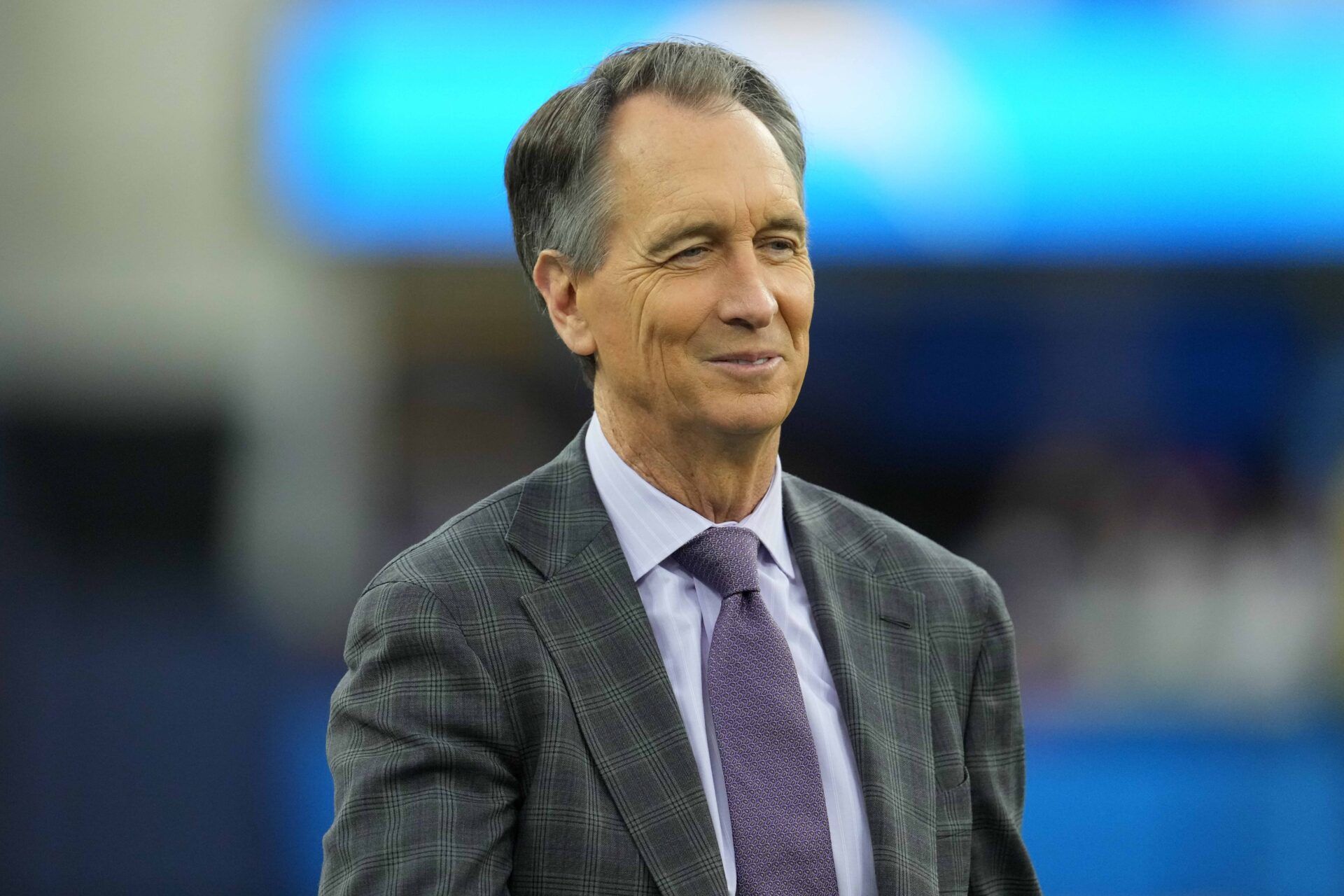
Cris Collinsworth doesn’t need reminding that Super Bowl 60 represents the biggest broadcast of his 35-year career.
“I’ve been through it before. You can’t help but think 130 million people are watching,” Collinsworth told PFSN in an exclusive interview. “You hope this isn’t the week that you decide to stumble over anything. But it’s a special treat, you know? They say pressure’s a privilege. Because it took a long time to get to where I was the voice on that broadcast.”
“I was playing football when I was a really young boy, and somehow, I get a chance to do this. That’s pretty cool.”
Cris Collinsworth’s Journey to Calling Super Bowl 60
The journey Collinsworth references stretches back to 1990, when he called his first NFL game at Rich Stadium alongside Jim Donovan. Thirty-five years later, he’ll work his sixth Super Bowl broadcast, tying Troy Aikman for third-most in television history. Between those bookends sits a career built on preparation, adaptation, and the willingness to accept stakes that would paralyze most broadcasters.
During his playing days, Collinsworth was a three-time Second-Team All-Pro and three-time Pro Bowler. He is a member of the Cincinnati Bengals’ 50th Anniversary Team after finishing his eight-year NFL career with 417 receptions for 6,698 yards and 36 receiving touchdowns.
After his playing career ended in 1988, Collinsworth started as a radio host in Cincinnati. He joined HBO’s Inside the NFL in 1989 as a reporter, graduating to the studio cast a year later. NBC hired him in 1990 for NFL coverage. He took a year off to finish his law degree, returned in 1992, and spent the next three decades building credibility across five networks.
NBC lost its NFL rights in 1998, sending Collinsworth to Fox. He worked studio shows before moving to the booth in 2002. When NBC reclaimed Sunday Night Football in 2006, Collinsworth returned as a studio analyst. Three years later, Madden retired, and the opportunity arrived.
When NBC tapped Collinsworth to replace John Madden in 2009, the network handed him the most scrutinized job in sports broadcasting. Sunday Night Football had established itself as primetime television’s top-rated show. Madden was an institution. The new guy in the chair needed to honor that legacy without attempting to replicate it.
Collinsworth won his first Emmy as a studio analyst in 1997. He’d worked Fox’s lead broadcast team. He’d called Super Bowl 39. None of it prepared him for the specific pressure of becoming NBC’s voice every Sunday night.
The role demands encyclopedic football knowledge deployed in real time. Schemes shift mid-snap. Coordinators disguise coverage. A broadcaster either identifies what happened in three seconds or loses credibility with 20 million viewers. Collinsworth earned 17 Sports Emmys by mastering that microscopic window between confusion and clarity.
His preparation shows. He studies All-22 film obsessively. He talks to coaches, players, and executives. When the camera finds him sliding into frame before kickoff, he’s already processed hours of information into digestible insights. The work eliminates uncertainty. What remains is execution under scrutiny that would destroy lesser analysts.
Super Bowl broadcasts operate under different physics than regular-season games. A stumble during Week 7 draws criticism. The same mistake in February becomes a career-defining moment replayed endlessly on social media.
Collinsworth has navigated five Super Bowls without disaster. He called Malcolm Butler’s goal-line interception in Super Bowl 49 with perfect indignation at Seattle’s play call. He’s dissected defensive schemes while 114 million viewers watched. The track record matters less than the reality that broadcast six demands the same precision as broadcasts one through five.
Super Bowl 60 marks Collinsworth’s 17th season as Sunday Night Football’s analyst and his 500th career broadcast.
Collinsworth’s willingness to acknowledge that pressure reveals something most analysts avoid discussing. The job looks effortless on television. Behind the smoothness sits constant calculation about what to say, when to say it, and whether the insight adds value or clutter.