
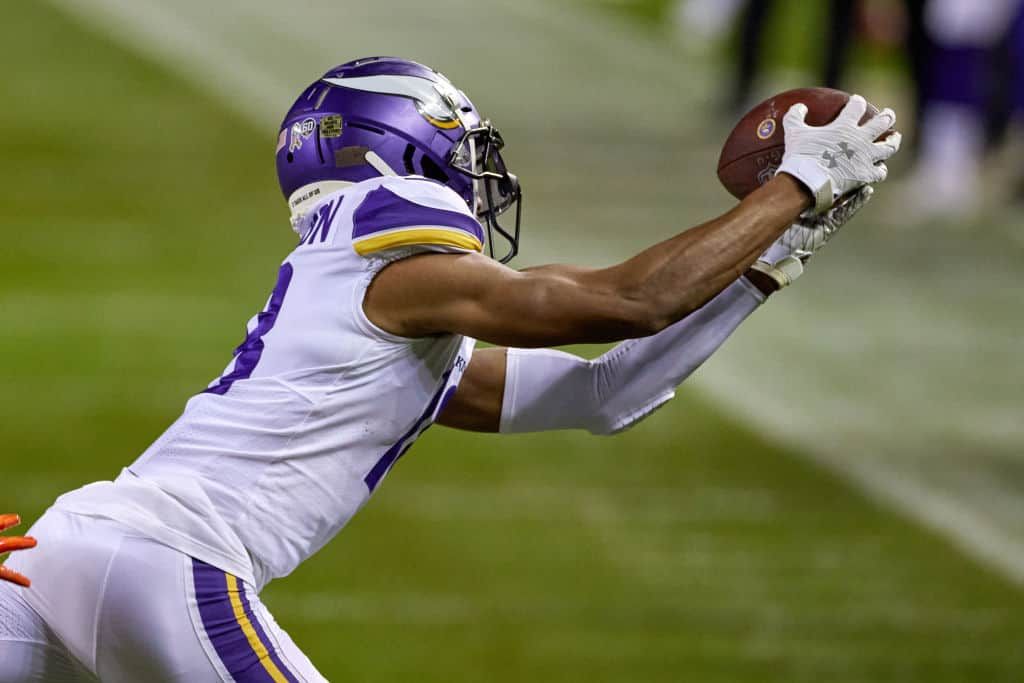
The AP Offensive Rookie of the Year award has historically been dominated by the quarterback and running back positions, with no tight end, or offensive lineman having ever won it and a wide receiver only doing so nine times. At first glance, it doesn’t seem as though this season will be any different. While it has looked for much of the season as though the Rookie of the Year Award would go to a QB, wide receivers such as Chase Claypool, CeeDee Lamb, and Justin Jefferson have more than made their case over recent weeks.
With Joe Burrow’s injury, Justin Herbert is now the clear favorite to take home the award. However, according to the Offensive Value Metric (OVM), which is a metric created by the (Bx) Movement to measure how efficiently a player created their statistics, Herbert’s victory should be far from guaranteed. Going into Week 12, Herbert’s OVM grade sits at 27.41. That isn’t a terrible grade, but it isn’t anything special either. There are currently quite a few players with higher OVM grades than that, including the wide receivers mentioned above.
Chase Claypool is a good wide receiver on a great team
Let’s start with Claypool, who has played a significant role in helping the Pittsburgh Steelers earn their undefeated record. He leads the team in both receiving yards, with 559, and receiving touchdowns, with eight (he also has two touchdowns on the ground.
However, his OVM grade isn’t quite as impressive as you might expect given that statistical success. At 29.87, the grade is fairly average when compared to other wide receivers. The primary reason for his relatively mediocre grade is his below-average catch percentage of 60%. Claypool’s grade indicates that his success might have less to do with his own abilities and more to do with the strength of the Steelers overall. That said, it is still more than two points higher than Herbert’s, which might give him the edge was this a two-person competition.
Related | Ezekiel Elliott has become the Cowboys’ unsolvable problem
In order to provide some context to Claypool’s overall OVM grade, let’s look at how it has changed throughout the season so far. The chart below shows his grade from each week of the NFL season, represented by the black dots, compared to the league average for wide receivers, represented by the yellow line.
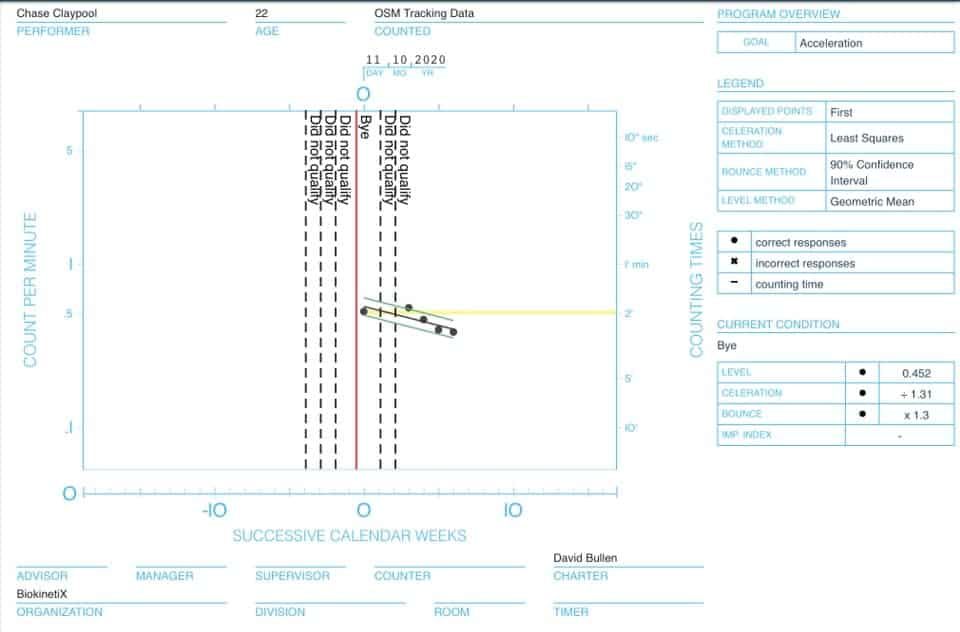
As you can see, while Claypool’s grades have been fairly consistent, many of them are slightly below average and are generally trending slightly downward as the season has progressed. That isn’t a great sign for the rookie, although there are still several weeks left in the season for him to rebound, something that he will need to do if he wants a shot at winning Offensive Rookie of the Year.
In a normal season, CeeDee Lamb would probably be the best rookie wide receiver
Note: Lamb’s data does not include statistics from Thursday’s game against the Washington Football Team.
The next player I want to talk about is CeeDee Lamb. In direct contrast to Chase Claypool, Lamb’s team, the Dallas Cowboys, is struggling mightily. They still have the chance to win the NFC East, although that says more about the division’s struggles rather than anything positive about the Cowboys. However, Lamb has been one of the few bright spots for the team in 2020, accruing 650 receiving yards and four touchdowns.
His OVM grade of 31.01 is better than Claypool’s, largely due to a slightly better catch percentage, at 64.86%, although it is still relatively average for wide receivers.
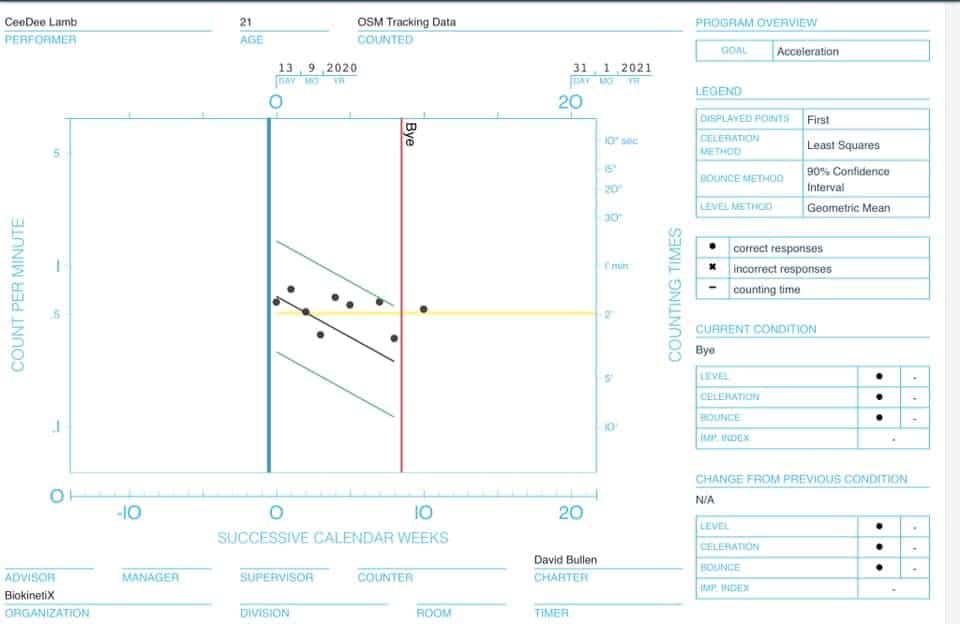
Comparing their charts, Lamb’s grade has varied more than Claypool’s has, but his peaks have been higher than his fellow rookies. In fact, Lamb has bested Claypool’s highest single-game grade, 32.32, five different times this season. In other words, while Lamb has had more off weeks than Claypool, he has consistently shown to have higher peaks. Those low points are somewhat concerning but are perhaps upsurprising given how much turmoil has engulfed the Cowboy’s offense this season. Lamb’s success in spite of those difficulties has been truly impressive to watch.
Justin Jefferson is the wide receiver most qualified to win Offensive Rookie of the Year
The statistics show that Chase Claypool and CeeDee Lamb have both been excellent this season. However, I mention them less because I believe they should be named Offensive Rookie of the Year and more to demonstrate a general trend of wide receivers being more valuable to their teams than Herbert. However, there is one rookie wide receiver who stands head-and-shoulders above the rest: Minnesota Vikings rookie Justin Jefferson. If any wide receiver wins Offensive Rookie of the Year this season, it will be him.
He leads this season’s rookies with 848 receiving yards, a number that is tied for eighth among all wide receivers after Thursday’s games. And unlike Claypool and Lamb, he has a stellar OVM grade to go along with those statistics. At 36.57, it is the highest grade of any rookie and ranks fourth when compared to all other wide receivers going into Week 12. It is higher than Herbert’s grade by almost 10 points. Even if you believe Herbert’s box score statistics are better than Jefferson’s, which is debatable, Jefferson has been far and away the more efficient of the two players.
Examining the statistics behind Justin Jefferson’s stellar OVM grade
Jefferson’s advanced metrics are unsurprisingly spectacular. Jefferson has caught an above-average 75.27% of his targets and has also been successful with the ball in his hands. He is currently averaging 6.5 yards after the catch, higher than any other rookie. More impressively, that number is 2.5 yards higher than expected according to the NFL’s advanced metrics, the second-highest differential in the NFL by any player, rookie or otherwise.
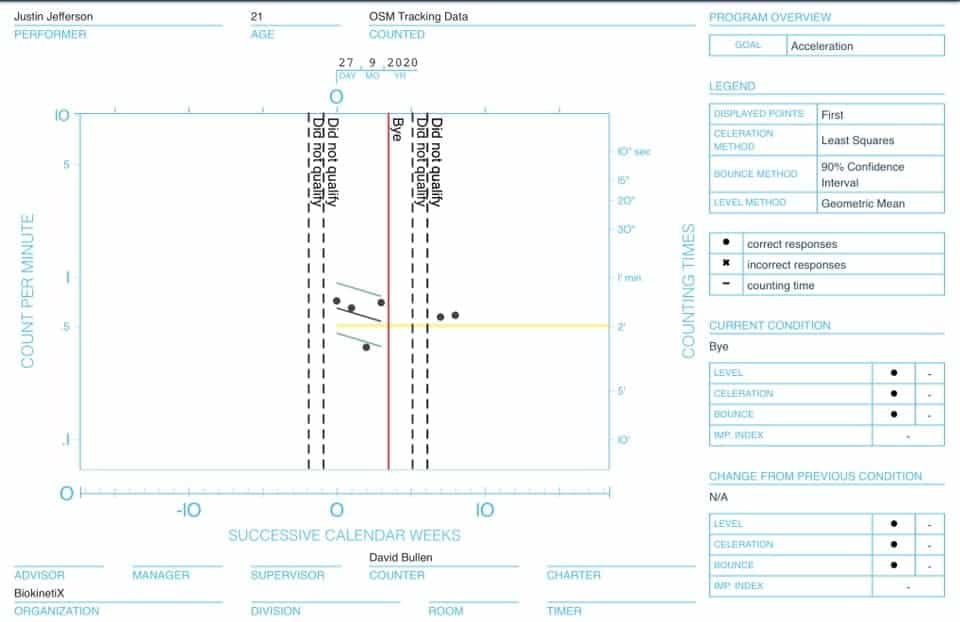
Looking at the chart of Jefferson’s weekly grades, the differences between him and his fellow rookie wide receivers should be obvious. Jefferson has ranked above the league average in every game but one this season, often by a significant margin. Although there have been a few games in which he was not targeted enough to earn a grade, when given sufficient opportunities, he has been consistently excellent.
Can a wide receiver really take the Offensive Rookie of the Year award away from Herbert?
Despite the statistics I have presented, Herbert might still win Offensive Rookie of the Year. The NFL voter’s bias towards quarterbacks and running backs is a tough thing to overcome, and the last player to manage it was Odell Beckham in 2014. However, Chase Claypool and CeeDee Lamb both deserve to be mentioned in that conversation. Justin Jefferson, meanwhile, has the numbers to win the award outright. His combination of elite box score statistics with hyper-efficient play marks him as one of the best young wide receivers in the NFL.
Perhaps, in the years to come, a different player from this rookie class will distinguish themselves as a better player. At the moment, however, Jefferson is in a class all his own.
Lucas Ellinas is a writer for Pro Football Network. You can follow him on Twitter @Lucas_Ellinas.
