
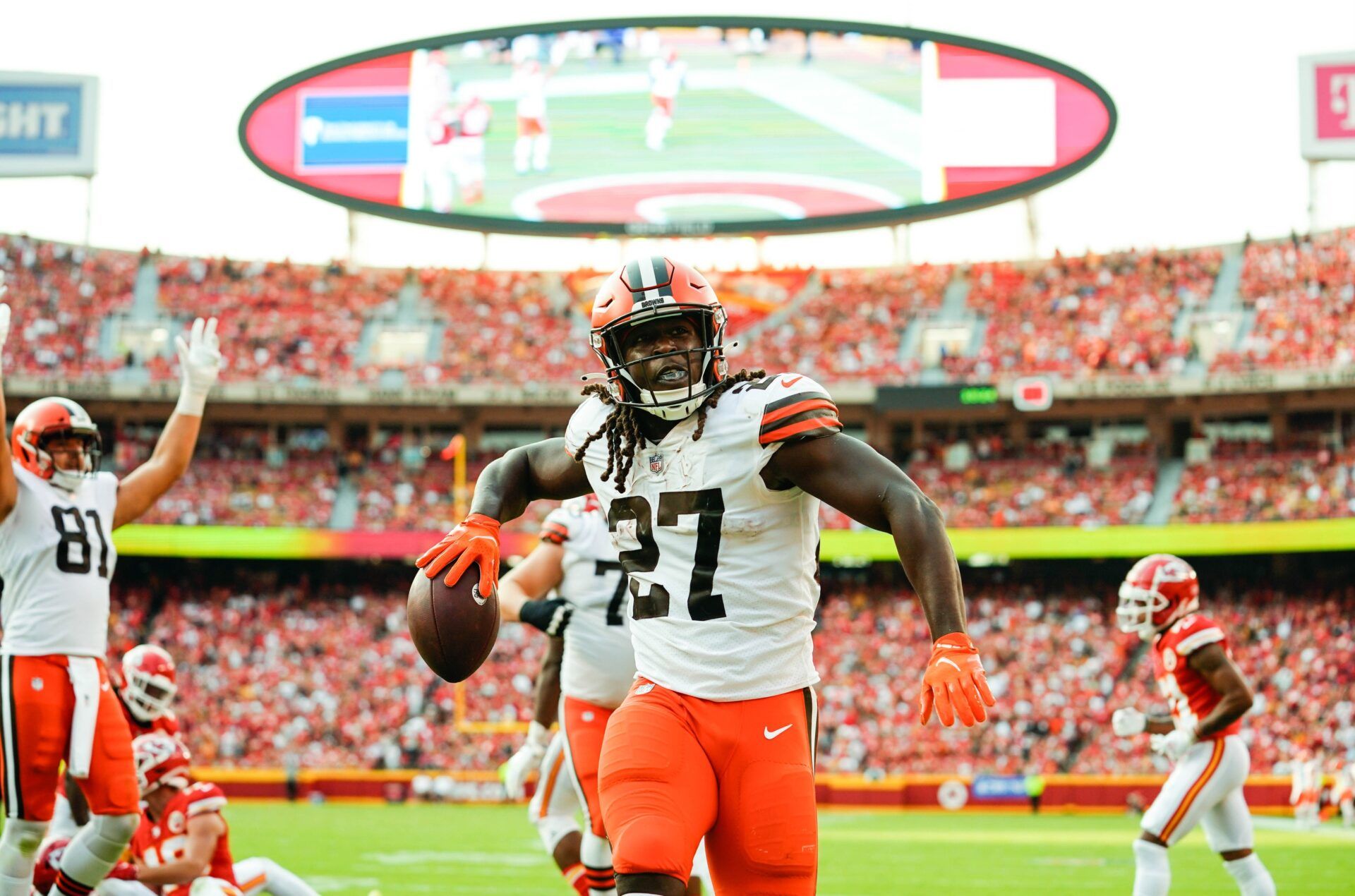
Kareem Hunt’s fantasy football value for 2022 remains largely unchanged despite the request for a trade. However, the offense around him looks rather different in what has been a turbulent offseason for the Cleveland Browns. Let’s examine Hunt’s current ADP in 2022 fantasy drafts and whether that presents a value entering the season.
Kareem Hunt ADP | Is he worth his current price in fantasy drafts?
Hunt’s 2022 ADP is remarkably consistent across all of the various formats. He’s either being selected around 85th overall as the RB33 on average across all three scoring formats. When we consider individual sites, the variation of ADPs is from 77th to 99th as the RB27 to RB35.
In terms of where Hunt’s ADP falls, he’s being selected late in the seventh or early in the eighth round. His earliest ADP on any site extends as early as the middle of the seventh through to the early ninth round.
Hunt’s projected fantasy value in 2022
Hunt is a really hard player to judge in terms of how to view him. His per-game fantasy outputs have been extremely consistent over the past two seasons, regardless of the format. Those per-game outputs make him a low-end RB2 on average, but there are some areas of concern.
Last season, Hunt averaged more than two touches fewer per game than in 2020. The majority of that was in terms of rushing output, which fell from 12.4 to 9.75 on average. However, a slight increase in targets, catch rate, yards per rushing attempt, and yards per target resulted in a 0.7 increase in yards per touch. That meant Hunt finished with just 1.6 fewer yards from scrimmage per game than the previous season.
The intriguing part is that the 5.6 yards per touch essentially matches the numbers he posted in the first three years of his career. Therefore, we can look at the 4.9 yards per touch number from 2020 as the potential outlier in terms of Hunt’s efficiency. That now switches the outlook for Hunt somewhat. If he sees the opportunities rise back to the 2020 numbers but retains his career efficiency, we’re now looking at the per-game fantasy outputs from the last two years as a potential floor.
That is certainly an intriguing element for Hunt. He was an RB2 in each of the previous two years, and there is optimism to consider he could actually be better than that. The problem is the turbulence that we have seen in Cleveland over the past few months.
Cleveland’s offense is somewhat of an unknown
Usually, a returning head coach would offer certainty about what we can expect from an offense. However, a lot has changed this offseason, even if the scheme and head coach remain. Baker Mayfield is gone. His replacement, Deshaun Watson, will only play the final six games, leaving Jacoby Brissett (or Joshua Dobbs) as the starting QB for the first 11 games.
There is then a big change in the receiving group, with Amari Cooper and David Bell as the potential top two receivers. Austin Hooper is gone, and David Njoku and Harrison Bryant are the headline acts at tight end. The offense just looks completely different, and that’s the tough part.
Could Cleveland ride their run game more in the first 11 weeks and hope to keep things tight with their defense? Sure. Could they also just have Brissett never throw the ball more than five yards? Absolutely. The problem is we have no idea. Brissett is a downgrade on Mayfield, and that raises concerns.
There is then the fact that in Week 13, the entire picture changes. When Watson returns, the offense will have a different shape. Watson’s intended air yards per pass attempt is between 0.8 to one yard more per attempt than Brissett over the past few years. He’ll likely throw deeper and utilize the weapons more. The team may also shift a handful of carries per game to pass attempts.
Should you draft Hunt in 2022?
Certainly, fantasy football is hard to come by. However, drafting a situation loaded with uncertainty is also extremely risky. That is what Hunt brings. In what was a weird environment in Cleveland in 2021, Hunt was no certainty. He scored 10 points or more in PPR scoring in three of his eight games. In the other three, he scored a total of 12.1.
But then you look at 2020, and it adds confusion. Hunt hit the RB3 threshold in PPR (10 fantasy points) on nine of 16 occasions. He only scored fewer than 7.5 fantasy points on three of the other seven. Those four in between were not ideal returns, but he was never a disaster. Hunt never scored less than five fantasy points. In PPR, he was always either a starting option or close to it.
In non-PPR, that picture is rockier, and it’s a surprise his ADP is basically the same across all three scoring formats. In PFN’s consensus RB fantasy rankings, Hunt sits just outside the top 30 at the position and just inside the top 70 overall for PPR and half-PPR. However, for non-PPR, he’s in the RB35 region and roughly 10 spots lower in the rankings in the mid-70s overall.
As a group — and myself especially __ we value running backs slightly higher on average in our overall rankings than ADP. That is especially the case this year, with the depth of WR and QB through the draft. Therefore, the picture is somewhat cloudy. Hunt appears as a value at his ADP overall, but basically sitting in the right region, or even slightly high at the position, depending on scoring.
That is where you have to judge your draft. Don’t just look at the number in rankings and decide, “I must target him.” Look who is around that player, at the position, and overall, and create a picture of how you want things to play out.
Just because Hunt is there at pick 75, and we have him 66 overall in PPR doesn’t mean you blindly select him. Have all the backs we rank above him and trust more gone first? Are there any players in the tier above or the same tier available? If so, how many? What about other positions? Is a tier about to drop off elsewhere? Hunt is outside the top 30 RBs for us for a reason — uncertainty. If your roster is not built to handle that uncertainty, look at those RB tiers and make an informed decision.
Hunt is a solid selection with an upside in terms of return on investment, but he could also be a headache. We have no idea what this offense will look like or how Hunt’s trade request impacted his standing in the eyes of the coaching staff.
Rankings cannot cover every available outcome, but your decision-making can. If you have a roster that can handle the potential stability of Hunt, take him in the early seventh. If it cannot, let someone else take that risk and put a more certain quantity on your roster in those crucial middle rounds.