
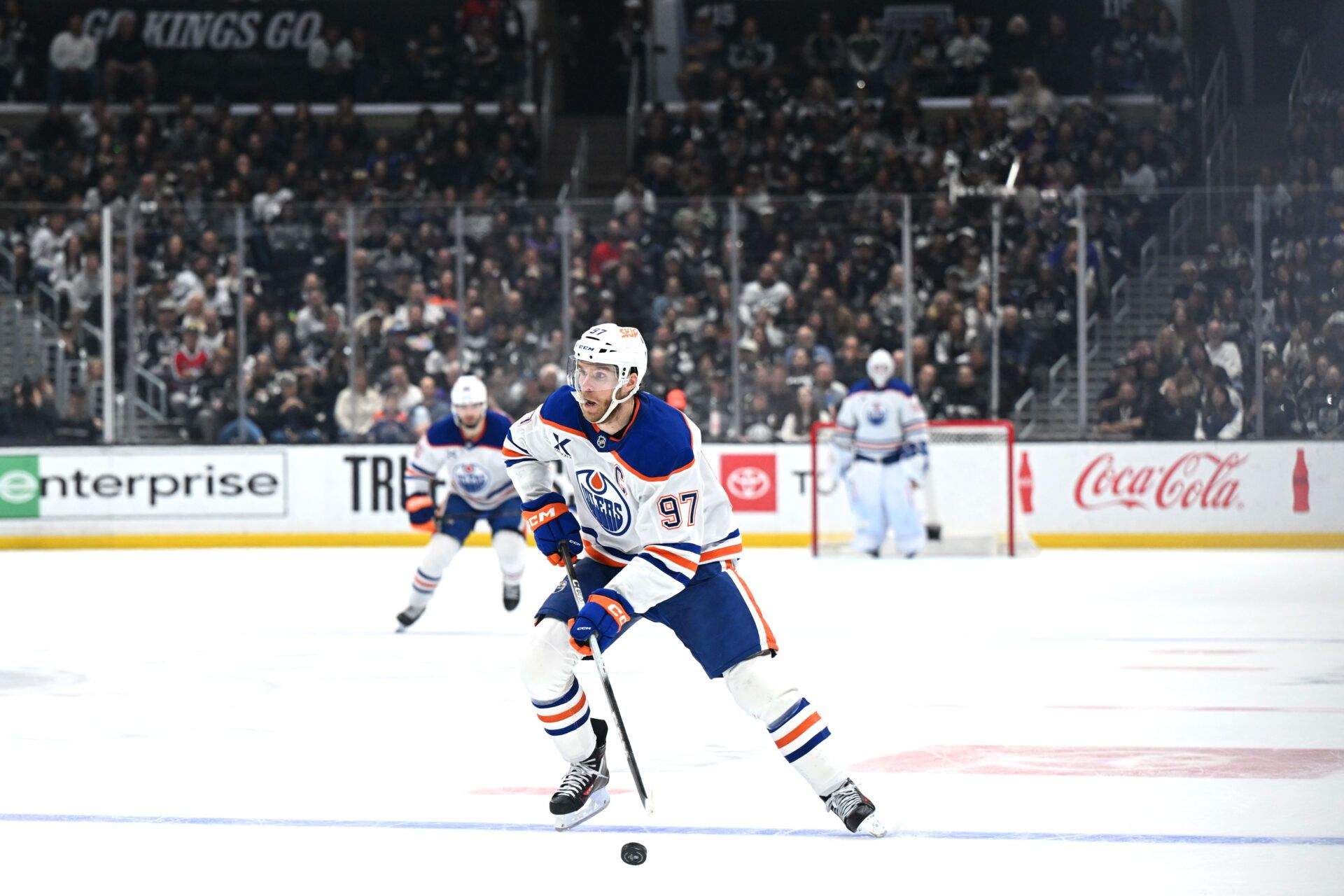
Game 5 now arrives with the Edmonton Oilers staring at a deficit that has turned an encouraging start into a fight to stay alive. Team captain Connor McDavid has four points through four games, yet the Anaheim Ducks have managed to limit his overall impact in the series.
Now, Oilers legend Mark Messier has pointed to key concerns for the group, and how those issues continue to show in Edmonton’s defensive play.
Mark Messier Breaks Down Oilers’ Defensive Issues and Ducks’ Advantage
The Oilers have given up 16 goals across the first three games and then dropped a tight overtime result in Game 4 in which they allowed four goals after the first period. Meanwhile, Anaheim continues to push the pace with a young, fast group producing with an average of five goals per game.
Oilers legend Messier offered a detailed assessment of why McDavid and the group are struggling against the Ducks, focusing on fatigue, defensive structure, and matchup dynamics. Speaking on Sportsnet 590 The FAN, Messier explained that long playoff runs take a toll that often shows up in moments like these, where execution drops at crucial times.
“I can’t speak to Connor because it’s so hard to just watch and see what’s going on and really understand everything, psychologically, mentally, physically, and all that kind of stuff. I do know that I can speak from my own experience,” Messier said.
He pointed to the mental and physical grind of playing deep into the postseason year after year, noting that “the mental grind and fatigue over that amount of hockey for those 10 years was enormous.” His point centered on how sustained contention can slowly impact performance, especially in tight playoff games.
From a technical standpoint, Edmonton’s issues have been most visible in their defensive play. Messier stressed that “great players don’t make great teams.” He emphasized that defensive execution remains the root issue, and Edmonton’s inability to manage those moments has led to repeated comebacks in this series.
“What makes great teams, are teams that are able to play the kind of hockey that wins in the playoffs. The kind of hockey that wins in the playoffs is you have to defend. If you can’t defend or figure out a way to defend, you’re going to have problems. You’re not going to score your mistakes. Right now, the Oilers are having a hard time defending,” Messier added.
If you look at Game 4, it felt like more of the same pattern playing out, where Edmonton built early control with goals from Kasperi Kapanen and Ryan Nugent-Hopkins and even regained the lead through Evan Bouchard, but never fully settled the game in their favor.
The Oilers struggled to handle sustained pressure in their own zone, allowing Anaheim to work their way back through Cutter Gauthier and Mikael Granlund before Jeffrey Viel tied it late, and the overtime loss came down to a lost face-off and a deflection that again exposed their ongoing coverage issues.
Messier also compared the current Ducks roster to the young Oilers teams of the early 1980s, describing Anaheim as “young, big, strong, could skate, and had talent.” He noted that the Ducks are playing with energy and structure, using their size and mobility on defense to limit sustained pressure while creating chances in transition.
Goaltending has not been the primary issue, as Tristan Jarry delivered a solid performance with 34 saves in his first playoff for the Oilers. Instead, the problem lies in the team’s inability to close games and control momentum swings, especially after building early leads.
With the Oilers trailing 3-1 in the series, they now need three straight wins to extend their season.
ALSO READ: Connor McDavid Puts Cards on the Table Over Tristan Jarry’s Performance in Oilers’ Game 4 Loss
