
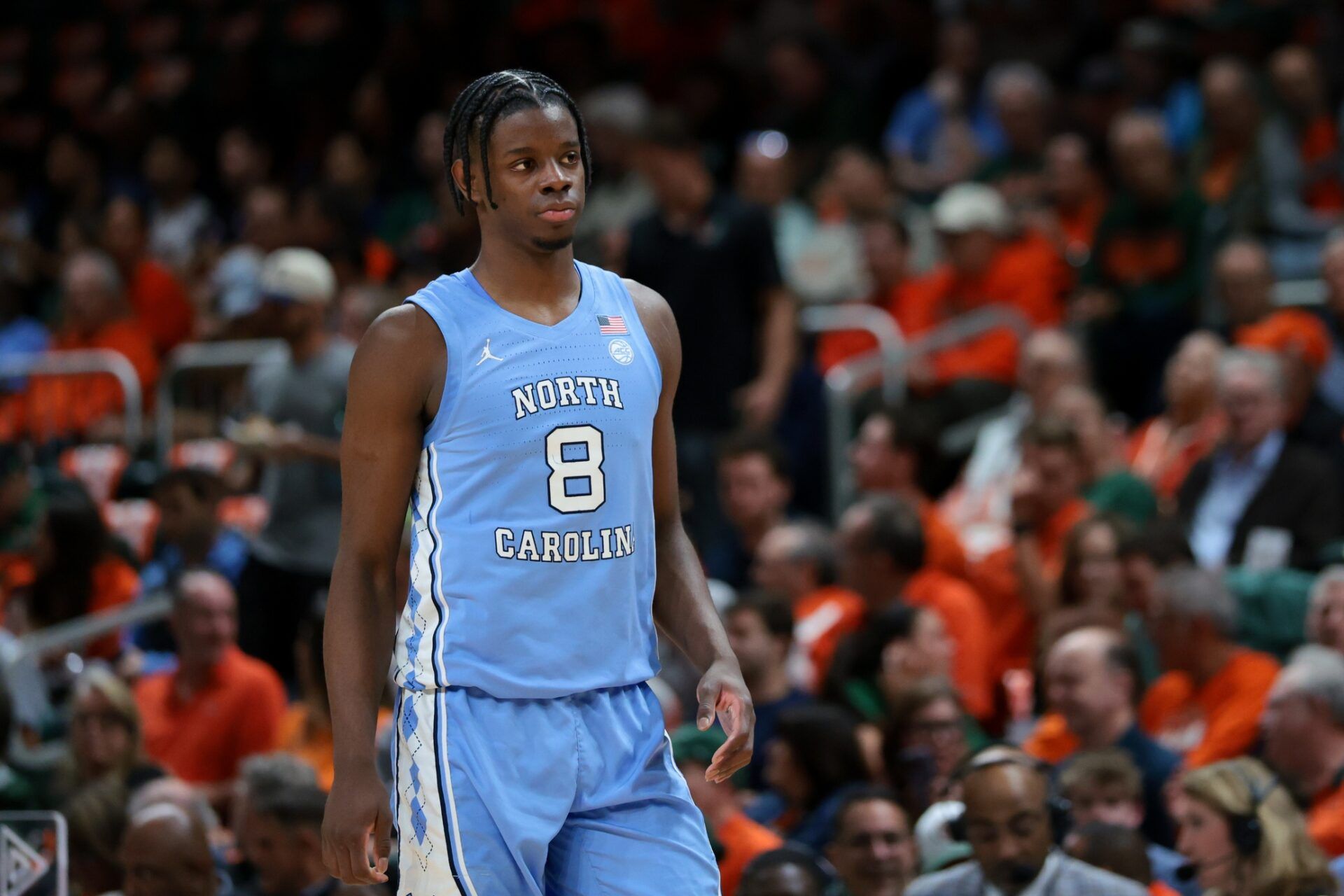
There are many questions surrounding the 2026 NBA Draft, but it is loaded with plenty of high-end talent. The stacked class is headlined by a projected top four of BYU forward AJ Dybantsa, Kansas wing Darryn Peterson, Duke power forward Cameron Boozer, and North Carolina big man Caleb Wilson.
It also features several talented guards, including Illinois’ Keaton Wagler, Arkansas’ Darius Acuff Jr., Louisville’s Mikel Brown Jr., Houston’s Kingston Flemings, and Arizona’s Brayden Burries. But how good could this class be from a historical perspective? One top prospect boldly predicted that this could go down in history as an all-time great draft.
UNC’s Caleb Wilson Calls 2026 Draft ‘Legendary’ and ‘One of the Best Classes Ever’
According to Wilson, the class of 2026 is going to be something special.
“Legendary,” Wilson said. “I feel like we have a lot great players and even players that aren’t considered top picks that will be really good in the NBA, just based on how the NBA is going. I’m excited to see how it turns out, but I feel like we’ll be one of the best, if not the best, draft classes ever.”
Caleb Wilson on how his draft class will be remembered:
“Legendary. I feel like will be one of the best, if not the best draft classes ever” https://t.co/I96qUrYlwE pic.twitter.com/pKb1mI7HKu
— Oh No He Didn’t (@ohnohedidnt24) June 22, 2026
Dybantsa agreed with Wilson.
“I think at least 10 of us will probably be still playing… let’s say 8 years down the road. I think that’s how deep we are but it could be more. I think it’s gonna be probably one of the most talked about draft classes since LeBron’s, I think,” he added.
SIMULATE THE NBA DRAFT: Try PFN’s Free NBA Mock Draft Simulator.
The 1984 NBA Draft class is often considered one of the best ever, with Michael Jordan (No. 3 overall), Hakeem Olajuwon (No. 1 overall), Charles Barkley (No. 5 overall), and John Stockton (No. 16) headlining the class.
The 1996 NBA Draft also stands out, with 10 All-Stars: Kobe Bryant (No. 13), Allen Iverson (No. 1), Steve Nash (No. 15), Ray Allen (No. 5), Stephon Marbury (No. 4), Peja Stojaković (No. 14), Shareef Abdur-Rahim (No. 3), Antoine Walker (No. 6), Jermaine O’Neal (No. 17), and Žydrūnas Ilgauskas (No. 20).
The hyped-up 2003 class featured No. 1 pick LeBron James. After Darko Miličić, the next few picks were Carmelo Anthony, Chris Bosh, and Dwyane Wade. This draft was deep, as it also produced several other All-Stars: Chris Kaman (6th), David West (18th), Josh Howard (29th), Mo Williams (47th), and Kyle Korver (51st).
It remains to be seen if the 2026 NBA Draft will be on this level, but it’s certainly being hyped up as one of the better classes in recent memory. Recently, ESPN analyst Jay Bilas had some high praise for this draft class in an exclusive interview with PFN.
“I think this is the deepest freshmen class of really high-level talent that I can remember, and I think it may be the best in my 30-plus years of dealing with this,” Bilas said. “That’s why you saw so many NBA teams wanting to get to the lottery because you’re going to get somebody really good even at No. 5, No. 6, No. 7, or No. 8, where in past years, maybe it wasn’t quite as good. That’s the beauty of this draft.”
The first round of the NBA Draft airs Tuesday, June 23, at 8 p.m. ET on ABC and ESPN, followed by the second round on Wednesday, June 24, at 8 p.m. ET on ESPN.
Who Are the Top Players in the 2026 NBA Draft?
Using the scouting reports from PFN’s NBA Mock Draft Simulator, let’s break down the top-four prospects in the 2026 NBA Draft.
AJ Dybantsa, Forward, BYU
Dybantsa entered BYU with as much hype as any freshman in recent memory, and he lived up to the buzz. At 6’9″ with a long frame, explosive burst, and the ability to score at all three levels, he embodies the modern two-way NBA wing. His handle and footwork allow him to create separation, and he can punish defenses both in transition and isolation. With his size, control, and polished skill, Dybantsa looked every bit like a future franchise centerpiece.
Dybantsa utilizes both strength and finesse, attacking the rim with power while displaying a smooth pull-up jumper from the midrange. He thrives in space and can facilitate when defenses collapse. Defensively, his quickness and motor make him capable of switching assignments and disrupting plays on both ends. To reach his full potential, he’ll need to find consistency from deep, but his physical tools, competitive fire, and upside make him a very safe prospect who also happens to have an extraordinary ceiling.
Darryn Peterson, Guard, Kansas
Standing at 6’6″ with long arms and a strong build, Peterson has the look of an NBA-ready wing and potential franchise cornerstone. Peterson is a true three-level scoring threat, using his smooth dribbling to create space, scoring well off the dribble, and hitting jump shots with confidence. Also, his balanced style and smart decisions make him effective as a playmaker as well.
Defensively, Peterson uses his length, quick instincts, and discipline to defend several positions and break up passes. He plays with maturity, stays under control, and understands team defense and rotations well. What really sets him apart is how he can take over a game without trying to do too much. Teams will want to look into his medicals after he dealt with cramping issues throughout his freshman year (including a scary full-body cramping incident).
Cameron Boozer, Forward, Duke
Boozer absolutely dominated throughout his freshman year at Duke, joining Cooper Flagg, Zion Williamson, Anthony Davis, and Kevin Durant as the fifth freshman to sweep the major Player of the Year awards. At 6’9″ with broad shoulders, excellent feel, and an advanced skill set, he combines old-school power with a modern forward’s versatility. The son of former NBA All-Star Carlos Boozer, Cameron scores efficiently from anywhere, whether facing up, backing down, or stretching the floor with his improving 3-point range. His poise and consistency stand out, giving him the look of a player ready to contribute immediately at the next level.
MORE: NBA Draft Rumors: Western Conference Contender ‘Discussing’ Trade With Mavericks To Move Into Top 10
Boozer thrives on fundamentals rather than flash, relying on touch, body control, and basketball IQ to dominate within the flow of a game. He’s comfortable facilitating from the post or attacking closeouts, reads defenses like a veteran, and controls the glass with positioning and strength. While not super bouncy, his mobility and anticipation make him a sturdy defender across multiple spots. The big question is how his game will translate to the pros. Some NBA executives believe he can be a team’s offensive engine, while others view him more as a star-caliber complementary piece.
Caleb Wilson, Forward, North Carolina
Wilson’s freshman year at North Carolina didn’t go according to plan due to injuries, but he has the size, mobility, and two-way potential that NBA scouts look for in modern forwards. Standing 6’10” with long strides and good bounce, he moves well for his height and makes an impact on both offense and defense. On defense, his quick feet and timing help him guard different positions, contest shots, and offer extra rim protection.
On offense, Wilson can drive to the basket, finish plays, and score from midrange, and he has shown flashes of improved 3-point shooting. Wilson is still developing, but he already shows the basics of a strong two-way NBA player. His jump shot is getting better, and he already fits well into team play as a passer and cutter. With his athletic ability and growing skills, Wilson could become a dynamic forward as he gets stronger and more confident.
To simulate the 2026 NBA Draft and read scouting reports for other prospects, check out PFN’s NBA Mock Draft Simulator.
