
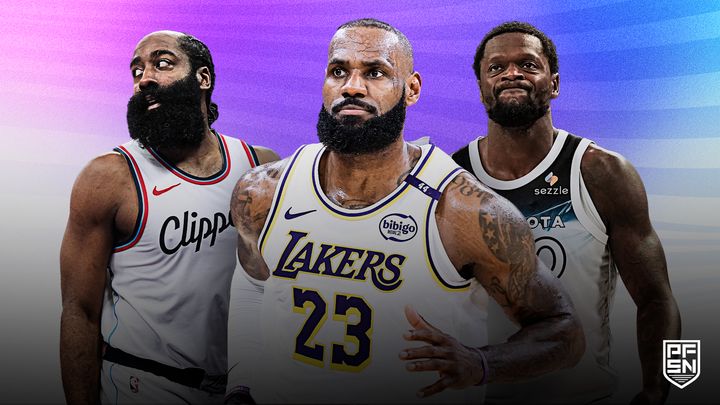
Player movement is the one constant in the NBA. While all eyes are on the playoffs, most of the league is looking ahead to the player acquisition part of the calendar.
Using PFSN’s 2025 NBA free agent rankings, let’s break down the best potential fit for each of these players. Note that not every player-team fit is currently possible based on the team’s current cap situation, so we’ve noted situations where a team would need to make another move prior to signing a given free agent.
1. LeBron James
Best Fits: Los Angeles Lakers, Retirement
LeBron James once again has a player option this summer, which he’ll likely opt out of to negotiate the potential final contract of his career. Even at age 40, though, the King has remained as efficient as ever. As a result, it’s fair to expect another two-year max extension with an opt-out after 2025-26, which has been the arrangement for each of his last three contracts.
Given the deep relationship between Klutch Sports Group and the Los Angeles Lakers, it would be fairly shocking to see a divorce between LeBron and the Lakers in the twilight of his career. It seems likely that James will want to run it back with Luka Dončić after the Lakers shockingly acquired the generational superstar during the season.
Frankly, it’s a massive long shot to think that any of the other 29 teams can provide LeBron with the right mix of salary, contention, and off-court accommodations that the Lakers can. As a result, if James isn’t playing for the Lakers next season, that likely means he’s decided that 22 seasons is enough and that he’d prefer to walk away while still playing at an All-NBA level. Given that the Lakers could be top-shelf title contenders with a strong offseason, however, that feels like a long shot as well.
2. James Harden
Best Fits: Los Angeles Clippers, Houston Rockets, Dallas Mavericks
James Harden returned to the All-Star game at age 35 this season, revitalizing a Los Angeles Clippers team that many expected to miss the Play-In after losing Paul George and missing Kawhi Leonard for the first two months of the season. Nevertheless, Harden has been durable and delivered an All-NBA caliber season, and keeping him is likely a priority for the Clippers this offseason.
Harden can opt out of his $36.3 million player option and likely earn a nice raise, possibly on a two-year deal with a player option after the first season. If he’s seeking upwards of $50 million a year, the Clippers are likely his only option, since most teams with the potential to carve out cap room either aren’t in contention or aren’t in the types of markets Harden would likely choose.
But what if Harden is willing to wait out salary moves from other franchises and potentially move on? His old team in Houston is in a different state than when he left five years ago, as the Rockets have become Western Conference contenders. Houston has a $44.9 million player option on point guard Fred VanVleet, who has been a strong veteran leader. However, if the Rockets get wind of Harden preferring a second stint in Houston (as some suspected when he wanted a trade out of Philadelphia), perhaps they could decline VanVleet’s option and pursue a reunion.
Another Texas team, the Dallas Mavericks, could loom as a dark horse. The Mavs won’t have Kyrie Irving for most or all of next season, leaving them in dire need of a point guard solution. The two famously played together in Brooklyn before Irving’s antics drove Harden to demand a trade, so it’s unclear if Harden would welcome an eventual reunion with his former Nets teammate. But the fit would be helpful for a Dallas team that ranked 27th in assist percentage this season.
3. Myles Turner
Best Fits: Indiana Pacers, New Orleans Pelicans, Chicago Bulls
The 29-year-old Myles Turner has been a very strong two-way center for years now. He shot a career-high 39.6% from three this season for the Indiana Pacers, while also averaging over five attempts per game from deep for the first time. Coupled with his strong rim protection, Turner will get a raise from the two-year, $40.9 million deal he signed on his last contract.
The Pacers would surely like to bring Turner back, as he’s been their most reliable big on a team that is in contention to win a playoff series or two every year in the East. Indiana was about 5.4 points per 100 possessions worse without Turner on the court this season, as they were slightly outscored when he sat on the bench. Also, they lack an obvious successor at center, which could motivate them to bring Turner back.
However, the Pacers have traditionally ducked the tax, so Turner could leave if the bidding war becomes too expensive. The New Orleans Pelicans have the third-most effective cap space at roughly $21.7 million, as they can free up a lot of space by renouncing Bruce Brown’s $34.6 million cap hold. The Pelicans had an abysmal season without a true veteran center, and Turner would add some much-needed balance to New Orleans’ lineup.
The Chicago Bulls could also use Turner’s rim protection. Chicago allowed the most made field goals in the restricted area per game this season, giving up nearly 40 points per game at the rim. The Bulls also shot threes 46% of the time, the third-highest rate behind the Boston Celtics and Golden State Warriors, so Turner’s stretch-big skill set on offense would fit in as well. To accommodate Turner, Chicago would likely need to find a suitor for Nikola Vucevic’s $21.5 million expiring deal.
4. Naz Reid
Best Fits: Minnesota Timberwolves, Brooklyn Nets, New Orleans Pelicans
Naz Reid has been an invaluable bench big for the Minnesota Timberwolves and could likely be a full-time starter next season if the Wolves move on from Julius Randle. Of course, Minnesota may try to duck the second apron next season, which could lead to some tough choices.
If Reid gets away, he could have a homecoming at a couple potential stops. The power forward grew up in Asbury Park, New Jersey, and went to high school at Roselle Catholic High School less than an hour from Brooklyn. The Nets have the most cap space of any team this offseason and will be a popular match for many of the top free agents on this list. The Nets also attempted the fifth-highest rate of three-pointers, so Reid’s skill set would fit with their team.
Reid also went to college at LSU, and the Pelicans loom as a team that should have plenty of cap room as well. New Orleans needs a little more size defensively than what Reid can provide, so he couldn’t be their only frontcourt addition. However, he would boost an offense that ranked 23rd in three-point field goal percentage this season.
5. Julius Randle
Best Fits: Brooklyn Nets, Miami Heat, Washington Wizards
Julius Randle was an inelegant fit during his first season with Minnesota. With the Timberwolves facing massive salary and roster penalties if they stay over the second apron for a second straight season, Randle is a good bet to move on in free agency for a team that can provide him more usage on offense.
The Nets and Washington Wizards are in the same bucket as bottom-10 offenses that just simply need offensive creation. Some of this depends on lottery luck. If either team wins the Cooper Flagg sweepstakes, for example, a similarly sized Randle would make for an awkward frontcourt pairing with Flagg. For now, though, those teams have the cap space and need for Randle’s offense.
The Miami Heat could also be an interesting fit, as Randle’s defensive limitations could be masked by playing in front of Bam Adebayo. After the Jimmy Butler trade, the Heat ranked 20th in offensive efficiency. Randle could help get them back into the top half of the NBA on the offensive end, though Pat Riley is surely on the hunt for bigger fish.
6. Kyrie Irving
Best Fits: Dallas Mavericks, Los Angeles Lakers
Irving is a very difficult player to project for the upcoming offseason. He’s certainly earned a lucrative long-term contract based solely on his play, particularly in the wake of the Dončić trade. However, he’ll miss most (if not all) of next season after his March torn ACL, and may not return until he’s nearly 35 years old.
Nico Harrison bet his job and legacy on Irving being a strong fit with Anthony Davis and a stacked frontcourt, so the Dallas Mavericks seem likely to retain Irving if he opts out. Irving could also choose to exercise his $40 million player option instead of testing the open market, which would buy him time to rehab while Dallas ponders whether it wants to pursue an Irving-Davis partnership in 2026-27.
If he does want to leave, the Lakers are one of the few franchises that would likely appeal more to Irving. He’s obviously demonstrated strong on-court chemistry with both James and Dončić, and he still appears to have a close relationship with both superstars as well. It’s unclear if the Lakers would be willing to make such a drastic move with no immediate payoff, as James would likely need to take a discount on his next contract and Dorian Finney-Smith would probably be a goner.
7. Malik Beasley
Best Fits: Detroit Pistons, Golden State Warriors, Houston Rockets
One of the surprising breakouts of the 2024-25 season, Malik Beasley could be tough for the Detroit Pistons to afford. After signing him to a cheap one-year, $6 million deal last offseason, the Pistons are limited in what they can offer him since they don’t have his Bird rights. That means Detroit will need to clear out cap space if Beasley receives a lucrative long-term deal, which he surely will after his strong season.
The Rockets are in a decent spot to make a free-agent splash if a blockbuster trade doesn’t materialize. Houston is projected to be slightly in the luxury tax, but can get well under if they decline VanVleet’s $44.9 million player option and get him at a much lower deal. Houston could use a player like Beasley after ranking bottom-10 in both three-point field goal percentage and bench scoring this season.
The Warriors are obviously famous for bombing away from deep, with only the Celtics attempting a higher percentage of shots from three this year. Beasley would represent an upgrade over Buddy Hield, though the Warriors would have to find a taker for the final three years and $29 million of Hield’s contract (which includes a player option in 2027-28).
8. Josh Giddey
Best Fits: Chicago Bulls, Dallas Mavericks, Sacramento Kings
Josh Giddey’s breakout end to the season could convince a team to pry him away from Chicago. The Bulls will likely make every effort to retain Giddey, and he’s a strong favorite to remain in place considering he’s a restricted free agent. Therefore, Chicago can match any offer for Giddey, tying up a team’s cap space while it awaits a decision.
The Mavericks could use Giddey’s playmaking, and their now-infamous emphasis on defense and size means that Giddey could fit their organizational philosophy. Dallas will have to acquire a point guard somehow while it waits for Irving to recover from his torn ACL. A short-term veteran is more likely, but adding youth to a very veteran-heavy team could be the smarter path (especially if Irving surprisingly leaves).
The Sacramento Kings are another sleeper possibility with a hole at point guard in the wake of the De’Aaron Fox trade. The Kings ranked 26th in assist rate after dealing Fox to the San Antonio Spurs, while also ranking 25th in potential assists per game. Adding a playmaker like Giddey could add some sorely needed ball movement, though the Kings might need to find a taker for Zach LaVine or DeMar DeRozan first.
9. Fred VanVleet
Best Fits: Houston Rockets, Toronto Raptors, Portland Trail Blazers
VanVleet has played a critical role as a steady veteran floor general for a young Rockets team over the last two years. Houston will surely negotiate a lower long-term deal instead of exercising his $44.9 million club option for next season. However, the Rockets may also need that room for a bigger splash, making VanVleet no lock to return.
If he does leave Houston, a similar role as a veteran caretaker on a young rebuilding team is probably his best fit, as his lack of size and a reliable jump shot make him a tough fit on championship contenders. His former team, the Toronto Raptors, could use VanVleet’s skill set. The Raptors ranked bottom-10 in turnover rate and points per game allowed off turnovers. VanVleet would give them more ball-handling beyond Immanuel Quickley and Scottie Barnes.
In addition, while Scoot Henderson has enjoyed a better second season, he and the rest of the young Portland Trail Blazers could use more organization on offense in general. Portland had the second-highest turnover rate this season, behind only the Utah Jazz, and had the second-worst assist-to-turnover ratio as well.
10. Jonathan Kuminga
Best Fits: Golden State Warriors, Brooklyn Nets, Miami Heat
The Warriors would surely love to keep Jonathan Kuminga, their most promising lottery pick from the last five years. Kuminga is only a restricted free agent, so Golden State is in a good spot to keep him around (especially since he holds plenty of trade value if the Warriors need to make another splash).
The Nets are the only team with enough cap space right now to overwhelm a restricted free agent with an offer sheet. Brooklyn could use Kuminga’s defense and athleticism, and the 22-year-old would also fit in with the team’s timeline. The Nets ranked 28th in paint points per game this season and 26th in field goal percentage at the rim.
The Heat have typically gone for older stars, but perhaps Miami could seek to retool around a younger core if they come up empty in the trade market. The Heat ranked 27th in points per game in the restricted area, where Kuminga’s athleticism and finishing ability could help.
11. Brook Lopez
Best Fits: Milwaukee Bucks, Los Angeles Lakers, Los Angeles Clippers
The Milwaukee Bucks will surely try to keep Brook Lopez, even at 37 years old. Lopez has been extremely durable in three years since a major back injury cost him most of the 2021-22 season, and he provides a steady diet of three-point shooting and rim protection.
Of course, that skill set also makes Lopez appealing to other contenders. The Lakers badly need more size, with Jaxson Hayes serving as the team’s only true center. Although the Lakers have exceeded expectations on defense since swapping Anthony Davis for Luka, they still only ranked 25th in field goal percentage allowed at the rim this season.
The Los Angeles Clippers were worse in that category, ranking 28th ahead of only the Wizards and Jazz. Despite Ivica Zubac’s best efforts, the Clippers’ lack of size made for a tough battle against teams capable of attacking the rim. Lopez would fix that weakness while also accentuating an offense that finished seventh in three-point field goal percentage.
12. John Collins
Best Fits: Utah Jazz, Charlotte Hornets, San Antonio Spurs
John Collins showed promise in a higher usage role with the Jazz this season. Although he was limited to a career-low 40 games, he averaged 19.0 points per game on 52.7% shooting, including just a hair under 40% from three-point land. As such, it wouldn’t be surprising to see the Jazz prioritize Collins as part of their rebuild.
His fit on contending teams could be a little dicier given his lack of defensive value. The Charlotte Hornets have room to give Collins plenty of touches and could use his offense, given that only the Wizards had a worse offensive rating this season. Their frontcourt depth could also take a hit if the team moves on from Mark Williams after nearly trading him to the Lakers at the deadline.
The Spurs could also cover up some of Collins’ defensive deficiencies with the best defender in the game. Collins would make for a very strong scoring frontcourt with Victor Wembanyama and give the Spurs a dangerous offensive trio of Collins, Wemby, and De’Aaron Fox.
13. Quentin Grimes
Best Fits: Houston Rockets, Orlando Magic, Detroit Pistons
Quentin Grimes was a breakout star after his midseason trade to the 76ers. But with Philly presumably retooling around their Big Three and promising rookie Jared McCain, there might not be room for Grimes to occupy the kind of role he enjoyed at the end of the season.
As a certified 3-and-D weapon, Grimes should fit in nicely with just about any contender, especially those who can offer the non-taxpayer midlevel (which projects at a little over $14 million). The Rockets ranked 21st in three-point field goal percentage, and adding Grimes wouldn’t compromise Ime Udoka’s defense-first culture.
The Orlando Magic and Detroit Pistons are both ascending Eastern Conference playoff squads who could use Grimes as well. The Magic were the worst three-point shooting team in the last nine seasons and badly need to add multiple shooters this offseason. The Pistons would likely prefer to retain Beasley, but could turn to Grimes (who briefly played for the team in 2023-24) as a solid fallback plan if Beasley gets too pricey.
14. Nickeil Alexander-Walker
Best Fits: Minnesota Timberwolves, Atlanta Hawks, Orlando Magic
Much of what was said about Grimes applies to Nickeil Alexander-Walker as well. The only difference is that Alexander-Walker is more well-defined in a lower usage offensive role, making him a better fit as a supporting player off the bench.
The Timberwolves will likely try to keep the 26-year-old wing around, though Reid might be a higher priority. If tax considerations force Minnesota to move on, the Atlanta Hawks are an interesting possibility. The Hawks lost a similar player when they traded De’Andre Hunter away, and the player they acquired in that deal (Caris LeVert) could leave as an unrestricted free agent.
For similar reasons to why they might want Grimes, the Magic could use Alexander-Walker as well. He’s shot at least 38% from three each of the last three seasons while playing in some very different situations between the Pelicans, Jazz, and Timberwolves. That makes it likelier he could continue to thrive in Orlando in the way that Kentavious Caldwell-Pope hasn’t after being removed from the Denver Nuggets infrastructure.
15. Chris Paul
Best Fits: Los Angeles Lakers, Memphis Grizzlies, Dallas Mavericks
While Chris Paul turns 40 in May, he is still a steady leader for a young Spurs team. Paul has remained durable (playing every game this season) and averaged over seven assists per game, helping San Antonio to a top-five mark in assist-to-turnover ratio.
As CP3 closes out his career, it might make more sense for him to chase that elusive championship ring. The Lakers have loomed as a logical fit for years given his friendship with LeBron James. While James and Dončić will handle most of the initiation, it’s telling that the Lakers ranked 24th in assist-to-turnover ratio after Dončić’s debut. Paul would help stabilize the offense as a secondary ballhandler in a smaller role.
The Grizzlies could use Paul in a similar role behind Ja Morant, whose unreliable health means that Memphis needs a reliable backup point guard. The Grizzlies have missed Tyus Jones since his departure, and Memphis ranked just 17th in assist-to-turnover ratio this year. For similar reasons as stated above, the Mavericks could be in on any veteran free agent point guard while Irving is on the mend from his torn ACL.
16. Santi Aldama
Best Fits: Memphis Grizzlies, New Orleans Pelicans, Atlanta Hawks
Santi Aldama is a restricted free agent who is a strong fit with the Memphis Grizzlies. Aldama gives Memphis a different look than Zach Edey, providing more spacing and mobility on defense. With the Grizzlies trading away Marcus Smart to free up cap space, it feels unlikely that Memphis would allow Aldama to get away.
The only teams that could potentially pry Aldama away would have to deliver a massive offer sheet that the Grizzlies can’t match. The Pelicans should potentially have the cap space to execute this if they want, and they have a glaring need at center. New Orleans ranked 29th in defensive efficiency, ahead of only the Jazz, and could pursue an upgrade in frontcourt defense.
The Hawks aren’t as clear-cut in terms of cap room, but they could open nearly $82 million in room by renouncing their rights to Clint Capela, Caris LeVert, and Larry Nance Jr. That would put Atlanta in play for free agency, with Aldama serving as a nice complement to Onyeka Okongwu in the frontcourt if they choose to go younger.
17. Al Horford
Best Fits: Boston Celtics, Oklahoma City Thunder
Al Horford has played less than half his NBA career with the Celtics, but he feels like a lifelong Bostonian with how he’s embraced the organization and city. Although the Celtics are facing some difficult cap choices this offseason as they potentially duck the second apron, Boston has Horford’s Bird rights and can keep him if he doesn’t retire.
However, if the Celtics want to get under the second apron, Horford would likely need to take a discount on his two-year, $19.5 million deal he last signed. Even trading Jrue Holiday wouldn’t give Boston enough room to sign Horford to a similar deal without dealing away another member of their rotation (most likely Sam Hauser).
If Horford doesn’t want to take a pay cut, the team he played for before his second Celtics stint would make sense as a suitor. The Oklahoma City Thunder are in a far different spot than when Horford had a half-season cameo with the team in 2020-21, but they would happily take his spacing, defensive versatility, and veteran leadership. If OKC can stay out of the tax (about $10 million under right now), they’d have access to the non-taxpayer mid-level exception and could pay Horford over $14 million for one year.
18. Dorian Finney-Smith
Best Fits: Los Angeles Lakers, Houston Rockets, Philadelphia 76ers
The prototypical 3-and-D wing, Dorian Finney-Smith will have plenty of suitors after a nice run with the Lakers following his trade from Brooklyn. Finney-Smith is older than some of the 3-and-D players ahead of him on this list, but he has a longer proven track record of fitting well on contending teams.
The Lakers could prioritize Finney-Smith if he opts out of his $15.4 million player option to secure one more strong multi-year deal. Houston also needs more three-and-D help, and Finney-Smith would fit in well with the Rockets’ defense-first identity.
The 76ers are an interesting candidate, depending on how they view their own free agents. Grimes might be seeking a larger role, while Kelly Oubre Jr. doesn’t provide the same level of spacing as Finney-Smith. As a result, he could be a solid addition if the Sixers can stay below the luxury tax to offer him the more lucrative mid-level exception.
19. Ty Jerome
Best Fits: Cleveland Cavaliers, Minnesota Timberwolves, Detroit Pistons
A breakout star off the bench for the Cleveland Cavaliers, Ty Jerome could be tough to keep for the Cavs this offseason. Jerome is due a huge raise from his $2.5 million salary this year, and Cleveland won’t have full Bird rights on him. The most they’ll be able to offer him in his first season is 105% of the league average salary, which will be somewhere around $11-12 million.
While the Cavs can escalate Jerome’s salary in future seasons, that could be a tough needle to thread with Evan Mobley and Darius Garland potentially getting hefty extensions. If he does leave, the Pistons will be a logical suitor. Detroit could lose one of its primary ballhandlers in Dennis Schroder (who is also a free agent), but Jerome would be a younger replacement who fits in better with the rest of the roster’s timeline.
A sneaky candidate to snag Jerome could be the Timberwolves. This would obviously require some major personnel shuffling elsewhere, with two of Randle, Reid, and Alexander-Walker likely saying goodbye.
However, the Wolves suffered a dramatic drop in playmaking when Mike Conley Jr. sat this season, with their assist rate falling from 66% with Conley on the court (would rank 10th) to 61% with Conley on the bench (would rank 21st). Adding another point guard like Jerome would give Minnesota a successor to the aging Conley and goose the offense in the short term.
20. Cam Thomas
Best Fits: Brooklyn Nets, Utah Jazz, Atlanta Hawks
As a guard whose only real ability is scoring, Cam Thomas is a tricky fit on most teams. He’ll likely end up signing with a rebuilding team without much offensive infrastructure since contenders typically already have players their offense is built around. Perhaps Thomas eventually assimilates to a smaller role, but that doesn’t feel likely just yet.
If Brooklyn hasn’t tired of the Thomas experience, the Nets could still use him after ranking 28th in offensive efficiency without him for most of the season. Similarly, the Jazz were 24th in offensive efficiency and one of the worst isolation teams in the NBA. If Collins leaves, Utah will have a big void to fill on offense.
An interesting candidate for Thomas’ services could be the Hawks. Atlanta was the worst isolation offense this year, ranking last in points per possession off isos. The Hawks also essentially stopped trying to isolate, attempting the fewest shots per game off isos. Thomas would bring a different skill set in that respect, potentially replacing LeVert’s bench role if the veteran leaves in free agency.
21. Kelly Oubre Jr.
Best Fits: Charlotte Hornets, Sacramento Kings, San Antonio Spurs
If the 76ers prioritize other free agents, Oubre could return to the team he played for before signing with Philadelphia. Oubre had a couple of productive offensive seasons in Charlotte, averaging a career-high 20.3 points per game with the team in 2022-23. He missed time that season with a torn ligament in his left hand, but a reunion makes sense with the Hornets in need of offensive creation beyond LaMelo Ball.
Similarly, Oubre’s defensive value could help the Kings and Spurs. Sacramento again recorded a top-10 offensive efficiency that was offset by a bottom-10 defense. Oubre would give the Kings a different look compared to LaVine and DeRozan and could pair well with either one.
The Spurs had the sixth-worst defensive efficiency this year, and it’s not all because of Wembanyama’s season-ending blood clot. Prior to Wemby’s departure, the Spurs were still only 19th in defensive efficiency. Adding more wing defense to alleviate pressure on their franchise center would give San Antonio a more well-rounded roster.
22. Clint Capela
Best Fits: Indiana Pacers, Philadelphia 76ers, Los Angeles Lakers
Assuming he can stay healthy, Clint Capela still brings value as a rebounder. The Hawks are likely moving on from the soon-to-be 31-year-old, as Onyeka Okongwu has shown he’s ready for the full-time center role.
The Pacers ranked 28th in rebounding rate this season, the worst of any playoff team. For all his strengths, Myles Turner isn’t a great rebounder for a seven-footer. That would make Capela a solid complement, either off the bench or as part of double-big lineups if the Pacers retain Turner.
The 76ers were the worst rebounding team in the league, driven largely by Joel Embiid’s absence. It’s foolish to count on Embiid’s availability now, and Philly has done an inadequate job of filling the backup center role for years. If Capela is interested in a larger workload, it’s possible he would be the Sixers’ primary starting center next season.
Finally, the Lakers are going to be connected with just about every starting-caliber center. Capela isn’t quite in his athletic prime anymore, but Dončić has fared well with lob threats throughout his career. Los Angeles also ranked 21st in rebounding rate this season, a weakness Capela could help address.
23. Caris LeVert
Best Fits: Atlanta Hawks, Los Angeles Clippers, Milwaukee Bucks
LeVert saw a spike in productivity after being traded from the Cavaliers to the Hawks midseason. LeVert averaged nearly 15 points per game on over 47% shooting with the Hawks, including just under 60% from two-point range. Both shooting percentages would have been career-highs over the course of a full season.
Atlanta could opt to keep LeVert as the team’s top bench scorer, but he’ll have other suitors given his track record. The Clippers ranked 24th in bench scoring this season and could use LeVert to take pressure off Leonard, Harden, and Norman Powell. All three would be ahead in the pecking order, but are also over 30 and can’t necessarily carry the scoring burden for the whole regular season.
The Bucks are also roughly $23 million under the tax, which could give them access to the non-taxpayer mid-level of roughly $14 million. That would be a slight pay cut from LeVert’s last contract (two years, $32 million), but also allow him to play for a contending team with a big void in offensive creation beyond Giannis Antetokounmpo and Damian Lillard.
24. Russell Westbrook
Best Fits: Denver Nuggets, Sacramento Kings, Phoenix Suns
The former NBA MVP has played for six teams in the last six years, making it tough to identify a fit he hasn’t already tried. Russell Westbrook briefly found a niche as an energy bench player for the Nuggets this season, but has an unclear future after ownership fired both head coach Michael Malone and GM Calvin Booth over disagreements about playing the team’s younger players.
The team could certainly be justified in keeping Westbrook, as he likely won’t cost much more than the one-year minimum he signed on for. If he departs, Sacramento could be a spot for him to occupy a similar role. The Kings had the third-lowest scoring bench this season and have a void at point guard with Fox gone.
The Phoenix Suns have largely been absent from this list, as they have an extremely uncertain offseason after firing head coach Mike Budenholzer and flopping with the most expensive payroll in 2024-25. Regardless of how the Suns retool, though, they can always sign minimum-contract players, and they could be in need of a point guard if Tyus Jones leaves. If Kevin Durant gets traded as expected, Westbrook could replace his old Thunder teammate and provide some offensive initiation for a thin squad.
25. Tyus Jones
Best Fits: Denver Nuggets, Boston Celtics, Cleveland Cavaliers
After playing on the minimum in Phoenix, Tyus Jones is likely looking at a similar deal with another contender in need of a reliable backup point guard. The Nuggets could fit that criteria if they let Westbrook walk. While very different stylistically from Westbrook, Jones’ reliability as an initiator might help give Denver a higher floor in the troublesome minutes with Nikola Jokic on the bench.
The Celtics are above the second apron, but could always sign Jones on a minimum deal. However, should Boston trade Jrue Holiday to slip below that second apron, they could need another guard if Payton Pritchard gets elevated to the starting lineup. Jones would be more of a target on defense than the Celtics prefer, but his 37.7% career three-point percentage would definitely play in their lineup.
Finally, the Cavaliers are as deep as any team in the East, but could need a fallback plan if Jerome leaves. Jones would cost considerably less than Jerome and will still be only 29 years old next season, fitting in with the rest of the team’s young core. Cleveland projects to be over the second apron next year, though, which could limit them to a minimum offer for Jones.
26. Guerschon Yabusele
Best Fits: Philadelphia 76ers, Washington Wizards, Orlando Magic
The 76ers may try to keep Guerschon Yabusele after the French power forward impressed in his return to the NBA. While he’s been forced into a bigger role than expected, Yabusele has proven to be an efficient scorer who 38% from 3-point range.
If he lands a more lucrative multi-year deal, the Wizards could look to pair him with No. 2 overall pick and fellow countryman Alex Sarr. Sarr’s length and defensive versatility would pair quite well with Yabusele, who is a little small to play center but is an impact offensive player. If Washington ends up drafting one of the top guards like Dylan Harper or V.J. Edgecombe, Yabusele could be a nice addition.
As for Orlando, Yabusele might feel a bit redundant in terms of size. The Magic have lots of wings and bigs in the range of 6’8” to 6’10”, but Yabusele comes with a very different skillset from most of those defense-first players who have trouble shooting threes. He might occupy a smaller role with Orlando than he did this season, but Yabusele would give the Magic a different look off the bench.
27. Amir Coffey
Best Fits: Los Angeles Clippers, Phoenix Suns, Milwaukee Bucks
The Clippers’ depth has shined this year, with Amir Coffey making himself some money after shooting 41% from 3. He’s less proven than the other 3-and-D free agents, as he’s yet to average 25 minutes per game in a season, but he will only be 28 years old in June and has excellent defensive versatility.
The Suns and Bucks were both reportedly suitors at the trade deadline. Milwaukee has an easier avenue towards offering Coffey more money with the non-taxpayer mid-level exception. The Bucks could use better wing depth with Taurean Prince hitting free agency and Pat Connaughton disappointing in a lost season.
Phoenix will need to at least duck under the second apron, at which point they’d have access to the taxpayer mid-level exception. That’s less than what the Bucks could offer with the non-taxpayer exception, estimated at $5.7 million. Thus, Coffey would need to have a disappointing market for the Suns to really be in play.
28. Bobby Portis
Best Fits: Milwaukee Bucks, New York Knicks, Philadelphia 76ers
Bobby Portis has been an efficient bench scorer with the Bucks, meaning Milwaukee will likely prioritize re-signing him if he opts out of his $13.4 million player option. The Bucks missed his offensive usage off the bench during his 25-game suspension, and there’s no guarantee a replacement would fit as well.
The New York Knicks don’t have much in the way of wiggle room, as they are just $8 million from the second apron. If Portis is willing to take a discount to play on a higher-level contender, the Knicks could potentially squeeze Portis in on the taxpayer mid-level exception without going into the second apron. That would give New York some much-needed bench scoring, perhaps encouraging Tom Thibodeau to break his habit of playing his starters huge minutes.
The 76ers aren’t the most obvious fit right now, but could turn to Portis if Yabusele leaves for a more lucrative multi-year deal. At that point, Philadelphia would need frontcourt depth. Portis has a longer track record than Yabusele as a proven NBA rotation player, though he’s also a year older.
29. Khris Middleton
Best Fits: Denver Nuggets, Detroit Pistons, Los Angeles Lakers
If Khris Middleton does reach free agency, it’ll be an indication that he’s willing to take a smaller deal to play for a contender. Middleton won’t make more than his $34 million player option with Washington, but he also may not want to play out his final seasons on a lottery team.
Operating under that assumption, the Nuggets might be the best fit even if they only offer the minimum. Denver’s wing depth beyond Michael Porter Jr. and Christian Braun has been extremely shaky.
Middleton’s original team was the Pistons, which many forget after his 12 years in Milwaukee. Detroit could lose Tim Hardaway Jr. in free agency and may want a similar veteran presence to help raise the floor of this young playoff team.
The Lakers would likely prefer higher-upside options given Middleton’s declining athleticism. However, if Finney-Smith gets away in free agency, perhaps Middleton could thrive in a smaller role, like he did when he shot over 40% from three while mostly coming off the bench for Milwaukee to start this season.
30. Jaxson Hayes
Best Fits: Los Angeles Lakers, Atlanta Hawks, New Orleans Pelicans
Jaxson Hayes turns only 25 years old in May, and the Lakers will hold his Bird rights. Los Angeles will seek an upgrade at starting center, but Hayes is a young option with upside who shouldn’t be particularly expensive. Having him return in a bench role would allow Hayes to develop into a potential future starter or trade chip.
If he does depart, the Hawks could plug him in as a backup center with Capela likely out the door. Hayes is an inferior rebounder to Capela, but is younger with far more athleticism and more of a lob threat at this stage.
Hayes would also make sense on his original team in New Orleans. Although Yves Missi has demonstrated some promise, the Pelicans need more playable options at center. New Orleans may not want to block Missi with another young big in need of minutes, but Hayes is further along and more capable of soaking up bigger minutes next season.
(Unless otherwise stated, salary data is courtesy Spotrac and all stats are via NBA.com).