
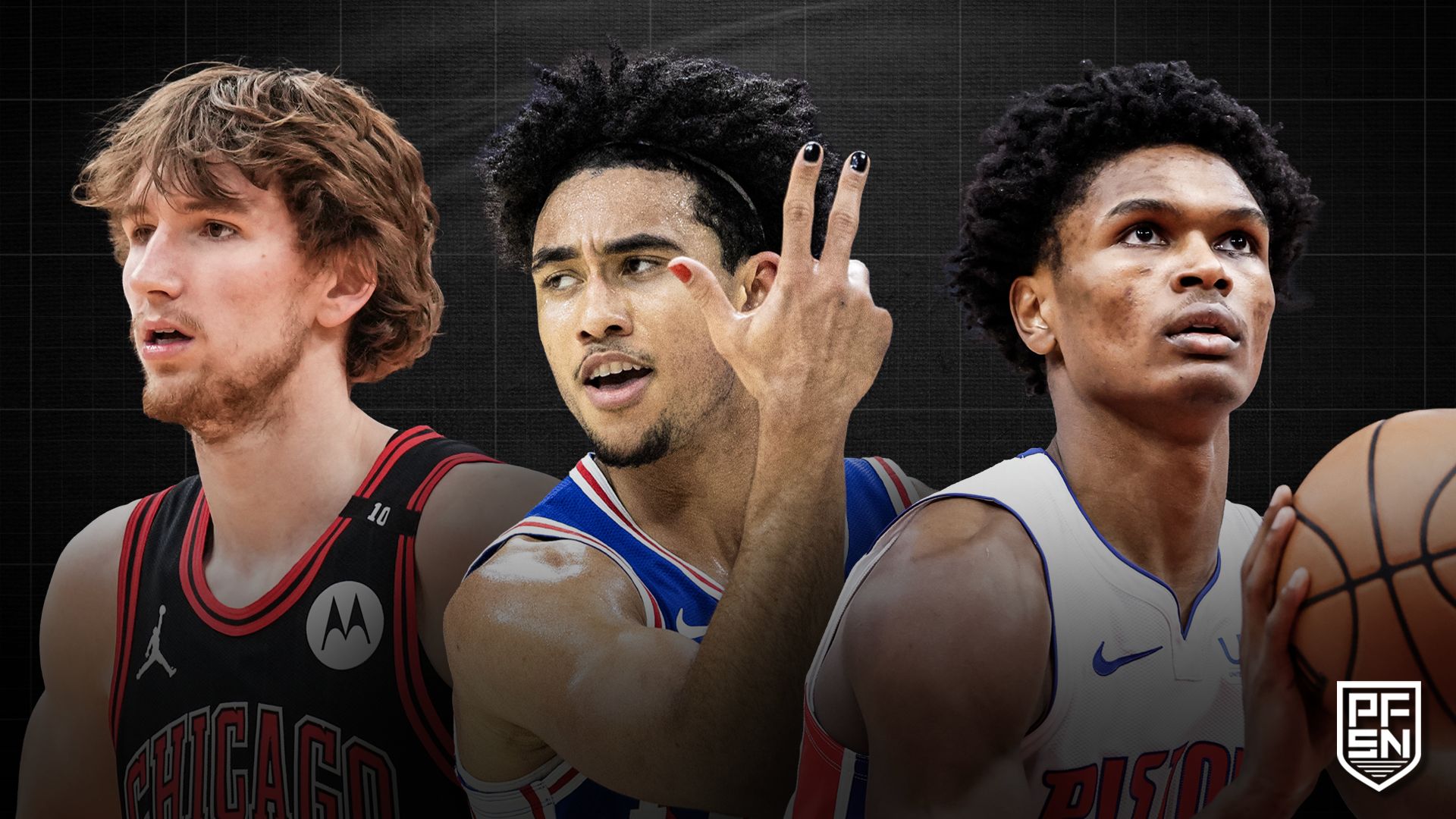
The NBA’s superstars will continue to dominate the headlines, but each year, we see young talents make a leap and begin to deliver on their flashes of promise.
With an entertaining offseason and the Summer League in full swing, the anticipation is building for the 2025-26 season. Across the league, each team harbors a player ready to transition from contributor to core piece.
Here is one breakout candidate from all 30 NBA teams who could turn heads in 2025.
Atlanta Hawks
Zaccharie Risacher
The No. 1 overall pick in the 2024 NBA Draft, Zaccharie Risacher, is a prime candidate to make a leap next season. He averaged 12.6 points and 3.6 rebounds across 75 games as a rookie with the Atlanta Hawks, per Basketball Reference. His efficiency improved as the season continued, highlighted by a 64.4% true shooting percentage in March.
Risacher also shot 45.0% from three on 5.0 attempts per game over his last 24 games, hinting at elite shooting potential. He also showed flashes on the defensive end, averaging 1.3 steals per 100 possessions.
He needs to get strong and improve his ball-handling, but his ability to stretch defenses and contribute on both ends positions him for a significant second-year breakout.
Sam Hauser
Boston Celtics
Sam Hauser has emerged as a key contributor in the Boston Celtics’ rotation. Still, he could be in for a larger role with Jayson Tatum expected to miss a large portion of the 2025 season due to an Achilles injury.
Hauser averaged 21.7 minutes per game last season, so it’s reasonable to expect an uptick next season. He shot 41.6% from three on 5.6 attempts per game. His 62.7% effective field goal percentage reflects his efficiency as a shooter, and his ability to space the floor and capitalize on open looks makes him a valuable role player.
Hauser’s 4.4 win shares last season suggest he can hold his own defensively and is more of an asset than a liability on both ends of the floor.
Brooklyn Nets
Noah Clowney
The Brooklyn Nets aren’t expected to be competitive in 2025, as questions remain about the franchise’s direction. However, Noah Clowney’s continued development could be a bright spot. He saw increased playing time in Year 2, jumping from 16.1 minutes per game to 22.7 in 2024.
The Alabama product averaged 9.1 points and 3.9 rebounds across 46 games. However, his efficiency numbers dipped, as he shot just 35.8% from the field and 33.3% from deep. Playing in an inefficient offense didn’t help his cause. Still, he has flashed some floor-spacing ability.
Clowney’s versatility as a mobile, lengthy big man positions him ideally for the modern NBA’s switch-heavy schemes. With the Nets prioritizing youth, Clowney’s role should continue to expand.
Charlotte Hornets
Kon Knueppel
The Charlotte Hornets entered the 2025 NBA Draft with one of the league’s weakest rosters and desperately needed to add talent. Duke’s Kon Knueppel wasn’t the flashiest player on the board, but Charlotte bet on shooting, feel, and fit.
Kon Knueppel vs the Mavs in NBA SL..
16 PTS (5-10 FG, 3-4 3PT)
10 REBS
4 AST
1 STL
1 BLKWe like what the Hornets did here? pic.twitter.com/gvaoLx0Ivk
— Frankie Vision (@Frankie_Vision) July 15, 2025
The 6’7” wing was one of the most polished scorers in the draft, boasting elite shooting splits, a high basketball IQ, and physical strength. On a team desperate for shooting structure around LaMelo Ball and Brandon Miller, Knueppel’s presence should help space the floor immediately.
Knueppel’s performance during the Summer League, including a double-double on 60% shooting from deep, has already opened eyes.
Chicago Bulls
Matas Buzelis
Matas Buzelis showed significant signs of growth and promise during his rookie campaign. The Chicago Bulls’ 2024 first-round pick averaged 8.6 points, 3.5 rebounds, and 1.0 assists in only 18.9 minutes per game, shooting a solid 45.4 percent from the field and 36.1 percent from 3-point range.
Those numbers scale to 16.4 points and 6.6 rebounds per 36 minutes, revealing an ability to be a high-efficiency contributor if given expanded opportunity. Buzelis also showed flashes of a player who can be disruptive on the defensive end, with a 4.3% block rate and 1.4 defensive win shares.
With more minutes and a higher usage rate, Buzelis could stamp himself as a cornerstone of Chicago’s young core.
Cleveland Cavaliers
Craig Porter Jr.
Craig Porter Jr. is heading into his third season with the Cleveland Cavaliers, and up to this point, he’s seen limited action, with 11.4 minutes per game through two seasons. However, his per-36-minute numbers show impressive versatility, averaging 14.7 points, 5.9 assists, 5.5 rebounds, 1.2 steals, and 0.9 blocks.
Porter, who went undrafted in 2023, has been an efficient scorer with minimal opportunities, shooting 51.4% from the field and 43.8% from beyond the arc last season.
His performance scales up when given extended minutes, suggesting he can handle a larger offensive role while maintaining solid contributions on both ends.
With Ty Jerome leaving in free agency, Porter could step into a larger role off the bench, even with the Cavaliers adding Lonzo Ball.
Dallas Mavericks
Dereck Lively II
Dereck Lively II has shown glimpses of the player he can be since the Dallas Mavericks landed him in the 2023 NBA Draft. He’s averaged 8.8 points, 7.1 rebounds, 1.6 assists, and 1.5 blocks through two seasons.
The Duke product is limited on the perimeter, but his shooting numbers are efficient, with an elite 72.9% career field goal percentage and 71.8% true shooting percentage. Lively isn’t a go-to scorer, but he doesn’t need to be for a Mavericks team featuring Kyrie Irving, Anthony Davis, and Cooper Flagg.
Lively’s elite finishing ability at the rim and valuable rim protection on the other end of the floor make him an impactful two-way player. Given his youth (21 years old) and efficiency metrics, if given a larger role, he could become a double-double threat in Year 3.
Denver Nuggets
Julian Strawther
Julian Strawther more than doubled his minutes to 21.3 per game in his second campaign with the Denver Nuggets. In turn, the former Gonzaga standout saw improved numbers across the board, averaging 9.0 points, 2.2 rebounds, and 1.3 assists.
Strawthers’ efficiency numbers improved tremendously as his shot volume increased. He shot just 36.9% from the field and 29.7% from deep as a rookie, but those marks jumped to 43.2% and 34.9%, respectively, in Year 2.
He has demonstrated the ability to stretch defenses and made progress on the defensive end. Strawther’s upward trajectory positions him for another step forward in 2025.
Detroit Pistons
Ausar Thompson
The league saw Amen Thompson break out last season, and his twin brother could be next. Despite missing the start of the 2024-25 season, Ausar Thompson averaged 10.1 points, 5.1 rebounds, 2.3 assists, and 1.7 steals in just 22.5 minutes per game while shooting an efficient 53.5% from the field.
Thompson’s defensive impact already places him among the most disruptive young wing defenders in the league, evidenced by his 3.5% steal rate, 2.5 defensive box plus/minus, and his energy against top assignments.
Thompson finished the Detroit Pistons’ playoff run with a surge, averaging 19.5 points on 75.7% shooting in the final two games. If he carries that momentum into 2025, he could make a leap as part of the Pistons’ young core.
Golden State Warriors
Brandin Podziemski
Brandin Podziemski has steadily developed since joining the Golden State Warriors in 2023. Last season, he posted 11.7 points, 5.1 rebounds, and 3.4 assists per game while shooting efficiently with a 44.5% field goal percentage and 37.2% from three-point range, indicating his scoring ability from inside and beyond the arc.
Podziemski’s ability to contribute across multiple statistical categories while maintaining solid efficiency metrics (14.4 PER) supports the notion that he can expand his role on a Warriors roster known for its ball movement and offensive schemes favoring versatile wings.
Podziemski’s growth as a facilitator and strong rebounding numbers (16.8% defensive rebounding rate) for a guard suggest he could be ready for more, especially with Golden State’s aging core.
Houston Rockets
Jabari Smith Jr.
The Houston Rockets retained Jabari Smith Jr. despite trading for Kevin Durant this offseason, signaling the franchise’s confidence in Smith as part of the future.
The former No. 3 overall pick started just 39 games last season due to Amen Thompson’s emergence. Smith still averaged 12.2 points and 7.0 rebounds, shooting 43.8% from the field and 35.4% from deep.
Smith had the lowest usage rate of his career (16.4%), but he’s got higher-quality looks, and he ended the season with 4.2 win shares, reflecting his contributions on both ends of the floor. At just 22 years old, there’s plenty of room for growth.
Indiana Pacers
Jarace Walker
Jarace Walker has played a limited role for the Indiana Pacers through two seasons despite being the 8th pick in the 2023 NBA Draft. The Houston product did see a slight uptick in playing time in 2024, though, with 15.8 minutes per game.
Walker averaged 6.1 points, 3.1 rebounds, and 1.5 assists per game, showing a solid foundation for a young forward. He posted a respectable 47.2% field goal percentage on limited opportunities and had multiple double-digit scoring games.
Defensively, Walker’s combination of size and agility gives him the tools to influence games on that end of the floor. Myles Turner’s departure could open the door for more meaningful minutes for Walker.
Los Angeles Clippers
Kobe Brown
Kobe Brown has had a minimal impact in the NBA since the Los Angeles Clippers took him in the first round in 2023. Through two seasons, he’s played just 7.9 minutes per game, averaging 2.0 points, 1.5 rebounds, and 0.6 assists.
However, advanced metrics suggest Brown could be productive if given meaningful playing time. He’s averaging 10.2 points, 8.6 rebounds, and 3.2 assists per 36 minutes, revealing strong versatility. His three-point shooting remains a work in progress at 23.1%, but his willingness to take the shot is encouraging.
The Clippers are legitimate contenders in the Western Conference with a strong veteran core. That foundation could allow Brown to flourish with more minutes.
Los Angeles Lakers
Dalton Knecht
Dalton Knecht has the foundation for a breakout in 2025. Despite averaging a modest 9.1 points in 19.2 minutes per game for the Los Angeles Lakers, his 57.6% effective field goal percentage, 37.6% 3-point percentage, and a 59.4% true shooting percentage were all above league-average for rookie wings.
Knecht’s per-36-minute stats reveal significant offensive upside with 17.0 points and 5.2 rebounds, hinting at strong production if given more minutes or a larger role. He has an aggressive scoring mentality, and despite his slow start to the Summer League, the tools are evident.
The Lakers’ roster doesn’t appear complete, so Rob Pelinka could make more moves, even potentially trading Knecht, which could ultimately serve him well.
Memphis Grizzlies
Jaylen Wells
Jaylen Wells put together a solid rookie campaign with the Memphis Grizzlies, finishing third in Rookie of the Year voting and making the All-Rookie Team. He averaged 10.4 points, 3.4 rebounds, and 1.7 assists in 25.9 minutes per game.
Jaylen Wells tonight in W vs Spurs:
22 PTS
3 REB
2 AST
8-11 FG
6-8 3P
+12Hit a one-legged three over Wemby😶🌫️🔥#GrindCity #SleepNation pic.twitter.com/LxFbgtXfA4
— Eddie Perez (@HoopOG) January 18, 2025
The Grizzlies hope Wells can become more efficient in 2025 after shooting 42.5% from the field, but his 35.2% 3-point percentage is promising. He also finished the year with 3.5 win shares and a 10.5 PER, highlighting his value when on the floor.
Memphis moved on from Desmond Bane this offseason, opening up more opportunities for Wells to grow alongside the All-Star duo of Ja Morant and Jaren Jackson Jr. Wells’ rookie showing hints that he could be up to the task.
Miami Heat
Nikola Jovic
Nikola Jovic has steadily improved yearly since joining the Miami Heat in 2022. The former first-round selection averaged a career-high 10.7 points, 3.9 rebounds, and 2.8 assists in 25.1 minutes per game last season.
Jovic scored the ball efficiently, shooting 45.6% from the field and 37.1% from 3-point range. His scoring spiked in January, when he averaged 12.9 points per game. His 13.8 PER and 59.5% true shooting percentage offer optimism for how he could fare in an increased role.
Jovic thrived as a reliable spot-up shooter and showed flashes as a secondary playmaker, which bodes well playing alongside All-Stars Tyler Herro and Bam Adebayo. He’s only 22 and has seemingly earned the coaching staff’s trust.
Milwaukee Bucks
Ryan Rollins
Ryan Rollins is entering his fourth NBA season, and there’s reason for optimism after seeing a decent uptick in playing time in 2024. The Toledo product averaged 6.2 points, 1.9 rebounds, and 1.9 assists in just 14.6 minutes per game.
The Milwaukee Bucks cut ties with 7-time All-NBA point guard Damian Lillard this offseason, which could translate into a larger role for Rollins. His per-36-minutes numbers show starter-level potential, averaging 15.3 points, 4.7 rebounds, 4.6 assists, and 1.8 steals.
Rollins has proven he can be efficient in a limited role. With a shaky supporting cast around Giannis Antetokounmpo, he can develop into a key rotational piece for the Bucks.
Minnesota Timberwolves
Terrence Shannon Jr.
The Minnesota Timberwolves are fortunate to have two players who could break out in 2025, Terrence Shannon Jr. and Rob Dillingham. Both players saw similar playing time as rookies, but Shannon’s polished game suggests he’s already ready for a larger role.
Shannon’s role in Year 1 was minimal (10.6 minutes per game), averaging 4.3 points, 1.5 rebounds, and 1.0 assists while shooting 48.2% from the field and 35.5% from beyond the arc. However, he averaged 14.7 points, 5.0 rebounds, and 3.4 assists per 36 minutes.
On the other end, Shannon’s athleticism and physical profile allow him to defend multiple positions, giving Minnesota lineup flexibility. He’s been a standout in the Summer League, with a couple of 20-point outings. Those flashes could translate into a more meaningful role next season.
New Orleans Pelicans
Jordan Hawkins
Jordan Hawkins’ natural scoring ability was on full display during his freshman season at UConn, and he flashed those chops as a rookie with the New Orleans Pelicans. The 2023 first-round pick averaged 10.8 points, 2.8 rebounds, and 1.2 assists in 23.6 minutes per game in his second NBA season.
Hawkins’ shooting efficiency is a work in progress. He shot just 37.2% from the field (9.9 attempts per game) and 33.1% from three (5.9 attempts). He could see an increased role if he could show growth in that area heading into Year 3.
Still, Hawkins’ ability to put the ball in the bucket should solidify his role in the Pelicans’ second unit, especially after adding a legitimate lead guard in Jeremiah Fears through the draft, who can create opportunities for himself and his teammates.
New York Knicks
Miles McBride
Miles McBride has seen his playing time increase every season since entering the league in 2021. The former West Virginia standout posted career highs in points (9.5 PPG), assists (2.9 APG), and rebounds (2.5 RPG) while playing 24.9 minutes per game last season.
McBride’s efficiency from the field leaves much to be desired (40.6%), but he shot nearly 37% from deep on 4.9 3-point attempts per game. His 12.6 PER and 3.2 win shares speak to his impact even without a featured role.
His playing time decreased in the postseason, highlighting Tom Thibodeau’s tendency to play his starters significant minutes. The New York Knicks moved on from their head coach, replacing him with Mike Brown. With that change, McBride could see a rise in usage.
Oklahoma City Thunder
Nikola Topic
The rich get richer, as the defending champion Oklahoma City Thunder are adding another promising young talent into the fold. Nikola Topić, the 12th overall pick in the 2024 NBA Draft, missed his entire rookie season due to a torn ACL.
Topic comes to the NBA with a pro-ready game that he brings from overseas. He’s an efficient scorer with advanced playmaking ability. At 6’6”, his size and vision allow him to function as both a primary creator and a secondary playmaker, making him a seamless fit alongside the Thunder’s core.
Topic is already showing what he can do during Summer League action, consistently looking like one of the best players on the floor. With a clean bill of health, his all-around skill set should earn him a valuable rotational role early on.
Orlando Magic
Jalen Suggs
Orlando Magic guard Jalen Suggs was in the midst of a breakout campaign last season, but a quad injury sidelined him for the remainder of the season after just 35 games. The former top-5 pick was having a career year with 16.2 points, 4.0 rebounds, and 3.7 assists per game.
Suggs saw his usage rate jump year-over-year to 27.5%, and his 14.4 PER was the best mark of his career. His shooting efficiency could improve, but he can put the ball in the basket. He also made a notable impact on the defensive end, recording 1.8 steals and 1.2 blocks per game.
While Suggs is further along than other players on this list, he hasn’t put it together for a full season. If the core of Suggs, Paolo Banchero, Franz Wagner, and Desmond Bane stays healthy, the Magic could make some serious noise in the Eastern Conference.
Philadelphia 76ers
Jared McCain
Jared McCain, a first-round pick in last year’s draft and a former five-star recruit, looked every bit the part as a rookie before suffering a season-ending knee injury.
In 23 games with the Philadelphia 76ers, McCain averaged 15.3 points, 2.4 rebounds, and 2.6 assists per game, shooting 46.0 percent from the field, 38.3 percent from deep, and 87.5% from the free-throw line. He generated 0.59 points per minute, highlighting efficient scoring in his minutes on the floor.
If McCain returns fully healthy, his advanced skill set and proven shot-making suggest significant upside. His growth alongside Tyrese Maxey, Joel Embiid, and VJ Edgecombe will be vital to the 76ers’ success in 2025.
Phoenix Suns
Ryan Dunn
Ryan Dunn has some areas to improve heading into his second season with the Phoenix Suns, but there’s plenty of reason for optimism. The Virginia Cavaliers product averaged 6.9 points and 3.6 rebounds in 19.1 minutes per game.
Despite the modest per-game numbers, Dunn flashed his elite defensive capabilities, boasting a 2.7% block rate and a 1.5% steal rate. He also finished the year with a 13.5% defensive rebounding rate.
Dunn must improve his shooting efficiency (51.7% true shooting percentage), particularly on the perimeter, where he shot just 31.1% from beyond the arc in 2024. With Kevin Durant gone, Phoenix will count on Dunn to take the next step as a two-way contributor.
Portland Trail Blazers
Donovan Clingan
Donovan Clingan played just 19.8 minutes per game as a rookie, but he’s set for a larger role in Year 2. The Portland Trail Blazers bought Deandre Ayton out of his contract, leaving a hole at the starting center spot.
Clingan has the tools to step up in a big way in 2025. The former UConn standout showed strong promise as a rookie, averaging 6.5 points, 7.9 rebounds, 1.1 assists, and 1.6 blocks, with a 53.9% field goal percentage.
When adjusted to per-36 minutes, his production balloons to 11.9 points, 14.3 rebounds, 2.1 assists, and 3.0 blocks, highlighting his potential for growth as his playing time increases.
Given his elite size (7’2″, 280 lbs) and proven production on a rebuilding roster, Clingan is positioned for a significant leap, especially if he locks down a starting spot.
Sacramento Kings
Keon Ellis
Keon Ellis carved out a significant rotation role for the Sacramento Kings last season, making a name for himself as a 3-and-D contributor. He appeared in 80 games, averaging 8.3 points, 2.7 rebounds, 1.5 assists, and an impressive 1.5 steals in 24.4 minutes per contest.
Ellis’ shooting splits were remarkable. He posted a 43.3% 3-point percentage and a 66.4% true shooting percentage. He also converted 84.9% of his free throws, showing improved efficiency across the board.
Ellis’ 5.0 win shares showcase his impact in a limited role, making him one of the more underrated free agents next offseason. His elite shooting and disruptive defense make him a valuable rotation piece or spot starter for the Kings heading into 2025.
San Antonio Spurs
Dylan Harper
Sure, we should expect the No. 2 pick in the draft to be good early on. However, Dylan Harper may still exceed expectations during his rookie season. The Rutgers freshman sensation comes with an NBA pedigree as the son of five-time NBA champion Ron Harper, and he plays a more seasoned and physical game than his age suggests.
There are valid concerns about perimeter shooting and backcourt fit alongside De’Aaron Fox and Stephon Castle. Still, his size, basketball IQ, and scoring instincts make him one of the most complete lead guard prospects in recent memory.
Harper plays with poise, control, and advanced decision-making, especially in the pick-and-roll. Defensively, his versatility and effort stand out. From the onset, Harper adds offensive juice to a young core led by Victor Wembanyama, even if it’s not a perfect fit on paper.
Toronto Raptors
Jamal Shead
Jamal Shead didn’t make the NBA’s All-Rookie team in 2024, which could motivate him as he enters his second season with the Toronto Raptors. The former Houston Cougars star finished the year averaging 7.1 points, 4.2 assists, and 1.5 rebounds in just 19.6 minutes per game.
Jamal Shead is an opposing guards worst nightmare 😈 pic.twitter.com/18cQ2fzlJJ
— Toronto Raptors (@Raptors) July 12, 2025
Defensively, Shead’s 0.8 steals per game and 1.1 defensive win shares in limited playing time highlight his ability to pressure the ball and disrupt opposing offenses. He also showed flashes as an offensive playmaker, posting a 29.8% assist rate.
Shead’s two-way skill set and relentless work ethic suggest he could be ready for a larger role in 2025. A valuable piece of Toronto’s second unit, expect him to take another step forward in Year 2.
Utah Jazz
Isaiah Collier
Isaiah Collier, a once highly touted five-star high school prospect, had an up-and-down first season with the Utah Jazz. He averaged 8.7 points, 6.3 assists, and 3.3 rebounds in 25.9 minutes per game.
Collier flashed exceptional court vision for a young guard but must improve his shooting efficiency. He shot just 42.2% from the field and 24.9% from three, a mark that needs significant improvement to reach his full potential.
Collier’s occasional bursts signal untapped scoring upside. He’s looked good in Summer League action, but his perimeter shot still has a long way to go. Still, his proven playmaking paired with incremental jumps in efficiency could create a pathway for a breakout sophomore campaign.
Washington Wizards
Bub Carrington
Bub Carrington endured growing pains during his first season with the Washington Wizards, but he showed tremendous development by season’s end. He posted averages of 9.8 points, 4.2 rebounds, and 4.4 assists per game over 82 contests, while playing 30 minutes per game.
Carrington’s role grew during the tail end of the season, and he flexed his all-around skill set, posting a few near triple-double outputs. He has some room to grow in efficiency, but this late-season uptick in usage indicates that he’s poised for a breakout with increased opportunities in 2025.
Carrington has shone in the Summer League so far, hinting at his development in the offseason. As a 19-year-old rookie, the production and playmaking he delivered in a challenging Wizards environment suggest that he’s capable of a substantial leap in his sophomore year.