
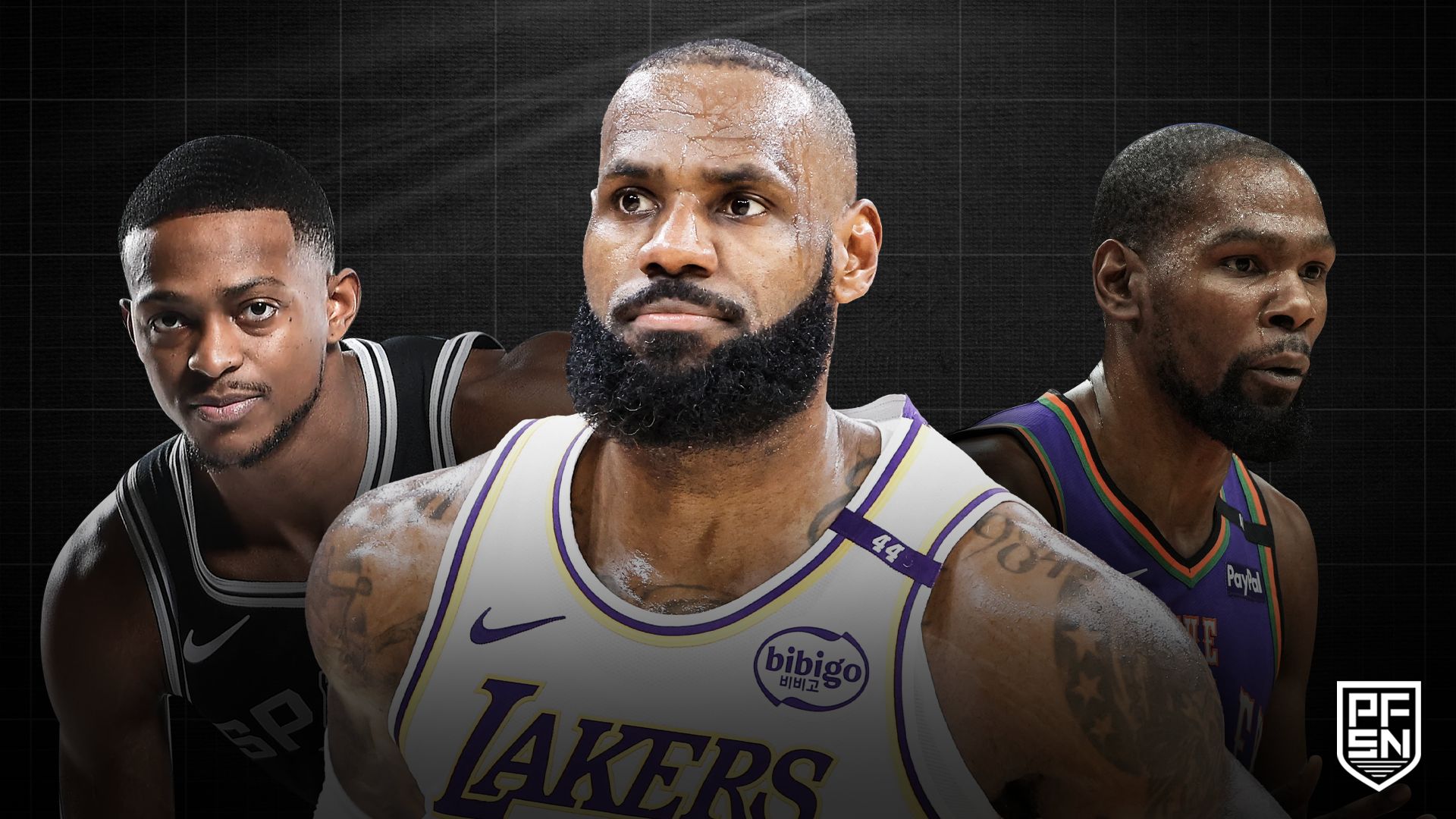
NBA free agency has always been a summer spectacle, and the 2025 offseason has solidified that claim. The 2026 class promises a level of intrigue and star power that could reshape the league’s landscape as we know it.
The group features a mix of All-NBA talents, rising young stars, and proven veterans who could be available next year. For these rankings, we included players who will become unrestricted and restricted free agents and those with player options.
Some of these players will almost certainly ink new deals before free agency, but history shows that every offseason brings its share of surprises. Here are the top 50 NBA free agents for 2026.
50) Kevin Huerter, G, Chicago Bulls
After a quiet start to the season with the Sacramento Kings, Kevin Huerter bounced back after getting traded to the Chicago Bulls, averaging 13.2 points, 3.3 rebounds, and 3.2 assists in 26 games. After shooting just over 30% from deep in Sacramento, his 3-point percentage also jumped after arriving in Chicago (37.6%).
Huerter’s off-ball movement and ability to run secondary pick-and-roll actions add value to his profile, and he’s shown growth as a playmaker. Still, he’s a streaky shooter who’s also inconsistent on the defensive end. But his size, secondary playmaking, and encouraging shooting signs could draw interest.
49) Jose Alvarado, G, New Orleans Pelicans (Player Option)
Jose Alvarado continues to be a spark plug off the bench for the New Orleans Pelicans. He’s known for his relentless ball pressure and knack for momentum-shifting plays. In 2024, Alvarado posted career highs in points (10.3 points per game) and assists (4.6 assists per game), shooting nearly 36% from deep.
Alvarado maintained a solid assist-to-turnover ratio, indicating his improved decision-making. On the defensive end of the floor, he’s consistently ranked among the top guards in steal rate (2.6%), using on-ball pressure to force turnovers and disrupt offenses routinely. His energy and playmaking can’t be overlooked.
48) Mitchell Robinson, C, New York Knicks
Mitchell Robinson could potentially be one of the league’s premier rim protectors and rebounders, but injuries again marred his 2024 season. He’s yet to play a full season since entering the NBA in 2018. Still, he’s averaged 1.8 blocks per game for his career, with a 1.5 defensive box plus/minus.
Robinson’s offensive limitations are apparent, and he’s never been trusted with a high-usage role. His skill set on that end of the floor is extremely limited, with nearly all his scoring coming via dunks, putbacks, and lobs. But his upside as an elite defender will attract some interest.
47) Keon Ellis, G/F, Sacramento Kings
Keon Ellis carved out a significant rotation role for the Kings last season, making a name for himself as a 3-and-D contributor. He appeared in 80 games, averaging 8.3 points, 2.7 rebounds, 1.5 assists, and an impressive 1.5 steals in 24.4 minutes per contest.
Keon Ellis – defensive playmaking 😈 pic.twitter.com/QNtaamW1OC
— Brett Usher (@UsherNBA) February 11, 2025
Ellis’ shooting splits were remarkable, posting a 43.3% 3-point percentage and a 66.4% true shooting percentage. He also converted 84.9% of his free throws, showing improved efficiency across the board. Ellis’ elite shooting and disruptive defense could make him a valuable rotation piece or spot starter for any team.
46) Ochai Agbaji, G, Toronto Raptors (RFA)
Ochai Agbaji has shown flashes of two-way potential but is still searching for consistency as he heads into his fourth NBA season. The former Kansas Jayhawks posted career highs in points (10.4 PPG), rebounds (3.8 RPG), and assists (1.5 APG), shooting nearly 50% from the field and 40% from behind the arc.
Agbaji’s best stretches came when he was given extended minutes, including multiple 20-point performances. Defensively, his athleticism and defensive versatility allow him to guard both wing spots, giving him upside as a 3-and-D contributor.
45) Terry Rozier, G, Miami Heat
Terry Rozier’s numbers saw a significant decline last season with the Miami Heat. After averaging 20 points over five seasons with the Charlotte Hornets, Rozier scored just 10.6 points per game in 2024. He was also wildly inefficient, shooting 39.1% from the field and 29.5% from deep.
Rozier had career-low usage and reduced minutes, but he did post a few standout performances. He also maintained his reputation as a reliable free-throw shooter, converting 85.2% from the line. At 31, his ability to provide scoring bursts and secondary playmaking remains, but questions exist about Rozier’s ceiling as a rotation guard heading into 2026 free agency.
44) Jusuf Nurkić, C, Utah Jazz
Inconsistency and durability have consistently plagued Jusuf Nurkić throughout his career, but his production dipped last season. He broke his streak of eight straight seasons with double-digit scoring (8.9 PPG). He also averaged just 7.8 rebounds during his time with the Phoenix Suns and Hornets.
Nurkić can still be a steady presence on the offensive end when he’s healthy. His 24.2% assist rate with Charlotte and overall 32% defensive rebounding rate are encouraging marks. He remains an effective screener and short-roll passer, and while not an elite rim protector, Nurkić can still be a high-level backup.
43) Nick Richards, C, Phoenix Suns
Nick Richards isn’t an exciting free agent, but he’s become a productive interior presence while playing role player minutes (22.7 minutes per game). In the second half of the year with the Suns, Richards averaged 9.5 points and 8.6 rebounds while making 60.5% of his field-goal attempts. He can also be a force on the glass, as reflected by his 13.6% offensive rebounding rate.
While his offensive game is limited outside the paint, Richards’ ability to control the boards and protect the rim makes him a valuable rotation big for teams needing interior defense and efficient finishing.
42) Khris Middleton, G/F, Washington Wizards
Khris Middleton is far from the All-Star caliber player he was in Milwaukee, but at 33 years old, the veteran still offers value. He’s been a double-figure scorer in all but one of his NBA seasons, and he can facilitate and crash the glass.
Unfortunately, durability has been a concern for Middleton lately, as he’s played less than 70 games in six straight seasons, including just 37 in 2024. His defense has also declined slightly with age, but Middleton’s experience and playmaking ability keep him in the conversation.
41) Ayo Dosunmu, G, Chicago Bulls
Ayo Dosunmu has developed into a steady two-way guard for the Bulls, known for his defensive versatility and improving offensive efficiency. In his fourth season, Dosunmu posted career highs in points (12.3 PPG), assists (4.5 APG), and rebounds (3.5 RPG), while shooting over 49% from the field.
Dosunmu has flashed an ability to finish at the rim and hit spot-up 3s. His defensive impact is notable, as he averaged 2.0 combined steals and blocks per 100 possessions. He also posted an elite 1.19 assist-to-usage rate, showing growth as a secondary playmaker.
40) Tobias Harris, F, Detroit Pistons
Tobias Harris remains a steady, versatile forward, capable of scoring in various ways and providing secondary playmaking. As a senior member of the Detroit Pistons, Harris averaged 13.7 points, 5.9 rebounds, and 2.2 assists last year, posting a 57.1% true shooting percentage.
Harris’ on/off splits were positive, particularly on offense. Defensively, he’s not a stopper, but his size and experience allow him to guard multiple positions. He still offers a reliable scoring punch and veteran leadership for teams seeking frontcourt stability.
39) Harrison Barnes, F, San Antonio Spurs
Harrison Barnes continues to be a model of consistency and professionalism. The 33-year-old is heading into his second season with the San Antonio Spurs after enjoying a productive 2024 campaign. He averaged 12.3 points, shooting 50.8% from the field and 43.3% from beyond the arc, highlighting his ability to be efficient with limited opportunities.
Barnes’ low turnover rate (6.1%) and ability to play both forward spots make him a stabilizing presence in any lineup. While his defensive impact has waned slightly, his experience, versatility, and efficient scoring ensure he remains a valuable rotation piece.
38) Kentavious Caldwell-Pope, G/F, Memphis Grizzlies (Player Option)
At 32 years old, Kentavious Caldwell-Pope still thrives as a 3-and-D wing, providing championship experience and two-way reliability. He’s played for three teams in four seasons, and he now takes his talents to Memphis as part of the Desmond Bane trade.
However, Caldwell-Pope’s recent dip in efficiency is something to monitor after shooting just 43.9% from the field and 34.2% from 3 with the Orlando Magic last season. The veteran’s defensive numbers remain strong, recording 1.3 steals per game and maintaining a positive on/off impact on that end of the floor.
37) Keegan Murray, F, Sacramento Kings (RFA)
Keegan Murray took a step back in 2024. Still, he appears to be a foundational piece for the Kings moving forward, thanks to his combination of size, shooting, and defensive versatility. Murray averaged just 12.4 points per game but posted career highs in rebounds (6.7 RPG) and blocks (0.9 BPG), according to NBA Advanced Stats.
Murray’s efficiency has been up and down, with his 3-point shooting regressing from his rookie season. However, he still offers value as a floor spacer. Defensively, he’s displayed an ability to guard multiple positions, a coveted trait in today’s game.
36) Nikola Jović, F, Miami Heat (RFA)
Nikola Jović has made notable strides as a versatile forward for Miami, carving out a significant rotation role (25.1 MPG) in his second NBA season. He had an 18.3% usage rate and averaged 10.7 points, 3.9 rebounds, and 2.8 assists.
Jović posted a 59.5% true shooting percentage and a 56% effective field-goal percentage, both above league average for forwards. He also contributed a career-high 16.6% assist rate, showing his ability to facilitate from the wing. Jović has proven he can be effective without needing to dominate the ball.
35) Jeremy Sochan, F, San Antonio Spurs (RFA)
Jeremy Sochan is a versatile forward known for his defensive switchability and playmaking flashes. In 2024, Sochan averaged 11.4 points, 6.5 rebounds, and 2.5 assists, shooting 53.5% from the field. He finished with a respectable 13.7% assist rate, highlighting an ability to facilitate from the frontcourt.
On the defensive end, Sochan has averaged 1.3 steals and blocks per game for his career. At just 22, Sochan’s combination of size, defensive versatility, and developing offensive game positions him as a high-upside forward.
34) Tari Eason, F, Houston Rockets (RFA)
Tari Eason has quickly established himself as one of the NBA’s most impactful young defenders. In his third season with the Houston Rockets, he averaged 2.6 steals and blocks in just 24.9 minutes a game, highlighting his disruptive presence on the perimeter and in the paint.
Eason’s offensive game is still developing, but his relentless energy translates to second-chance points and transition opportunities. He posted a 9.4% offensive rebounding rate and finished with a career-best 2.6 plus/minus. At 24, Eason can bolster a team’s wing defense and athleticism.
33) Rui Hachimura, F, Los Angeles Lakers
Rui Hachimura has become a reliable and efficient forward for the Los Angeles Lakers. Last season, he averaged 13.1 points and 5.0 rebounds per game, shooting 50.9% from the field and 41.3% from behind the arc.
Hachimura’s offensive game is built on midrange and improved spot-up shooting. He’s also proven capable of exploiting mismatches in the post. Defensively, he’s a solid team defender, though not a primary stopper. Still, Hachimura has established himself as a dependable option.
32) Kelly Oubre Jr., F, Philadelphia 76ers
Kelly Oubre Jr. has made a name for himself as a high-energy wing capable of providing instant offense and defensive versatility. In 2024, the 29-year-old averaged 15.8 points, 6.1 rebounds, and 1.5 steals per game for the Philadelphia 76ers. His aggressive style translated to frequent trips to the line and a 55.1% true shooting mark.
Oubre’s defensive activity is a hallmark of his game, as he regularly takes on challenging assignments and generates turnovers. Offensively, he thrives in transition and as a slasher. Oubre’s playmaking is limited, but he’s a valuable rotation piece for teams seeking energy and scoring on the wing.
31) Shaedon Sharpe, G, Portland Trail Blazers (RFA)
Shaedon Sharpe has rapidly evolved into one of the NBA’s most promising young scorers with the Portland Trail Blazers. In his age-21 season, Sharpe averaged a career-high 18.5 points, with 4.5 rebounds and a 55.1% true shooting percentage over 72 games. His usage rate climbed to 25.1%, indicating growing value as a primary option.
2025 Shaedon Sharpe tough shotmaking pic.twitter.com/Sq8gr2mFlD
— Pitless (@pitlessball) April 11, 2025
Sharpe’s offensive game is built on athleticism and a knack for getting to the rim. While his 3-point shooting is still developing, he’s shown the ability to create off the dribble and finish through contact. Defensively, Sharpe uses his length to disrupt passing lanes, flashing two-way potential.
30) Jalen Duren, C, Detroit Pistons (RFA)
Jalen Duren is quickly making his mark as a high-upside young center for the Pistons. He’s averaged a double-double in back-to-back seasons and shot an impressive 69.2% from the field on 7.0 attempts per game last year.
Duren is a dominant force in the paint, ranking among the top centers in offensive rebounding rate (15.2%). His physicality and motor translate to elite rim protection and second-chance opportunities. He’s also shown flashes as a passer, averaging 3.7 assists per 36 minutes.
29) John Collins, F, Utah Jazz
John Collins continues to provide valuable frontcourt production, now as a starter for the Utah Jazz. In 2024, he averaged 19.0 points, 8.2 rebounds, 1.0 steals, and 1.0 blocks per game, shooting 52.7% from the field and nearly 40% from 3.
Collins’ athleticism and versatility allow him to play power forward and center. He’s an excellent offensive rebounder and a capable rim protector, posting a 3.1% block rate. While not a primary shot creator, Collins’ efficiency and ability to space the floor make him a strong fit for modern offenses.
28) Anfernee Simons, G, Boston Celtics
Anfernee Simons has become a dynamic scoring guard, averaging more than 20 points per game over the last four seasons. His game features elite shot creation and deep shooting range, even if he’s not the most efficient scorer (42.6% FG, 36.3% 3PT).
Simons’ ability to generate offense on and off the ball makes him a tough cover. His assist rate has climbed since he arrived in the NBA, reflecting his growth as a playmaker. At 26, Simons is entering his prime as a high-volume scorer and secondary creator, making him one of the most attractive perimeter options in the 2026 free agent class.
27) Mark Williams, C, Phoenix Suns (RFA)
Mark Williams has quickly established himself as one of the league’s most promising young centers for the Charlotte Hornets. The 7-footer averaged 15.3 points, 10.2 rebounds, and 1.2 blocks per game this past season, while shooting 60.4% from the field.
Williams is a dominant presence in the paint, both as a rim protector and lob finisher. Offensively, his low-usage, high-efficiency game fits perfectly alongside high-volume perimeter creators. The biggest knock on Williams is that he has yet to play more than 44 games in a single season.
26) Draymond Green, F, Golden State Warriors (Player Option)
Draymond Green remains the heartbeat of the Golden State Warriors, anchoring their defense and contributing on offense with his signature versatility. In his 13th NBA season, Green averaged 9.0 points, 6.1 rebounds, and 5.6 assists in 68 games, while logging nearly 30 minutes per night.
The counting stats don’t jump off the page, but Green impacts the game in ways that don’t always appear in the box score. With a 25.5% assist rate and a combined 2.5 steals and blocks per game, the nine-time All-Defensive Team selection’s impact is felt everywhere.
25) Collin Sexton, G, Charlotte Hornets
Collin Sexton has carved out a niche as a high-energy scorer and penetrator in the NBA. The now-Hornets guard averaged 18.4 points and 4.2 assists in 2024. His game is built on aggressive attacking, driving to the rim, and creating scoring opportunities in transition.
Sexton’s speed and explosiveness create matchup problems. Defensively, he’s active and capable of generating steals, though size limits his defensive versatility. At 26, Sexton offers teams a dynamic scorer who can ignite offenses and provide instant offense off the bench or as a starter.
24) CJ McCollum, G, Washington Wizards
CJ McCollum isn’t the flashiest scorer, but he remains one of the league’s most consistent scoring guards. He averaged 20+ points for the 12th straight campaign, flexing his polished offensive arsenal and veteran savvy. His 37.3% 3-point percentage is a dip, but still highly efficient.
Though he’s 33 years old, McCollum’s scoring efficiency and ability to create his own shot keep him relevant as a high-level offensive option. Defensively, he’s solid, though not elite, but McCollum’s leadership and scoring make him a sought-after veteran presence.
23) P.J. Washington, F, Dallas Mavericks
P.J. Washington remains a reliable stretch forward with a well-rounded game. The Kentucky product averaged 14.7 points and 7.8 rebounds last season, shooting 38.1% from 3-point range. His ability to space the floor with consistent perimeter shooting and contribute on the glass makes him a valuable asset for the Dallas Mavericks.
Washington’s game is defined by versatility. He can defend multiple frontcourt positions and provide secondary playmaking, averaging over two assists per game. While he occasionally struggles with consistency, he’s a solid role player who can contribute meaningful minutes on both ends.
22) Christian Braun, G, Denver Nuggets (RFA)
Christian Braun has steadily grown into a reliable two-way wing, playing a key role for the Denver Nuggets. At 6’6” and roughly 220 pounds, Braun combines physicality with efficient scoring and solid rebounding. This past season, he averaged 15.4 points, 5.2 rebounds, and 2.6 assists per game, boasting a remarkable 58.0% field-goal percentage (eighth in NBA) and 66.5% true shooting percentage (fourth).
Braun’s efficient scoring, particularly near the rim, makes him an effective finisher for Denver. His defensive impact is equally notable, as he ranks highly in defensive rebounding for the position and is a versatile defender capable of guarding multiple positions.
21) Dyson Daniels, G, Atlanta Hawks (RFA)
At just 22 years old, Dyson Daniels has quickly emerged as a versatile wing for the Atlanta Hawks. Standing 6’8” and weighing 199 pounds, Daniels offers a rare combination of size and playmaking ability. In Year 3, he saw a surge in minutes (33.8 MPG), averaging 14.1 points, 5.9 rebounds, and 4.4 assists per game.
Daniels really made a leap on the defensive end of the floor, leading the NBA with 229 steals on the year. He finished with the seventh-best defensive box plus/minus (2.6) and had an impressive assist rate for a wing (17.9%).
20) Jaden Ivey, G, Detroit Pistons (RFA)
Jaden Ivey has emerged as a dynamic young guard for Detroit, showing significant growth in his third NBA season. He averaged 17.6 points, 4.1 rebounds, and 4.0 assists per game, shooting 40.9% from deep. Unfortunately, his season got cut short after 30 games due to a leg injury.
Ivey’s explosiveness and attacking mentality stand out. He gets to the rim at a high rate and draws fouls consistently. His assist percentage (19.7%) is respectable, and he’s flashed potential as a secondary playmaker.
19) Bradley Beal, G, Phoenix Suns (Player Option)
Bradley Beal is still one of the NBA’s most skilled scoring guards, even as his role has shifted with the Suns. In 2024, Beal averaged 17.0 points per game, shooting an efficient 49.7% from the field and 38.6% from 3. He’s no longer the player he once was, but Beal continues to show an ability to create offense both on and off the ball.
Playing alongside Devin Booker and Kevin Durant, Beal became a secondary playmaker. His defensive impact is modest, but his scoring efficiency and experience make him a valuable addition for teams seeking perimeter offense and veteran leadership.
18) Andrew Wiggins, G/F, Miami Heat
Andrew Wiggins has re-established himself as a high-level two-way wing. In 17 games with the Heat, he averaged 19.0 points, 4.2 rebounds, and 3.3 assists per game, shooting 36.0% from beyond the arc.
Wiggins’ athleticism and improved shot selection have made him a reliable secondary scorer, and his ability to finish at the rim or space the floor adds versatility to any lineup. Defensively, he remains in the upper tier for wings in steal and block rates, and his experience as a key contributor on a championship team adds intangible value.
17) Coby White, G, Chicago Bulls
Coby White enjoyed a breakout campaign in 2023, and he built on that momentum this past season, scoring a career-high 20.4 points per game while shooting 37% from deep.
Sub-Zero leveled up this season 🥶
Coby White’s Top 10 Plays: pic.twitter.com/jf3OvtcWsY
— Chicago Bulls (@chicagobulls) April 30, 2025
The North Carolina product has established himself as a reliable starting guard for the Bulls. With a career-best 60.1% true shooting percentage and a 15.5 player efficiency rate, White’s advanced stats highlight his offensive impact. He’s also shown growth as a defender and rebounder, averaging nearly a steal per game and contributing on the glass.
16) Nikola Vučević, C, Chicago Bulls
Even at 34, Nikola Vučević remains one of the NBA’s most skilled and consistent centers, bringing a rare blend of scoring, rebounding, and passing to the frontcourt. Over 14 seasons, Vučević has averaged 17.2 points, 10.5 rebounds, and 2.9 assists per game across 972 regular-season contests. In 2024, he averaged a double-double for the ninth straight season, with a 40.2% 3-point percentage.
Vučević’s ability to stretch the floor adds valuable spacing, and his soft touch around the rim keeps defenses honest. On the glass, he remains elite, ranking among the NBA’s top rebounders year after year.
15) Bennedict Mathurin, G, Indiana Pacers (RFA)
Bennedict Mathurin has emerged as a dynamic young scorer for the Indiana Pacers, showing significant growth in his third NBA season. The Arizona product averaged 16.1 points per game with a career-best 57.9% true shooting percentage.
Mathurin ranked in the 70th percentile among wings for free throw rate (83.2%), per Cleaning the Glass, reflecting his aggressive, downhill style. He also tended to show up late in games as a scorer. While his defense is still developing, Mathurin’s athleticism and scoring instincts make him a high-upside wing.
14) Mikal Bridges, F, New York Knicks
Mikal Bridges has continued his ascent as one of the NBA’s premier two-way wings. His usage has dropped significantly since joining the New York Knicks (18.4%), but he consistently found ways to make an impact while playing a career-high 37.0 minutes per game.
On the offensive end, Bridges is a threat both on and off the ball. Defensively, he regularly takes the most challenging perimeter assignments. Bridges is only 28 years and has shown ironman durability, playing all 82 games for the second consecutive season.
13) Kristaps Porziņģis, F/C, Atlanta Hawks
Availability continues to be a concern for Kristaps Porziņģis, but he’s still one of the league’s most impactful two-way bigs when he’s on the floor. He averaged 19.5 points and 1.5 blocks per game while posting a 61.8% true shooting percentage.
Porziņģis’ ability to stretch the floor and protect the rim makes him a valuable asset in today’s game. He excels as a pick-and-pop threat and holds his own as a primary defender. He’ll be 30 when he enters free agency, and while he’s a proven All-Star-caliber player, Porziņģis has to prove he can stay on the floor.
12) Norman Powell, G, Los Angeles Clippers
Norman Powell remains one of the NBA’s most reliable scoring wings. The veteran averaged 21.8 points on a career-high 15.8 attempts per game, shooting 48.4% from the field and 41.8% from deep. He ranked in the 89th percentile among wings in effective field-goal percentage thanks to his elite catch-and-shoot ability and relentless rim attacks.
While Powell is not a primary playmaker, his low turnover rate and ability to guard both backcourt spots add value as a two-way role player.
11) Austin Reaves, G, Los Angeles Lakers (Player Option)
Austin Reaves has solidified himself as a high-level starting guard and one of the best No. 3 options in the NBA. He showcased remarkable growth in his fourth season with the Lakers, averaging career highs in points (20.2 PPG), rebounds (4.5 RPG), assists (5.8 APG), and free-throw percentage (87.7%).
Reaves has shown a knack for big performances, including a 45-point outing during the regular season and nine double-doubles.
10) Zach LaVine, G, Sacramento Kings (Player Option)
Zach LaVine is one of the NBA’s most dynamic scorers, capable of taking over games with his athleticism and shot-making. He averaged more than 22.0 points per game for the eighth time in his career and shot a career-high 44.6% from behind the arc.
While his defense remains a work in progress, LaVine’s ability to create off the dribble, finish at the rim, and stretch defenses with deep shooting makes him a coveted option for teams seeking perimeter scoring.
9) James Harden, G, Los Angeles Clippers (Player Option)
James Harden remains one of the NBA’s most creative playmakers, even as he transitions into the later stages of his career. In 2024, Harden averaged 22.8 points (his highest since 2021), 8.7 assists, and 5.8 rebounds per game.
Harden’s usage has decreased, but his efficiency remains strong, as he posted a 58.2% true shooting percentage. He remains a threat in isolation and is among the league leaders in free-throw attempts per game (6.4 per game).
8) Chet Holmgren, F/C, Oklahoma City Thunder (RFA)
Chet Holmgren’s unique blend of size, skill, and defensive instincts has made him a foundational piece for the Oklahoma City Thunder. In his sophomore campaign, he averaged 15.0 points, 8.0 rebounds, 2.0 assists, and 2.2 blocks per game, shooting 49% from the field and 37.9% from 3.
Holmgren ranked in the 98th percentile for block rate and 94th percentile for defensive rebounding percentage among bigs, anchoring one of the league’s most improved defenses.
7) De’Aaron Fox, G, San Antonio Spurs
De’Aaron Fox has evolved into one of the NBA’s most explosive guards, combining elite speed with improved scoring touch and leadership. He played just 17 games with the Spurs before a finger injury ended his season, so we didn’t see much of him and Victor Wembanyama together, but he’ll have a chance to improve his stock in 2025.
Fox’s ability to attack the rim makes him a relentless force in transition and half-court sets. At 28, Fox will be entering his prime, and he should command significant attention on the open market.
6) Trae Young, G, Atlanta Hawks (Player Option)
Trae Young will carry a player option, but he could enter the 2026 free agent market as one of the league’s most prolific offensive engines. In 2024, he averaged 24.2 points and 11.6 assists per game, ranking first in the NBA in assists and top 10 in scoring.
Young’s 34.5% usage rate highlights his central role in Atlanta’s offense, and he remains a constant threat from beyond the arc. While turnovers (4.7 per game) and defensive limitations persist, Young’s offensive impact is undeniable.
5) LeBron James, F, Los Angeles Lakers
LeBron James, the NBA’s all-time leading scorer, continues to defy age and expectations. He’ll turn 41 during the 2025-26 season, and his future beyond that is uncertain, but there’s no denying he’s still one of the best in the game.
James is coming off another astonishing campaign. He averaged 24.4 points, 7.8 rebounds, and 8.2 assists per game, and shot 51.3% from the field and 37.6% from deep. His playmaking remains elite, and his on-court leadership is unmatched.
4) Kevin Durant, F, Houston Rockets
Even as he approaches his late 30s, Durant remains an offensive force and one of the most respected veterans in the league. This past season, he averaged 26.6 points, 6.0 rebounds, and 4.2 assists per game, shooting 52.7% from the field and 43% from deep, with a 64.2% true shooting percentage.
Durant’s ability to score efficiently at all three levels and create mismatches remains elite. His leadership and championship pedigree make him an invaluable addition to any contender.
3) Jalen Williams, G/F, Oklahoma City Thunder (RFA)
Jalen Williams has emerged as a foundational piece for the Thunder, playing an integral role in the team’s run to becoming NBA champions. His scoring, playmaking, and defensive versatility will be highly coveted.
In 2024, Williams averaged 21.6 points, 5.3 rebounds, and 5.1 assists per game, shooting 36.5% from beyond the arc. He’s also a strong defender, averaging 1.6 steals per game and earning his first All-Defensive Team nod.
2) Paolo Banchero, F, Orlando Magic (RFA)
Paolo Banchero has quickly ascended to stardom with the Magic. He’ll be a restricted free agent, but it’s hard to imagine Orlando not matching any potential offer sheet, if not extending him outright.
Jaylen Brown on Paolo Banchero:
“He’s the life source for their team, he’s a phenomenal young player… the future is bright for him.”
Despite losing the series 4-1 to Boston, Banchero averaged 29.4 PPG, 8.4 RPG and 6.0 APG 👏 pic.twitter.com/FaZFpcmwi8
— NBA (@NBA) April 30, 2025
Banchero averaged 25.9 points, 7.5 rebounds, and 4.8 assists while playing 34.4 minutes per game in 2024. His ability to create his own shot and facilitate for others is rare for a forward his age. Let’s see if he can elevate the Magic to the next level.
1) Luka Dončić, G, Los Angeles Lakers (Player Option)
Luka Dončić will have a player option after the 2025-26 season, and his decision will likely hinge on how Rob Pelinka upgrades the roster this offseason. Dončić continues to redefine offensive versatility and production. This past season, he averaged 28.2 points, 8.2 rebounds, and 7.7 assists over 50 games.
Dončić’s usage rate (37.1% in 28 games with the Lakers) remains among the NBA’s highest, and his ability to generate efficient offense as both a scorer and playmaker is unmatched.