
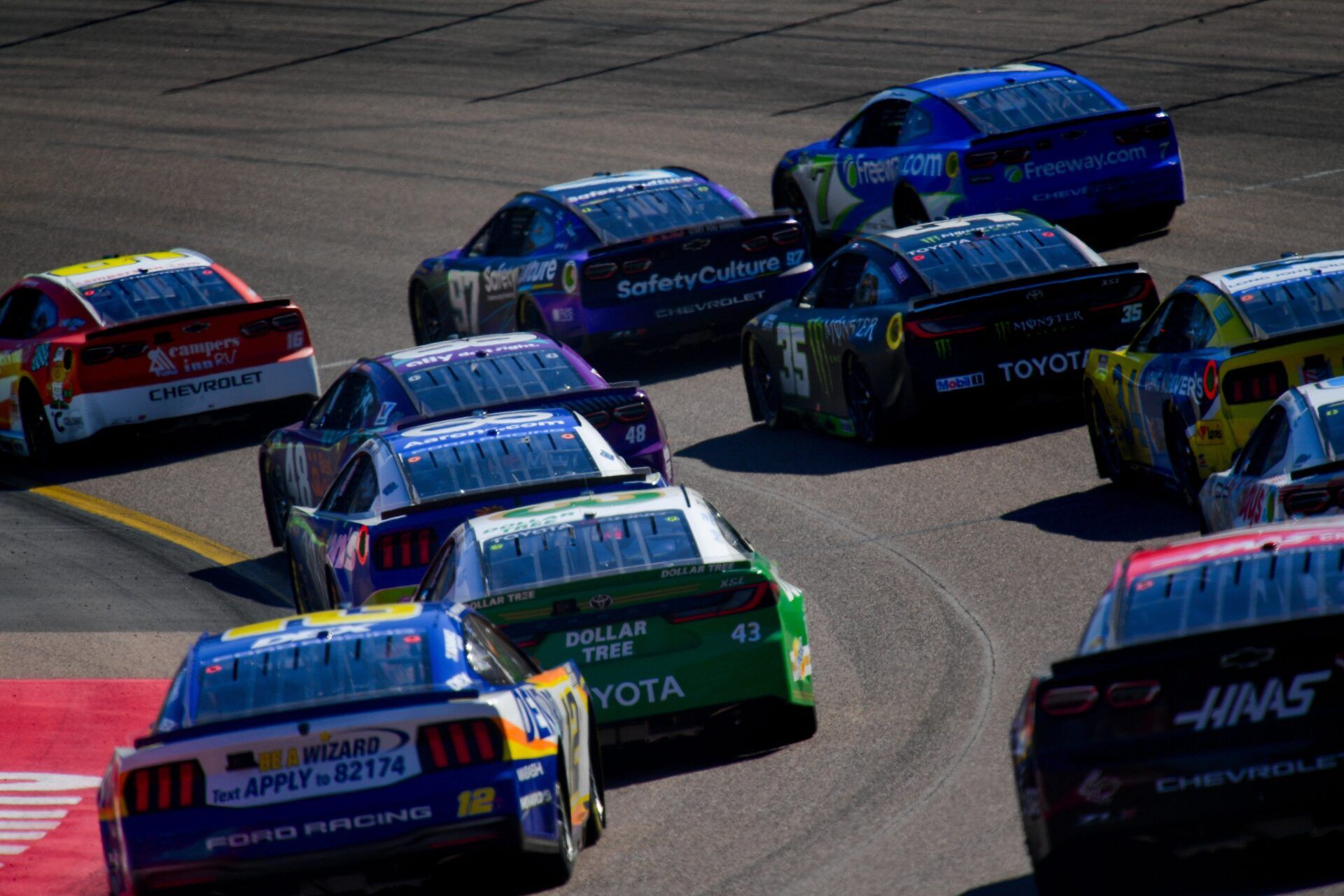
Before Sunday’s Straight Talk Wireless 500 even reached its midpoint, tire troubles had already begun to surface at Phoenix Raceway. Blowouts and shredded rubber quickly turned the race into a survival test for teams across the NASCAR Cup Series field.
But inside the garage, several veteran crew chiefs say the real explanation isn’t nearly as simple as blaming the tires. According to multiple insiders, the wave of failures was largely the result of teams pushing aggressive setups, strategic gambles, and driver limits right to the edge.
Joe Gibbs Racing Crew Chief Explains NASCAR’s Tire Chaos at Phoenix
The tire drama was evident long before the race reached its closing stages. Several teams had already experienced issues during the weekend, raising concerns about how aggressively crews were willing to chase speed.
In Saturday’s practice session, both Brad Keselowski and Riley Herbst suffered flat tires, while Chris Buescher also encountered similar trouble.
Sunday’s race, however, proved even more chaotic. Two-time Cup Series champion Kyle Busch endured a flat tire early in Stage 2 while driving the No. 8 Chevrolet for Richard Childress Racing. Although the veteran managed to limp back to pit road, he lost significant track position after going multiple laps down.
In the aftermath of the race, Adam Stevens of Joe Gibbs Racing (crew chief of the No. 20) acknowledged that teams knowingly walk a razor-thin line when it comes to maximizing performance.
“It’s so tough,” Stevens admitted during an appearance on SiriusXM NASCAR Radio. “It’s just a quirk of our sport that the fans don’t understand. We just don’t know the load, air pressure, and camber combination with certainty where we’re going to have a problem.”
The delicate balance between speed and durability is at the heart of the issue. Technically, higher camber angles can generate more grip in the corners, while lower air pressures help tires last longer during extended runs. However, those two approaches often work against each other, leaving teams guessing how close they can get to the limit before something gives way.
Stevens described the process as an unavoidable gamble. “What we do know is generally the tires make the most grip at higher camber settings and they last the longest at lower air pressure settings,” the 47-year-old explained. “Those two material facts are polar opposites… the only way to really know where the edge is unfortunately is to cross it.”
That mindset means teams are often intentionally testing the boundary during the race itself. Ideally, if the limit is crossed early enough, they can adjust the setup before the damage becomes race-ending.
But Stevens emphasized that tire issues rarely come from a single cause. Sustained loads, rising air pressure during long runs, and even minor manufacturing variations can influence when a tire reaches its breaking point.
On Sunday, another incident unfolded when Shane van Gisbergen suffered a right-rear tire failure exiting Turn 4. The sudden loss of grip sent his No. 97 Trackhouse Racing Chevrolet spinning, bringing out a caution that briefly neutralized the race.
Perhaps the most costly moment came for JGR ace Chase Briscoe. Running third with just over 50 laps remaining in the stage, Briscoe suffered a right-rear tire failure exiting Turn 4. The blowout sent his No. 19 Toyota hard into the outside wall, causing heavy suspension damage.
After previously reporting a vibration over the radio, Briscoe was forced to take the car behind the wall and into the garage, ending what had been a promising run.
Meanwhile, Rudy Fugle of Hendrick Motorsports highlighted how the characteristics of NASCAR’s Next Gen car have intensified the challenge. The design features shorter sidewalls on the tires, which reduce flex and make it harder for drivers to feel the car’s limits through the steering wheel.
“The lower air pressure gives that sidewall way more flex, way more feel,” Fugle, who led William Byron to his first Daytona win, said. “So we want to push down to those limits.”
While teams work the numbers from the pit box, drivers also play a significant role in tire survival.
While teams work the numbers from the pit box, drivers also play a significant role in tire survival. Former crew chief and current analyst Todd Gordon pointed out that aggressive driving lines can quickly accelerate tire wear.
At Phoenix, one particularly risky area is the dogleg section of the track, where drivers often cut across the apron on restarts to gain positions. The abrupt transition from the flat apron back to the banking can place sudden shock loads on the tires, especially when they are still cold.
“Phoenix is tough on them because everybody wants to bail off and shorten the dogleg on cold tires,” Gordon said. “It’s a brutal transition both down and back onto the race surface.”
In the end, the tire chaos at Phoenix seemed less about the tires themselves and more about how aggressively teams were willing to push their setups.
In a sport where every bit of speed matters, crew chiefs and drivers constantly flirt with the limit. At tracks like Phoenix Raceway, that fine margin between speed and reliability can disappear quickly, turning a calculated risk into a race-altering problem.
