
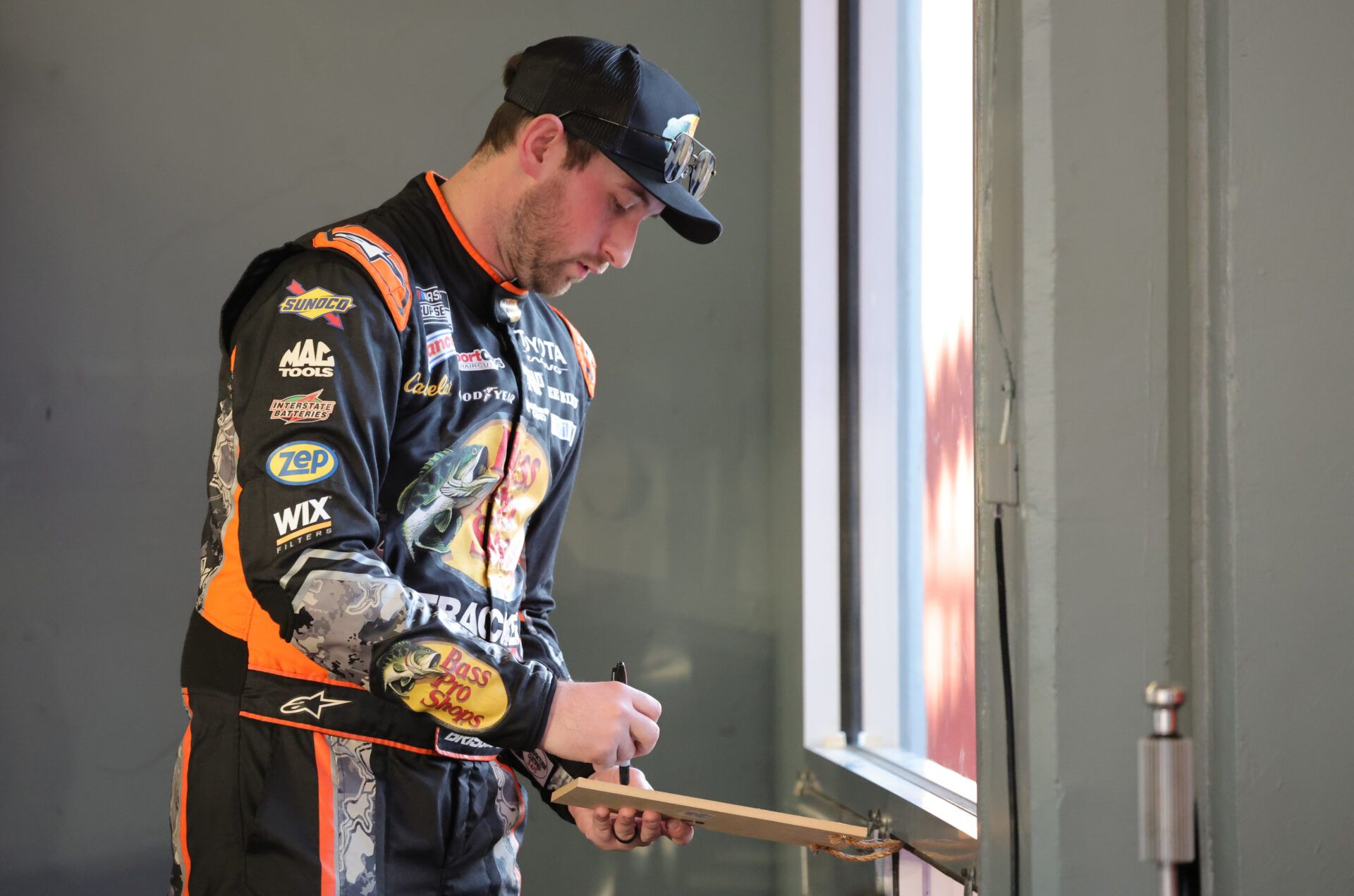
Chase Briscoe didn’t sugarcoat it. After one season at Joe Gibbs Racing, the 30-year-old driver finally said what many inside NASCAR already suspected about Stewart-Haas Racing.
Chase Briscoe’s Candid Take on Stewart-Haas Racing Reveals NASCAR’s True Competitive Gap
“At JGR, you might have 15 to 20 race-winning opportunities,” Briscoe told The Athletic. At SHR, that number was three or four. That gap tells the whole story.
Briscoe spent four Cup Series seasons at Stewart-Haas Racing, driving the iconic No. 14 car. It was his dream job.
He idolized team co-owner Tony Stewart growing up and genuinely believed he would retire there. Then, SHR sold three of its four charters and shut down at the end of 2024.
Briscoe sat on the grid at Phoenix for the final race in SHR history and cried. His crew members cried, too. It was the end of something he thought would last a lifetime.
But once he got inside JGR, his perspective shifted fast.
MORE: Try PFSN’s NASCAR Season Predictor 2026
He texted his old SHR teammates after settling into his new team, telling them that being inside JGR made him even more proud of what they had accomplished together.
High praise, but also an honest admission that the two organizations were not on the same level.
Briscoe was careful not to trash his former team. He pointed out that SHR had the same parts as JGR and Hendrick Motorsports.
The equipment wasn’t the problem. It was the depth of engineering support and the sheer number of people working on solutions. When NASCAR introduced the Next Gen car in 2022, SHR couldn’t keep up with the resources that bigger teams had available.
Before the Next Gen car, SHR had thrived on ingenuity. Engineers found creative ways to gain an edge. The new car took a lot of that creativity out of the equation, and suddenly, the resource gap between SHR and the superpowers became very visible.
The transition to JGR wasn’t instant for Briscoe either. He struggled early. At Phoenix in March, he qualified 30th and wrecked before 100 laps were done.
He later admitted he had no idea what he was doing. He had spent years learning how hard he could push an SHR car. A JGR car had a completely different ceiling, and it took him months to find it.
He described the early frustration of trying to push a JGR setup the way he had always driven, only to find the car could handle far more than he was giving it. It took three or four months before he truly understood where the new limits were.
By Pocono, something clicked. He won. Then he won at Darlington in dominant fashion, leading 309 of 367 laps. Then Talladega. Suddenly, Chase Briscoe was a championship contender.
Crew chief James Small said that after Darlington, he felt certain he had a driver capable of winning a title. Team owner Joe Gibbs was equally surprised by how quickly it all came together, saying nobody inside or outside the organization had seen it coming.
SUBSCRIBE: The Side Draft, PFSN’s free NASCAR newsletter
Briscoe finished the regular season with three wins, seven poles, and 15 top-five finishes. He made the Championship 4 at Phoenix, the same track where he had cried on the grid just one year earlier.
The story of Chase Briscoe in 2025 is not just about one driver having a breakout year. It is about what happens when a talented driver finally gets the machinery and support to match his ability.
SHR did the best it could with what it had. JGR showed what “enough” actually looks like. Briscoe isn’t bitter about his time at SHR. He’s proud of it. He just knows the difference now, and he’s not pretending otherwise.
