
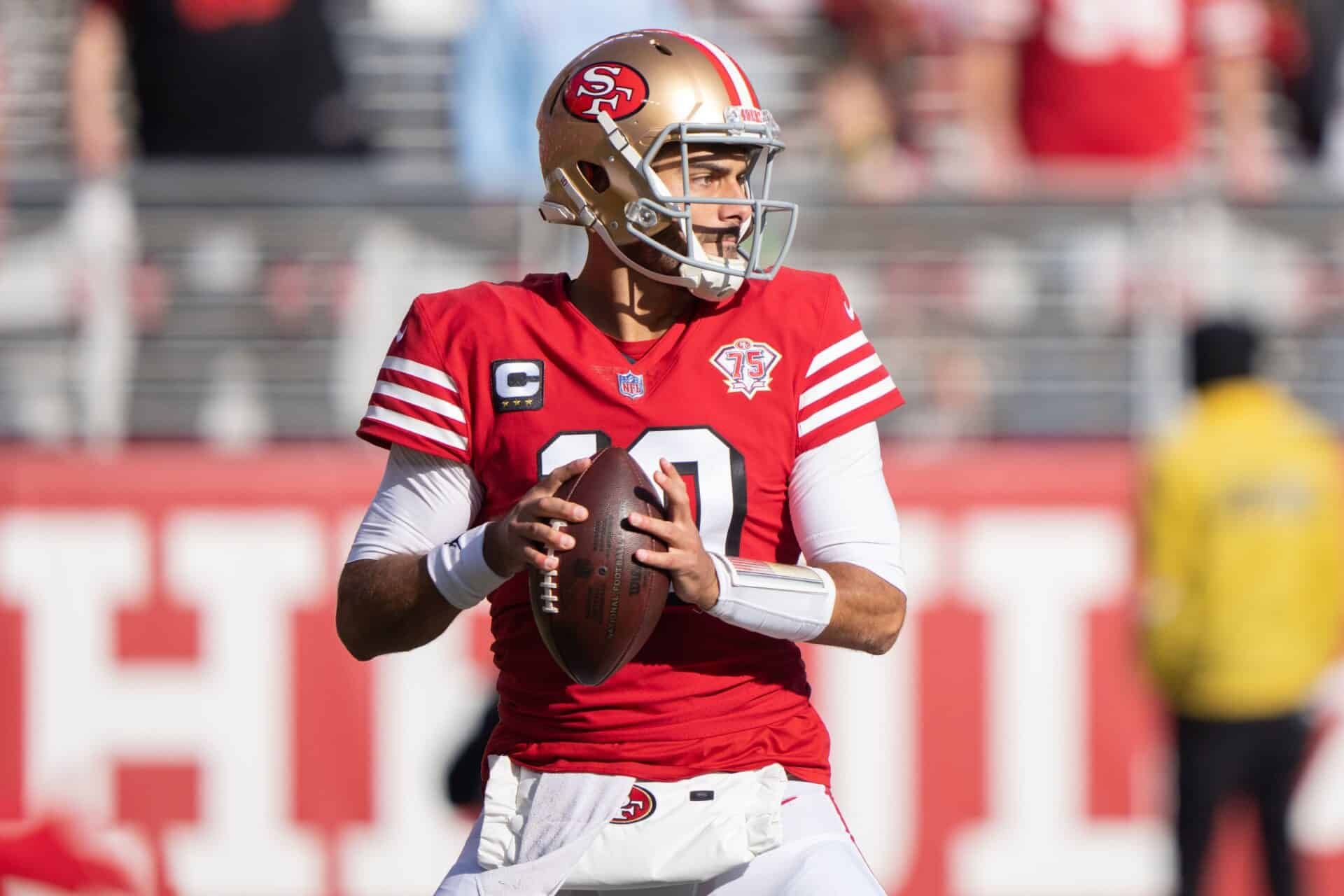
This past season, Jimmy Garoppolo took the San Francisco 49ers to the NFC Championship Game. However, there are rumors that he might have played his last snaps in San Francisco. Let’s look at the advanced metrics to see if trading Garoppolo would be a wise decision, and examine what sort of value he could provide to his new team following a trade.
Jimmy Garoppolo had an excellent box score this season
Looking purely at his box score, it would seem that 2021 was one of the better seasons of Garoppolo’s career. Of course, it was also only the second season in which he started more than 10 games, but let’s set that aside for now. During the regular season, he totaled 3,810 yards, 20 touchdowns, and 12 interceptions.
None of those numbers ranked particularly highly, but it’s here that we must return to the number of games Garoppolo played. While he did start more games last season than in almost any other in his career, he still missed several weeks. As such, his regular-season statistics could have been better.
Statistics fell off in the playoffs
Although Garoppolo had a strong regular season, he didn’t keep that up during the playoffs. The 49ers made a surprisingly deep run, but it’s tough to give Garoppolo too much credit for their success. Across three playoff games, Garoppolo threw for 553 yards, 2 touchdowns, and 3 interceptions.
Most of those numbers came in his last game of the season. During that loss against the Los Angeles Rams, he threw for 232 yards, both of his touchdowns, and an interception. Garoppolo really fell apart when his team needed him most, which isn’t great for his potential trade value.
Using advanced metrics to see how valuable Garoppolo was last season
Injuries have kept Garoppolo from reaching his full potential on many occasions, and that was true again in 2021. Fortunately, we can turn to the Offensive Value Metric (OVM) to help us measure his impact on San Francisco’s offense.
The OVM is a grading system created by the (Bx) Movement to evaluate players based on how much of their statistical production they were actually responsible for.
This past season, Garoppolo earned an OVM grade of 24.94, which ranked seventh in the NFL among qualifying quarterbacks. That is an exceptionally impressive performance, and it looks even better when you consider how much of a dramatic improvement it was over the year prior.
Although he missed much of the year, he underperformed significantly when he was on the field, earning the second-worst grade at his position, at 13.52.
Garoppolo’s improvement likely had something to do with his better health. That said, it’s still a good sign for his future prospects.
The advanced metrics behind Garoppolo’s grades
To see why the OVM gave Garoppolo a better grade during this season than the last, we need to look at the numbers involved in calculating those grades. Unsurprisingly, Garoppolo improved in multiple areas. To start with, he threw into tight windows 2% more frequently, at 15.6% compared to 13.6%.
He also threw the ball significantly further downfield, averaging 7.4 yards compared to 6.2 yards. His completions improved even more dramatically, rising by a full 2 yards, from 3.9 yards to 5.9.
In comparison, the change in Garoppolo’s completion statistics doesn’t seem all that impressive. His completion rate only rose by a relatively small amount, a little over one percent, from 67.1% to 68.3%.
However, the real change was in how he played relative to the NFL’s projections. His completion rate went from being 3.6% lower than expected to 1.2% higher.
Taking all those statistics together and the reason for Garoppolo’s OVM improvement becomes clear: he attempted significantly more difficult passes but still completed more of his attempts this season.
Examining the variation of his grades across the season
To help better grasp how Garoppolo has played in the last two years, let’s look at his weekly grades from each of the previous two seasons. You can see them in the chart below, marked by the black dots. For comparison, the average grade for quarterbacks from each season is represented by the yellow line.
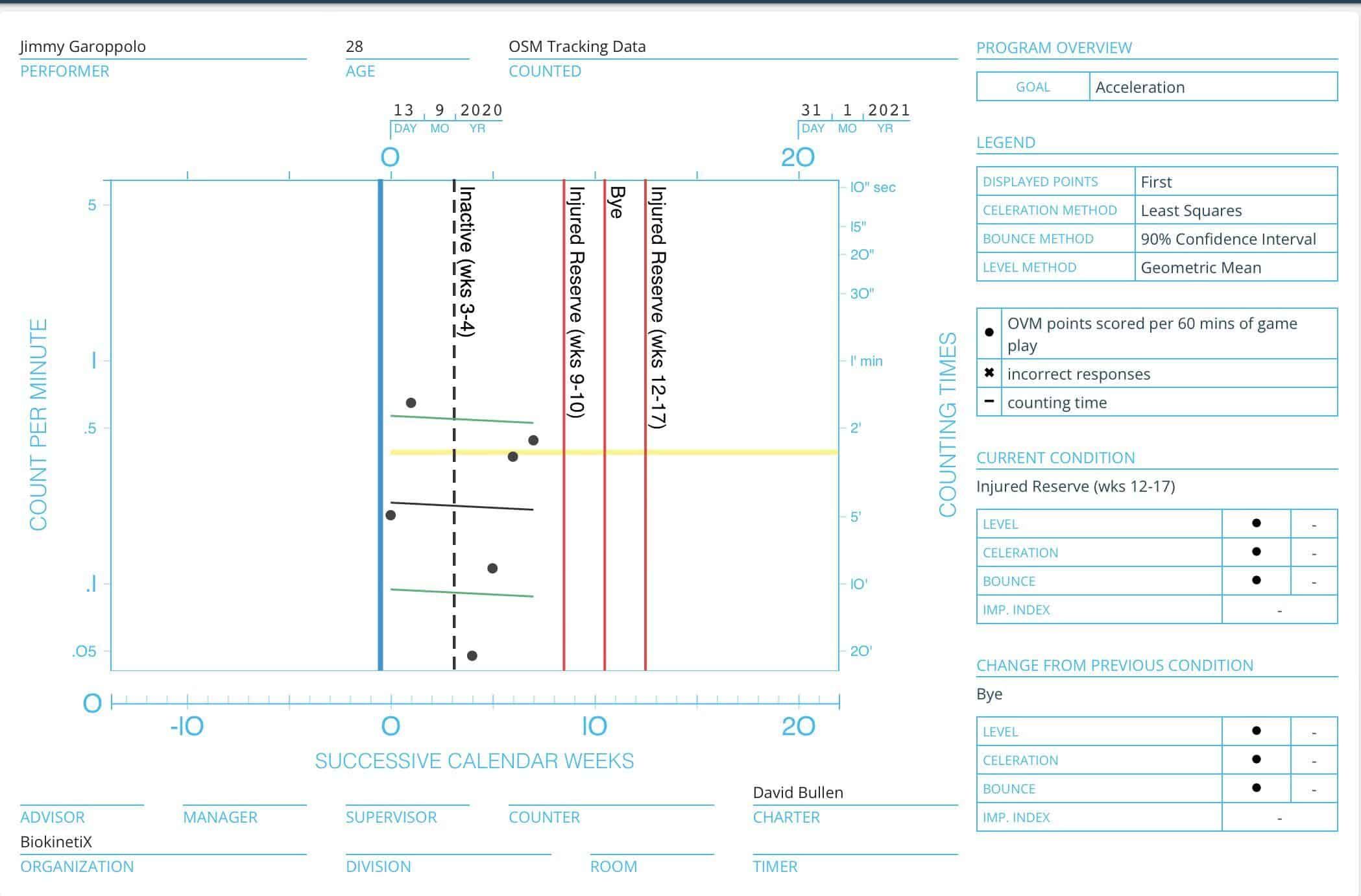
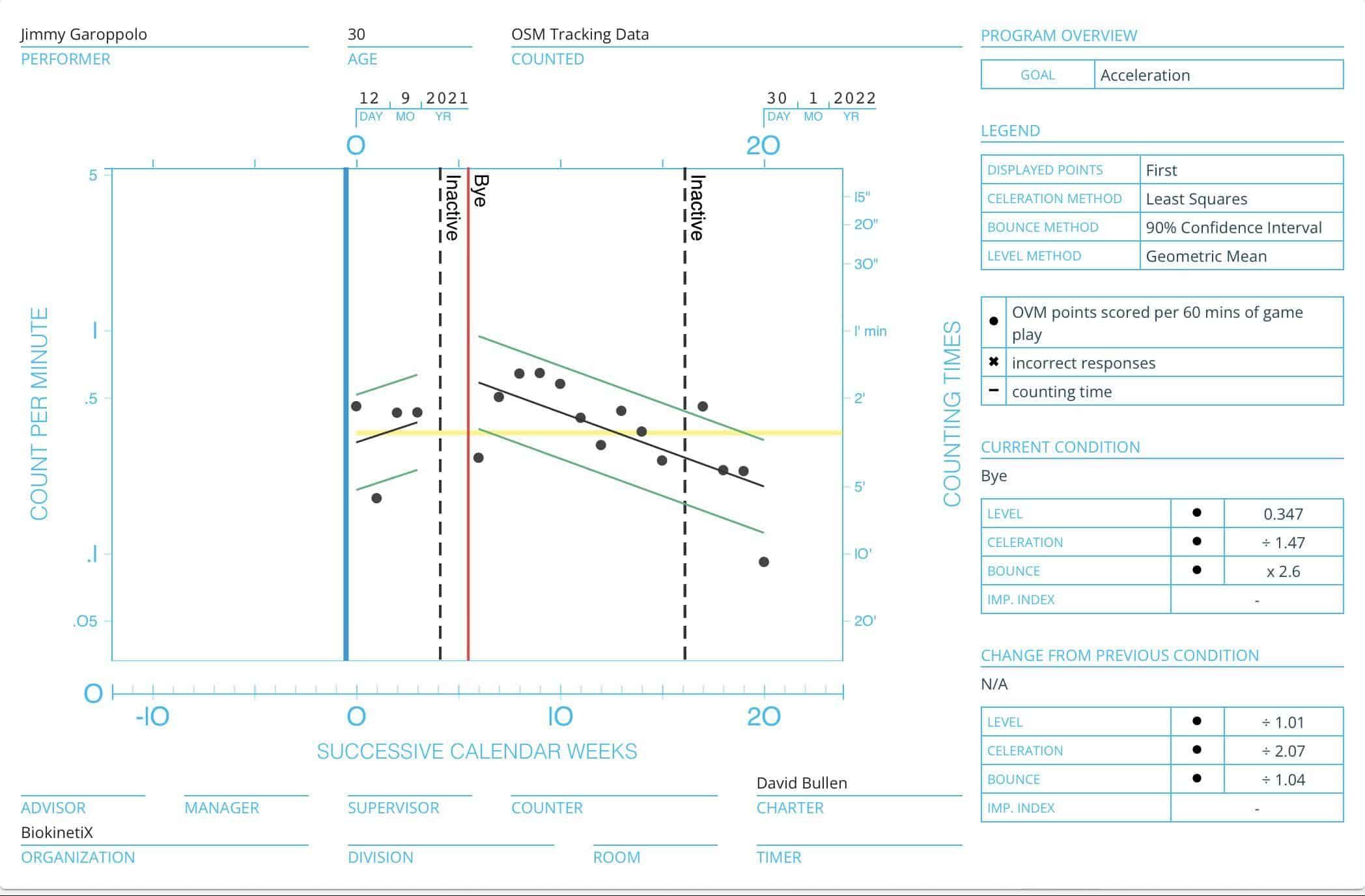
These charts reveal some interesting patterns. The difference between the two seasons should be obvious. In 2020, Garoppolo earned four grades below 20 points and two below 10, including an abysmal low of 2.84 in Week 5. In 2021, more of his grades were above the average than not. However, the trend within those grades also provides a significant cause for concern.
Garoppolo had a strong stretch in the middle of the season but was on a steady decline going into the playoffs. Then, as his box score would suggest, Garoppolo played some of his worst football in the playoffs. He ended the year with his worst game of the season, at 5.49.
Garoppolo’s high overall grade still provides reasons for optimism. But his low-impact performances in key games do temper that rather significantly.
Should a team trade for Garoppolo?
During the 2021 season, Garoppolo proved once again that he can take a great team far into the playoffs. And when looking at San Francisco’s season overall, he seems to have contributed heavily to their success.
However, the statistics also show that he wasn’t the driving force in their offense late in the season. There will definitely be teams who are unwilling to trade significant assets for him because of that flaw. Their concerns will likely be heightened by the real risk that injuries could once again sideline Garoppolo.
Even so, Garoppolo has seen more success than many quarterbacks do across their entire careers, and teams have won Super Bowls with far worse players leading their offenses. A franchise with a lot of talent on their roster and desperate need of a quarterback, such as the Indianapolis Colts, might look at Garoppolo as their best option.

Surprised that the article mentions, several times, that Jimmy’s performance dropped during the end of the season and playoffs but neglected to mention that he was playing with an injured thumb on his throwing hand effecting his grip, as well as an injured throwing shoulder. Not making an excuse but just providing at least a partial explanation. The author left out this glaring omission. Why? Also, the author contradicts himself. Reread paragraph 5 (“Most of the numbers…”) How can the author argue that most of Jimmy’s numbers (performance) came in that last game (the NFCC) AND that he let his team down when they needed him the most? How can he let his teammates down when they needed him by playing BETTER in that last game?? Anyone watching that game could see that the 49er’s usually-dominant running game wasn’t successful (for the first time) and Jimmy’s passing game carried the offense, or what success they DID have, including those 2 TD passes. Jimmy’s INT at the end of the game was a desperation play made after his O-line collapsed 3 times in a row. I wish he had just thrown it away, but even then with 4th and 18 yds, the game was essentially over anyway at that point.
I think the media and many SF fans just don’t like Jimmy, maybe his poor choices in dating or his undeniable good looks. That said, I think he’s actually a good guy, pretty humble and as a player he gives it all. I heard a commentator once say “he’s more a football player than a quarterback” and I think that accounts for both his very high winning percentage and popularity with his teammates (not just in SF but as a Patriot). If you look around the league and avoid bias, you have to see Jimmy as being in the top half of all QBs, and with an intangible quality to rally a team. I’d say there are a lot of teams that could benefit from having Jimmy on their roster. I’m also wondering (in part due to comments from high level current and past 49ers) if SF is not balking at trading Jimmy until they can see Trey more in game situations. He seems talented, but so have many other young And over the years. Just my two cents… FYI, I’d have loved to see him here in NY starting for either team.