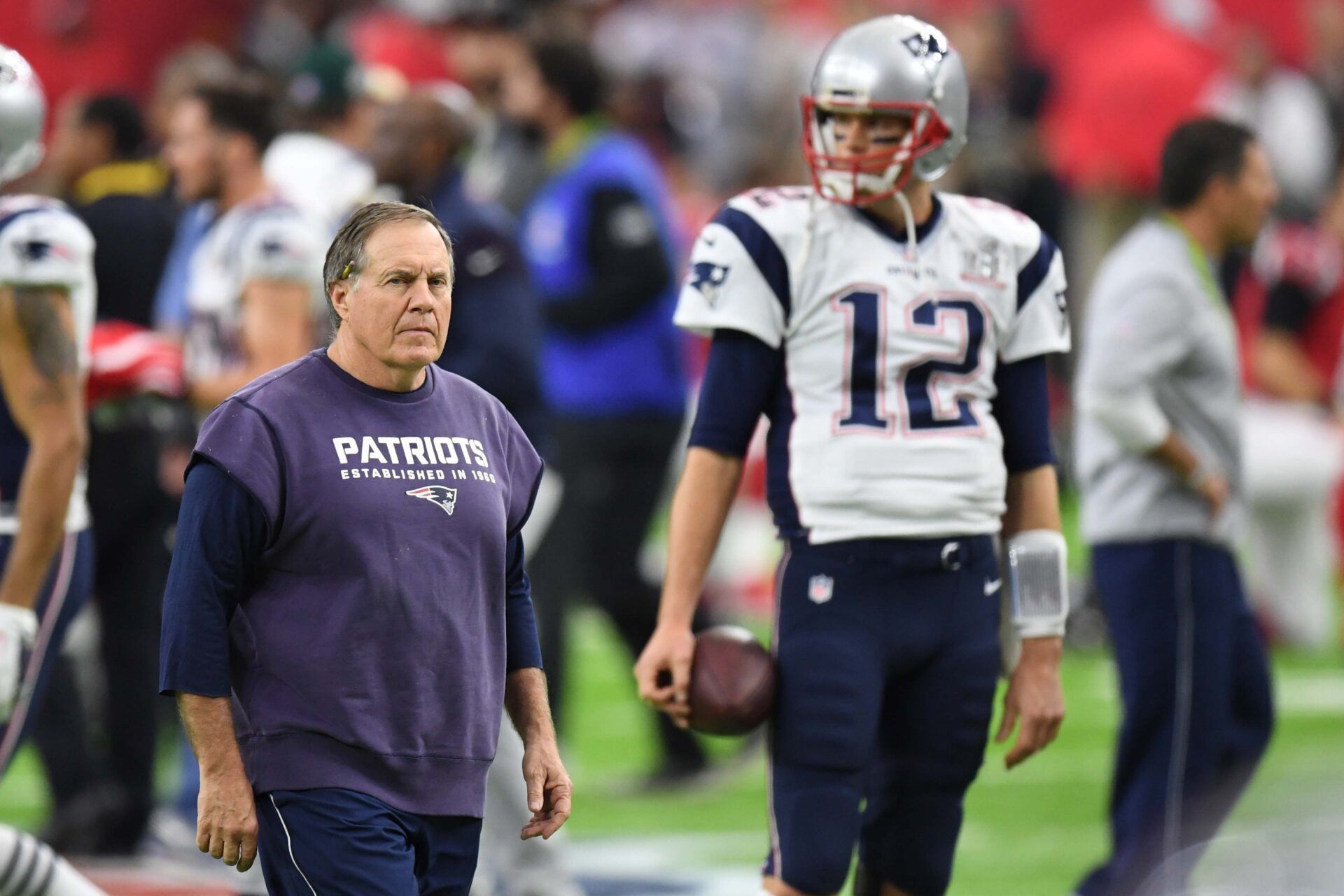
Legendary NFL coach Bill Belichick said on “The Pat McAfee Show” that Tom Brady changed his late-game approach to the use of timeouts.
Brady convinced Belichick to use his last timeout differently — the quarterback took control over clock management at the end of the game.

Bill Belichick Claims Tom Brady Changed His Late-Game Timeout Regimen
Belichick called the bad clock management in today’s NFL games “mystifying”. He then offered some insight into how Brady changed his late-game approach to using timeouts.
Belichick said his basic approach to the use of timeouts was relatively simple: If his team had its full complement of three timeouts at the two-minute warning, he’d want to use the first between 2:00-1:00, the second between 1:00-0:30, and the final one between 0:30-0:00.
“That wasn’t an absolute rule, but that was a rule of thumb,” Belichick said. “You didn’t really want to have two timeouts with 20 seconds to go, and you didn’t want to use two of your timeouts in the first 30 seconds of a two-minute situation where you didn’t need to. … So you get down to that last 30 seconds, and the decision really is: Do you save the [final] timeout for the very end?”
The coach said around 2014 he had a conversation with Brady and offensive coordinator Josh McDaniels, and the talk centered around the use of the timeouts late in the game.
Bill Belichick wanted to save Timeouts for end of game situations, but Tom Brady convinced him otherwise.
This is amazing content.
(@PatMcAfeeShow 🎥) pic.twitter.com/eMkTuARpvw
— Brycen 🧲 (@Brycen2047)
“I had always wanted to save it for the end,” Belichick said. “Especially if you need a field goal, so you didn’t have to run the no-huddle field goal team on. You could just take a timeout and go in there and kick it. But Brady said, ‘Look, I’d rather have more time and less timeouts because it gives me more options than less time and a timeout. So let me handle it. If I screw it up, then that’s my fault and you can take it away from me.’
“‘But I would rather you take a timeout with 27 seconds and give me more time to do something with than run a play with 27 seconds, and now we go to 13 seconds and we have one timeout,'” Belichick continued, paraphrasing Brady. “‘I’d rather have 27 seconds and no timeouts than 12 seconds and one timeout.’”
Belichick said it was a gamble and put a lot of pressure on Brady. However, Brady asked for the added responsibility and he understood what he was getting into.
“It puts a lot of responsibility on the quarterback, but Tom wanted that, and I felt very confident in giving it to him. So basically, we fundamentally made that switch,” Belichick said.
“I would take that third timeout a lot of times in the 30-second range even though it had gone against a little bit of my previous thinking because Tom felt more comfortable managing the game that way, and he did it very well. So I was more than happy to give him that responsibility because he could manage it.”