
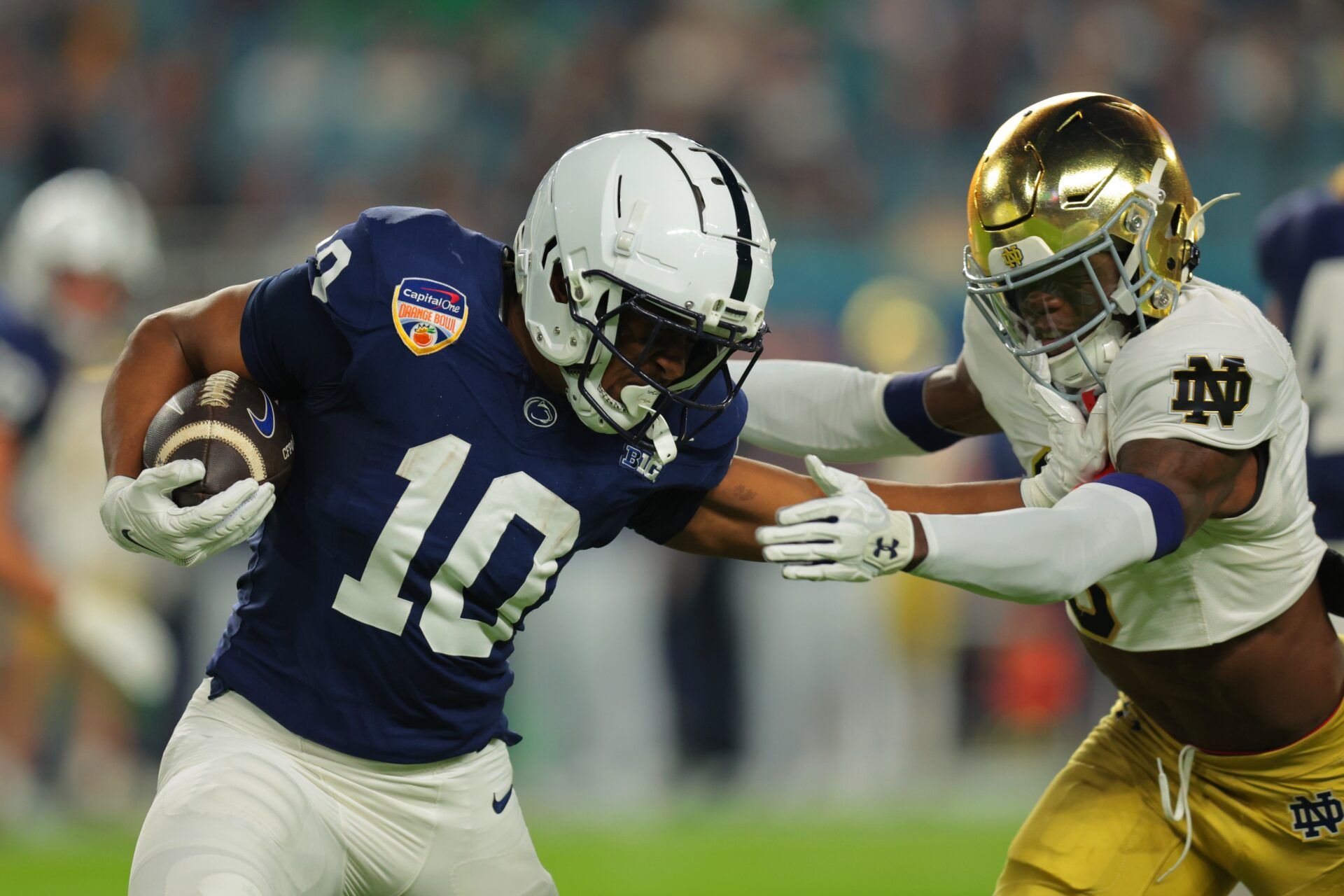
The Penn State Nittany Lions have two high-profile running back prospects in the 2026 NFL Draft cycle, and Nicholas Singleton in particular has long held NFL aspirations. Can he be the latest after Saquon Barkley and Miles Sanders to earn a professional starting role?
Singleton and his teammate Kaytron Allen loom large in the 2026 NFL Draft, but Singleton’s pedigree as a raw athletic talent has long tantalized evaluators. Here’s how he translates in his current state, and where he stands early on in the 2026 NFL Draft cycle.

Nicholas Singleton’s Pedigree Points to a Destiny in the NFL
As early as high school, there were already whispers that Singleton could challenge for early-round NFL Draft capital down the road. He was a consensus five-star recruit in the 2022 cycle, after dominating to the tune of 2,043 yards and 41 touchdowns on the ground in his final season. Across his career at Governor Mifflin High School, he amassed a whopping 6,326 rushing yards and 116 touchdowns, outmatching almost everyone his age.
Singleton had offers from virtually every blue-blood CFB program and took part in visits to Alabama and Texas A&M, among others. But the chance to play in his home state, for the school that produced NFL MVP candidate Barkley, was too enticing to pass up.
Singleton was one of the most heavily anticipated Penn State signees in recent memory, and he backed up the high expectations with a strong true freshman campaign, racking up 1,061 yards and 12 TDs on 156 carries.
The 2023 campaign featured a downturn in production for Singleton, and he was surpassed by Allen on the ground. Yet, he still managed to eclipse 1,000 yards from scrimmage and bounced back with a stellar 2024 showing.
Taking almost 50 carries less than Allen in 2024, Singleton nearly matched his counterpart’s yardage total, accruing 1,099 yards and 12 rushing touchdowns, while logging 41 receptions for 375 yards and five additional scores.
Singleton could’ve declared for the 2025 NFL Draft, but he ultimately chose to come back to school and settle unfinished business for a Penn State squad that made the College Football Playoff semifinal. Can he challenge Jeremiyah Love for the RB1 crown in the process?
Singleton’s Deep Dive: How Does the Penn State RB Make His Mark?
Singleton will check plenty of surface-level boxes for evaluators. First and foremost, he’s a stellar locker room presence. He was a team captain in high school and is active in the community. And physically, he’s one of the best overall athletes in the 2026 NFL Draft.
According to Bruce Feldman’s annual “Freaks” list, Singleton has reached 23.6 miles per hour and has run the 40-yard dash as fast as 4.35 seconds. There’s so much explosive energy packed into his 6’0″, 227-pound frame, and it routinely shows up on film.
Rumored to have ~4.35 speed at 6’0″, 227 pounds, Penn State’s Nicholas Singleton is one of the 2026 RB class’ superlative athletes, pound-for-pound.
That speed is a central part of his game. Particularly on zone runs, he’s potent. Can traverse the line and explode through seams. pic.twitter.com/F741fTGN9d
— Ian Cummings (@IC_Draft) June 17, 2025
Singleton is built like an inside-the-tackles bruiser with his grating legs and frame density, and yet, he has the track speed to capitalize on seams in the defense. He operates best on outside runs, where he can get out in space, align himself with creases, and accelerate, warping pursuit angles.
While Singleton is most comfortable as a linear mover (more on this later), he’s shown that he can at least modulate his tracking angle and weave through narrow creases, discreetly adjusting his alignment to scrape past adjacent defenders.
Outside runs are where Nicholas Singleton’s range shines. Wide + outside zone, sweeps, tosses — if he’s in space, he can chew up ground.
There are flashes of more, too. Watch how he modulates his tracking angle to weave upfield, and how he pries past DBs to eek out max yardage. pic.twitter.com/Qisq1SlwrF
— Ian Cummings (@IC_Draft) June 17, 2025
Many of Singleton’s best runs come with clear runways, but later in the season, he showed more comfort picking out cutback lanes on the frontside and the backside, and timing his diversions upfield on zone runs.
The play below is a great example from Singleton’s three-touchdown game against Notre Dame. Here, Singleton isn’t surviving by his inhuman acceleration alone. He successfully identifies the defense’s frontside gap leverage and rolls his hips to cut inside. Then he gets skinny and rockets up the gap, using his powerful leg churn to finish the run with a score.
Nicholas Singleton’s game in the CFP against Notre Dame was one of his best showings. 15 carries for 84 yards and 3 touchdowns.
Still not a ton of creation, but you did get to see him use zone timing and get skinny through lanes. And he was on a *mission* in the red zone. pic.twitter.com/mfkt6Y1pBD
— Ian Cummings (@IC_Draft) June 17, 2025
Singleton’s ability to generate chunk runs at a high clip is valuable, and it’s part of what will lock him into an NFL rotation. But beyond being a sparkplug on the ground, he also has exceptional receiving value.
Operating in a versatile Penn State offense that moved pieces around — with Tyler Warren as the focal point — Singleton got to take reps from countless alignments, with plenty of motion looks.
He’s a high-level RAC threat, has a role-diverse skill set and a functional RB route tree, and can track the ball vertically, as shown below.
Beyond being an elite size-speed athlete at 6’0″, 227 pounds, another top selling point of Nicholas Singleton’s profile is his receiving value.
He caught 41 passes for 375 yards and 5 TDs in 2024. He’s role versatile, he can be used for designed RAC, and he can track the ball. pic.twitter.com/8UMmkCOdyT
— Ian Cummings (@IC_Draft) June 17, 2025
Singleton stylistically has a predisposition to get upfield quickly. He’s a vertical seam-runner whose speed and size combination is his best weapon. It’s a gift, ultimately — but that same predisposition can hint at notable limitations in his NFL projection.
Singleton thrives with a runway to operate, but when he has to use setup space in a different manner, he’s not very adaptable with his tempo and footwork, nor is he very imaginative with second-level control.
The run below is a good example of how Singleton’s strengths and weaknesses blend together. Here, Singleton is unable to modulate his tempo and use his setup space efficiently. He’s also late to process his cutback. As a result, he runs straight into a wall.
Ultimately, Singleton is able to right his wrong by bouncing off contact, recalibrating outside, and teleporting up the newly opened backside seam with his hyper-elite explosive capacity. But in the NFL, the margin for error might be slimmer on these types of plays.
This Nicholas Singleton run is unique because it displays the pros & cons of his eval.
He recklessly uses his set-up space and is late to process cutbacks, running into a wall. But once he recalibrates, he has the burst to flip the script, and the powerful leg churn to finish. pic.twitter.com/ilv9Dym4rf
— Ian Cummings (@IC_Draft) June 17, 2025
The play below, from one of Singleton’s least efficient games of the year against USC, is another suitable example of his flaws as a creator.
It’s an inside zone run where Singleton doesn’t get an overly favorable look right off the jump. He has a pursuit defender closing in, and USC’s frontside defenders do a good job of controlling their gaps.
However, on the backside of the run, the right guard is working past his man and is about to execute a solid reach block to open up the backside A-gap. If Singleton slow plays this and manages space with tempo modulations, he can anticipate the A-gap opening and capitalize.
Instead, he chews up his setup space far too recklessly and drifts right into the left-side A-gap, where the defenders have control and swallow him up.
Plays like this hint at potential limitations with Nicholas Singleton.
If he slow-plays this a little more, he has a crease opening on the right-side A-gap. But he doesn’t consistently show the vision to anticipate these lanes, or the pacing to control second-level defenders. pic.twitter.com/V8tjTwrCBG
— Ian Cummings (@IC_Draft) June 17, 2025
Singleton is perfectly fine as he is: an explosive zone and seam runner with exciting receiving versatility. But his capabilities of a space creator and manipulator are limited. He’s not great at anticipating lanes and setting up gaps, and his moderate hip stiffness also limits his ability to break down and cut back when given peripheral voids.
If Singleton can improve his tempo variation and footwork behind the line in 2025, he could become a more scheme-diverse and universal option in the 2026 NFL Draft. However, as it stands, he might be confined to a more zone-heavy role, and lapses in interior gap processing might cap his upside beyond the athleticism.
Nevertheless, Singleton has early-round merit with his athletic gifts and two-phase ability. Zone-heavy systems should have him circled as a speed phenom who can take advantage of their spacing, and he has the role versatility and blocking utility to be an ancillary asset.