
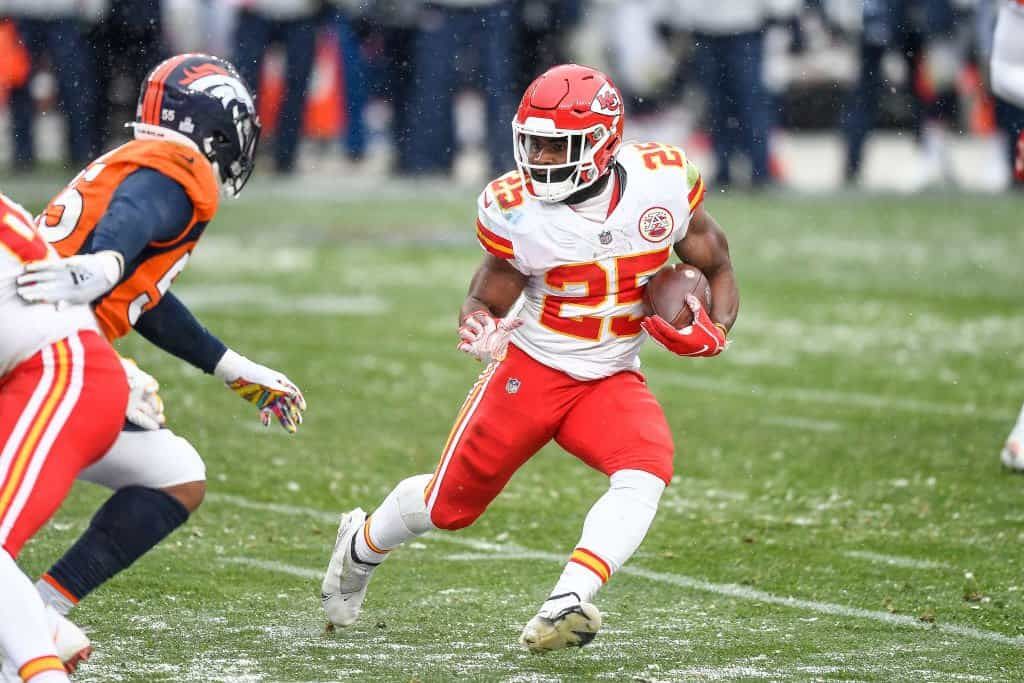
Clyde Edwards-Helaire officially returned from injury last Sunday in the NFL‘s AFC Championship Game. Unfortunately, he didn’t seem to be fully healthy, and his teammate, Darrel Williams, did most of the work at running back. However, Edwards-Helaire is back to practicing in full and should be ready for the Super Bowl. How much of a difference will the RB’s return make for the Kansas City Chiefs’ offense?
Clyde Edwards-Helaire struggled in his first game back from injury
Despite starting the game and playing more snaps than any of the Chiefs’ other RBs, Edwards-Helaire only carried the ball six times in the AFC Championship Game, totaling a measly seven yards. His receiving statistics, often a significant part of his game, were no more impressive. He was only targeted twice, resulting in one reception for zero yards.
Edwards-Helaire’s teammate, Williams, was significantly more impactful, with 13 carries for 52 yards. Overall, Edwards-Helaire’s production seemed to be limited compared to what it was during the regular season. However, now that he is fully participating in practice, it’s worth looking back at his regular season performance to see what kind of impact he might have on the Super Bowl.
Evaluating Edwards-Helaire’s rookie season
Edwards-Helaire’s box score statistics seem reasonably impressive, especially for a rookie. He totaled 803 rushing yards and 4 touchdowns on the ground and adding 297 yards and 1 touchdown as a receiver.
However, a player’s box score rarely tells the whole story of their season. That’s why we will use the Offensive Value Metric (OVM) to evaluate Edwards-Helaire’s season better. The OVM, a grading system created by the (Bx) Movement, evaluates players based on how much they contributed to their offense rather than the statistics they produced.
In short, the metric allows us to measure how valuable a player was to their offense. Unfortunately, thanks to his low number of carries, Edwards-Helaire didn’t qualify for an OVM grade against Buffalo. However, we can look at his regular season metrics for clues about what he will contribute next week.
Clyde Edwards-Helaire’s overall statistics are unimpressive
Edwards-Helaire’s OVM grades from the regular season don’t paint him in a particularly positive light. His overall grade of 3.25 is exceedingly low, even for a running back, ranking as the sixth-worst grade of any qualifying player at the position this season. For comparison, his backup, Williams, has earned three grades this season: 4.17, 13.5, and 8.73, all higher than Edwards-Helaire’s average.
Related | Chiefs Pre-Senior Bowl 7-Round 2021 NFL Mock Draft
In fairness to Edwards-Helaire, his low grade is in part a product of Kansas City’s excellence in the passing game. The Chiefs’ offense is built around Patrick Mahomes, Tyreek Hill, and Travis Kelce, but not their RBs. As such, defenses put most of their effort towards slowing down the passing game.
That led to Edwards-Helaire performing poorly on one of the key metrics involved in calculating the OVM. When he was on the field, opposing defenses positioned eight or more defenders in the box on 9.39% of his snaps. That was the sixth-lowest percentage of any qualifying running back in 2019.
However, there is more to Edwards-Helaire’s season than simply how his team has performed around him. He struggled on an individual level as well. According to the NFL’s calculations, the Chiefs’ RB averaged .29 fewer yards per rushing attempt than he should have. That was the eleventh-worst mark among all qualifying running backs.
He also ran 3.81 yards for each statistical yard he gained, indicating that he was highly inefficient. Overall, even though Edwards-Helaire faced less resistance than most other running backs this season, he didn’t take advantage of the extra space he was given.
Clyde Edwards-Helaire’s weekly statistics
Taking a more granular view of Edwards-Helaire’s OVM grades in 2020 doesn’t help his case. The chart below shows how Edwards-Helaire’s OVM grade varied from week to week, represented by the black dots. For comparison, the yellow line shows the average OVM grade for running backs during the regular season.
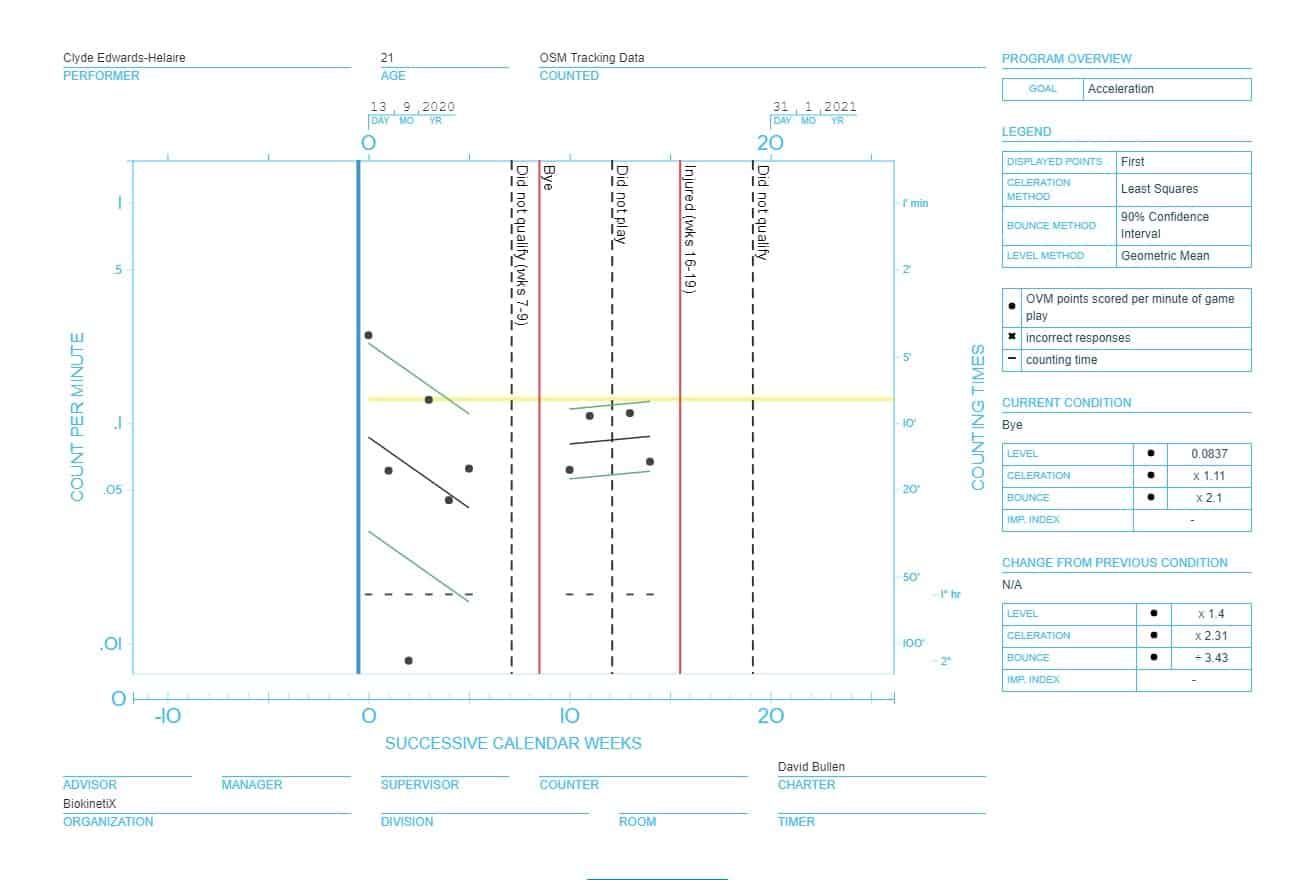
He had his best game of the season in Week 1 and hasn’t matched that level since. Of course, he was injured in recent weeks, and during the season, he often did not receive enough carries to qualify for a grade. As such, he had fewer opportunities to prove himself than other running backs. Still, the fact that he spent most of the season below the league average is not encouraging.
Examining Clyde Edwards-Helaire’s receiving statistics
Observant readers might have noticed that I did not mention Edwards-Helaire’s receiving statistics during our OVM grades discussion. Unfortunately, the NFL does not record advanced metrics for running back receiving statistics. Therefore, I can’t discuss Edwards-Helaire’s performance in that area in the same manner as I would a tight end or wide receiver.
However, while Edwards-Helaire was productive as a receiver, it wasn’t as though he would break any records. Going into the Super Bowl, he is averaging 22.85 receiving yards per game. That isn’t terrible, but it barely cracks the top 20 running backs in that category. And that’s with two of the NFL’s best receiving backs, Christian McCaffrey and Saquon Barkley, missing most of the season.
For comparison, the league leader, Alvin Kamara, averaged 50.4 yards. Of course, Kamara is an exception, rather than the rule, but it shows how far below him Edwards-Helaire was. A more fair comparison would be Giovani Bernard or Chris Carson, who had similar averages to the Chiefs’ RB. They’re solid players out of the backfield but far from irreplaceable ones.
However, it is worth noting that this is an area in which Edwards-Helaire appears to have the edge over his backup. In the three games since Clyde Edwards-Helaire’s injury in which Williams saw significant playing time, he has averaged 17.33 receiving yards. Not a massive dropoff from Edwards-Helaire, but a significant one nonetheless.
Clyde Edwards-Helaire can still be an asset
Ultimately, I don’t think that Clyde Edwards-Helaire’s return from injury will be particularly impactful. Kansas City’s offense is so dangerous in other areas that many other running backs could fill his role. If you asked me today who I thought would win Super Bowl LV, I would say the Chiefs.
Related | What is the Super Bowl Experience in Tampa Bay this year?
If it were announced tomorrow that Edwards-Helaire would be unable to play, my prediction would not change. He is a solid enough player in many respects, but he simply isn’t that important to Kansas City’s offense.
That said, it certainly doesn’t hurt to have him back. If nothing else, the RB is another weapon in the Chiefs’ arsenal, representing a receiving threat out of the backfield. He likely won’t be the most impactful player in the Super Bowl, but his presence will give the Tampa Bay defense something else to focus on, making it easier for the real stars of Kansas City’s offense to work their magic.
Want more NFL news and analysis?
Be sure to follow us on Twitter (@PFN365) to stay in the loop on all things around the NFL. Also, continue to visit Pro Football Network for NFL news and in-depth analysis concerning the 2020 season and beyond.
Lucas Ellinas is a writer for Pro Football Network. You can follow him on Twitter @Lucas_Ellinas.
