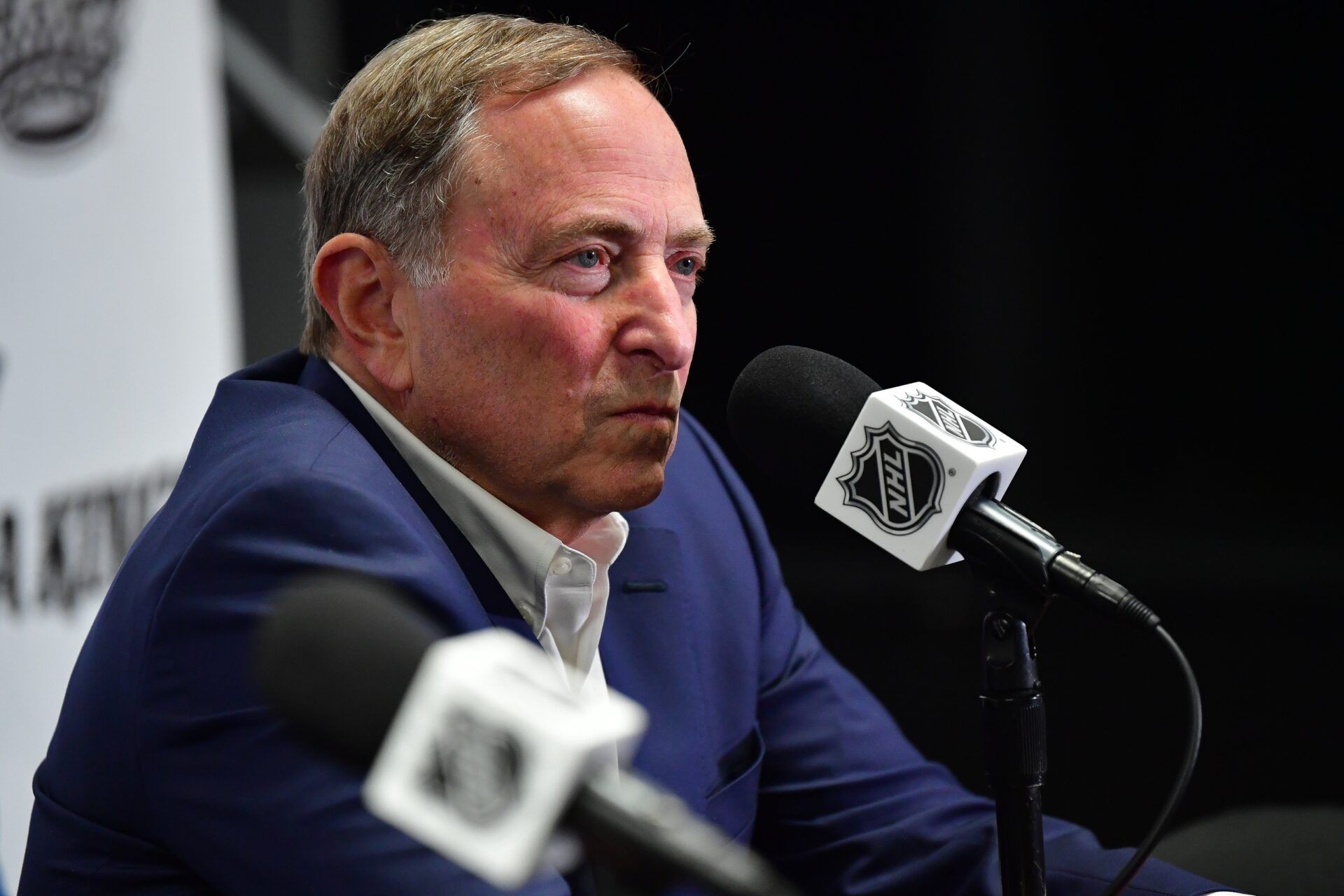
Before Game 3 of the Stanley Cup Final, NHL Commissioner Gary Bettman strongly dismissed analyst Paul Bissonnette’s recent remarks suggesting Florida-based teams have an unfair edge due to the state’s lack of income tax.
Speaking on the NHL on TNT broadcast ahead of the Florida Panthers’ matchup against the Edmonton Oilers, Bettman called the criticism “ridiculous” and downplayed the idea that tax policy drives player decisions.
“When the Florida teams weren’t good, which was for about 17 years, nobody said anything about it,” Bettman said.
“For those of you that played, were you sitting there with a tax table? No, you wanted to go to a good organization in a place you wanted to live where you wanted to raise your kids and send them to school. You wanted to play in a first-class arena with a first-class training facility with an owner, an organization, a GM and a coach that you were comfortable with,” he added.
He argued that NHL players prioritize other factors, including organizational stability, coaching, arena quality, and the chance to compete for championships.
NHL commissioner Gary Bettman calls Paul Bissonnette’s concern about the NHL & Florida’s lack of state tax “ridiculous.”
Bettman adds, “I was watching you during the prior rounds. Your attire was a little suspect in terms of your journalistic objectivity.” 🏒🎙️#NHL #StanleyCup https://t.co/eLmLyNCi2c pic.twitter.com/25Tuu8gKnm
— Awful Announcing (@awfulannouncing) June 9, 2025
Bettman also pointed out that high-tax states like California and New York continue to host competitive teams, challenging the notion that state tax levels directly influence success.
“Could it be a little factor if everything else were equal? I suppose. But that’s not it,” he added. “State taxes are high in Los Angeles, high in New York. What are we going to do, subsidize those teams?”
Bissonnette responded on social media shortly after, joking about the interaction and acknowledging the buzz it generated. “Get the people talking. Look at that engagement,” he wrote on X, formerly Twitter.
Get the people talking. Look at that engagement. Throwing Gary softballs. 🥎
— Paul Bissonnette (@BizNasty2point0) June 10, 2025
The tax debate began during the Eastern Conference Final when Bissonnette suggested that Florida’s no-income-tax environment might be an issue worth addressing in the next collective bargaining agreement.

NHL Commissioner Shuts Down Competitive Balance Concerns
The NHL has faced similar discussions in the past. Franchises in states like Florida, Nevada, and Texas have often been spotlighted for perceived financial advantages. Yet league officials have consistently dismissed the idea that state tax discrepancies create structural imbalances.
Deputy Commissioner Bill Daly reiterated that stance last week. Speaking at a media availability at Rogers Place, Daly said the league does not share the “level of concern” voiced by some critics. He emphasized that tax variations have always existed in the NHL and are not seen as a serious competitive issue by the league’s leadership.
Academic voices have offered more nuanced perspectives. Jim Weese, a sports management professor at Western University, noted that players in no-tax states can stretch their salaries further, allowing teams to maximize their cap space.
Still, both Bettman and Daly continue to assert that organizational culture, leadership, and market appeal remain the primary motivators for players when choosing where to sign.
Bettman confirmed that the league is not currently considering tax parity in labor talks. The existing collective bargaining agreement runs through 2026, and there is no indication that the topic will be added to the agenda.
While Bissonnette may have sparked the latest round of discussion, Bettman appears eager to put the issue to rest. His message was clear, after all. Taxes might play a role, but they are far from the deciding factor in the NHL’s competitive landscape.
As the Stanley Cup Final heads to Game 4 in Florida, the league’s focus remains on the ice, not income brackets.
