
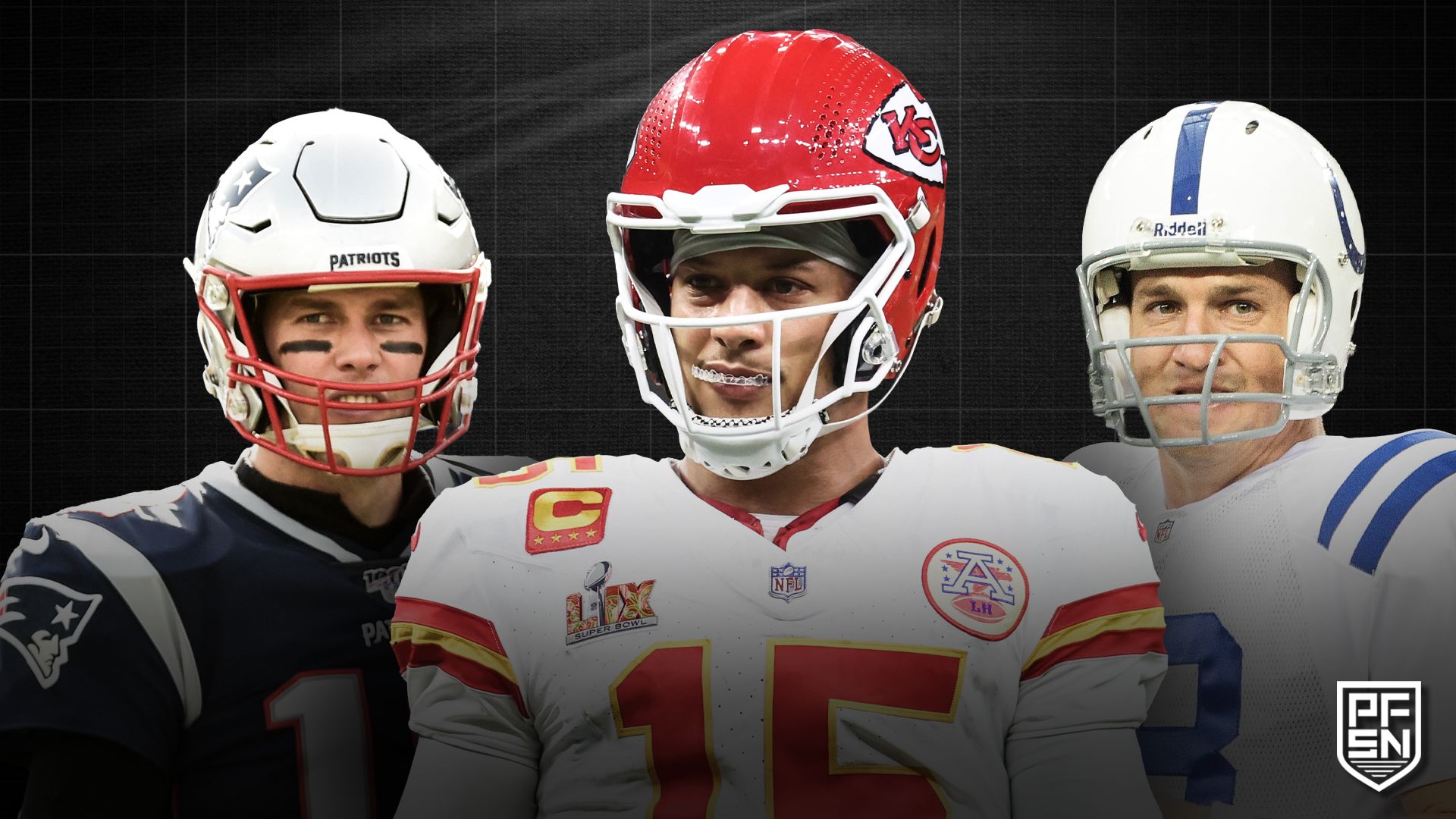
Comparing quarterback play across different eras can be a difficult task. Traditional stats still dominate the headlines, but advanced metrics offer a more nuanced look at who truly played at the highest level. To eliminate bias, we used our proprietary QB+ metrics to evaluate quarterback seasons from this century.
QB+ is a formula that assigns a score and letter grade to every quarterback’s individual performance. The metric molds stats that include success rates when pressured, third-down conversion rate, and pocket production. The added wrinkle in this insight is quantifying “clutch.” We’ve used timeliness-based stats to account for score and situation.
To avoid small sample-size anomalies, we’ve set the bar at 200 regular-season pass attempts to qualify for a ranking but also discussed quarterbacks who did not reach that mark where they are relevant.
Here is the highest-grade quarterback for all 32 NFL teams since 2000.
Arizona Cardinals: Carson Palmer (2015)
The Arizona Cardinals haven’t had many strong quarterback seasons since 2000. Carson Palmer’s 2015 campaign was the only one to earn a score inside the top 100 in our QB+ metric (88.8 score, 62nd overall). That year, Palmer delivered the best showing of his five-year stint with the Cardinals, leading them to a 13-3 record.
Palmer threw for a career-high 4,671 yards and 35 touchdowns with 11 interceptions, leading the league in net yards per pass attempt (8.04) and yards per completion (13.7). Those numbers helped Palmer earn his third and final Pro Bowl selection and a second-place finish in MVP voting at age 36.
From an advanced stats view, Palmer graded fairly well. His +0.26 EPA per dropback and 47.9% conversion rate on third and fourth downs were the best of his time in Arizona. Palmer also posted the second-best QB+ score by a Cardinals quarterback (2014).
Atlanta Falcons: Matt Ryan (2016)
The Atlanta Falcons had one of the worst defenses in the NFL during the 2016 season, but Matt Ryan and the offense made up for it, carrying the team to an 11-5 record and a Super Bowl appearance.
Ryan finished with a career-high 4,944 passing yards, 38 touchdowns, and just seven interceptions while completing 69.9% of his throws. He led the league in passer rating (117.1) and net yards per pass attempt (8.25), winning NFL MVP.
While Ryan posted a -0.09 EPA per dropback in the first half of games, his +0.37 mark in the second half showed he could finish strong. He didn’t run often (just six designed runs), but made the most of them with a +0.32 EPA per rush. The four-time Pro Bowler owns 11 of Atlanta’s top 12 QB+ scores since 2000, with Michael Vick recording the other.
Baltimore Ravens: Lamar Jackson (2019)
Lamar Jackson took over as the full-time starter for the Baltimore Ravens and completely rewrote what was possible for an NFL quarterback. His MVP season redefined dual-threat dominance.
Jackson led the league with 36 touchdown passes and a wild 6.9 yards per carry for 1,206 yards, the most ever by a quarterback in a season. He ran one of the most electric offenses in the NFL, guiding Baltimore to a 14-2 record. His 113.3 passer rating ranked among the best in league history, and he did it all in just 15 games.
Jackson’s 2019 advanced stats were elite, giving him the fifth-best QB+ score ever. He posted a +0.47 EPA per dropback from a clean pocket and converted 50.3% of third and fourth downs. His 112 designed runs helped him finish with a +0.3 EPA per rush, and most teams had no answer for it.
Buffalo Bills: Josh Allen (2024)
After losing wide receivers Stefon Diggs and Gabe Davis, many thought the Buffalo Bills’ offense would take a step back in 2024. But the team scored 30.88 points per game in the regular season, led by quarterback Josh Allen.
It wasn’t a career year in raw stats, but Allen led Buffalo to a 13-4 record and edged out Jackson for MVP. Allen totaled 40 touchdowns (28 passing and 12 rushing), with a 101.4 passer rating, the second-best of his career. He threw only six interceptions, showing growth after hitting double digits in five of his first six seasons.
Never forget when Josh Allen made one of the WILDEST plays in SNF history! 😱
Happy birthday to the reigning MVP. #BillsMafia pic.twitter.com/6iyScdaz5V — NBC Sports (@NBCSports) May 21, 2025
Allen’s dual-threat skills helped him post the eighth-best QB+ score ever (96.3). He had 51 designed runs and a +0.56 EPA per rush, his second-best career mark. He also held up as a passer, with a -0.05 EPA per dropback under pressure and +0.37 from a clean pocket.
Carolina Panthers: Cam Newton (2015)
Cam Newton’s athleticism and dual-threat game were on full display in 2015. Even without top wideout Kelvin Benjamin, who went down in the preseason, Newton carried the Carolina Panthers’ offense with 3,837 passing yards, 636 rushing yards, and 45 total touchdowns.
Newton was a force on the ground, finishing with a +0.33 EPA per rush on 88 designed runs. His passing numbers weren’t dominant but held up — +0.14 EPA per dropback, which rose to +0.27 in close games. His 88.2 QB+ score narrowly beat his 2012 campaign and ranked 70th all time.
Newton’s MVP year powered Carolina to a 15-1 regular season and a Super Bowl appearance. His ability to lead with both his arm and legs made 2015 the clear peak of his career.
Chicago Bears: Josh McCown (2013)
No one is confusing Josh McCown with an elite quarterback, but he made the most of his shot with the Chicago Bears in 2013. He played in eight games and started five after Jay Cutler was hurt.
McCown threw for 1,829 yards, 13 touchdowns, and one interception, with a 66.5% completion rate and a 109.0 passer rating, leading the Bears to a 3-2 record as a starter.
Though he wasn’t the full-time starter, McCown showed poise when called on. He finished with a +0.34 EPA per dropback, which jumped to +0.40 in close games. He converted 47.6% of third and fourth downs. It was a true outlier season, earning the 16th-best QB+ score ever (93.6).
Cincinnati Bengals: Joe Burrow (2021) and Andy Dalton (2015)
The Cincinnati Bengals have had solid QB play this century, even if the record didn’t always show it.
Both Andy Dalton and Joe Burrow have posted 86.1 QB+ scores. Dalton only played 13 games in 2015 but finished with 3,250 yards, 25 touchdowns, seven interceptions, and a 66.1% completion rate. His 106.2 passer rating was the best of his career, and he had a +0.23 EPA per dropback and averaged 8.1 net yards per pass attempt.
Burrow, meanwhile, bounced back in a big way in 2021 after his rookie injury. He threw for 4,611 yards and 34 touchdowns with 14 picks. He also took 51 sacks, the most in the league. Still, he led the NFL with a 70.4% completion rate and had a +0.40 EPA per dropback when kept clean.
Cleveland Browns: Baker Mayfield (2020)
The Cleveland Browns haven’t had much success at quarterback this century. All of their QB+ scores rank outside the top 200, but Baker Mayfield’s 2020 season (81.5) leads the pack.
That year, Mayfield threw for 3,563 yards, 26 touchdowns, and eight interceptions with a 62.8% completion rate and a 95.9 passer rating. His advanced numbers were a mix — +0.37 EPA per dropback in close games and +0.36 with a clean pocket, but -0.58 when pressured.
Still, Mayfield led the Browns to an 11-5 record, their best since 1994. It may not stack up against all-time greats, but Cleveland should be thankful for what he gave them.
Dallas Cowboys: Tony Romo (2006)
Believe it or not, Tony Romo has two of the 30 best QB+ seasons ever. While his 2014 campaign was strong, his 2006 season stands out. That year, Romo started 10 games, including his first since joining the Cowboys in 2004. He finished with 2,903 passing yards, 19 touchdowns, and 13 interceptions, with a 65.3% completion rate.
While the interception total was high, Romo’s advanced stats were among the best the metric has seen. He got off to quick starts, posting a +0.74 EPA per dropback in first halves, and in close games (+0.42). His 50.9% conversion rate on third and fourth downs was also the best of his career.
Romo’s late-down and clutch performance made 2006 his most prolific QB+ year. He holds the top three Cowboys QB+ scores, with Dak Prescott’s 2019 season next in line.
Denver Broncos: Peyton Manning (2013)
Peyton Manning’s 2013 season is often called one of the most dominant in NFL history. Coming off a serious neck injury, he rewrote the record books with 5,477 passing yards and 55 touchdowns — both still NFL records.
Manning won his fifth MVP and led one of the most explosive offenses ever. He showed off from Week 1, tying the single-game TD record with seven against the Ravens. The Denver Broncos finished 13-3 and appeared in the Super Bowl.
Manning dominated in first halves with a +0.86 EPA per dropback. He was strong in close games, too, with a +0.25. Manning recorded three of the four best QB+ seasons in team history, with Brian Griese holding the other.
Detroit Lions: Jared Goff (2024)
Matthew Stafford had great years in Detroit, but no Lions QB matched Jared Goff’s 2024 season. It helped that Goff had top talent around him — Amon-Ra St. Brown, Jahmyr Gibbs, Sam LaPorta, and Jameson Williams — with the group finishing No. 1 in PFSN’s Offense+ metric.
Goff threw for 4,629 yards, 37 touchdowns, and 12 interceptions, completing a career-best 72.4% of his passes. His 111.8 passer rating was also a personal best. He posted a +0.27 EPA per dropback and 8.2 net yards per attempt. And on third and fourth downs, he converted at a 48.5% clip.
Goff’s numbers under pressure weren’t great (-0.21 EPA), but with time, he carved defenses up, posting a 0.5 EPA per dropback from a clean pocket. A five-interception game against the Houston Texans hurt his MVP hopes, but Goff was consistent otherwise.
Green Bay Packers: Aaron Rodgers (2011)
Aaron Rodgers’ 2011 season was a clinic. He went 14-1 as a starter and threw for 4,643 yards, 45 touchdowns, and six interceptions. He completed 68.3% of his passes and posted what was then a record 122.5 passer rating — all while resting the final regular-season game.
Rodgers’ 98.6 QB+ score ranks fourth all time. He had a +0.40 EPA per dropback, which jumped to +0.52 in tight games. He also averaged 8.8 net yards per attempt.
Rodgers’ ability to raise his play when it mattered helped make 2011 a standout. He earned MVP and added to his case as one of the most talented passers ever. The Green Bay Packers didn’t make a deep playoff run, but his individual season was unforgettable.
Houston Texans: Sage Rosenfels (2007)
Sage Rosenfels isn’t the first name that comes to mind with Texans quarterbacks, but his 2007 season ranks above those of Deshaun Watson, Matt Schaub, and even C.J. Stroud’s rookie year.
Rosenfels played in nine games, starting five, yet still posted an 89.1 QB+ score — 56th all time. His basic stats were modest: 1,684 yards, 15 touchdowns, 12 interceptions, and an 84.8 passer rating. Yet, his advanced stats told a different story.
Rosenfels had a huge boost in close games, posting a 1.08 EPA per dropback (no Texans QB has come close to that). He also converted 50.7% of third and fourth downs. The small sample size definitely helped, but the numbers hold.
Indianapolis Colts: Peyton Manning (2004)
Manning’s 2004 season was one of the most efficient ever and earned the top QB+ score since 2000 — a record-setting 99.7. He led a high-powered Indianapolis Colts offense that included Marvin Harrison, Reggie Wayne, and Edgerrin James to go 12-4.
Manning broke Dan Marino’s single-season touchdown record with 49, doing it in just 16 games. His 9.9% touchdown rate was the highest of his career, and he led the NFL with 9.2 yards per attempt.
Manning’s advanced numbers were elite. He posted a +0.53 EPA per dropback in the second half of games and +0.44 in close ones. He also converted 45.4% of third and fourth downs.
A perfect QB+ score may be impossible, but Manning came closer than anyone else.
Jacksonville Jaguars: David Garrard (2007)
David Garrard owns the Jacksonville Jaguars’ two best QB+ seasons since 2000, with 2010 also in the mix. However, his 2007 season (87.5 score) gets the edge.
Garrard only had two full seasons in the NFL, and 2007 wasn’t even one of them. Nevertheless, he put up solid numbers. He finished with 2,509 passing yards, 18 touchdowns, and just three interceptions.
Garrard also completed 64% of his throws and had a 102.2 passer rating. He posted a +0.21 EPA per dropback and was +0.14 in close games, with a 48.5% conversion rate on third and fourth downs.
Jacksonville’s offense leaned on Fred Taylor and Maurice Jones-Drew, who combined for 1,970 rushing yards. Still, Garrard added value as a runner, too. On just 19 designed runs, he posted a +0.87 EPA per rush.
Kansas City Chiefs: Patrick Mahomes (2018)
No shock here, as Patrick Mahomes leads the way for the Kansas City Chiefs. He’s logged four of the team’s top five QB+ seasons, but 2018 is No. 1 with a 97.4 score (No. 6 overall) and an A+ grade.
That was Mahomes’ first year as a full-time starter, which makes it even more remarkable. At 23, he lit up the NFL with 5,097 yards and 50 touchdowns. He became the second player after Manning to hit both in the same season and just the third ever with 50 passing scores.
Mahomes had multiple six-touchdown games and threw at least three in 10 games. He came through in key moments, with a +0.41 EPA per dropback in close games and a 51.9% conversion rate on third and fourth downs. His legs added more value, with a +0.37 EPA per rush.
Las Vegas/Oakland Raiders: Rich Gannon (2000)
Rich Gannon owns the three best Raiders QB+ scores this century, with 2001 and 2002 being the other two seasons. His 2000 campaign stands out among the rest, though, as he finished with a 91.5 mark, which ranked 28th overall.
The Raiders finished with a 12-4 record in 2000, and the team not reaching the Super Bowl doesn’t take away from the fact that this was a top-three scoring offense that year. The core nucleus of Gannon, Tyrone Wheatley, Tim Brown, and Andre Rison led the way for Oakland. Gannon threw for 3,430 yards, 28 touchdowns, and 11 interceptions, on the way to earning Pro Bowl and All-Pro nods.
Gannon put up strong advanced numbers across the board. He was a clutch performer, posting a +0.38 EPA per dropback in close games. He also displayed an ability to make plays with his legs, finishing with a solid +0.51 EPA per rush on 83 designed runs.
The Raiders franchise hasn’t had much stability since Gannon, and it’s been 21 years since he retired from the NFL.
Los Angeles/San Diego Chargers: Drew Brees (2004)
Drew Brees played just five seasons for the Chargers franchise, but he certainly left his mark during his time in San Diego. Brees’ age-25 season stands out as his most efficient with the team and the best by any Chargers quarterback since 2000, narrowly edging out Philip Rivers’ 2009 campaign.
Brees started 15 games in 2004, leading San Diego to an 11-4 record during that span. He threw for 3,159 yards, 27 touchdowns, and just seven interceptions while completing 65.5% of his attempts. His 104.8 passer rating was also the best of his young career at that point.
Brees’ play was solid throughout the year, but he stepped things up in the second half of games (+0.36 EPA per dropback). He also had a +0.36 EPA per dropback in close games and put up strong numbers on third and fourth downs (46% conversion rate).
Brees’ 92.1 QB+ score ranked 23rd in the history of the metric. His performance in 2004 earned him Comeback Player of the Year honors and his first of 13 career Pro Bowl selections.
Los Angeles/St. Louis Rams: Kurt Warner (2000)
Kurt Warner’s 1999 season was on another level, but it just missed the cutoff. Still, he put up strong numbers in 2000 despite missing five games in the middle of the year.
Warner finished the 2000 season with 3,429 yards and 21 touchdowns in just 11 games. His 18 interceptions were a considerable jump from the 13 picks he threw the previous season, but he did lead the NFL in multiple categories, including completion percentage (67.7%) and yards per completion (14.6).
As the field general for the “Greatest Show on Turf,” Warner had the luxury of playing alongside Hall of Famer-caliber talents like Marshall Faulk, Isaac Bruce, and Torry Holt. Warner’s 9.03 net yards per pass attempt was easily the best mark of his career. He also posted career-highs in EPA per dropback (+0.29) and third and fourth-down conversion rate (53.20%).
Even though the Rams’ season didn’t end how they planned, there’s no doubt that this offense is one of the best we’ve ever seen. And it wouldn’t have been the same without Warner running the show.
Miami Dolphins: Jay Fiedler (2001) and Tua Tagovailoa (2022, 2024)
The Miami Dolphins had a three-way tie for the best QB+ season, as Jay Fiedler recorded a score of 84.4 in 2001, and then Tua Tagovailoa posted the same score in 2022 and 2024.
When looking at Fiedler’s career, his 2001 campaign was a bit of an outlier, as he threw for a career-high 3,290 yards and 20 touchdowns. He also threw 19 interceptions, but his +0.46 EPA per rush and +0.32 EPA per dropback in close games helped inflate his score.
Both of Tagovailoa’s best seasons were limited due to injuries, having played just 13 games in 2022 and 11 games in 2024. However, his numbers were mostly solid when he was on the field.
In 2022, Tua led the NFL in net yards per pass attempt (8.04), QB rating (105.5), yards per completion (13.7), and touchdown rate (6.3%). He was dominant in the first half of games (+0.45 EPA per dropback) and was +0.33 EPA with a clean pocket.
In 2024, Tagovailoa threw for 2,867 yards, 19 touchdowns, and seven interceptions in 11 games, leading the NFL with a 72.9% completion rate. He was the best quarterback in the league when facing pressure, but had just a 0.27 EPA/DB from a clean pocket (15th).
Minnesota Vikings: Daunte Culpepper (2004)
Daunte Culpepper is a QB+ legend, recording two top-10 season scores. Yet, it’s his 2004 campaign that stands tall and ranks third all time.
Culpepper led an explosive Minnesota Vikings offense that ranked top 10 in scoring and featured a dynamic wide receiver duo of Randy Moss and Nate Burleson.
Culpepper benefited from a pass-heavy attack and put up some elite numbers through the air. He finished with 4,717 passing yards and 39 touchdowns to just 11 interceptions, leading the league in passing yards and pass attempts. His 110.9 passer rating was the best of his career by far (87.8 career average).
Culpepper also posted a career-high +0.32 EPA per dropback that year. He stepped up his game in big moments, finishing with a +0.47 EPA in close games and a 51.9% conversion rate on third and fourth downs.
To put it further into perspective, Culpepper accounted for five of Minnesota’s top seven QB+ scores since 2000.
New England Patriots: Tom Brady (2007)
Tom Brady’s 2007 season was nothing short of legendary. Even though the New England Patriots got knocked off by the New York Giants in Super Bowl 42, Brady’s play helped lead them to a 16-0 regular-season campaign.
Brady posted the second-best QB+ rating in the history of the metric (99.5), behind only Manning in 2004. He became the first quarterback in NFL history to throw for 50 touchdown passes in a single season and led the league in completion rate (68.9%), passer rating (117.2), and passing yards (4,806).
Brady’s counting stats were prolific, but his advanced numbers in big moments truly set him apart. The future Hall of Famer finished with the second-best overall QB+ clutch rating that year, with a +0.42 EPA per dropback in close games and a 52.5% conversion rate on third and fourth downs.
It’s only right that Brady earned MVP honors in 2007.
New Orleans Saints: Drew Brees (2011)
Brees’ 2011 campaign stands out as the crown jewel of his Hall of Fame career. That season, he accomplished the rare quarterback “triple crown,” leading the NFL in passing yards (5,476), touchdowns (46), and completion percentage (71.2%). His yardage total shattered Marino’s 27-year record and edged out Brady, who also broke the mark that same year.
Brees guided the New Orleans Saints to a 13-3 record and became just the second quarterback ever to surpass 5,000 passing yards and 40 touchdowns in the same season. It was also his second of an NFL-record five 5,000-yard seasons.
Brees is a legend in New Orleans. In terms of QB+, he posted each of the Saints’ 14 best quarterback seasons since 2000. In 2011, he posted a +0.44 close game EPA per dropback and a 54.8% third and fourth-down conversion rate, as well as 8.1 net yards per pass attempt.
Brees’ 2011 season remains one of the most prolific campaigns in NFL history.
New York Giants: Eli Manning (2009)
In terms of efficiency, the Giants haven’t had any elite QB play this century. The group doesn’t have any scores that rank in the top 100 of the QB+ metric’s all-time scores, but Eli Manning’s 2009 season remains the best in franchise history.
In 2009, Manning threw for a then-career-high 4,021 yards, 27 touchdowns, and 14 interceptions. He finished with a 62.3% completion rate and a 93.1 passer rating, both of which were among the better marks of his career.
Manning’s performance in the clutch was his most redeeming quality that year, recording a +0.31 EPA per dropback in close games. He also converted on a respectable 44.6% of third-down and fourth-down plays.
It’s interesting that Manning’s most efficient campaign came during an 8-8 season for the Giants, one that saw them miss the playoffs. He also received a better score in 2009 than he did in any of his Pro Bowl seasons.
New York Jets: Chad Pennington (2002)
No New York Jets quarterback has come close to Chad Pennington’s 90.0 QB+ score from 2002. The Marshall product shined in his first season as the full-time starter, throwing for 3,120 yards, 22 touchdowns, and six interceptions. He also led the league in completion rate (68.9%) and passer rating (104.2).
Pennington posted a +0.27 EPA per dropback, the best mark of his career. He also had 7.5 net yards per attempt — the highest by a Jets QB this century. In tight moments, he recorded a +0.33 EPA per dropback. And while he only had 16 designed rushes, Pennington made the most of them with a +0.43 EPA per carry.
Pennington’s 2002 season may not have been flashy, but his QB+ score ranked 43rd all time. The next closest Jets QB? Ryan Fitzpatrick in 2015, who ranked 206th.
Philadelphia Eagles: Nick Foles (2013)
Nick Foles will always be a Philadelphia Eagles legend for delivering the franchise’s first Super Bowl win in 2017, but his best regular season came in 2013. That year, he posted a 92.1 QB+ score — the best by any Eagles QB since 2000, ahead of strong seasons from Jalen Hurts and Carson Wentz.
Foles started 10 games and finished with 2,891 passing yards, 27 touchdowns, and just two interceptions. He led the NFL in touchdown rate (8.5%), yards per completion (14.2), and passer rating (119.2). His second-half performance stood out, jumping from +0.14 EPA per dropback in the first half to +0.53 in the second.
Foles also delivered in the clutch, with a +0.79 EPA per dropback in close games. He earned his only Pro Bowl nod for that season.
Pittsburgh Steelers: Ben Roethlisberger (2007)
You can’t talk Pittsburgh Steelers football since 2000 without mentioning Ben Roethlisberger. He owns 13 of Pittsburgh’s top 14 QB+ scores, with only 2001 Kordell Stewart cracking the list otherwise.
Roethlisberger’s 89.4 score ranks 52nd all time. In 2007, he threw for 3,154 yards, 32 touchdowns, and 11 interceptions, completing 65.3% of his passes. His 104.1 passer rating was the highest of his 18-year career.
Roethlisberger posted a +0.24 EPA per dropback, the second-best of his career. He elevated in tight moments, with a +0.41 in close games. He converted 48.8% of third and fourth downs. Even on just seven designed runs, Roethlisberger added value with a +0.54 EPA per rush.
San Francisco 49ers: Brock Purdy (2023)
Brock Purdy may have entered the league as “Mr. Irrelevant,” but his 2023 season was vital to the San Francisco 49ers’ Super Bowl run. That season, Purdy posted a 12-4 record as a starter and threw for 4,280 yards, 31 touchdowns, and 11 interceptions. He completed 69.4% of his passes and led the NFL in passer rating (113.0), TD rate (7.0%), yards per completion (13.9), and net yards per attempt (8.74).
Purdy had some weak spots — notably a -0.17 EPA per dropback in close games and -0.15 when pressured — but he excelled when protected (+0.54 EPA/DB) and on the ground (+0.81 EPA per rush). Love him or doubt him, Purdy delivered when it counted.
Seattle Seahawks: Russell Wilson (2015)
The 2015 season marked a turning point for Russell Wilson. Known for leading a team built around defense, he proved he could carry the offense, too.
Wilson threw for 4,024 yards and 34 touchdowns with just eight interceptions. His 110.1 passer rating was the best in the NFL that year. He also added 553 rushing yards and went on a hot streak, throwing 19 touchdowns without a pick from Weeks 10 to 14.
Wilson’s +0.18 EPA per rush wasn’t his best, but his passing growth stood out. He posted a +0.23 EPA per dropback and a +0.39 in close games. That season earned Wilson an 89.4 QB+ score and a B+ grade.
Tampa Bay Buccaneers: Ryan Fitzpatrick (2018)
Mayfield nearly claimed this spot for 2024, but Ryan Fitzpatrick’s 87.4 QB+ score from 2018 still leads the way. Fitzpatrick started seven games and played in eight, which is just enough to qualify.
Despite a 2-5 record as a starter, Fitzpatrick threw for 2,366 yards, 17 touchdowns, and 12 interceptions while completing 66.7% of his passes. He also led the NFL in net yards per attempt (8.81) and yards per completion (14.4).
Fitzpatrick’s advanced numbers weren’t elite, with a +0.17 EPA per dropback and a 44.9% third/fourth-down conversion rate. But “Fitzmagic” showed up late in games, posting a +0.32 EPA per dropback in close situations.
Tennessee Titans: Steve McNair (2003)
Steve McNair and Ryan Tannehill each had strong cases, but McNair’s 2003 season gets the edge with an 89.3 QB+ score. He led the Tennessee Titans to a 12-4 record and a trip to the Divisional Round.
That year, McNair started 14 games, throwing for 3,215 yards, 24 touchdowns, and seven interceptions. He led the NFL in net yards per attempt (7.42), yards per completion (12.9), and passer rating (100.4) — the best of his career.
McNair showed up in big moments, posting a +0.36 EPA per dropback in close games. He only had 18 designed runs but still managed a +0.75 EPA per rush. With Eddie George leading the run game, McNair was able to thrive in all areas.
Washington Commanders: Jayden Daniels (2024) and Robert Griffin III (2012)
Washington had two quarterbacks post identical 87.4 QB+ scores — and both did it as rookies: Robert Griffin III in 2012 and Jayden Daniels in 2024.
Griffin burst onto the scene with 3,200 yards, 20 touchdowns, and five interceptions while completing 65.6% of his passes. He had a 102.4 passer rating and added 815 rushing yards and seven additional scores. Griffin’s passing EPA wasn’t elite (+0.22), but his +0.38 EPA per rush pushed his grade up.
JAYDEN DANIELS WITH A HAIL MARY TO BEAT THE BEARS AS TIME EXPIRES 🤯
WHAT HAVE WE JUST WITNESSED?!?!?! (via @NFL) pic.twitter.com/xuSQsWlODR — SportsCenter (@SportsCenter) October 27, 2024
Daniels was just as electric in 2024. He ranked eighth in EPA per dropback (+0.15), ninth from a clean pocket (+0.30), and sixth under pressure (-0.11). Like Griffin, Daniels won Offensive Rookie of the Year. This time, the team hopes the success sticks.