
In every fantasy football format, running backs who catch passes are desirable assets. While it’s more pronounced in PPR, a target is worth more than a carry even in non-PPR. We’ve gone through all 16 NFC teams to pinpoint the best pass-catching RB on each of them.
Which Running Backs Are the Best Pass-Catching Options on Each NFC Team in 2024
Arizona Cardinals: James Conner
The Cardinals don’t really have a clear receiving back. The past two seasons, they’ve used James Conner in a three-down role. Although Conner’s target share was only 8% last season, it was 11.6% in 2022, which was 14th in the league.
The main addition the Cardinals made to their backfield was adding Trey Benson in the third round of the NFL Draft. However, he projects more as a pure runner, as his highest target share in a college season was just 6.5%. If Benson shines as a receiver, it would be quite a surprise.
Atlanta Falcons: Bijan Robinson
As underwhelming as Bijan Robinson’s rookie season was (thanks to Arthur Smith’s gross incompetence), he saw plenty of volume as a receiver. Robinson’s 17.2% target share was third in the league. That’s mighty impressive for a rookie, let alone a running back who only saw a 52.5% opportunity share in his team’s backfield.
Robinson actually led all running backs, not just rookies, in routes run. If he maintains similar passing game usage this season with Kirk Cousins at quarterback, the sky is the limit for his production.
Carolina Panthers: Chuba Hubbard
The Panthers are a bit of an unknown this season. They drafted Jonathon Brooks in the second round, making him the first running back off the board. However, he is going to open the season either on the PUP list or as an inactive as he works his way back from a November ACL tear. This leaves Chuba Hubbard in the RB1 role to start the season.
Last year, Hubbard led the team with an 8.2% target share. Hubbard should open the season in a three-down role. However, it remains to be seen how much work Hubbard receives once Brooks is back and acclimated.
We can reasonably infer Hubbard will remain in the role, though. Brooks wasn’t a prolific receiver in college. Now, to be fair, he spent two of his three collegiate seasons behind Bijan Robinson. But even in Brooks’ lone season as the clear lead back, he only commanded a 6.3% target share. That’s not a profile that screams passing-down back at the NFL level.
Chicago Bears: Roschon Johnson
The Bears are one of the trickier teams to decipher. The only thing we can say definitively is that it won’t be Khalil Herbert. It could easily be D’Andre Swift, whose best attribute was his receiving ability coming out of college. The reason I think it will be Roschon Johnson is due to the way Swift has been used in each of the past two seasons.
In 2021, Swift earned a career-high 18.4% target share. That dropped to 15.1% in 2022. Then, in 2023 with the Eagles, Swift’s target share dropped to 10%. The Eagles were right smack in the middle in targeting running backs with a 17% target share. They chose not to throw to Swift.
Meanwhile, as a rookie, despite being limited to just 81 carries on the season (a paltry 31.3% opportunity share), Johnson garnered a 9.5% target share. Surprisingly, he was tied with Herbert for the team lead. Still, we can readily dismiss Herbert as the receiving back this season due to Swift’s addition.
If Johnson winds up operating as the passing-down back, he won’t have stand-alone value. Rather, he would merely serve to take a chunk out of Swift’s fantasy value.
Dallas Cowboys: Rico Dowdle
For the past three years, the Cowboys’ receiving back was Tony Pollard. Now that he’s gone, it will either be Rico Dowdle, whose career-high target share was last season’s 3.9%, or Ezekiel Elliott, who is 29 years old but saw a 15% target share last season.
Based on the comments we’ve gotten from Mike McCarthy, the team is not going to use Elliott as they did during his first run. He is best used in short-yardage situations. That doesn’t mean he won’t handle plenty of early-down work. But if there is going to be a timeshare, it makes sense that the younger, more dynamic Dowdle would be the preferred option on passing downs. If Elliott is out there, he would likely be pass-blocking anyway.
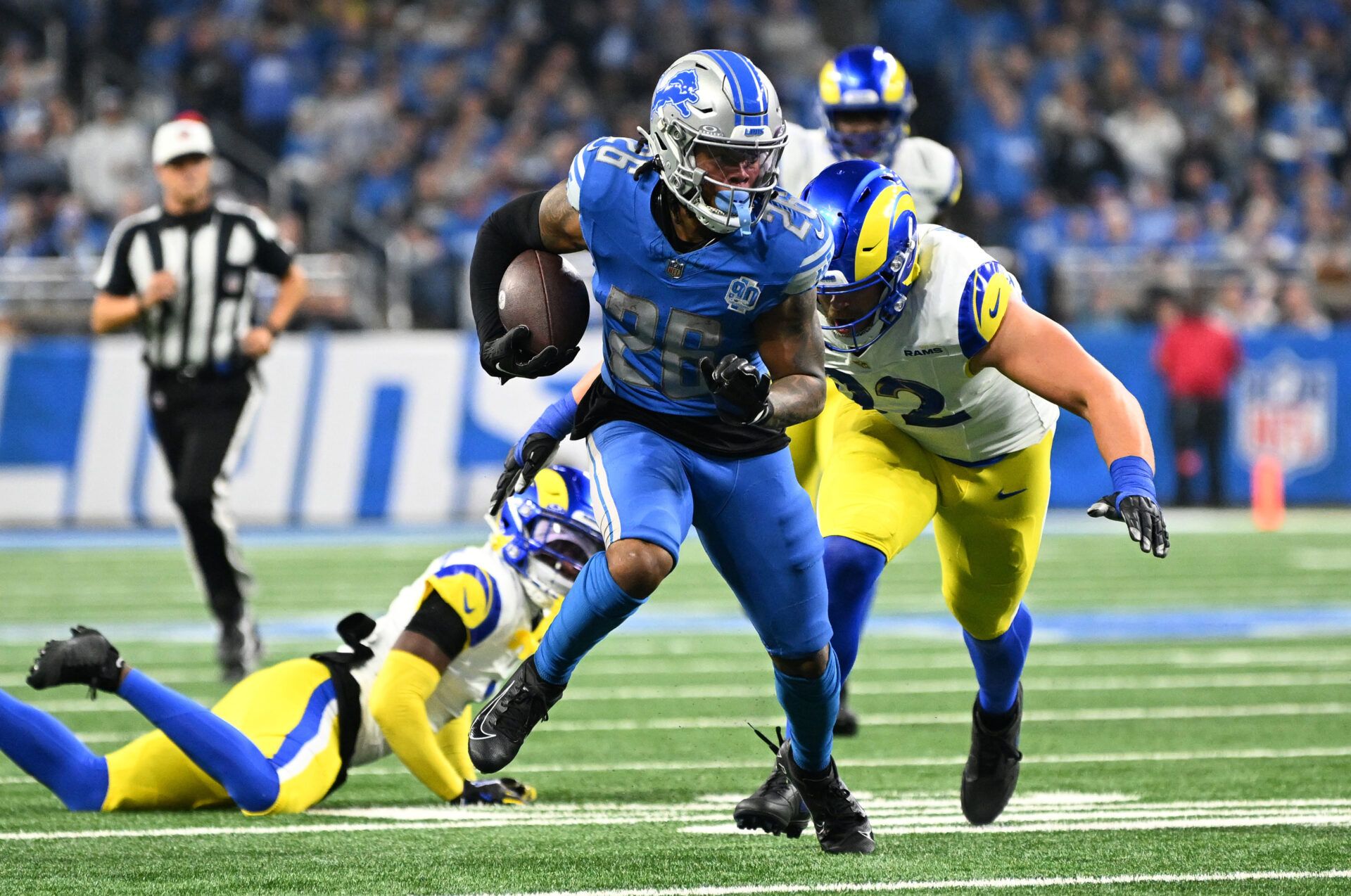
Detroit Lions: Jahmyr Gibbs
This one is as easy as it gets. The Lions have a two-man committee featuring Jahmyr Gibbs and David Montgomery. The latter is a pure two-down grinder. His target share was a mere 5.3% last season. Meanwhile, Gibbs saw a 14.1% target share, ninth in the league.
Furthermore, Gibbs said to reporters that one of his primary focuses in this training camp has been working on his receiving and improving in that area. It’s not as if anyone needed more of a reason to know Gibbs would be the Lions’ best receiving back. There is zero doubt about this one.
Green Bay Packers: Josh Jacobs
Make no mistake about it, the Packers’ backfield is going to be a timeshare. Josh Jacobs will lead it, but Matt LaFleur has always used two backs.
For most teams, the running back handling passing-down work is the one on the lower end of the timeshare. In Green Bay, Jacobs still projects to lead this backfield in receptions.
Behind Jacobs will be rookie MarShawn Lloyd and veteran plodder AJ Dillon. It actually wouldn’t be a complete shock if Dillon opened the season in the passing-down role. Despite Aaron Jones being a vastly superior receiver, Dillon was playing ahead of him on third-down passing situations for much of the season.
While Lloyd should be able to beat out Dillon for the RB2 role, he’s not exactly a receiver. Lloyd’s highest college target share was just 6.7%. Jacobs saw a 13.4% target share last season. It may not be that high with the Packers, but he should be considered the heavy favorite to lead this backfield in targets.
Los Angeles Rams: Kyren Williams
In reality, Kyren Williams is not a great receiver. He averaged 0.77 yards per route run last season, 37th in the league. His 32 receptions in 12 games were a product of volume. Yet, he’s still the best receiving back on the Rams.
How can this be? It’s the way Sean McVay utilizes his running backs.
Williams led all running backs in opportunity share at 83.9%. The Rams like to have one back who plays on all three downs. Even though Williams was incredibly inefficient with his targets, when Matthew Stafford checked it down, the ball went to Williams since he was almost always on the field. That is how he managed an 11.5% target share.
Williams will open this season in the same role he had last year. It’s possible he gets hurt or proves to be a fluke, resulting in Blake Corum overtaking him, but I’m not willing to predict that.
Minnesota Vikings: Aaron Jones
I’m expecting a relatively even split between Aaron Jones and Ty Chandler in terms of snaps and total touches in the Vikings backfield. But when it comes to who is going to handle the most receiving work, I have to give a strong edge to Jones.
While Jones has never been a high-volume receiving back, he’s always been a productive pass catcher. Before last season, he caught at least 47 passes for four consecutive years.
On the other hand, Chandler doesn’t have a rich history of pass-catching. Last season, Chandler did catch at least three passes in four of his final eight games. However, that was more of a product of circumstance than a deliberate intent to utilize him as a receiver. The only thing standing in the way of Jones leading this backfield in target share is his health.
New Orleans Saints: Alvin Kamara
Throughout his career, Alvin Kamara has always been a great pass catcher. As he’s gotten older, his efficiency has declined, and it’s noticeable. However, what hasn’t changed is his ability to catch the football.
Last season, Kamara was second in the league with a 19.3% target share. Derek Carr just checked it down to Kamara over and over again. Kamara averaged 1.73 yards per route run, fourth in the league, but only 6.2 yards per reception, 26th in the league.
The Saints’ two other backs are Jamaal Williams and Kendre Miller. Neither is even a slight threat to Kamara as the best pass-catching back on this team.
New York Giants: Devin Singletary
It’s difficult to project the Giants’ backfield in a post-Saquon Barkley world. Devin Singletary will definitely be the lead back, but will he be a three-down back? I genuinely don’t know.
Last season, the Texans were willing to use Singletary on all three downs at times. But by the end of the season, it was Dare Ogunbowale in the receiving back role.
If Singletary isn’t the receiving back for the Giants, the role would almost certainly go to rookie fifth-rounder Tyrone Tracy Jr. The Purdue product is a former wide receiver. In three of his four years at Iowa and one of his two at Purdue, he had more receptions than carries. If the Giants trust the rookie early, it won’t shock me if Tracy wound up topping Singletary in receptions.
Philadelphia Eagles: Saquon Barkley
The Eagles may very well pull Saquon Barkley on third downs or obvious passing situations. However, even if they opt to do that, Barkley should see enough work in the passing game on early downs to lead this team in receptions.
Barkley has always been a true three-down back. He is one of the best runners in the league and has a history of high target shares. Last year, he was at 15.3%.
Despite the fact that rushing quarterbacks throw to running backs less, Jalen Hurts targeted the RB position 16.5% of the time last season. The Eagles did not spend significant financial capital to sign Barkley to make him a glorified two-down grinder. Expect to see pass plays designed for Barkley, allowing him to easily lead the Eagles in targets.
San Francisco 49ers: Christian McCaffrey
If there is one team in the league where there is absolutely no doubt as to who the receiving back is, it’s the 49ers. Christian McCaffrey is arguably the greatest pass-catching back in NFL history.
Since entering the NFL, excluding the two years he was injured (2020 and 2021), McCaffrey has led all running backs in target share every year of his career. The 49ers may try and reduce McCaffrey’s workload to keep him fresh coming off a 400+ touch season, but absolutely no one is a threat to his role as the receiving back.
Seattle Seahawks: Zach Charbonnet
The Seahawks’ situation is not as straightforward as it may seem. Zach Charbonnet is the clear passing-down back. However, he and Kenneth Walker III saw near identical target shares last season (7.7% and 7.6%).
This year, we have a new coaching staff that drafted neither of these backs. The roles will likely be determined purely by performance; a true meritocracy.
Based on the skill sets of both backs, I give the edge to Charbonnet. The sophomore RB has a much stronger history of receiving, most notably an 11.2% target share his final season at UCLA. Walker had fewer than 20 receptions in all three of his collegiate seasons. The role likely belongs to Charbonnet.
Tampa Bay Buccaneers: Rachaad White
Last year, the Bucs had to put a lot on Rachaad White’s plate due to the simple fact that they didn’t have another NFL-caliber running back on the roster. In an effort to combat that, the team drafted Bucky Irving in the fourth round this season.
Interestingly, Irving was a very good pass catcher in college, earning a 12.7% target share in his final season at Oregon. Even so, it would be a major stretch to expect White’s passing-down role to be reduced. White was one of the worst runners in the league last season, but he was one of the best receivers. If anything, White deserves a higher target share than the 12.7% he saw last season.
Any role Irving can carve out would likely come at the expense of White’s early-down work. Fantasy managers can confidently expect White to be a prolific receiver once again.
Washington Commanders: Austin Ekeler
Was Austin Ekeler’s poor 2023 season a product of age-related decline or his early season high ankle sprain? We’ll probably find out this season. Regardless, Ekeler should dwarf Brian Robinson Jr. in target share.
Robinson was actually quite efficient as a pass catcher last season, leading all running backs in yards per reception at 10.2. His 1.72 yards per route run was fifth.
If the Commanders need Robinson to catch passes, he can. But Robinson is not the receiver that Ekeler is. Ekeler is one of the best receiving backs of all time. Last year was the first time since 2018 that Ekeler was outside the top five in target share. If he’s healthy this season, even if his ability is declining, he should at least be toward the top of the league and far ahead of Robinson.
