
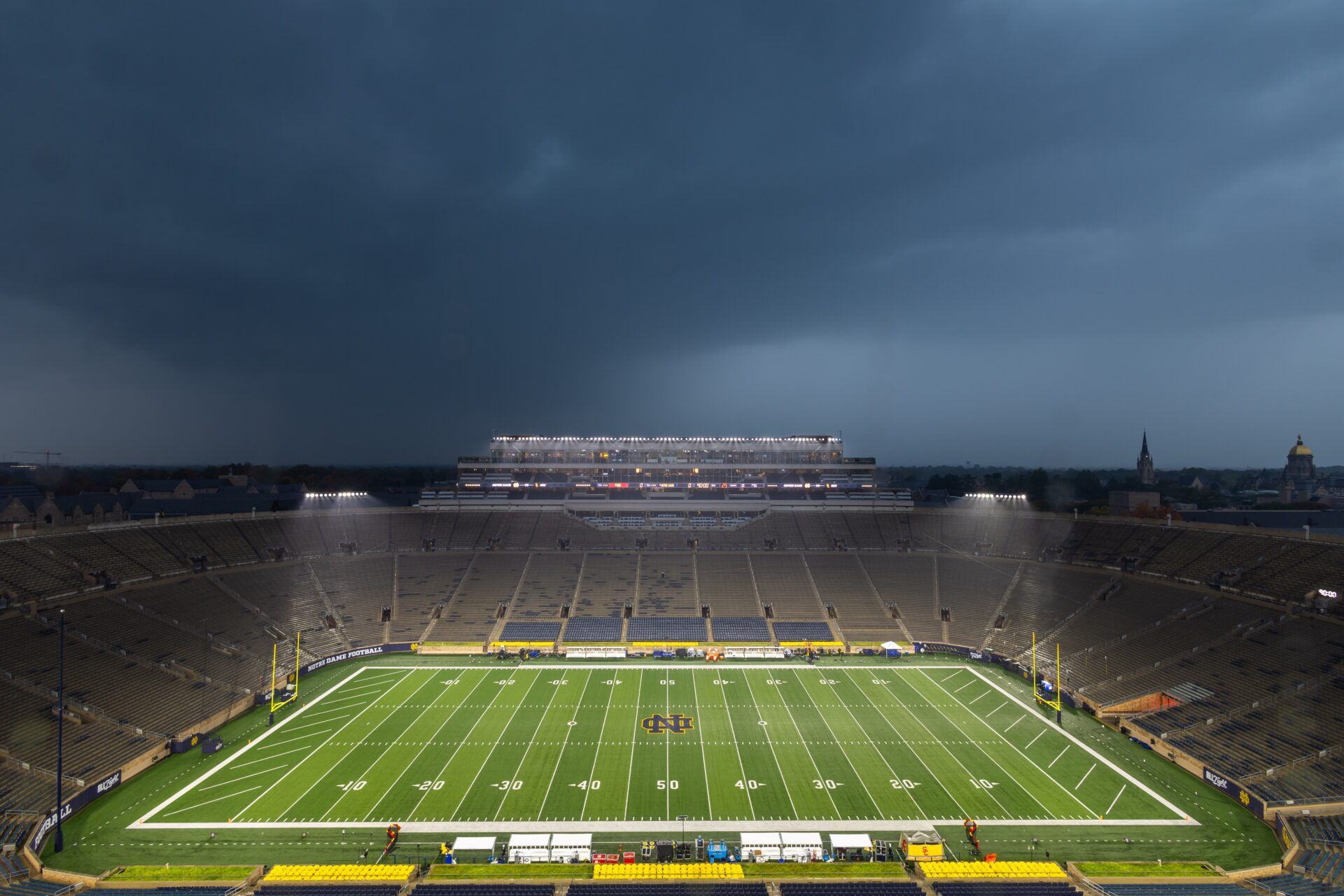
With the first busy day of the 2026 NCAA college football season happening on Saturday, a couple of games have already had to deal with weather delays.
The teams and players, of course, want to be on the field and get their seasons underway. Yet, the skies are not always friendly around a college football stadium. That leads to a question: Can a college football game be canceled due to rain and lightning?
NCAA Guidelines Around Weather-Related Cancellations
For instance, a game might be interrupted due to lightning in the stadium area. Teams are supposed to wait 30 straight minutes after a final lightning strike is recorded. Additionally, that lightning strike must happen within an 8-10-mile radius before officials allow a game to start again.
Should a lightning strike happen again while teams are back in the locker rooms, then the clock to restart the game will be reset.
PREDICT THE CFB SEASON: PFN’s Free CFB Playoff Predictor
What, though, happens if a weather delay is just too long? Head coaches, school officials, and the on-field referees will consult to determine whether it is safe to continue. There are games, such as non-conference games, where a decision to cancel can be made.
Conference games, though, are a different story. Why? Those conference games are important not only for determining who finishes first, but also for getting teams into the College Football Playoff. Therefore, it has to be a really bad situation for a cancellation to take place.
When looking at rescheduling a conference game, those are put at the top of the list. The weather rules are implemented to ensure that games are played safely and fairly.
So, what is the difference between a game being suspended and a game being canceled? For suspended games, they might be able to resume on the same day or potentially be moved to the next day. A cancellation decision typically involves both schools’ athletic administrators and conference officials, though the exact authority varies by conference.
In the SEC, for example, the Commissioner holds sole authority to declare a game canceled, postponed, or terminated, based on input from the conference office representative on site and in consultation with each school’s athletics director and game management personnel.
When it comes to player safety on the field, weather conditions such as lightning and other hazards must be factored into the decision.
DIVE IN: PFN’s NFL Draft HQ: Draft Prospect Analysis, Stats & Info
College football fans who are in person for games on Saturday will have to keep an eye on the skies around the stadium. Should weather, especially lightning strikes, become a major issue, then getting into safe spaces must be done quickly.
For fans watching at home, they might pull up a weather app to check and see if the weather conditions are changing during a delay.
