
There is a specific type of player that is incredibly difficult to rank. They could win you a championship or end upon waivers before your league’s trade deadline. The honest answer on which direction they go is closer to a coin flip. The distance between the ceiling and the floor is so vast that these players’ draft costs tells you almost nothing about what you are actually buying. Here are the players with the widest range of outcomes for the 2026 fantasy football season.
QB: Kyler Murray, Minnesota Vikings
ADP: QB17
No quarterback in this range splits the room quite like Kyler Murray. The Minnesota Vikings brought him in to compete, not to hand him the keys, and that is the entire problem for fantasy. If JJ McCarthy wins the job (unlikely), or if Murray loses it midseason the way he effectively did with the Arizona Cardinals, his managers are left holding a backup. Bench risk is the fastest way to torpedo a fantasy quarterback. Murray carries more of it than almost anyone at his price.
The health piece only widens the gap. Murray played just five games in 2025 and averaged a career-worst 15.6 PPG in them. A repeat of that availability turns a QB17 pick into a wasted one.
Now flip it over. When Murray has started and stayed upright, he has finished as a QB1 in six straight seasons, with a floor of 17.5 PPG in 2024 and peaks of 23.7 and 21.5 PPG in 2020 and 2021. He steps into Kevin O’Connell’s system with Justin Jefferson, Jordan Addison, and Jauan Jennings to throw to. O’Connell is the same coach who developed Sam Darnold into a Super Bowl winner.
The rushing is the tiebreaker. Murray averages 36.7 rushing yards per game and can add four to six scores on the ground, which is a floor a pocket passer simply cannot match. If Murray wins the job and stays healthy, a top-12 finish is the likely outcome, not the dream. That is the bet. The two sides of it could not look more different.
RB: TreVeyon Henderson, New England Patriots
ADP: RB22
TreVeyon Henderson is the cleanest example of this entire exercise. The talent is loud. As a rookie for the New England Patriots, he rushed for 911 yards and nine touchdowns on 5.1 yards per carry. He also set a franchise record with four rushing scores of 50-plus yards. Give him a real workload, and he can win you a week by himself.
The floor is just as loud, and just as ugly. Rhamondre Stevenson is still on the roster and still trusted. This exact backfield arrangement just carried New England to a Super Bowl. Henderson’s playoff snap shares came in at 38%, 40%, 7%, and 40%, while Stevenson lived on the field and produced. I have Henderson at RB27. More tellingly, I have Stevenson, whose own ADP sits at RB30, ranked ahead of him. Preferring the cheaper back in the same backfield is the loudest signal I can send.
START PREPARING: PFN’s Fantasy Mock Draft Simulator
Here is where the range explodes. Stevenson comes with a lengthy fumbling history. One injury or one lost fumble reopens the job in a hurry. Should that happen, Henderson has the juice to smash his RB22 cost and pay off like a mid-round steal. Bet on it at your own risk, because the version where Stevenson simply holds the job leaves Henderson as a bench stash you probably won’t cut, but who will burn a hole on your roster all season.
Bucky Irving, Tampa Bay Buccaneers
ADP: RB20
No player on this list divides even our own staff like Bucky Irving. Our consensus lands him at RB20, but that number papers over a genuine chasm: Kyle Soppe ranks him RB14, while I have him all the way down at RB29. When two analysts staring at the same profile disagree by 15 spots, you are looking at the definition of a wide range.
The ceiling is his rookie production. From Week 6 of 2024 through his Week 4 injury last season, Irving was a fantasy RB1; a do-it-all back who caught passes and pounded the ball at the goal line for the Tampa Bay Buccaneers. He is only 24. Health alone could drag that version back to the surface.
The floor is everything that came after the 2025 shoulder injury. Irving’s efficiency cratered to 3.4 yards per carry, dead last among 33 qualifying backs. His receiving role evaporated at the same time. Tampa Bay then spent the offseason signing Kenneth Gainwell for passing downs and bringing back Sean Tucker for goal-line work. If Gainwell owns third downs and Tucker owns the red zone, Irving is a two-down grinder with no path to points. That is exactly the archetype you never want to draft. Volume without receptions or touchdowns is how a mid-round pick becomes a Round 12 result.
Bhayshul Tuten, Jacksonville Jaguars
ADP: RB25
I called Bhayshul Tuten one of fantasy’s biggest wild cards for a reason. The Jacksonville Jaguars cleared the runway by letting Travis Etienne walk. They also finished as the No. 6 scoring offense last season. Hand the lead job in a Trevor Lawrence and Liam Coen offense to a back with 98th-percentile speed and 97th-percentile burst and the upside sells itself.
The catch is that we barely know if Tuten is any good. He managed 93 touches and 5.9 PPG as a rookie, posted a discouraging 3.7 yards per carry, and could not pry the passing-down role away from a seventh-round pick in LeQuint Allen. Jacksonville also imported Chris Rodriguez, who quietly took a starting job in Washington last year and ran for 4.5 yards per carry. That leaves a real chance Tuten is buried in a three-way committee where Rodriguez grinds early downs, Allen handles passing situations, and the lead role never materializes.
STAY UPDATED: PFN’s Fantasy News Tracker
Tuten’s RB25 cost is fair, which is precisely the point. I have him at RB24, right on top of consensus, because I do not have a strong read either way. He could be the value of the middle rounds or a complete zero. I would not argue hard against either.
Jonathon Brooks, Carolina Panthers
ADP: RB36
No range on this entire board is wider than Jonathon Brooks. This is a player with 12 career touches to his name.
Brooks was drafted by the Carolina Panthers back in 2024 and then robbed of his first two seasons by knee injuries. He tore his ACL his final season at college, fought back, and re-tore it three games into his NFL debut, costing him the rest of his rookie season and all of 2025.
The bear case writes itself. Two ACL tears can quietly end a career. There is a real chance the explosive prospect Carolina fell for in college simply does not exist anymore. If that is where this lands, Brooks could be droppable by Week 4.
The bull case is why he is on this list. Reports out of Carolina suggest the recovery is going well. Brooks was a strong enough prospect that talent was never the question. The Panthers have already shown they will elevate the right back over Chuba Hubbard, doing exactly that when Rico Dowdle, a former UDFA and free agent signee, seized the RB1 job a year ago. If Dowdle could do it, so could Brooks.
Win the job outright, and weekly RB2 production as Carolina’s lead runner is squarely in play. Few players in the entire pool can swing from waiver fodder to must-start starter as violently as this one.
WR: Malik Nabers, New York Giants
ADP: WR18
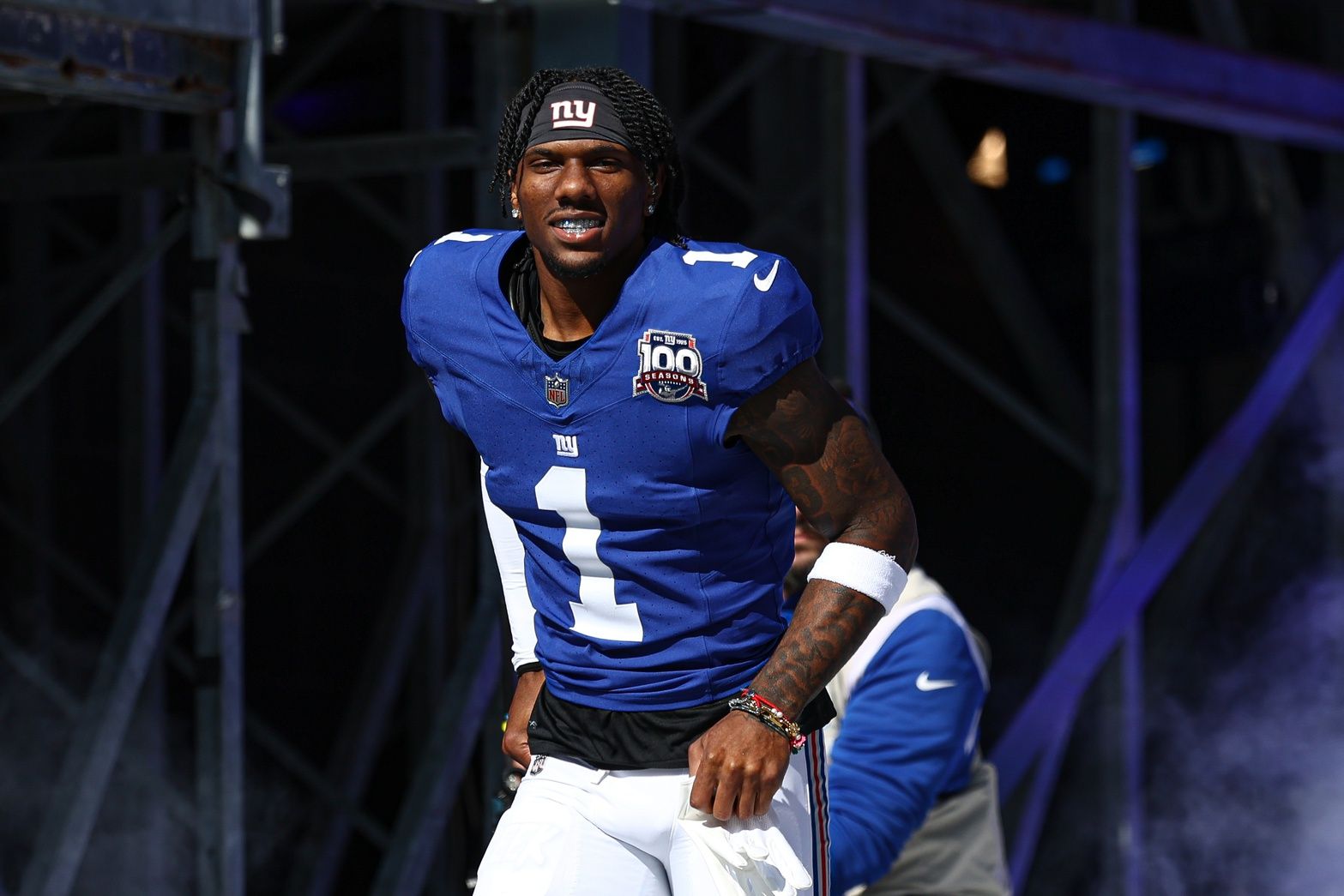
Malik Nabers might be the highest-ceiling name in this entire piece, and also one of the scariest to actually draft. The talent is not in question. As a rookie for the New York Giants, Nabers caught 109 passes for 1,204 yards and seven scores, finishing as the PPR WR6 at 18.2 PPG. He did that while underachieving on deep balls, hauling in just 17 of 43 targets that traveled 15-plus yards. The alpha version is a top-five overall receiver.
TRADE NOW: PFN’s Dynasty Trade Calculator
The floor is written on a medical chart. Nabers tore his ACL and meniscus in Week 4 last season, and the recovery has not been smooth. He needed a second procedure in May to clear out scar tissue. The reporting out of New York points to him missing at least the first month, with a real chance he opens on the PUP list. A receiver you cannot start in September is a very different asset than the one the box score promises.
Layer in the surrounding uncertainty and the range only grows. Nabers saw just three targets from Jaxson Dart before his injury. We have almost no read on that connection. Dart and Cam Skattebo also missed time last year. Every different shape this offense can take widens the band of outcomes, both weekly and across the full season. The discount is real. The reason for it is just as real.
Brian Thomas Jr., Jacksonville Jaguars
ADP: WR31
Twelve months ago, Brian Thomas Jr. was in the conversation for the best young receiver in football. Then last season happened. Thomas managed a single top-12 week and just three top-24 finishes for the Jacksonville Jaguars. He had fewer top-24 weeks than teammate Parker Washington, a player who was barely rostered a year earlier. That is a brutal fall for someone coming off a dynamic rookie campaign.
The reason for the collapse is what makes the floor sticky. Thomas’ red zone target rate fell off a cliff, from 28.6% as a rookie to 9.4% last season, stripping away the easiest points a receiver can bank. At the same time, 46.2% of his targets traveled 15-plus yards downfield, up from 31.6% the year before. That is a boom-or-bust, Gabe Davis-style profile, and it introduces a floor nobody thought possible after 2024.
The ceiling is the talent and the discount attached to it. Thomas is still the WR1 in this offense. His rookie production was more encouraging than his sophomore year was discouraging.
Wide receivers who post 1,200+ receiving yards as rookies have quite literally never failed before. It’s a small but elite group consisting of Puka Nacua, Ja’Marr Chase, Justin Jefferson, Odell Beckham Jr., and Malik Nabers. This is the company Thomas keeps.
Buy him at last year’s price, and a bounce-back sends his value climbing fast. A repeat of last season, though, drops him out of the tier of receivers you can start with confidence. That is the bet: a genuine alpha at a marked-down cost, with a very real chance the discount is the market being right.
