
Fantasy football championships are won by those who work during the season, but laying a strong foundation is never a bad thing.
“My guys” are the ones circled on my cheat sheet. Yeah, I’m old school and use a printout. Sue me. You can highlight them in pretty colors in your Excel file or write code to elevate them in your rankings past a certain point of the draft. However you do it, the point remains: these are the guys I’m actively targeting in all formats and am willing to overpay for before I risk missing out on an opportunity to add a share to my portfolio.

Kyle Soppe’s Fantasy Football Must-Have Players
D’Andre Swift, RB, Chicago Bears
I mentioned Swift as a target of mine earlier this summer, and I see zero reason to pivot. Check out my Top Fantasy Football Targets piece for the nitty-gritty on him and others (Tucker Kraft is another name on that list and this one, but that list gets creative with players like Jakobi Meyers and Tank Bigsby as well), but it’s essentially a bet on the creativity of Ben Johnson.
He nearly doubled the play-action rate from where Chicago stood in 2024, and in order for it to be effective, the opposition has to fear the ground game.
Jordan Mason, RB, Minnesota Vikings
There have been speculative reports this summer about Mason controlling this backfield sooner rather than later, something that always seemed likely to be the case. Aaron Jones is 31 years old with over 2,000 touches on his NFL resume and is in the final year of his deal.
Mason is four years his junior and is in an evaluation spot with his contract expiring at season’s end. The dynamic ability of Kyler Murray stands to open up running lanes, and in what glimpses we’ve seen from Mason to date, that has the potential to turn him into a player you’re locking into your flex spot before Halloween.
For his career, Mason has produced 11.2% above per-touch expectations. He’s been able to sustain his efficient ways thanks to averaging north of three yards per carry after first contact in every season.
This Vikings line has been a liability in each of the past three years (all bottom-10 in terms of Offensive Line Impact), but again, a bet on Mason is a bet on this offense as a whole, and that means a rebound from Murray—a QB that changes how defenses scheme.
Minnesota’s post-Thanksgiving schedule has the potential to be as favorable as any in the game, yet another feather in the cap of a running back going outside of the top 100 picks.
Nico Collins, WR, Houston Texans
Collins is entering his age-27 season and is an unquestioned WR1 at the NFL level. He’s cleared 1,000 receiving yards in each of the past three seasons and hauled in 21 touchdowns over that stretch despite nine DNPs; this is a profile I’m going to be early on rather than late in terms of his “takeover-the-NFL” season.
He’s #good at the game. That’s an important first step, and while it may seem obvious, it’s important to highlight his skills before getting into the upside case.
- PPR Points Over Expectation: 1st
- Targets Per Route: 2nd
- Red Zone Target Rate: 4th
Those rankings are for WRs with at least 250 targets over the past three seasons. Within the ecosystem, he’s the only player on the board to average at least 12.0 air yards per target and 5.0 yards per catch after the reception.
If someone is going to add a chair to that table atop the position, they need to be a well-rounded threat with the ability to produce in a variety of ways, and there is no question that Collins does just that.
His late-second-round ADP is weighed down by missed time in the past (I’m way more willing to roll the dice in that regard at this position and at this draft slot than on a Christian McCaffrey type in Round 1) and some concerns over the upside of C.J. Stroud.
Is that fair?
C.J. Stroud: When Throwing Past The Sticks
- 2024: 75.6 rating
- 2025: 95.5 rating
Jaylen Waddle, WR, Denver Broncos
We’ve seen Jaylen Waddle do a bit of everything through five seasons. He’s had a 100-catch season (something only seven players did in 2025), an 18-yard-per-catch season (Alec Pierce was the only member of that club last year), and a season averaging north of 2.2 PPR points per target (Jaxon Smith-Njigba in 2025: 2.20).
We know the pieces to the puzzle are on the table, and now we have a situation where he can flourish in a creative offense with a QB on an upward trajectory. He was stuck in Miami (24th in points per drive and 26th in offensive EPA over the past two seasons), but now he has Sean Payton’s buy-in (they sent three 2026 picks to the ’Fins in this trade) in a system that flashed tremendous potential as Bo Nix’s development picked up.
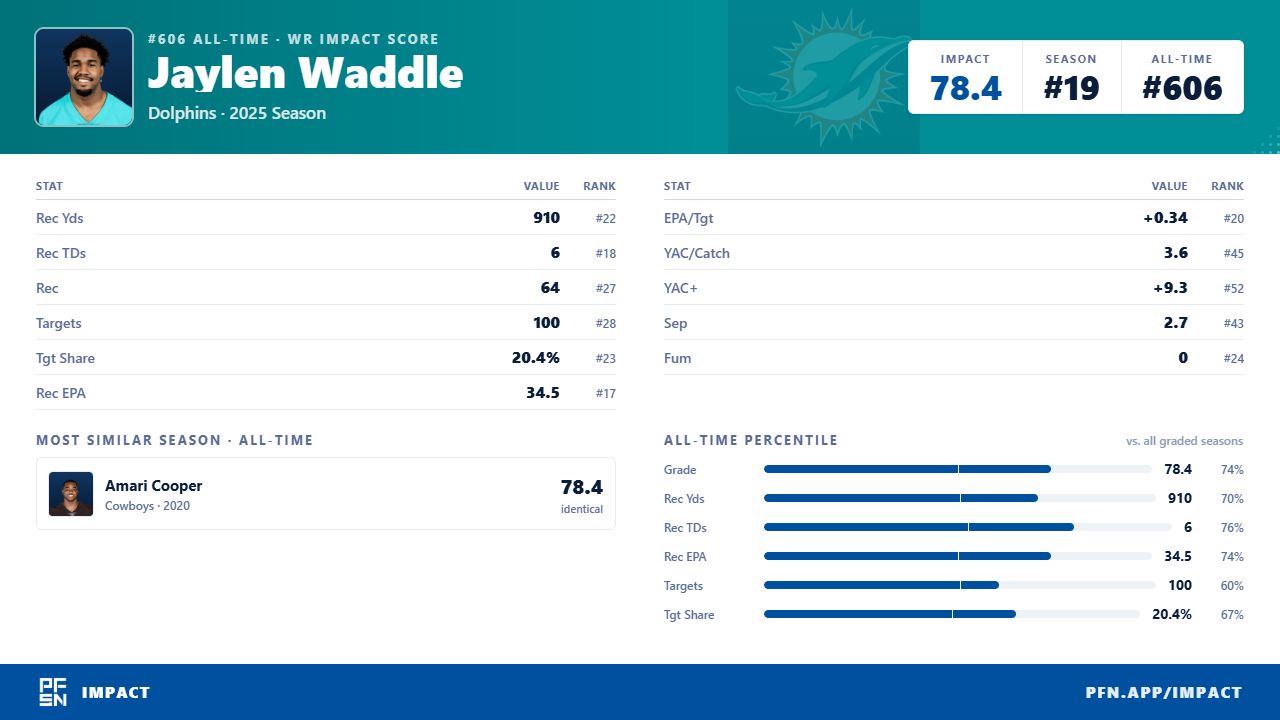
The only case against smashing Waddle at his current cost, I suppose, would be the number of options in this Denver receiver room. I don’t think that’s wrong (Troy Franklin and Pat Bryant are interesting long-term options), but I do think an overindexing of Courtland Sutton is giving us a nice discount.
Sutton is a solid player; he’s not Waddle. We saw his target rate and yards per route run dip in Year 2 of the Nix experience—signs that are being overlooked in favor of raw counting numbers that were as much the product of limited competition last season.
Even with the situation working in his favor (limited push from his teammates and growth under center), Sutton was outside of the top 24 receivers just as often as he was inside of it.
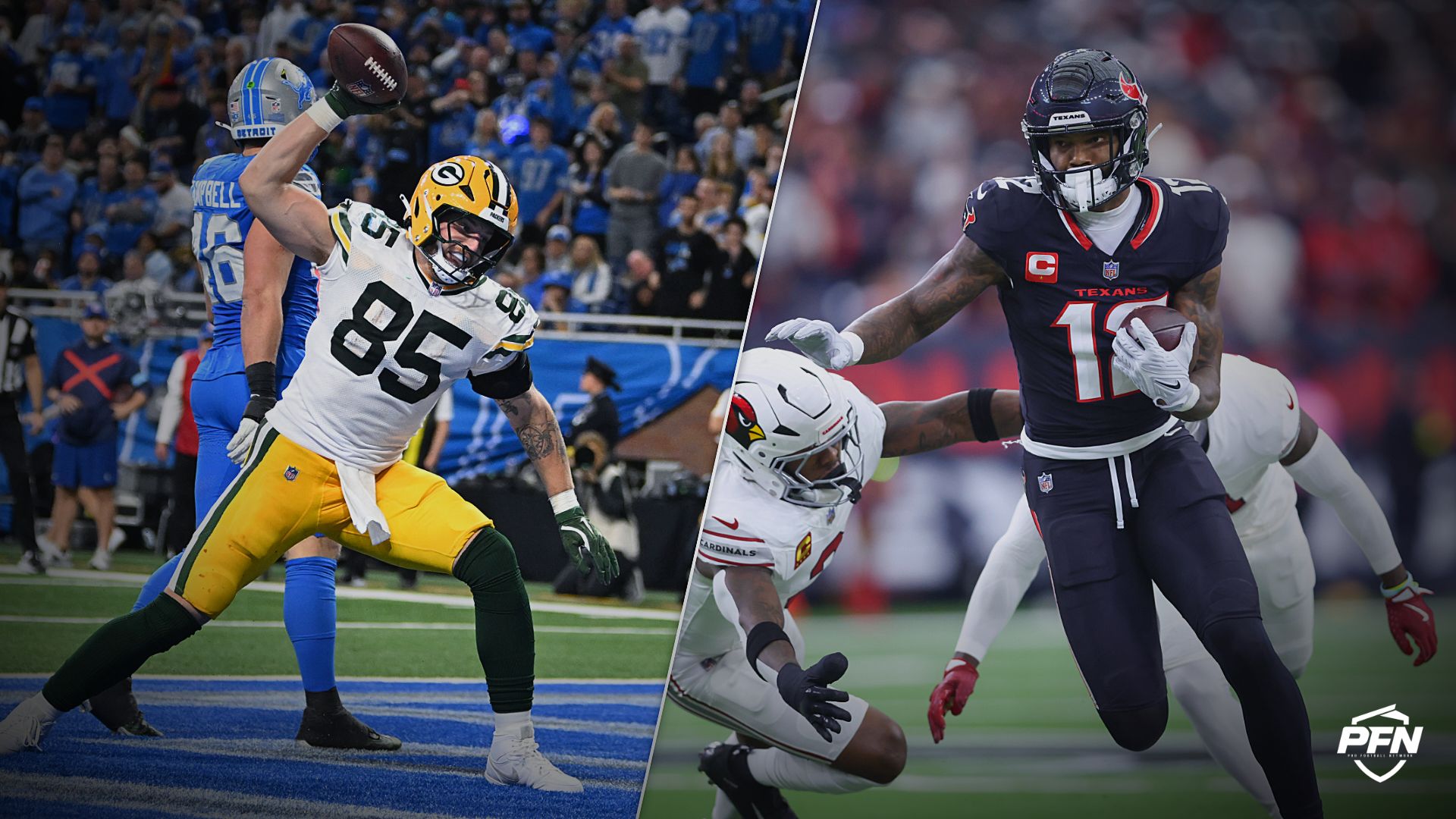
Tucker Kraft, TE, Green Bay Packers
This is exactly why tiering players is important.
In terms of industry consensus, Kraft is being drafted as the TE5. I have him ranked as TE4 and can very much understand how the field settles where it has.
But the seventh round?
We all agree that Trey McBride and Brock Bowers are Tier 1 options at the position and demand high-end draft capital. The second tier, across the board, includes Colston Loveland and Tyler Warren. For me, that’s where Kraft belongs, whereas the drafting public is slotting him into the third tier with names like Kyle Pitts and Sam LaPorta.
That may sound like a small distinction, but we are talking 20–25 picks in terms of the overall rankings, and that’s huge.
Kraft was third at the position in PPG (min. eight games played) last season, and with positive reports coming out of Green Bay in terms of health, I’m struggling to find reasons why he can’t repeat.
From Weeks 4–8, this unique weapon accounted for 25.7% of Packer pass-catcher points, a signal that he has the potential to function as the WR1 in this offense. Even if you’re skeptical in assuming that, the departures of Dontayvion Wicks and Romeo Doubs certainly give him the potential to sustain and extend that role for an entire season.
Isaiah Likely, TE, New York Giants
Everyone wants to bet on the Giants… but no one wants to do it via a onesie position that allows you to start a late-round pick from the jump?
That’s fine, more shares for me.
Jaxson Dart ranked 28th in passer rating last season when throwing to or past the sticks and 5th when taking the less aggressive approach short of the chains.
New York is clearly interested in improving the former (Malik Nabers returning will help, and the Darius Slayton/Darnell Mooney duo is threatening defenses in one way), but in order to do so, the short pass game needs to remain lethal.
Enter Likely, the ninth-best TE after the catch since he was selected in the fourth round by the Ravens (34 qualifiers).
We’ve begged for him to get the opportunity to thrive for years, and the path is now clear. He’s averaged 12 PPR points per game when running north of 20 routes for his career, a figure that would have slotted him as TE6 last season.
With Wan’Dale Robinson out of town, I think we get PPR scam weeks to elevate Likely’s floor in addition to the big weeks that can come when tethered to an offense on the up-and-up.
I’ve got him ranked as a Week 1 fantasy starter, and I expect that to be the industry norm by the time we get into October.
Looking to practice? Our FREE Fantasy Football Mock Draft Simulator gets you through an entire draft, in any format, as you look to hone your skills for draft day!