
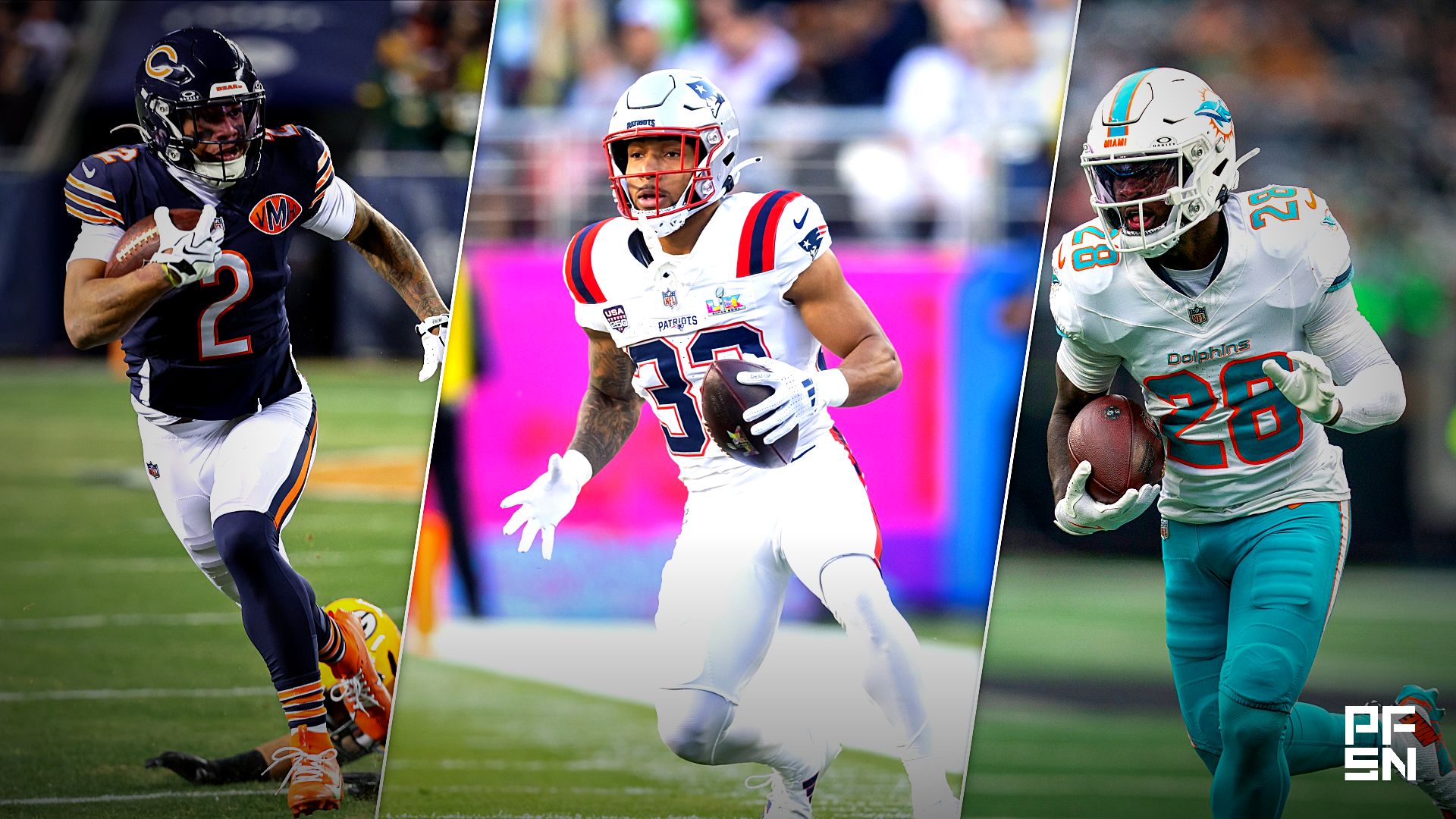
Every fantasy football draft is decided as much by the players you avoid as the ones you land. The expensive picks carry the most risk, because paying a premium for a player who returns middling production sets your roster back in a way a late-round miss never could. Value works in both directions, and spotting the names priced well above their likely outcome is just as important as finding the bargains. Based on current ADP, here are the players I am fading in 2026.
QB Busts: Joe Burrow, Cincinnati Bengals
ADP: QB4
Let me be clear about Joe Burrow, the football player. He’s a perennial top-five quarterback in real life, and if the league held a draft tomorrow, he’d go in the first handful of picks. Fantasy football is a different exercise, and it’s the one place where a QB4 ADP on Burrow doesn’t add up for me.
The issue is that Burrow generates almost nothing on the ground. Just 2.9% of his fantasy points came from rushing last season, in an era where nearly every elite fantasy quarterback leans on his legs.
Josh Allen, Patrick Mahomes, and Jayden Daniels all offer a rushing baseline that Burrow simply cannot match, which caps his ceiling right around 22 to 23 PPG. We’ve already seen the top of his range, too. Even in his monster 2024, it took 43 passing touchdowns to finish as the QB3 at 22.5 PPG.
START PREPARING: PFN’s Fantasy Mock Draft Simulator
That’s the trap. Burrow’s value is almost entirely tied to touchdown volume, and touchdowns are the most variance-prone stat in the sport.
The Cincinnati Bengals threw for 76.5% of their touchdowns last season, and even a modest regression toward the league norm takes a real bite out of his numbers. Add in the injury that wrecked yet another season, plus a deep quarterback pool where QB1 upside is available several rounds later, and the opportunity cost is too high. He’s my QB6, and I’m not paying a top-five price.
Matthew Stafford, Los Angeles Rams
ADP: QB14
Matthew Stafford just posted a top-five fantasy season, and I want no part of the encore. Stafford is a genuinely great quarterback, but his fantasy value has always been a touchdown mirage, and 2025 was the biggest mirage of them all. His touchdown rate was 7.7%, the highest of his career, buoyed by Davante Adams operating as a de facto goal-line back.
Regression is not a maybe here; it’s a certainty. Stafford’s career touchdown rate is 4.8%, and history could not be clearer on the pattern: every time his rate spikes, it craters the following year. That happened after 2011, after 2019, and after 2021, when a 41-touchdown, Super Bowl-winning season still only produced a QB11 finish. Banking on a 38-year-old pocket passer to repeat a career-outlier touchdown rate is not a bet I’m making.
The bigger structural problem is the lack of a floor. Stafford contributes nothing with his legs. His percentage of fantasy points to come from rushing last year was literally negative. 12 of the top 15 quarterbacks got at least 17% of their production on the ground.
In today’s game, a pure pocket passer needs an elite touchdown environment just to stay afloat. Stafford is going around QB14 off the back of that top-five finish, and I have him at QB17. Let someone else pay for last year.
RB Busts: Omarion Hampton, Los Angeles Chargers
ADP: RB8
Omarion Hampton is one of the trendiest breakout picks of the summer, and I’m not paying the freight. The foundation is legitimately strong, with first-round draft capital, a sturdy 221-pound frame, a 4.46 40-time that earned him a 93rd percentile speed score, and a real receiving background. My problem is that his RB8 ADP rests on a mountain of projection rather than production.
Look closer at that rookie season everyone points to. Hampton averaged 15.1 PPG, but the number leaned heavily on receptions, including four games with five-plus catches, and his 12.4% target share is now threatened by passing-down back Keaton Mitchell. His rushing was worse than advertised, too. Strip out one game against the league’s worst run defense, and Hampton’s 3.68 yards per carry would have ranked 37th of 43 backs, with a 45.1% success rate that landed 37th as well.
TRADE NOW: PFN’s Dynasty Trade Calculator
The role and the scheme both work against him in 2026. Mike McDaniel runs a zone-heavy attack, and Hampton graded out far better as a gap runner. Additionally, Kimani Vidal is good enough to keep this a committee rather than a bellcow arrangement.
There’s a real path to a smash season if the offense takes a leap and the volume consolidates, and I’ll acknowledge that. I’m just not spending an early-second-round pick to find out. Hampton is my RB12, and even that might be charitable.
Kenneth Walker III, Kansas City Chiefs
ADP: RB9
Nobody is going to enjoy this one, but the Kenneth Walker III hype has officially outrun reality. The Super Bowl MVP tag and a move to Kansas City have his price up at RB9, the most expensive tag of his career, and it’s attached to a player coming off the worst fantasy season of his career. Walker has finished as a top-12 back exactly zero times in four years, and he was the RB28 a year ago.
This move is not the upgrade the market thinks. The Seattle Seahawks ranked third in scoring last season, while the Chiefs were 21st, so Walker is trading down in offensive environment.
His touchdown ceiling is the bigger issue. He scored five times last season and has never topped nine, and Kansas City hasn’t produced a double-digit-touchdown back since rookie Kareem Hunt. Patrick Mahomes returning from a torn ACL doesn’t exactly scream goal-line bonanza.
Then there’s the missing receiving role. Walker has drawn a sub-8% target share in three of his four seasons, and Andy Reid has always deployed a separate passing-down back, so there’s no reception floor to prop him up.
His realistic ceiling is around 16 PPG with a 12-to-13 PPG floor. That’s a fine RB2 but nowhere near the 20-PPG upside you want from an early-second-round pick. I have Walker at RB11, and I’d rather chase that asymmetric upside elsewhere.
De’Von Achane, Miami Dolphins
ADP: RB11
Fading a talent like De’Von Achane makes me nervous, and I’ll say up front that he is the most gifted back on this entire list. He was the only running back in football to score 12-plus fantasy points in every single game last season, pairing an absurd floor with three outings north of 26 points. The talent is not the question. His situation is a full-blown crisis.
This organization tore the whole thing down. The Miami Dolphins moved on from Mike McDaniel, cut Tua Tagovailoa and Tyreek Hill, and traded Jaylen Waddle, leaving a receiver room fronted by Malik Washington and Jalen Tolbert. Malik Willis is now the quarterback, and he’s never attempted more than 23 passes in an NFL game. This offense could see its total pass volume drop by close to 100 attempts.
MORE: ‘A Player You Want Exposure To’ — Fantasy Analyst Sees Rashid Shaheed As a Player On the Rise
Here’s the math that scares me. Achane’s elite 2025 was built on a 19.8% target share and a steady diet of manufactured touches in McDaniel’s system, plus 12 rushing touchdowns. How does he replicate that if the Dolphins can’t sustain drives or reach the red zone, and if Willis is throwing 25 times a game while vulturing goal-line carries with his own legs?
Elite backs can survive bad offenses, and Achane just proved he can outrun his circumstances. This situation, though, might be a bridge too far, so he lands at RB13 for me.
TreVeyon Henderson, New England Patriots
ADP: RB22
Let me own this one up front. I was all in on TreVeyon Henderson last year, arguably to a fault. I rode the hype even as his price jumped two full rounds for no real reason. This year I’m finally stepping off, and it has nothing to do with the talent. The talent was never the problem.
Henderson is legitimately explosive. He ran for 911 yards and nine scores at 5.1 yards per carry and set a New England Patriots record with four rushing touchdowns of 50-plus yards. What he could not do was win the job.
Even after he flashed for 243 yards and five touchdowns across Weeks 10 and 11 with Rhamondre Stevenson banged up, Stevenson returned, and Henderson was right back on the bench for the rest of the season.
STAY UPDATED: PFN’s Fantasy News Tracker
The playoffs removed all doubt. On the run to the Super Bowl, Stevenson played 65%, 59%, 93%, and 63% of the snaps while Henderson was a total afterthought. The efficiency gap tells the same story, with Henderson’s 1.02 yards per route run sitting well below Stevenson’s 1.45. A coaching staff that just reached a Super Bowl told us exactly which back it trusts.
Sure, an injury to Stevenson blows this open, and Henderson is talented enough to smash if it happens. I’m not paying an RB22 ADP to bet on it, though. He’s my RB27, behind Stevenson in the very same backfield.
Jadarian Price, Seattle Seahawks
ADP: RB26
The Jadarian Price hype is built on opportunity and draft capital, and both are doing a lot of work to obscure a shaky prospect profile. Seattle used the final pick of the first round on Price, and first-round backs get every chance to produce. The concern is the player himself, because the single most predictive indicator of NFL running back success is college production, and Price barely has any.
Consider the résumé. Price entered the NFL with fewer than 300 career college touches and never logged a game with more than 15 touches in his final season at Notre Dame, where he played behind the No. 3 overall pick in Jeremiyah Love. He also caught just 15 passes in 40 college games, which is the profile of a pure two-down grinder rather than a modern three-down back.
Late-first-round backs also carry a spotty history to begin with, and the Seattle Seahawks themselves once buried a No. 32 overall pick in Rashaad Penny behind Chris Carson.
The path to volume is murkier than it looks, too. George Holani is already running with the first team as the passing-down option, and a returning Zach Charbonnet looms around midseason to eat into the goal-line and change-of-pace work that would define Price’s ceiling. His RB26 ADP is reasonable enough given the situation, but I’m a data guy, and the history of college non-producers is not kind. Price is my RB28, and I’m fading him in redraft.
WR Busts: Mike Evans, San Francisco 49ers
ADP: WR24
Fading Mike Evans feels borderline sacrilegious given his sustained excellence, but the warning lights are all flashing. His streak of 1,000-yard seasons ended last year, and while injuries were the headline, the play itself slipped badly when he was on the field.
Evans managed just 10.6 PPG on a career-worst 1.62 yards per route run and 6.0 yards per target. He also had an ugly 48.4% catch rate is impossible to spin. Evans found the end zone only three times on 61 targets.
Now the context turns actively hostile. Evans is 33, the age at which receivers tend to fall off a cliff, and he’s coming off the worst season of his career with hamstring strains in each of the last two years. He’s also switching teams, which is a historically bad sign for aging receivers who are already slipping.
HisEvans’new home doesn’t help, as the San Francisco 49ers run one of the lowest-volume passing attacks in the league and funnel heavily through Christian McCaffrey. Over the past three seasons, Brock Purdy has averaged 3.4 fewer attempts per game than Baker Mayfield.
Evans reminds me of late-career Julio Jones, whose body gave out at 31 before the talent followed at 32. Only a small handful of receivers have averaged 16-plus PPG at age 33 or older. Since 2011, it’s been names like Larry Fitzgerald and Reggie Wayne. So, the bar he’d need to clear is historically steep.
I’ll grant the upside case, since Purdy is a better quarterback than Mayfield and Kyle Shanahan is a far better play-caller than Todd Bowles. I was in on Davante Adams in this exact spot a year ago. For now, though, Evans is my WR30 against a WR24 ADP, and I can see him tumbling to WR4 territory as easily as bouncing back.
DJ Moore, Buffalo Bills
ADP: WR27
The DJ Moore rebound narrative is one of the more popular takes of the offseason, and I think it’s a trap. Moore is coming off the worst season of his career, a 50-catch, 682-yard, six-touchdown dud that produced just 10.0 PPG after he’d cleared 14.0 in five of his previous six years. The efficiency crater is what alarms me most, headlined by a career-worst 1.26 yards per route run and a first-downs-per-route-run rate that fell to 74th at the position.
Changing zip codes doesn’t automatically fix that. Moore reminds me an awful lot of 2022 Allen Robinson: an age-29 receiver coming off a career-worst year and switching to a better offense with an elite quarterback and lesser target competition, while the fantasy world talks itself into a bounce back. Robinson was no worse in Los Angeles than he’d been in Chicago, and that was exactly the problem.
The destination is genuinely good, to be fair. Moore will be the clear WR1 for the Buffalo Bills and should lead the team in targets with Josh Allen throwing them. The issue is volume.
Allen has averaged under 29 attempts per game in each of the last two years under Joe Brady, and even a generous 25% target share caps Moore around 120 looks, which pencils out to roughly 12.5 PPG in a best-case scenario. That’s WR30-to-36 production at a WR27 price, and the downside is a lot worse. I have Moore at WR35, and I’m not interested at cost.
DK Metcalf, Pittsburgh Steelers
ADP: WR27
The idea of DK Metcalf has always been more thrilling than the actual product. One time, back in 2020, he delivered a true difference-making fantasy season at 17 PPG. Every other year of his seven-year career, he’s topped out at 14.4 PPG. The past two seasons he’s checked in at 12.8 and 12.5. That’s a good NFL receiver and a wildly overhyped fantasy one.
The role is only trending the wrong way. Metcalf’s fantasy value has always been tethered to touchdowns and red-zone work, and his red-zone target rate has now sat under 20% in back-to-back seasons after three straight years above 30%. That collapse guts the one thing that gave him a ceiling. His deep-ball juice went dormant with Aaron Rodgers under center, too, as his average depth of target fell to a career-low 11.3 yards.
The situation isn’t getting better. Rodgers is back for a final lap, and the Pittsburgh Steelers just imported Michael Pittman Jr. to further crowd the target tree. So why is Metcalf going as the WR27?
Best case, he returns something close to par. Worst case, the bottom falls out, and he’s a droppable piece by midseason. That’s a brutal risk-reward profile at a top-30 price, which is why he sits all the way down at WR44 for me. No, thank you.
TE Busts: Mark Andrews, Baltimore Ravens
ADP: TE11
Mark Andrews was a fantasy cheat code for years, but the 2025 version looked finished. He finished as the TE23 with a career-worst 8.8 yards per catch and a meager 422 receiving yards, and he did it across a fully healthy 17-game season. When a player regresses that far with no injury excuse, it’s hard to write off as a fluke.
The touchdown dependence is the scariest part of the profile. Andrews has propped up his fantasy value with scores for years, to the point that roughly 35% of his 2024 production came from touchdowns alone. Yet, even an 11-touchdown campaign that year netted only 11.1 PPG. His 1.3 yards per route run last season shows how little he’s generating between the 20s. That kind of touchdown reliance is not something you can safely bank on repeating.
There is a bull case, and it’s purely situational. Isaiah Likely and Charlie Kolar are both gone, which should bump Andrews past the modest 63% snap share he ran last year. Behind Zay Flowers, the Baltimore Ravens don’t have another dependable pass catcher. In theory, the targets should funnel his way. Theories are nice, but the data raises a fair question: does a clear path to volume matter if Andrews can’t get open anymore? I have him at TE15, below a TE11 ADP I have no interest in paying.
Jake Ferguson, Dallas Cowboys
ADP: TE13
Jake Ferguson keeps getting drafted like a difference-maker he simply isn’t. He averaged 11.1 PPG last season, a figure that looks fine on the surface until you break down how lopsided it was. In the four games CeeDee Lamb missed, Ferguson feasted to the tune of 18.6 PPG. With Lamb on the field, that number cratered to 8.9.
That split is the whole story. Ferguson is a genuine weapon when he gets elevated to the No. 2 role in the passing game, but that’s not his job when the offense is at full strength. Behind Lamb and George Pickens, he’s the third option at best, and third options at tight end are not startable in most weeks.
Absent an injury to one of the guys ahead of him, Ferguson profiles as a touchdown-or-bust streamer rather than a set-and-forget starter. That’s not a player I want to reach for at a TE13 ADP, not when I can grab a cheaper punt option later or a real difference-maker earlier. He’s my TE16, and I’d rather let someone else pay for the four-game mirage.
Oronde Gadsden, Los Angeles Chargers
ADP: TE17
Oronde Gadsden flashed enough as a rookie to earn some late-round buzz, but the full-season profile screams streamer. He averaged 8.8 PPG on a 14.4% target share and an 18.6% targets-per-route-run rate, neither of which points to a featured role. Take away one hot stretch, and there wasn’t much on his ledger at all.
That stretch deserves respect, to be clear. From Weeks 6 through 9, Gadsden ripped off 11.8, 29.4, 18.7, and 11.8 fantasy points, a genuinely startable month. Outside of that window, though, he was essentially unusable.
This offseason made a murky picture murkier. The Los Angeles Chargers went out and added David Njoku and Charlie Kolar, crowding a tight end room that now features real competition for targets and snaps. Gadsden’s TE17 ADP isn’t egregious, but I don’t see a clear path to consistent production, so he lands at TE18 for me. There are steadier punts to be had at the position.
