
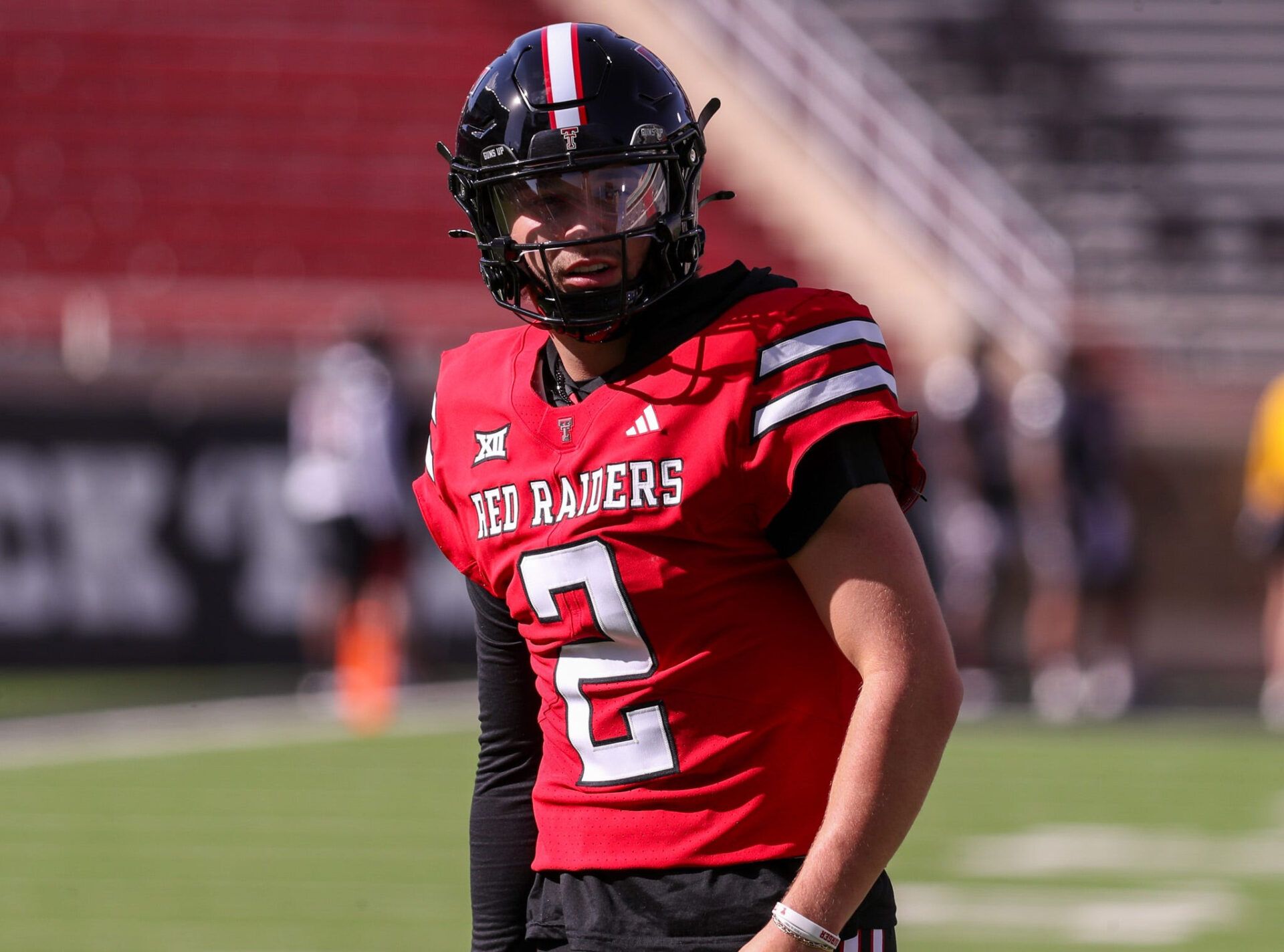
Amid a fight over his eligibility after admitting that he bet on sports, Texas Tech quarterback Brendan Sorsby has decided to enter the NFL via the Supplemental Draft.
This begs the question: what is the Supplemental Draft, and how does it work?
The NFL’s last Supplemental Draft took place in 2023, although no players were selected. The last player selected in the Supplemental Draft was Jalen Thompson in 2019, so it’s understandable that many fans know very little about it.
Everything to Know About the NFL’s Supplemental Draft
The main NFL Draft is one of the most popular events on the NFL calendar, with more than 50 million viewers tuning in over three days. The Supplemental Draft has been around for a long time, too, beginning in 1977 as another avenue for draft-eligible players to enter the league.
For the first 13 years, from 1977 to 1990, only players who either graduated or exhausted their eligibility were eligible to participate in the Supplemental Draft. However, since 1993, the NFL has allowed players who faced other adversity, including disciplinary reasons, to petition the league for Supplemental Draft entry as well. Basically, the Supplemental Draft is for players who weren’t eligible to be picked at the time of the NFL Draft.
Al Hunter, a former Notre Dame running back, was the first player ever taken in the Supplemental Draft. The Seattle Seahawks used a fourth-round pick on Hunter, who was suspended from the team for disciplinary reasons but was already draft-eligible since he was out of high school for three years.
In total, there have been 46 players drafted in the Supplemental Draft since 1977. In 2019, the Arizona Cardinals used a fifth-round pick on Thompson, who played at Washington State.
BE THE GM OF YOUR FAVORITE TEAM: PFN’s FREE NFL Mock Draft Simulator
There have been eight first-round picks used in the Supplemental Draft, including on Pro Bowlers such as quarterback Bernie Kosar, running back Bobby Humphrey, and wide receiver Rob Moore. The best Supplemental Draft pick of all time, however, was former Philadelphia Eagles wide receiver Cris Carter, who was a fourth-round selection in 1987.
For a player to be granted entry into the supplemental draft, he must meet three primary criteria:
- Three Years Removed from High School
- Changed Circumstances
- Loss of Collegiate Eligibility
How Does the Supplemental Draft Work?
The Supplemental Draft works differently from the regular draft, as teams submit blind bids indicating which round they want to select a player.
While the main draft order is determined by the standings, the Supplemental Draft has a different way of determining which team selects first. It uses a tier system that splits the league’s 32 teams into three different buckets. Once they’re in tiers, a weighted lottery is used to determine the order within the tiers, favoring teams with worse records.
Here are the three tiers that are used to group teams, with the records pulled from the previous season:
1) Non-playoff teams with six or fewer regular-season wins
2) Non-playoff teams with more than six regular-season wins
3) The 14 teams that made the playoffs
PREDICT THE NFL SEASON: PFN’s FREE NFL Playoff Predictor
The draft uses a blind bidding system. The team with the bid in the highest round with the highest pick will acquire the player and forfeit the corresponding pick in the following NFL Draft.
For example, if a team uses its second-round pick in the Supplemental Draft to select Sorsby, it would cost them their second-round pick in the 2027 NFL Draft.
Brendan Sorsby NFL Scouting Report
Going into this year’s transfer portal, Sorsby was seen as one of the top quarterbacks on the market, and rightfully so. In fact, with 31 collegiate starts, he was one of the most experienced starters in college who didn’t enter the 2026 NFL Draft. He started as a redshirt freshman for Indiana in 2023, and two years as Cincinnati’s starter had him well-regarded when Texas Tech signed him out of the portal.
First and foremost, you have to talk about Sorsby’s arm talent. He has the elasticity to deliver fast throws from any angle, utilizing sidearm throws to direct passes around defenders. The velocity and zip he gets behind his passes are truly impressive. That pure arm strength allows him to fit throws into short-lived windows.
There are some serious flashes of timing behind some of Sorsby’s passes. Especially across the middle of the field, he’s one of the more efficient passers you’ll find in college football. He can thread the needle and work the seam thanks to his aforementioned arm talent, as well as the touch he displays hitting his receivers in stride.
Listed at 6’3″ and 235 pounds, Sorsby has an NFL-ready frame for the quarterback position. He possesses good height to stand tall and scan the field, and he also has a dense frame that’s filled out, which helps him take hits in the pocket and battle through would-be tacklers when he takes off as a runner.
That running ability might be Sorsby’s most underrated quality. Cincinnati executed plenty of read options in 2025, during which he demonstrated good judgment reading the edge defender with above-average acceleration taking off with the ball. He won’t wow you making defenders miss in space, but he can run in a straight line quite well.
As far as the polish in his game goes, Sorsby still has a long way to go. He trusts his arm a little too much, which can see him try to force the ball into tight windows too often. That raw arm talent works sometimes, but he delivers the ball into crowded quarters far too often.
Part of the reason that backfires on Sorsby is because he stares down his first read too often. It’s much easier to act upon your progressions as a defensive back when the opposing quarterback is a one-read passer, which he predominantly is at this stage. As far as full-field progressions and finding the checkdown option go, he’s unproven.
Sorsby particularly struggles throwing to his right, which is a bit unusual as a right-handed quarterback. His passer rating on throws outside the hashmarks to the right is just 42.4 on passes that travel 20+ yards, and it’s only 66.9 in the range of 10-to-19 yards out. Part of that might be the wider hashmarks college teams have to work with, though.
Brendan Sorsby’s College Stats and Accolades
Career:
- Passing Yards: 7,208
- Passing Touchdowns: 60
- Interceptions: 18
- Completion Percentage: 61.4%
- Passer Rating: 96.5
- Rushing Yards: 1,295
- Rushing Touchdowns: 22
2025 (at Cincinnati):
- Passing Yards: 2,800
- Passing Touchdowns: 27
- Interceptions: 5
- Completion Percentage: 61.4%
- Passer Rating: 107.0
- Rushing Yards: 580
- Rushing Touchdowns: 9
- PFN QB Impact Score: 88.2 (10th in FBS)
How High in the Supplemental Draft Could Sorsby Be Drafted?
All told, Sorsby is a raw but physically gifted quarterback who showcased some serious potential during his 2025 season at Cincinnati. Another year of polishing at Texas Tech could have propelled him into early-round status, but that won’t be an option for him.
REDRAFT THE ENTIRE NFL: PFN’s FREE NFL Ultimate Redraft Simulator
Had he declared for the 2026 NFL Draft, Sorsby would have been our third-ranked quarterback in this year’s class. The only two prospects I would have had above him would have been Fernando Mendoza and Ty Simpson, and both players ended up getting drafted in the first round.
That’s not to say Sorsby would’ve been a first-round pick, far from it. Given his raw mental processing capabilities, I would have projected him as a Day 2 selection. When you throw in his run-in with sports gambling issues, you have a potential conflict of interest and another factor hurting his draft stock.
If he declares, don’t be surprised if a team is willing to use a fourth-round pick on Sorsby in the 2026 NFL Supplemental Draft. His draft profile has its fair share of concerns, but he’s a natural thrower of the football with the arm talent and other physical attributes worth developing as a potential future NFL starter in the making.