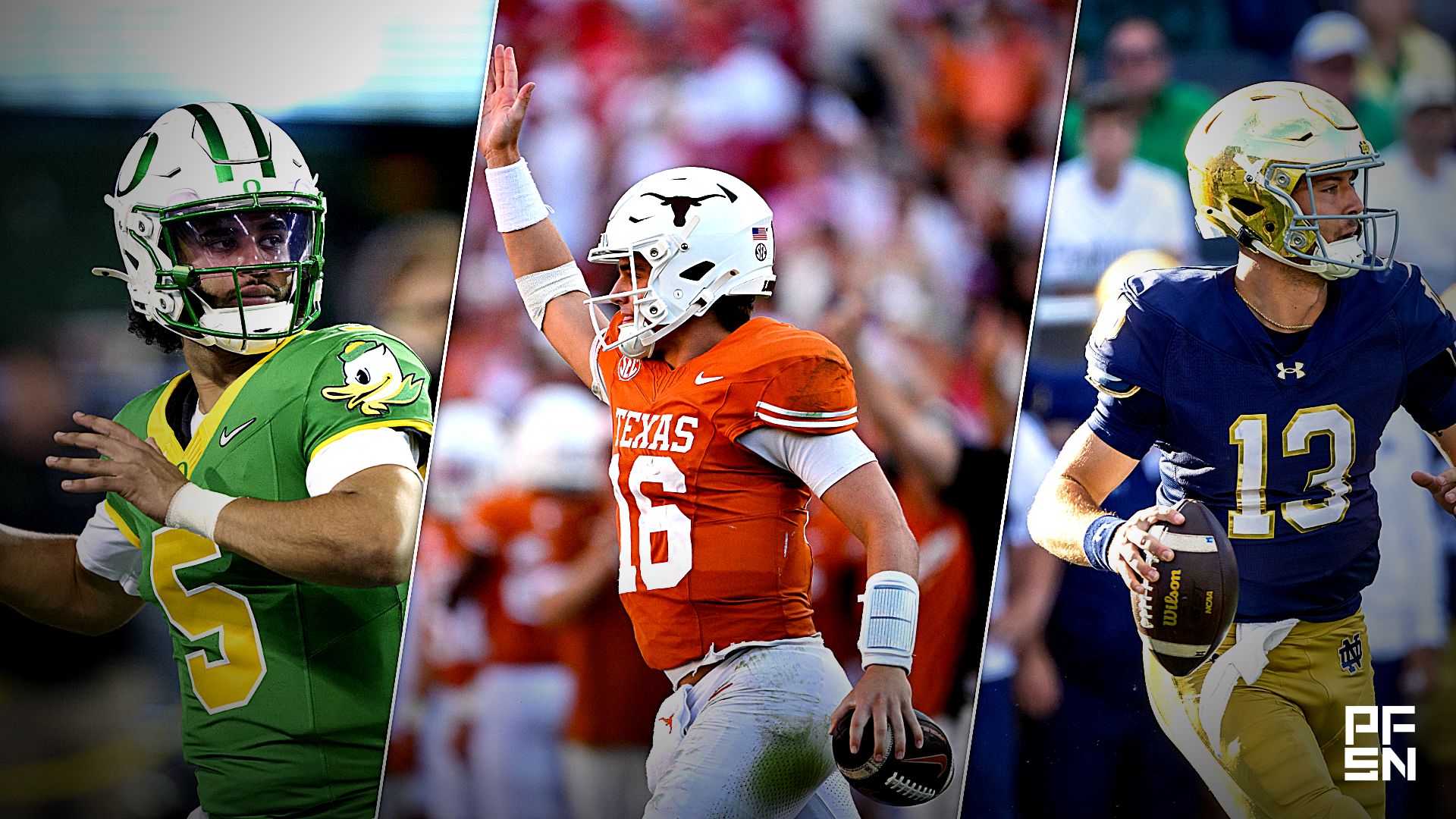
The 2027 NFL Draft quarterback class is on the way, and it has the potential to be legendary.
“Potential” is the keyword, of course. One thing that’s been reaffirmed over the past few NFL Draft cycles is that it’s dangerous to prematurely anoint anyone before the body of work is complete. We can’t get ahead of ourselves in the quest to be first.
Nevertheless, what we can do is honestly look at the volume and natural talent the prospective 2027 class has to offer. That volume is compelling and is the source of the present upside.
There are 20 passers in the Top 250 on the initial Mock Draft Simulator board. Conventional logic and a study of recent draft history tells us at least two, and as many as perhaps five, could eventually become Round 1 picks in the 2027 cycle.
Below, you’ll find my personal Top 10 QB rankings in the 2027 NFL Draft cycle, as it stands. It’s still very early, but these are the passers who’ve made the strongest impression to me on the film, and this is how they stack up in the way-too-early months.
10) Josh Hoover, Indiana
Josh Hoover is a mid-round QB prospect in the 2027 NFL Draft with an intriguing high-floor profile, and his move to Indiana further solidifies his potential as a sleeper and riser candidate in the upcoming QB class.
Hoover joined up with the TCU Horned Frogs as a three-star signee in 2022, and bided his time until an injury thrust him into the starting lineup midway through the 2023 season.
That short audition would earn Hoover the starting role in 2024, and he carried it through the next two seasons, eclipsing 3,400 passing yards and 27 touchdowns in both campaigns. In 2025, Hoover’s PFSN QB Impact score of 86 placed him above Dante Moore and Ty Simpson.
Now a highly-touted transfer recruit, he’d make the move to Indiana, joining up with Championship-winning head coach Curt Cignetti. Following in the footsteps of Heisman winner and first overall pick Fernando Mendoza is a tall order, and to be clear, Hoover doesn’t possess that level of physical upside.
At 6-foot-2, 200 pounds, Hoover is slightly undersized and not powerfully built, with only an above-average arm and modest creation ability. But what Hoover does have is an extremely translatable in-structure skill set.
Mentally, he’s an adept processor with quick-firing first and second-level vision, keen opportunity identification skills, and excellent anticipation and layering ability over the middle of the field.
He’s relatively accurate and mechanically sound, tough in the pocket in spite of his leaner build, and he has the nimble pocket mobility to slide from pressure and keep himself clean.
Hoover’s decision-making can be a touch reckless at times; while many of his risks are calculated, he can succumb to arm arrogance on tight-window throws, as evidenced by 33 interceptions in 36 games played.
He’ll have to tone down that volatility if he wants to field looks as a potential starter, but nonetheless, Hoover has the profile of an ideal backup, spot-starter, and safety blanket in the pros.
9) Jayden Maiava, USC
Jayden Maiava is an experienced sleeper QB prospect in the 2027 NFL Draft with notable upside, but also notable flaws to address.
Maiava first signed with UNLV out of high school as a three-star recruit, and after redshirting in 2022, he started 11 games in 2023, leading his team to a 7-4 record over that stretch while earning Mountain West Freshman of the Year honors.
Maiava’s early-career production earned him interest in the transfer portal, and he eventually made the move to USC, joining up with Lincoln Riley. He began the 2024 season as the backup to Miller Moss, but was later elevated to the starting role, and retained that role for the 2025 campaign.
In 2025, Maiava achieved career-bests in yardage and touchdown output, while earning third-team All-Big Ten recognition and a PFSN QB Impact score of 93.1. Maiava’s 0.55 EPA per clean dropback was strong, and he was one of a select few passers to have a positive EPA per dropback under pressure, per TruMedia.
At 6-foot-4, 230 pounds, Maiava has the look of a prototypical passer, with great size, solid size-adjusted athleticism, high-level arm talent and velocity generation, and a fearless gunslinger’s risk propensity.
That gunslinger mentality is as double-edged as it gets with Maiava; he’s thrown 26 interceptions in 34 career games. The film confirms that forcing ill-advised throws is a habit he’ll need to break, and his field vision also has room to level up further to avoid improper layering.
Additionally, Maiava can be mechanically volatile in his lower body at times, a quality that yields imprecision and inaccuracy.
Having said all this, Maiava is extremely tough and composed working the pocket, he flashes excellent pre-snap vision and discernment, and he can place passes to WR leverage in 1-on-1 situations.
With another year of ideal growth, Maiava has early-round and NFL starter upside, but nearing his ceiling as an accurate, risk-aware distributor will be key. Otherwise, he may max out as a quality backup and spot-starter.
8) Trinidad Chambliss, Ole Miss
Trinidad Chambliss has been a revelation for the Ole Miss Rebels, after leading the Ferris State Bulldogs to a Division II National Championship and earning a spot as a Harlon Hill Trophy finalist in 2024.
In 2025, Chambliss was a key catalyst in the Rebels reaching the CFB Playoff semifinals, even after the loss of head coach Lane Kiffin, and he’s one of the few QBs who came away with an elite PFSN QB Impact grade over 90 on the season.
At around 6-foot-1, 200 pounds, Chambliss is average-sized at best, with middling arm strength, but he nonetheless proves more than competent as a prospect with his athleticism, hyper-elite creative instincts, arm elasticity, quick coverage discernment, and anticipation in the short and intermediate ranges.
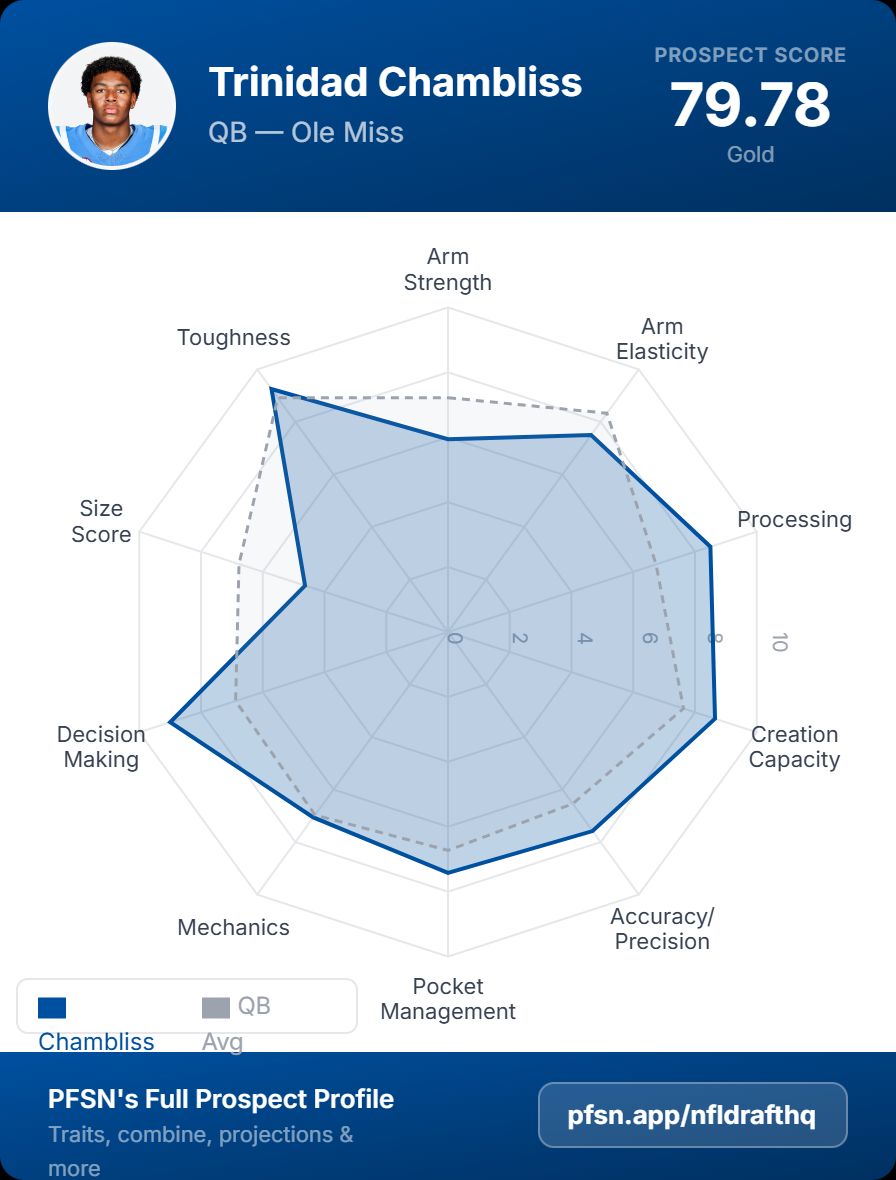
Chambliss is a capable quick-game and RPO operator with good pre-snap and post-snap reasoning, reliable decision-making, solid overarching accuracy, and the quiet toughness and resolve to stand in, adapt, and slide through pocket corridors when working against pressure.
Chambliss generated a strong EPA per clean dropback figure of 0.49 in 2025, per TruMedia, and he was also one of a select few QBs to generate a positive EPA per pressured dropback.
MORE: Latest 2027 NFL Mock Draft
Two cosmetic factors, Chambliss’ size and his age, may work against him in the 2027 NFL Draft cycle. He’s not powerfully built, and he’ll be a 25-year-old rookie.
But irrespective of these elements, Chambliss is a smart, adaptable, and athletic game manager who’s proven capable of commanding an offense, keeping the chains moving, and keeping resolve in high-pressure and high-leverage situations.
Chambliss always has an answer, and that quality should make him a popular prospect for teams in search of a potential starting QB contender or high-level spot-starter. A strong 2026 campaign can put him in the same range as Tyler Shough.
7) Darian Mensah, Miami (FL)
Darian Mensah is one of the more storied returners in college football, and there exists early-round potential at his absolute maximum. That said, he’s a prospect with much left to prove at Miami, and measured limitations that may come to define his stock.
He began his career as a three-star signee at Tulane and, after redshirting in 2023, broke onto the scene as a redshirt freshman in 2024. He started 13 games, passing for 2,723 yards, 22 touchdowns, and 6 interceptions, and would later transfer to Duke for the 2025 season.
At Duke, against Power Four competition, Mensah only continued his rise, this time amassing 3,973 yards, 34 TDs, and just 6 INTs on almost 67% completion, while earning a PFSN QB Impact score of 88.2 that ranked top-ten in the nation, and leading the Blue Devils to a surprise ACC Championship.
BE AN NFL GM: PFSN’s Ultimate GM Simulator
In late January, Mensah transferred within the conference to Miami, where he’ll follow in the footsteps of Carson Beck and Cam Ward. Ward went first overall in 2025, while Beck went at the top of Round 3. That range will no doubt be the goal for Mensah.
At 6-foot-3, 205 pounds, Mensah has a lighter prototypical build, but boasts seveal hallmarks of a potential starting NFL QB beyond that.
He generates velocity with relative ease and can layer the ball with pace and touch. He has nimble pocket mobility and excellent platform freedom. He’s a great processor with inspiring field vision, a quick trigger, and clear anticipatory tendencies over the middle of the field.
There still remain modest limitations and areas for improvement, nonetheless. Mensah is a capable but closer-to-average creative threat, his arm strength is visibly non-elite, and his pocket habits and pressure responses need major work. His depth discipline is below-average, and inconsistent pocket navigation can lead him into trouble.
Additionally, while Mensah is relatively accurate and mechanically sound, his situational precision can still reach a greater echelon.
Having said all this, Mensah’s baseline arm talent, in-structure mobility, and anticipatory feel lay a strong foundation, and he can be a first-round QB with quality starter potential at his maximum.
6) Brendan Sorsby, Texas Tech
Brendan Sorsby transferred from Indiana to Cincinnati in 2024 after two seasons with the Hoosiers and, unfortunately, missed out on Curt Cignetti’s dramatic revitalization of the program.
But in joining up with the Bearcats, Sorsby got something just as valuable: A second chance at developing into a legitimate 2027 NFL Draft prospect. Sorsby’s first season in Cincinnati was solid, but he took it up a notch in his second campaign with the team.
Through his first eight games in 2025, he led Cincinnati to a 7-1 record, and though the Bearcats stalled out down the stretch, Sorsby still put up a strong campaign. On the year, he completed 61.6% of his passes for 2,800 yards, 27 touchdowns, and just 5 interceptions, while also rushing for 580 yards and 9 scores.
Sorsby’s 88.2 PFSN QB Impact score was near-elite, and he generated particularly inspiring EPA efficiency in scoring situations and on scrambling reps. His 0.37 EPA per dropback in scoring territory was 12th among qualifying QBs.
At 6-foot-3, 235 pounds, Sorsby has excellent size-adjusted athleticism, velocity generation and angle freedom, and he’s a keen creative mind who flashes stellar layering ability and situational precision on drive throws.
Right now, he’s a developmental QB prospect; he still has a higher echelon to reach as a processor and anticipator, and his release mechanics and dropback discipline can be lax at times, but he has nonetheless has NFL starter upside.
With Sorsby, however, another matter that demands attention is his NCAA eligibility. He returned for the 2026 season, but his status has been placed in jeopardy by an investigation pertaining to Sorsby’s sports gambling.
Sorsby’s request for eligibility restoration was denied, and Texas Tech is expected to appeal on his behalf. There’s a chance Sorsby could be forced to enter the NFL supplemental draft. If that happens, he could field mid-round interest from teams.
If he’s able to return to school and put a stronger endcap on his collegiate career, he’s candidate to fight for early-round capital in the 2027 NFL Draft.
5) Drake Lindsey, Minnesota
Drake Lindsey is one of three redshirt sophomores in the top five of this list, and of those, his 2027 NFL Draft profile arguably involves the most projection. Nonetheless, Lindsey’s film confirms that first-round upside is quietly present in Minnesota.
Lindsey originally joined the Golden Gophers as a three-star recruit in 2024, but won the starting QB job as a redshirt freshman in 2025 and led his team to a 8-5 record in 13 starts, as well as a bowl victory.
He turned in a respectable PFSN QB Impact score of 77.8, and his 0.5 EPA per dropback in close-game scenarios was 15th among passers with at least 10 starts, according to TruMedia.
The sample is small, and there are still areas in which Lindsey can improve, to be sure. Most notably, segmented footwork can impact his shoulder alignment and in turn his situational precision, and creation in the face of pressure simply isn’t a sizable part of his game; he can be late to sense interior rushing threats, and he’s not explosive or fleet-of-foot on the escape.
Nevertheless, at 6-foot-5, 230 pounds, Lindsey perfectly fits the profile of the old-school, big-armed pocket passer. He’s big and high-mass, with quantifiably elite arm strength, velocity generation, and angle freedom, and those domineering traits aren’t just for show.
On top of having elite size and arm strength, Lindsey also shows off impressive pre-snap command, post-snap vision, opportunity identification skills, and layering ability for such a young QB.
He can stand tall in the pocket, reposition within gaps, and dish out high-velocity darts in the short and intermediate ranges, while unleashing inspiring touch and loft on the vertical plane.
It’s worth noting that on May 1, Lindsey was arrested in Arkansas for underage drinking and fake ID presentation, and was released from jail after posting a $470 bond.
Any and all incidents on a prospect’s record are notable, but in the grand scheme of things, this arrest is for a very minor offense, and isn’t likely to affect Lindsey’s stock at all, especially if he plays well enough to declare early.
Lindsey won’t be for every team, as his lacking creation limits his profile in some respects. But as a pure pocket passer, he displays the requisite combination of elite arm talent and natural processing to underlie quality NFL starter upside, and another year of experience can unlock his best play yet.
4) CJ Carr, Notre Dame
CJ Carr is still very young and very early in his NFL ascent; he’s a redshirt sophomore who just completed his first year as a full-time starter in 2025. But already, the returns are promising, and Carr has clear early-round upside with more development.
A high-end four-star recruit from Michigan, Carr committed to Notre Dame out of high school and redshirted his first season. In 2025, Carr won the starting QB job for the Fighting Irish as a mere redshirt freshman, and threw for 2,741 yards, 24 touchdowns, and just 6 interceptions on 66.6% completion.
Carr’s 85.9 PFSN QB Impact score was Top 25 overall in the nation, and other metrics also reflected well on his early performance, among them a 0.53 EPA per clean dropback figure, and a 0.46 EPA per play in two-minute situations, per TruMedia.
At 6-foot-2, 215 pounds, Carr falls within the prototypical framework, and has great natural arm talent. He can generate velocity with relative ease and has the high-level arm elasticity to layer the ball and adjust arm angles without strain.
He packages this new-age arm talent with an otherwise cerebral skill set. He’s not the most dynamic athlete or creator, but he has smooth off-platform feel and structural malleability. He’s a good processor for his experience level with age-defying pre-snap command, who shows promising glimpses of progression work, anticipation, and DB manipulation.
His risks are calculated, he’s mechanically sound, reasonably accurate, and he’s shown a willingness to stand in the pocket with pressure bearing down. Carr’s combined mental acuity, mechanical prowess, and arm talent grant him quality NFL starter potential, but another year of experience is a necessary catalyst; his field vision can still be inconsistent at times, his pocket navigation skills can improve, and there remain slight mechanical tweaks to make. All this being said, Carr is a young, ascending QB prospect with a translatable skill set and the ultimate ceiling of a franchise QB candidate.
3) Drew Mestemaker, Oklahoma State
Drew Mestemaker was one of the greatest stories of the 2025 college football season, and is firmly on NFL Draft radars as he joins head coach Eric Morris at Oklahoma State.
Famously, Mestemaker never started a game in high school. He played backup QB, safety, and punter, and ultimately joined North Texas’ 2024 recruiting class as a walk-on.
Despite having no starting experience, Mestemaker rose to the primary backup QB spot as a true freshman, and would see playing time while preserving his redshirt. In 2025, Mestemaker won the starting QB battle, and paid it forward with a legendary campaign.
In 14 games started, Mestemaker led the Mean Green to a record of 12-2, while passing for an FBS-leading 4,379 yards, 34 touchdowns, and 9 interceptions, at nearly 70% completion and nearly 10 yards per attempt, and he added 5 additional scores on the ground.
Along the way, he earned a PFSN QB Impact grade of 86.2. Mestemaker has to do more before he locks in first-round capital, but the early returns are promising, and the talent is undeniable.
At a prototypical 6-foot-3, 211 pounds, Mestemaker has high-level arm talent with easy velocity, arm angle freedom, and torquing ability both in-structure and off-platform.
He’s an excellent athlete with a creative affinity and the nimble mobility to navigate and create in and out of structure. He has strong reactive processing, understands how to ordain actions from second and third-level defenders with his eyes, and he’s tough as nails.
More experience will help Mestemaker in certain areas. His processing still remains spotty on layered middle-field concepts, and mechanical inconsistencies can arise from his undisciplined dropback footwork, concentric throwing motion, and lower arm slot.
It’s still early for Mestemaker, and patience is needed. Ultimately, the 2028 NFL Draft cycle may be his time to rise, not 2027. But if he can keep growing with familiar surroundings and optimal support, he can become a Round 1 pick and potential franchise QB candidate.
2) Arch Manning, Texas
Arch Manning is a franchise QB candidate. We couldn’t say that in the lead-up to the 2025 season, but now we can.
Manning’s preseason 2027 NFL Draft grade is a vast improvement from his preseason 2026 grade. That 2026 grade was based on a limited amount of film and showcased visible talent but also stark inconsistencies.
After carrying those inconsistencies over early in 2025, Manning developed down the stretch and put some of his best play on film late in the SEC slate, ending up with a PFSN QB Impact score of 83.1.
At 6-foot-4, 226 pounds, Manning is an elite creative threat with high-level arm talent and platform freedom, and he flashes exciting operational comfort, with glimpses of impressive pocket maneuverability, navigation, pre-snap discernment, and coverage diagnosis.
Manning’s 2026 season was a massive step in the right direction, and the future Round 1 buzz that was premature last summer is now truly warranted. Having said this, Manning still needs to stack development if he wants to claim the QB1 mantle outright.
Manning’s accuracy and situational precision remain somewhat inconsistent, a product of ongoing lapses in shoulder alignment and mechanical synergy.
Additionally, while he’s a very good processor from the pre-snap phase to his first read, inter-progression speed and anticipation remain areas of needed improvement. That lack of consistent anticipation over the middle of the field can render throws late and opportunities untested, and it’s something he’ll need to keep improving ahead of any NFL ascent.
One year made a major difference for Manning, and slowly but surely, he’s earning the place on the draft board that was proselytized by pedigree and legacy.
There’s still work to do before he becomes the unquestioned QB1, but at Texas, he has the support to reach his ceiling and challenge for the top positional spot in the class.
1) Dante Moore, Oregon
After a re-emergent 2025 season that saw him inch closer to his potential, Dante Moore holds the preliminary QB1 title on my board, by a slight margin over Manning. Manning has the potential to pass him, but Moore can also lock it down with another year of growth.
Originally, Moore was a 5-star high school recruit who signed with UCLA, and he started five games as a true freshman. But after an up-and-down inaugural campaign, Moore transferred to Oregon, where he was able to sit, learn, and recalibrate behind Dillon Gabriel.
In 2025, Moore resurrected his career as a starter, passing for 3,565 yards, 30 touchdowns, and 10 interceptions in 15 games. He completed over 70% of his passes at almost 9 yards per attempt, and secured a strong PFSN QB Impact grade of 85.9, which cleared 2026 first-rounder Ty Simpson.
Moore clearly has first-round physical talent. At 6-foot-3, 206 pounds, he’s a bit light, but is a prototypical passer with easy velocity and drive, both downfield and outside the numbers. He’s a smooth operator off-platform and out-of-structure with nimble mobility and impressive arm elasticity, and as an operator, he showcased notable growth in 2025.
He’s a competent pre-snap processor who can discern coverage styles and depths, and post-snap, he’s shown he can bait safeties out of position with his eyes, as well as sift through 2-on-1 spacing and throw receivers open with proper placement.
All this being said, there’s an echelon of post-snap operator and anticipator that Moore still has yet to reach, and his relative turnover propensity is a product of late triggers, at-times forced decisions under pressure, and undiagnosed underneath defenders in zone.
Moore is still growing, but with another year of development, he can challenge for first overall capital as a QB in the mold of C.J. Stroud.
Honorable Mentions
- LaNorris Sellers, South Carolina
- Julian Sayin, Ohio State
- Aidan Chiles, Northwestern
- Sam Leavitt, LSU
- John Mateer, Oklahoma
- CJ Bailey, NC State
- Byrum Brown, Auburn
- Jaden Craig, TCU