
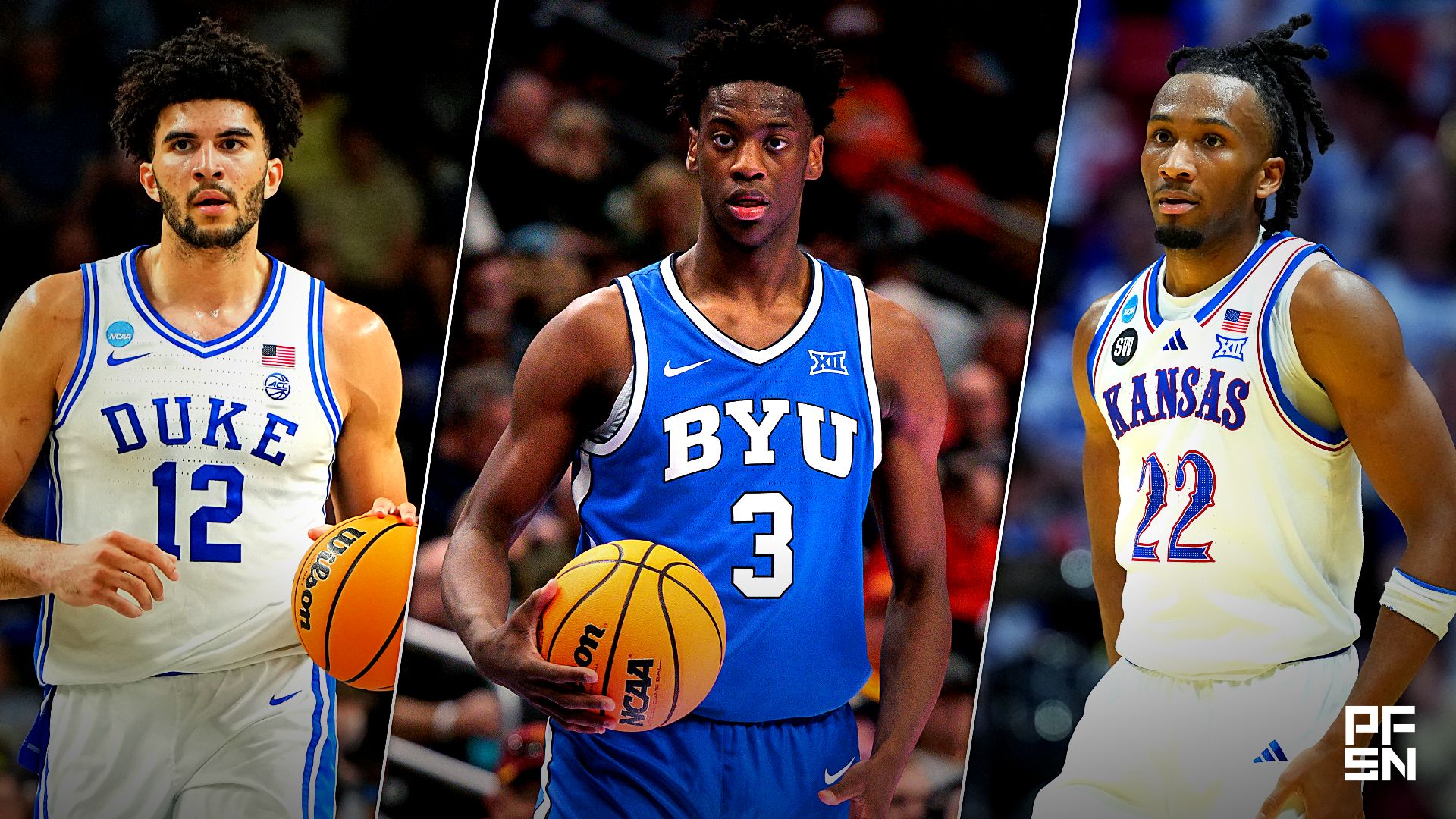
After a season full of tanking and debates over how the league should address the epidemic, we will finally learn which team lands the No. 1 overall pick in this year’s draft today at 3 p.m. ET when the 2026 NBA Draft Lottery takes place.
The Washington Wizards, Indiana Pacers, and Brooklyn Nets have the best odds of landing the No. 1 pick (14%), followed by the Utah Jazz and Sacramento Kings (11.5%). In this 2026 NBA mock draft using PFSN’s NBA Mock Draft Simulator, the Jazz won the lottery.
For this mock, former NBA agent turned draft expert Matt Babcock joined me to break down each of the picks. You can watch our live mock draft here or check out the picks below:
If you missed it, check out my live 2026 NBA mock draft with @MattBabcock11! We used @PFSN365‘s NBA Mock Draft Simulator to run through the first round: https://t.co/CVuAbEsN1s
— Alex Kennedy (@AlexKennedyNBA) May 10, 2026
1) Utah Jazz
AJ Dybantsa, SF, BYU
This is the dream scenario for the Jazz. Not only do they leap up to No. 1, but they get to keep AJ Dybantsa in Utah, where he’s already a fan favorite after starring at BYU. Dybantsa was one of the most hyped-up prospects in recent memory, yet he lived up to the buzz. At 6’9″ with a long frame, explosive burst, and the ability to score at all three levels, he embodies the modern two-way NBA wing. His handle and footwork allow him to create separation, and he can punish defenses both in transition and isolation. With his size, control, and polished skill, Dybantsa looks every bit like a future franchise centerpiece.
Dybantsa utilizes both strength and finesse, attacking the rim with power while displaying a smooth pull-up jumper from the midrange. He thrives in space and can facilitate when defenses collapse. Defensively, his quickness and motor make him capable of switching assignments and disrupting plays on both ends. To reach his full potential, he’ll need to find consistency from deep, but his physical tools, competitive fire, and upside make him a very safe prospect who also happens to have an extraordinary ceiling.
2) Washington Wizards
Darryn Peterson, SG, Kansas
Standing at 6’6″ with long arms and a strong build, Darryn Peterson has the look of an NBA-ready wing and potential franchise cornerstone. Peterson is a true three-level scoring threat, using his smooth dribbling to create space, scoring well off the dribble, and hitting jump shots with confidence. Also, his balanced style and smart decisions make him effective as a playmaker as well. Defensively, Peterson uses his length, quick instincts, and discipline to defend several positions and break up passes.
He plays with maturity, stays under control, and understands team defense and rotations well. What really sets him apart is how he can take over a game without trying to do too much. Babcock notes that teams will want to look into his medicals after he dealt with cramping issues throughout his freshman year (including a scary full-body cramping incident that led to a brief hospitalization).
3) Atlanta Hawks
Cameron Boozer, PF, Duke
Cameron Boozer absolutely dominated throughout his freshman year at Duke, joining Cooper Flagg, Zion Williamson, Anthony Davis, and Kevin Durant as the fifth freshman to sweep the major Player of the Year awards. At 6’9″ with broad shoulders, excellent feel, and an advanced skill set, he combines old-school power with a modern forward’s versatility. The son of former NBA All-Star Carlos Boozer, Cameron scores efficiently from anywhere, whether facing up, backing down, or stretching the floor with his improving 3-point range. His poise and consistency stand out, giving him the look of a player ready to contribute immediately at the next level.
Boozer thrives on fundamentals rather than flash, relying on touch, body control, and basketball IQ to dominate within the flow of a game. He’s comfortable facilitating from the post or attacking closeouts, reads defenses like a veteran, and controls the glass with positioning and strength. While not super bouncy, his mobility and anticipation make him a sturdy defender across multiple spots. The big question is how his game will translate to the pros. Babcock argued that he won’t be an NBA team’s offensive engine, but he still believes he has All-Star potential as a complementary piece similar to a prime Kevin Love.
4) Brooklyn Nets
Caleb Wilson, F, North Carolina
Caleb Wilson’s freshman year at North Carolina didn’t go according to plan due to injuries, but he has the size, mobility, and two-way potential that NBA scouts look for in modern forwards. Standing 6’10” with long strides and good bounce, he moves well for his height and makes an impact on both offense and defense. On defense, his quick feet and timing help him guard different positions, contest shots, and offer extra rim protection. On offense, Wilson can drive to the basket, finish plays, and score from midrange, and he has shown flashes of improved 3-point shooting.
Wilson is still developing, but he already shows the basics of a strong two-way NBA player. His jump shot is getting better, and he already fits well into team play as a passer and cutter. With his athletic ability and growing skills, Wilson could become a dynamic forward as he gets stronger and more confident. Wilson has a lot of fans in NBA front offices, and Babcock noted that he may sneak into the top-three ahead of Boozer depending on which teams land those picks.
5) Indiana Pacers
Keaton Wagler, SG, Illinois
Standing at 6’6″, Keaton Wagler turned heads at Illinois with his pro-ready frame, smooth perimeter skills, and mature feel for the game. He’s a fluid ball-handler who plays with rhythm and change of pace, and he’s able to score off pull-ups, hit from deep, and punish defenses from the mid-range. Wagler can handle secondary playmaking duties, operate as an initiator, and generally makes sound decisions that keep the offense humming.
Wagler entered the season as a relative unknown and flew up draft boards after a dominant freshman year. Wagler projects as a high-upside, versatile perimeter piece who can grow into a legitimate long-term NBA contributor. Babcock slotted Wagler to Indiana because he can thrive alongside Tyrese Haliburton for years to come.
6) Sacramento Kings
Kingston Flemings, PG, Houston
Kingston Flemings climbed draft boards thanks to his explosive athleticism and playmaking. He combines elite speed with a quick first step and sharp change of direction, consistently pressuring defenses in transition and out of ball screens. Flemings is a natural scorer who can finish above the rim, attack gaps, and keep defenses honest with a reliable pull-up mid-range game. His downhill aggression and feel as a passer make him a dynamic threat whenever he has the ball.
Flemings competes with energy and confidence on defense, using his quickness and strong hands to disrupt passing lanes and generate steals. He plays with an edge on both ends of the floor and excels when the pace picks up. To reach his ceiling as a lead guard, improving his three-point consistency will be crucial.
7) Memphis Grizzlies
Darius Acuff Jr., PG, Arkansas
With a Ja Morant trade seeming more and more likely this offseason, the Memphis Grizzlies find a new face of the franchise at point guard in Darius Acuff Jr. The Arkansas star emerged as the best guard in the country during his lone season under John Calipari. Standing at 6’3″ with a strong build, he plays with confidence and controls the game at a speed most defenders struggle to keep up with. Acuff is a creative scorer who can beat defenders off the dribble, score from anywhere on the court, and finish through contact with either hand. He stands out in isolation and pick-and-roll situations, using skill and composure to create offense against any defense.
Although Acuff is known for creating his own shots, he also shows promise as a playmaker, using his awareness to find open teammates when defenses close in. Defensively, Acuff leaves a lot to be desired, but his strength and effort help balance out his average quickness. Acuff looks like a confident lead guard who can control the game for long stretches.
8) Dallas Mavericks
Nate Ament, SF, Tennessee
Nate Ament had an up-and-down freshman year, but the 6’9″ forward stands out with a rare mix of length, mobility, and perimeter skill. A smooth athlete, he runs the floor effortlessly and handles the ball well for his size. His face-up game and shooting touch stretch defenses, while his vision and passing make him a strong connector. With a high release and fluid mechanics, Ament is already a confident shot creator from deep.
On defense, Ament’s length and agility let him switch across positions and disrupt passing lanes, though he’ll benefit from added strength and better footwork. He plays with poise and shows advanced feel, suggesting more upside as his frame and on-ball defense mature. Early in his development, Ament’s size, skill, and potential make him a compelling prospect as his body and game continue to catch up to his tools.
9) Chicago Bulls
Brayden Burries, SG, Arizona
Brayden Burries is a physically mature, big-bodied guard known for his versatile three-level scoring ability. At 6’4″, he combines a powerful frame with a methodical attack, using balance and body control to finish through contact. Burries excels with a smooth left-hand finish, midrange pull-ups, and step-back shooters extending beyond the arc. Beyond scoring, he’s a capable passer with a reliable handle and good floor vision, offering flexibility to play both on and off the ball.
Defensively, Burries competes with physicality and intelligence, guarding both 1s and 2s effectively despite lacking elite quickness. He is an excellent rebounder for his position, consistently contributing energy and hustle. Though not the flashiest athlete, his smart approach and all-around skill set project him as a high-upside guard who can impact both ends of the floor at the next level.
10) Milwaukee Bucks
Labaron Philon Jr., PG, Alabama
Labaron Philon Jr. is a skilled, high-IQ scoring guard who stands at 6’4″ and shows poise, advanced passing vision, and versatile scoring ability. He plays at a controlled pace, showing patience and touch around the rim, with a quick first step and a knack for finding gaps in defenses. Philon converts at all three levels, is most comfortable attacking the basket, and excels in pick-and-roll playmaking. His polished handle and creative finishes create constant offensive threats.
Defensively, Philon is a pesky on-ball defender with quick hands and solid anticipation, despite a slight frame and limited explosiveness. To realize his potential, he needs to improve strength, consistency from three-point range, and decision-making under pressure. Philon’s maturity, basketball IQ, and aggressiveness, along with his developing physical tools, make him a promising guard prospect who can become a versatile, efficient playmaker at the next level.
11) Golden State Warriors
Mikel Brown Jr., G, Louisville
Mikel Brown Jr. is a skilled lead guard known for his poise, shooting, and advanced playmaking. At 6’3″, he runs the offense confidently, stays calm under pressure, and can play both on and off the ball with a smooth handle and reliable jumper.
Brown’s shot-making stands out. He is consistent off the catch and dribble, makes clutch threes, and reads defenses well to make the right play. Babcock likes the idea of Brown learning from (and playing alongside) Stephen Curry, who is 38 years old.
On defense, Brown relies on anticipation, intelligence, and quick feet to stay involved. He will need to add more strength for the NBA because of his lighter frame. If he keeps improving as a shot creator and gets stronger, Brown could become a dynamic, smart guard who fits well in today’s NBA.
12) Oklahoma City Thunder
Karim López, SF, New Zealand Breakers
That’s right, the Oklahoma City Thunder have a lottery pick thanks to their first-round pick swap with the Los Angeles Clippers. They take Karim López, who is the first international prospect selected in this mock. At 6’8″, he combines size, coordination, and versatility on both ends of the court. He finishes well at the rim, can space the floor, and is steadily improving as a shooter and passer. López plays with confidence and maturity, using his movement off the ball, defensive instincts, and rebounding to make an immediate impact at the professional level. On defense, López uses his length and awareness to guard multiple positions, challenge shots, and grab rebounds.
He is still working on his perimeter skills and figuring out whether he fits best as a wing or a stretch four. Even so, he already has the skills and mindset needed for the league. If his shooting keeps improving, López could become a reliable rotation player with the potential to develop into a key forward in the NBA.
13) Miami Heat
Yaxel Lendeborg, PF, Michigan
Yaxel Lendeborg is a high-IQ, versatile forward with a relentless motor and outstanding defensive anticipation. At 6’9″ with a lengthy wingspan, he fills the stat sheet, rebounds at an elite rate, makes plays as a connector on offense, and logs blocks and steals across multiple positions. Lendeborg excels near the basket with a soft touch and strong frame, and shows flashes as a floor spacer and creative passer, though his shooting consistency is still a work in progress.
Defensively, Lendeborg’s quick hands, positioning, and ability to disrupt passing lanes make him a valuable asset, though his foot speed against quicker wings could be tested at the NBA level. He’s a vocal leader and efficient team defender, thriving in help-side and switching schemes. While questions remain about his positional fit and upside given his age (he’ll be a 24-year-old rookie), Lendeborg’s all-around production, high motor, and impact on winning project him as a potential steal with clear rotational value.
14) Charlotte Hornets
Aday Mara, C, Michigan
Michigan center Aday Mara helped his draft stock during Michigan’s national title run, averaging 14.7 points, 5.7 rebounds, 3.2 assists, 2.3 blocks while shooting 64.4% from the field, 50.0% from 3-point range, and 78.6% from the free-throw line. He dominated Arizona in the Final Four, totaling 26 points, 9 rebounds, 3 assists, and 2 blocks after Lendeborg got hurt.
Here’s what Babcock has to say about the Michigan big man: “Mara is a uniquely skilled big man with elite size, advanced feel, and exceptional passing instincts for his position. Standing at 7’3” with a 7’7” wingspan, Mara immediately impacts both ends of the floor with his sheer presence and natural feel for the game. Offensively, he’s comfortable facilitating from the high post, elbows, and short roll, displaying touch and vision uncommon for a player his size. He uses angles and timing effectively to score with finesse rather than power, finishing with either hand and utilizing an array of hooks and soft lay-ins. While his physical strength and lateral mobility remain areas of development, his basketball IQ, passing, and touch make him an intriguing prospect.”
15) Chicago Bulls
Hannes Steinbach, PF, Washington
Hannes Steinbach is a 6’11” big man known for his physicality, touch, and advanced feel for the game. He’s a strong interior presence with great hands, polished footwork, and the ability to finish efficiently through contact. Steinbach operates well in pick-and-roll and high-post actions, showing awareness as both a finisher and passer. He plays with composure beyond his years, using positioning, timing, and effort to impact both ends rather than relying on flash or raw athleticism. Defensively, Steinbach provides dependable rim protection and rebounding thanks to his strength and anticipation.
While he lacks elite mobility on the perimeter, he communicates well and competes with discipline. The next step in his development is expanding his shooting range and becoming more confident as a floor spacer. Steinbach projects as a steady two-way frontcourt piece who can fit a modern NBA system.
16) Memphis Grizzlies
Cameron Carr, SG, Baylor
Cameron Carr is a high-level combo guard with a smooth shooting stroke and a modern offensive skill set. At 6-foot-5, Carr combines a quick release with deep range, thriving as a floor-spacer and off-ball shooter who needs little space to get his shot off. A former four-star recruit and Tennessee transfer, he has expanded his game at Baylor, showing bounce finishing at the rim and solid court vision as a ball handler. His length and athleticism help him get downhill, though adding strength remains important for maximizing his effectiveness.
Carr’s long arms and lateral quickness give him the potential to become a versatile defender, able to match up with both guards and wings. He is disruptive in the passing lanes and projects as an above-average team defender. While he has improved as a finisher, getting stronger and more consistent off the dribble will be key to unlocking his ceiling.
17) Charlotte Hornets
Chris Cenac Jr., F/C, Houston
Chris Cenac Jr. is a 6’11” forward/center whose size, mobility, and growing skills make him a promising long-term prospect. At Houston, he stands out for his smooth movement for his height, running the floor, finishing above the rim, and showcasing perimeter skills that are rare for someone his size. Cenac can face up, handle the ball, and has a good shooting touch from midrange and beyond.
On defense, Cenac uses his length and agility to rotate, protect the rim, and guard smaller players when needed. He rebounds well and has instincts that help on both offense and defense. As he gets stronger and refines his game, his potential becomes even more obvious. With his smooth athleticism, improving offensive skills, and ability to play both ends, Cenac could become a high-impact player at the next level.
18) Oklahoma City Thunder
Jayden Quaintance, F, Kentucky
Jayden Quaintance’s freshman year at Kentucky didn’t go according to plan, as injuries limited him to four games (and one start). The 18-year-old is one of the youngest players in the draft, and his size and athleticism already stand out. He brings a mix of strength, agility, and bounce that shows up on both ends. Defensively, he protects the rim, switches onto smaller players, and grabs rebounds. On offense, he finishes well around the basket, has a soft touch, and is getting more confident with his midrange shot. Despite his youth, he makes a difference in games with his energy, athleticism, and instincts.
Quaintance is adding more to his offensive game as his footwork and ball-handling get better, showing signs he could become a modern, face-up big man. He has shown some passing ability and could develop into a reliable shooter from outside. For him to reach his potential, he will need to be more consistent and make good decisions, especially when playing away from the basket.
19) San Antonio Spurs
Koa Peat, SF, Arizona
Standing 6’8″ and weighing 235 pounds, Koa Peat was one of the most physically ready and skilled forwards in college basketball. He uses his strength, coordination, and agility to make an impact on both offense and defense. Peat is a versatile player inside, able to finish through contact, rebound well, and defend several positions. He always plays with high energy and effort, making him a dependable option for the next level.
On offense, Peat is starting to show more skills beyond his physical tools. He handles the ball well, helps in transition, and can attack defenders, but he still needs to improve his outside shooting. He reads plays quickly, defends different positions, and fits well into team systems, making him ready to contribute right away. If he keeps developing, Peat could become a tough, two-way forward with a long NBA future. The big question with Peat is whether he will stay in the 2026 NBA Draft, as he could opt to return to college.
20) Toronto Raptors
Christian Anderson, PG, Texas Tech
Christian Anderson is a dynamic lead guard whose polish, feel, and shooting touch stand out despite his lack of ideal size. He plays with poise and pace, utilizing a tight handle, quick first step, and sharp changes of speed to create paint touches and pressure the rim. A true three-level scorer, Anderson can pull up off the dribble, shoot off movement, and space the floor with deep, confident range from three. His clean mechanics and balance allow him to hit tough shots under pressure and function as a primary option without forcing the issue.
Beyond scoring, Anderson shows command as a floor general, reading defenses in pick-and-roll and delivering accurate passes as a willing facilitator. He’s vocal, competitive, and carries himself like a leader, organizing the offense and setting the tone with his energy. Defensively, his size limits him to guarding ones, but he compensates with quickness, active hands, and effort at the point of attack. Anderson has the skill and mentality to project as a potential NBA starter despite a small guard frame.
21) Detroit Pistons
Tounde Yessoufou, SF, Baylor
At 6’5″ with a unique mix of strength, speed, and intensity to the wing, Tounde Yessoufou is strong, fast in the open court, and can jump well. Yessoufou is at his best when attacking the basket, finishing through contact, and drawing fouls. He controls his body well in traffic and uses his size to take advantage of smaller defenders, making him tough to guard in both transition and half-court play. As his shooting continues to improve, he is becoming more than just a slasher and now offers a more complete scoring game.
On defense, Yessoufou stands out for his strength and quickness. He can guard different positions, uses his hands to break up passes, and rebounds well on both ends of the floor. His energy and physical play are significant strengths, and if he continues to improve his ball handling and shooting, he could become a talented two-way contributor.
22) Atlanta Hawks
Bennett Stirtz, PG, Iowa
Bennett Stirtz is one of the best stories in the 2026 NBA Draft, as he moved from a Division II standout to a key player at Iowa to a likely first-round pick. Standing 6’4″, he has good size for his position, along with sharp instincts and a strong sense for running an offense. Stirtz is comfortable in pick-and-roll situations and reads defenses well, using his pace, footwork, and creativity to control the game. He shoots smoothly off the catch or dribble, helps space the floor, and finishes at the rim with skill instead of speed. His steady approach makes each offensive possession look calm and controlled.
Stirtz may not be the most explosive athlete, but his well-rounded offensive game should translate to the NBA. He can run the offense or play off the ball, finding open teammates and making smart choices with impressive efficiency. His dependable outside shot and ability to create while moving make him useful even when he doesn’t have the ball. If he adjusts to the NBA’s physical style and keeps improving on defense, his basketball IQ, leadership, and scoring versatility could help him stick as a reliable guard in a team’s rotation.
23) Philadelphia 76ers
Isaiah Evans, SF, Duke
Isaiah Evans is a 6’6″ wing with a knack for catching fire and taking over games as a shooter. He brings confidence, microwave scoring, and NBA-caliber range. At Duke, he showed a knack for hitting threes from deep and in bunches. Evans has the tools of an elite floor-spacer, with a quick release, smooth shot, and a feel for scoring off movement or attacking closeouts. His length and agility give him the upside to grow into a multi-level creator as he rounds out his game.
While Evans still needs to get stronger and may take time to adjust to the NBA’s physicality, his energy, confidence, and willingness to defend could allow him to make an immediate impact. He flashes disruptive hands and length on defense, with room to improve his consistency as he grows into his frame. If he continues to refine his shot selection, playmaking, and off-ball focus, Evans could quickly become a valuable scoring wing.
24) New York Knicks
Dailyn Swain, SF, Texas
Here’s what Babcock has to say about Dailyn Swain: “Dailyn Swain is a versatile two-way wing with size, athleticism, and skill set that projects well at the next level. His fluid movement, defensive versatility, and ability to operate in transition make him an intriguing prospect. Swain is a high-IQ player who thrives as a connector, impacting the game as a passer, defender, and transition playmaker rather than a high-usage scorer.
“While he is a strong downhill attacker who can finish with both hands, his shooting is a concern. His mechanics, particularly his balance and follow-through, need improvement, as he lacks confidence and consistency from beyond the arc. Additionally, he can sometimes fade into the background, not asserting himself offensively. His decision-making as a passer also needs refinement, as he can get careless with the ball when trying to make high-level reads. Despite these concerns, Swain’s defensive versatility, transition play, and ball-handling for his size make him a prospect worth monitoring. His game is likely better suited for the NBA than college, where more spacing could allow him to maximize his strengths.”
25) Los Angeles Lakers
Amari Allen, SF, Alabama
Amari Allen is a versatile Swiss-army-knife forward with plus size, feel, and a well-rounded offensive game rooted in IQ and unselfish play. He showed real comfort initiating offense for Alabama, consistently making sound decisions as a passer and secondary playmaker. While not a dynamic shot-creator, Allen keeps the ball moving, reads defenses well, and plays within the flow of the game. His smooth shooting stroke stands out as a key pillar of his pro outlook, projecting as a reliable catch-and-shoot threat with enough off-the-dribble punch to attack closeouts and finish through contact.
KEEP READING: ‘Overrated,’ ‘Sell High’: Calls Mount for Lakers to Cut Ties With Austin Reaves in Free Agency As Playoff Struggles Continue
Defensively, Allen brings multi-positional versatility, solid lateral quickness, and a steady motor, giving him real two-way value. He’s competent guarding both wings and forwards, but improving his footwork, physical strength, and overall discipline will be vital to thriving against NBA-level athletes. Though not an explosive leaper, Allen’s combination of size, intelligence, and shooting projection makes him an ideal connective piece. He’s a modern wing who enhances good lineups by competing, spacing the floor, and making the right play. The big question is whether he will stay in the draft, as Babcock has heard his camp wants a top-20 promise otherwise he could return to school prior to the May 27 deadline.
26) Denver Nuggets
Ebuka Okorie, PG, Stanford
Here is what Babcock has to say about Ebuka Okorie: “Okorie is an intriguing young guard with real offensive talent and upside. A quick, shifty ball-handler, he plays with pace, creativity, and confidence, showing the ability to create his own shot, get downhill, and make plays for others. He is especially effective operating inside the arc, where his change of speed, touch, and craft allow him to score in a variety of ways.
“He also shows promise as a playmaker and brings defensive value with his quickness, activity, and ability to generate steals. While his long-range shooting consistency, shot selection, and defensive versatility still leave room for improvement, his talent, feel, and scoring instincts make him a legitimate prospect worth monitoring.”
27) Boston Celtics
Henri Veesaar, C, North Carolina
Henri Veesaar is a 7-footer known for advanced footwork, rim protection, and improved offensive versatility. He combines a high motor with good hands and quick leaping ability, making him an effective lob threat and rim protector. Despite a lean frame, Veesaar’s footwork and fundamentals compensate for limited explosiveness, allowing him to create advantages in the post and show strong shot-blocking instincts. He also shows promising shooting touch and efficient finishing around the rim.
Veesaar has overcome injury setbacks to display intelligent decision-making, skillful passing, and defensive versatility, though he needs to improve his strength and foul discipline to reach his full potential. Projected as a developmental NBA prospect, Veesaar’s size, smarts, and touch make him a modern rim-protecting big with upside for an evolving frontcourt role.
28) Minnesota Timberwolves
Allen Graves, PF, Santa Clara
Allen Graves is a very skilled, high-IQ complementary player who could fit the mold of a modern four in the pro ranks. The 6’9″ forward averaged 11.8 points, 6.5 rebounds, 1.8 assists, and 1.9 steals per game while helping Santa Clara reach the NCAA Tournament for the first time in 30 years. Babcock likes how he would fit with the Minnesota Timberwolves, explaining that they could be patient with him and develop him into a key role player.
However, the big question is whether Graves will stay in the 2026 NBA Draft. Babcock noted that there are rumblings that LSU is preparing a lucrative NIL offer for Graves in hopes that he’ll return to college and commit to Will Wade and the Tigers.
“The question is: is he gonna stay in? I heard rumors that LSU is in the mix with a big potential payday. We will see how it unfolds,” Babcock said. Graves got an invite to the NBA Combine, where he’ll try to improve his draft stock. He has until May 27 to withdraw from the 2026 NBA Draft and return to college.
29) Cleveland Cavaliers
Morez Johnson Jr., C, Michigan
Here’s what Babcock has to say about Morez Johnson Jr.: “At 6’9”, 255 lbs., Johnson is a physical, rugged big man who thrives on effort and strength. He’s a constant double-double threat and was one of the most capable rebounders in college basketball. Johnson isn’t the tallest or most offensively skilled big man, but his combination of power, motor, and efficiency in his role makes him a highly dependable interior presence. He’s tough and physical on both ends and projects as a player whose strengths could translate well to the professional level.
“Johnson is a tough player who does a lot of the dirty work. He’s physical, plays hard, dominates the glass, and is capable of throwing it down at the rim. And he’s shown growth in his overall offensive skillset.”
30) Dallas Mavericks
Joshua Jefferson, PF, Iowa State
Joshua Jefferson is a strong, versatile forward whose game is built on toughness, feel, and doing the dirty work that helps teams win. He uses his powerful frame to carve out space inside and scores with solid touch and footwork around the rim. As a connective offensive piece, Jefferson is an excellent positional passer. His game isn’t flashy, but his processing, unselfishness, and reliability make him an ideal complementary offensive engine.
Jefferson is fundamentally sound and competitive on defense, using his strength, instincts, and underrated agility to guard multiple positions and battle on the glass. He’s not an explosive leaper or high-end rim protector, but he is a sturdy team defender who stays in position, has good hands, and competes every possession. The key swing skill for his pro outlook is perimeter shooting. If he can continue to become a credible floor spacer while maintaining his physicality and playmaking, Jefferson has a clear pathway to a role at the NBA level.