
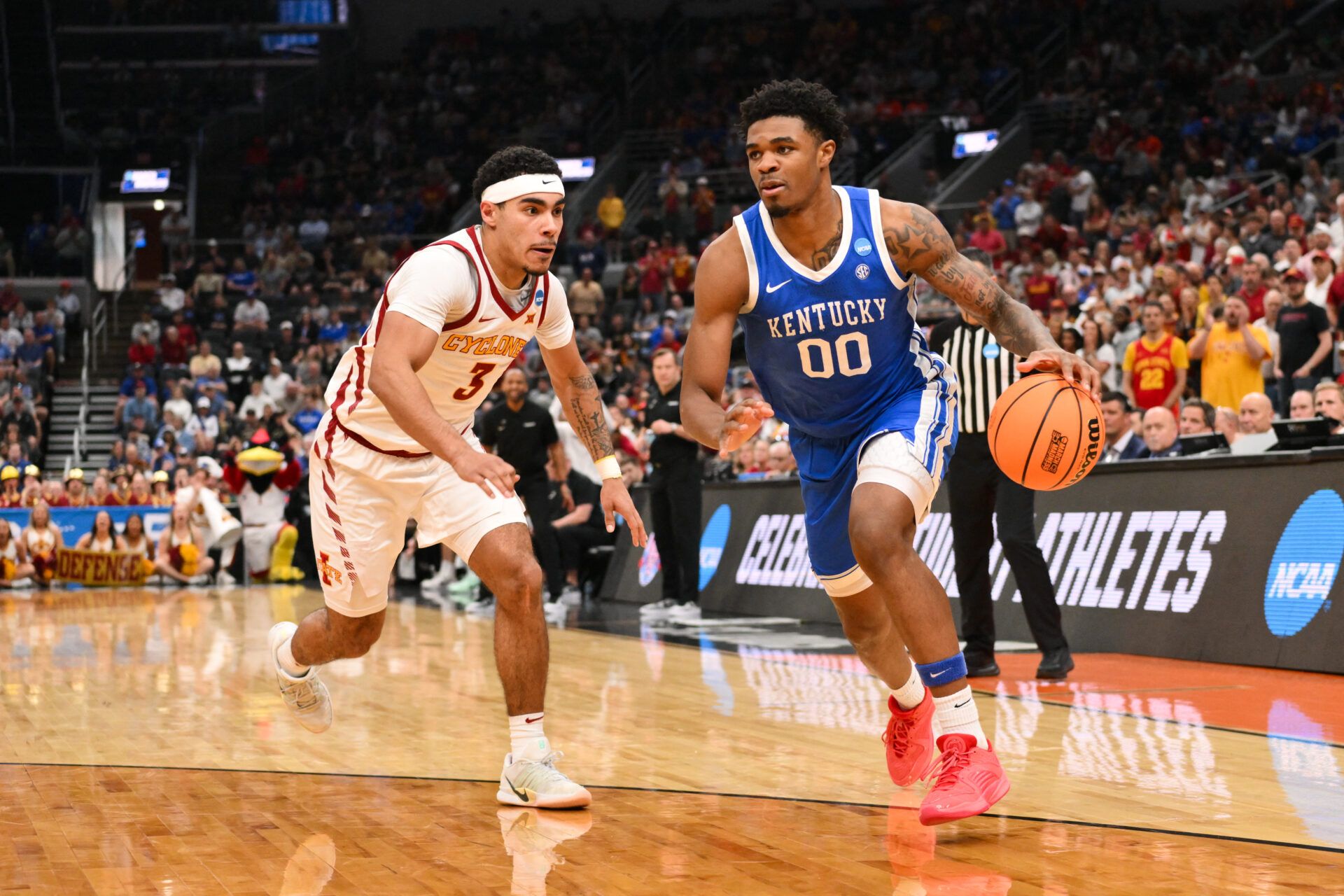
College basketball teams in the current era, particularly the blue blood programs, have reportedly spent large sums to build competitive rosters capable of contending for the national championship. An article published before the Final Four revealed that most programs spent between $10 million and $22 million to compete for the NCAA title this past season.
Michigan allocated more than $10 million to build a national championship-winning roster. By contrast, Kentucky and North Carolina spent a combined $36 million but fumbled early in the NCAA Tournament.
College Basketball World Floored by Teams’ Record-Setting Costs
Texas head coach Sean Miller said he believed offseason spending could be much higher, with about 20-25 teams spending more than $20 million to build competitive rosters. Miller shared his assessment during Monday’s episode of the “Field of 68: After Dark” podcast. Hosts Jeff Goodman and Rob Dauster asked the Texas head coach about the current spending situation, and they were stunned by his response.
How many 20+ million dollar rosters are there in college basketball this offseason? Sean Miller’s perspective:
“Educated guess? Sometimes you don’t have all the information… I would say 20-25.” 👀
🎥: https://t.co/kRYnhn5fpC pic.twitter.com/nG8CMfoVOg
— The Field of 68 (@TheFieldOf68) May 4, 2026
Texas, in fairness, secured commitments from five portal players, including TCU forward David Punch, whose NIL valuation was pegged at $1.8 million (per On3). Although spending figures for the transfer portal have not yet been released, the Longhorns are expected to have spent a significant amount to recruit Punch and fellow transfers Mikey Lewis, Elyjah Freeman, Amari Evans, and Isaiah Johnson from their respective teams.
Dauster followed up with a social media post, noting that he received a message from an insider heavily involved in the NIL space who said the most expensive roster costs about $30 million. He expects another program to surpass that figure once the roster changes are finalized.
Jason Scheer, senior editor/publisher and podcast personality at WildcatAuthority.com, also reacted to Miller’s estimate, saying, “The sport is as entertaining as it has ever been. It’s also a broken system.”
Arizona reached the Final Four of the 2026 NCAA Tournament after spending more than $10 million, according to On3’s Pete Nakos. For the 2026-27 season, the Wildcats welcomed McDonald’s All-American Game Co-MVP and five-star prospect Caleb Holt, along with transfer guards Derek Dixon and JJ Mandaquit. Wildcats head coach Tommy Lloyd retained centers Motiejus Krivas and Mabil Mawut and guard/forward Ivan Kharchenkov.
Goodman also responded with a quote from a high-major head coach who said, “The cap is irrelevant to us. With the way we are operating, there’s no cap at all.”
Kentucky Sports Radio host Matt Jones was also surprised by Miller’s “educated guess.” At the same time, Trilly Donovan jokingly reacted to several athletic directors who may be in disbelief at the Texas college basketball head coach’s statement on the program.
Villanova Sports Law Professor and former Green Bay Packers vice-president and agent Andrew Brandt described the NIL cap for college basketball teams as a nuisance, given that many teams have already surpassed the $20-million mark in building competitive men’s basketball programs.
“Twenty to twenty-five $20 million CBB rosters. For a Rev Share Cap of $20.5 million for all sports, including football. Translation: the Cap is merely a small nuisance,” Brandt said.
Spending tons of NIL resources to build a competitive roster is a risk high-major schools are willing to take to secure the national championship. But it has been a source of ridicule for other programs that ended up with disappointing finishes after hyping the college basketball world into believing their lineup was the best assembled roster money could buy.
