
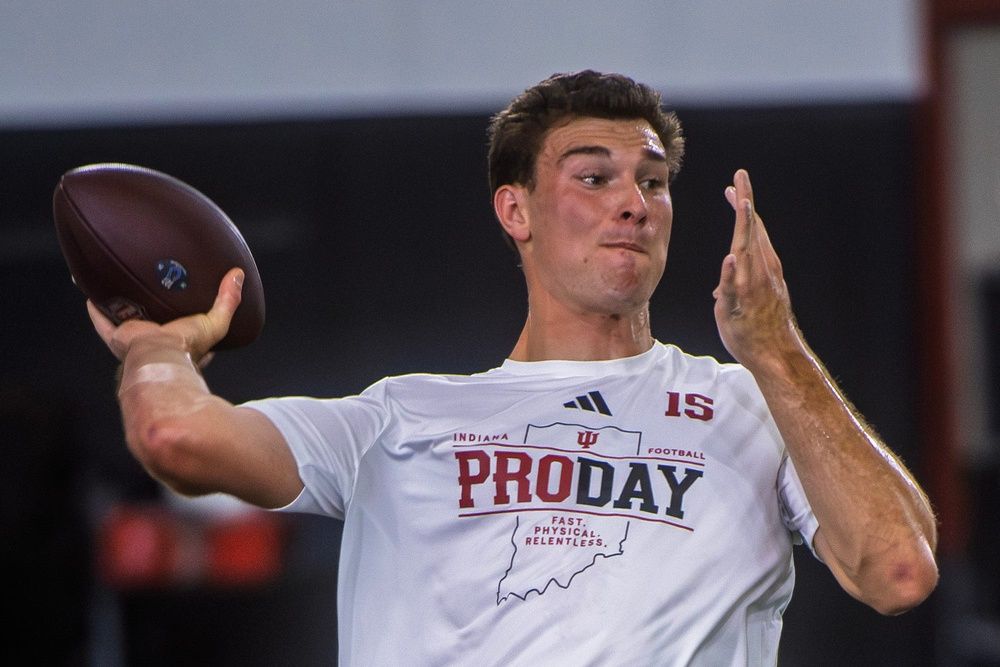
Quarterback evaluations are once again dominating pre-draft discussions ahead of the 2026 NFL Draft, even in a year lacking a universally agreed-upon top prospect. As teams continue to dissect film and refine their boards, opinions remain split across the league.
One name that has been dominating the spotlight is the Heisman winner Fernando Mendoza, whose production and demeanor have made him one of the more solidified options in this class. However, not every analyst is fully convinced about how quickly his success will translate to the next level. Former NFL QB Dan Orlovsky is among those urging patience when projecting Mendoza’s NFL readiness.
Dan Orlovsky Explains Why Fernando Mendoza’s College System Could Slow NFL Transition
During a recent breakdown on the “Ross Tucker Football Podcast,” Orlovsky raised concerns about the offensive structure Mendoza operated in at the college level, pointing to elements that may not immediately translate to the NFL.
He specifically highlighted how much of the offense was predetermined before the snap, limiting the quarterback’s exposure to full-field reads and post-snap adjustments.
“I would tell you the stuff that has given me reservation is, one, so much of the offense was declared pre-snap,” Orlovsky said. “When you watch their games, one of my notes overwhelmingly is — why does everybody just play them in man? It feels like here comes man, here comes all-out man.”
Expanding on that point, Orlovsky referenced multiple game situations where opposing defenses simplified their approach, often relying heavily on aggressive man coverage and pressure packages.
According to him, this made reads more predictable and allowed Mendoza to capitalize on isolated matchups, but didn’t necessarily prepare him for more complex defensive disguises.
“You go to the Penn State game, the touchdown to Omar Cooper Jr., I think Penn State runs all-out pressure in the red zone like three snaps in a row,” Orlovsky added. “I just think at times it’s so clear what the coverage is going to be. They were so RPO-heavy that you created these one-on-ones on the perimeter all the time. And he was good — he was very good at them. He would get the one-on-ones and kill you on it.”
“But a lot of the offense just felt like, watching it, ‘Okay, we’re outside. We’re throwing stop route, go route, back-shoulder route because of the RPO.’ So, I just didn’t get to see him operate a ton of the stuff that I think you’re going to be asked to operate in the NFL at a high level as the number one pick. A lot of shotgun,” Orlovsky stated.
Orlovsky’s evaluation centers on the idea that Mendoza thrived within a system built around quick reads and RPO concepts, which often dictated where the ball should go before the play even unfolded. While effective in college, that structure can limit a QB’s development in areas critical for NFL success.
“So I just think that’s going to be a transition. I’ve never said he’s going to be incapable of it — it’s just going to take time,” said Dan Orlovsky.
Despite those concerns, Mendoza’s overall profile remains highly appealing. On the PFSN Consensus Big Board, Mendoza carries a grade of 90.61 and ranks as the sixth overall prospect, and is without a doubt expected to hear his name get first in the draft.
His underlying metrics further reinforce his standing among the top quarterbacks in this class. Mendoza posted an elite 93.3 score on PFSN’s CFB QB Impact Metrics, ranking second overall, while earning an A grade for his performance across the 2025 season.
BE AN NFL GM: PFSN’s Ultimate GM Simulator
In a draft cycle filled with uncertainty, Mendoza’s projection reflects the broader ambiguity surrounding QB evaluations this year. With fewer clear landing spots and no consensus top pick, teams are being forced to weigh system fit more carefully than ever.
That dynamic could lead to unexpected movement on draft night, whether through aggressive trades or surprising slides. For Mendoza, the path to NFL success may not be immediate, but if developed correctly, his skill set still offers vital long-term upside in a league constantly searching for quarterback stability.
