
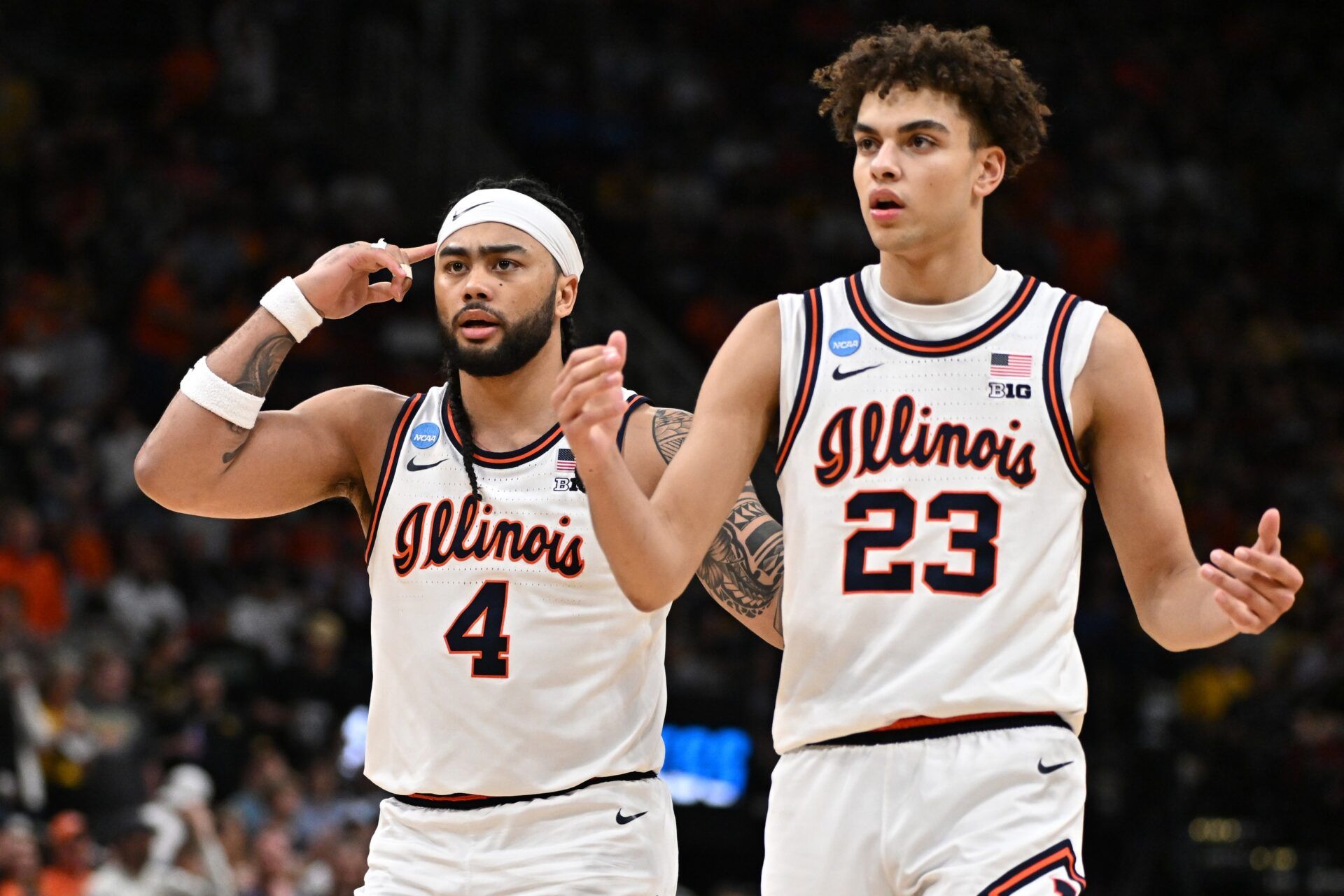
The Illinois Fighting Illini are once again playing on college basketball’s biggest stage, and the historic achievement has fans across Champaign celebrating their first Final Four appearance in over two decades.
For a program that has reached the sport’s penultimate weekend just five times in its history before this, every trip to the Final Four represents a special moment that becomes etched in the memories of players and fans alike.
Understanding when Illinois last reached this level provides crucial context for appreciating the magnitude of what the current team has accomplished.
Head coach Brad Underwood has built something special in Champaign, guiding a roster that blends veteran leadership with dynamic young talent. The comparisons to Illinois’ most recent Final Four squad have been unavoidable, and for good reason.
When Did Illinois Last Make the Final Four? Remembering the 2005 Team
The 2004-05 Illinois Fighting Illini men’s basketball team remains one of the most celebrated squads in college basketball history.
Led by Deron Williams, Dee Brown, and Luther Head, that roster featured five players who went on to play in the NBA: Williams, Head, Brown, James Augustine, and Roger Powell Jr. In 2014, Sports Illustrated voted the 2005 Illinois team as the best ever not to win a national title, a distinction that speaks to both their dominance and heartbreak.
MORE: When Was the Last Time Arizona Made the Final Four? Revisiting the Wildcats’ March Madness History
Head coach Bruce Weber, in just his second season at Illinois, orchestrated the most successful campaign in program history. The Illini finished 37-2, tying the NCAA record for victories in a season at the time. They started 29-0 before losing their regular-season finale at Ohio State on a last-second three-pointer, then rebounded to win the Big Ten Tournament championship.
Illinois spent the entire season virtually ranked No. 1 in the country, becoming the first team in program history to finish unanimously atop the final Associated Press poll.
The roster was loaded with talent and depth. Williams, who would become the third overall pick in the 2005 NBA Draft, averaged 12.5 points and led the team with 6.8 assists per game. He was essentially a second point guard alongside Brown, keeping the ball moving and making everyone around him better.
Williams went on to play 12 seasons in the NBA, earning All-NBA second-team honors twice with the Utah Jazz.
Brown, the face of the program, captured The Sporting News National Player of the Year award along with Big Ten Player of the Year and Big Ten Defensive Player of the Year honors. The 6-foot guard from Maywood, Illinois, averaged 13.3 points, 2.7 rebounds, and 4.5 assists per game, but his impact went beyond the statistics.
MORE: LeBron James Celebrates Arizona’s Win Over Purdue As Bryce James and Co. Are Final Four Bound
Known as “The One Man Fast Break,” Brown catalyzed Illinois’ transition offense and brought relentless defensive energy despite his size. He was selected 46th overall in the 2006 NBA Draft and played professionally in nine different countries.
Head led the Illini in scoring with 15.9 points per game while adding 4.0 rebounds and 3.8 assists. The Houston Rockets selected him 24th overall in 2005, and he played six seasons in the NBA.
Augustine and Powell rounded out the starting five, and both eventually reached the NBA. The team’s depth extended to the bench, where super-sub Jack Ingram provided crucial minutes in several must-win situations.
Weber was named National Coach of the Year by nine different organizations, becoming the first coach in 100 years of Big Ten basketball to win consecutive outright league championships in his first two seasons. The Illini dominated the conference with a 15-1 record and became just the second team to win both an outright Big Ten regular-season title and the Big Ten Tournament in the same season.
Illinois led the nation in assists and was fourth in scoring, second in three-pointers made, and eighth in points allowed. The team was noted for its impeccable ball movement on offense, embodying the beautiful game at its purest. Weber’s system maximized the talents of his versatile roster, creating a squad that could beat opponents in multiple ways.
The NCAA Tournament run was nothing short of spectacular. As the overall No. 1 seed, Illinois won its first three games by double digits, setting up an Elite Eight showdown with Arizona that would become one of the most memorable games in tournament history.
The Wildcats, featuring future NBA players Channing Frye, Salim Stoudamire, and Hassan Adams, built a commanding 75-60 lead with just over four minutes remaining. The game appeared over.
What happened next is the stuff of legend. Williams hit a three-pointer with 3:50 remaining to ignite a furious comeback. Over the next three minutes, Arizona managed no field goals and committed four turnovers while Illinois hit seven consecutive baskets.
Head drained a three-pointer, Brown scored in the lane, Head converted a steal into points, Williams drove for a basket, then stole the ball and fed Brown for another bucket.
With 39 seconds left in regulation, Williams tied the game at 80-80 with a three-pointer that sent the orange-clad crowd into hysterics. The shot capped an improbable 20-5 run that Arizona never saw coming.
In overtime, Williams opened the extra period with another three-pointer. After Frye gave Arizona a brief lead, Powell’s dunk put Illinois back on top. Williams connected on yet another three-pointer with just over two minutes left to make it 88-84, and when Head stole a pass and sprinted for a layup, the celebration was on.
Williams finished with 22 points, 10 assists, and five three-pointers. Head added 20 points despite playing with a sore hamstring. The final score, 90-89, sent Illinois to its first Final Four since 1989.
The national semifinals in St. Louis were a weeklong Orange party, with tens of thousands of Illini fans descending on the city. An NCAA Final Four record crowd of 31,500 attended Illinois’ open practice session.
The hype was real, and the Illini delivered against Louisville in the semifinal, dominating the Cardinals 72-57 behind hot shooting from Head, an explosive second half from Powell, and suffocating defense from Williams. The victory gave Illinois its 37th win, tying the NCAA record at the time.
The national championship game on April 4, 2005, matched Illinois against North Carolina, marking the first time in 30 years that the nation’s top two teams met for the title. Roy Williams had returned to his alma mater and was seeking to complete his mission of bringing a championship to Chapel Hill.
The Tar Heels featured a balanced attack led by Raymond Felton, Rashad McCants, Sean May, and Marvin Williams.
MORE: College Basketball 2026 Transfer Portal Tracker: Complete List of Players Who Are Available
Despite entering the game as slight favorites, Illinois struggled to find its offensive rhythm. The Illini shot poorly from the perimeter and couldn’t overcome North Carolina’s size advantage inside.
May dominated the paint with 26 points and 10 rebounds, earning Final Four Most Outstanding Player honors. McCants added 14 points, and the Tar Heels controlled the tempo throughout the second half.
Illinois made several runs to get back into the game, but North Carolina had an answer each time. The final score, 75-70, didn’t fully capture how competitive the game remained until the final minutes.
Head led Illinois with 21 points, while Williams added 17 points and seven assists, and Brown contributed 12 points and seven assists. The loss was devastating, but the team’s accomplishments throughout the season remained undeniable.
After the game, Weber found perspective in defeat. “This season was enjoyable. This team was enjoyable to coach,” he said. The players echoed that sentiment, recognizing that their 37-2 season and improbable tournament run would live forever in Illinois lore.
Twenty-one years later, that 2005 team remains the gold standard for Illinois basketball. Williams became the highest-drafted player in school history at No. 3 overall.
All five starters played in the NBA, a testament to the professional-level talent Weber had assembled. Brown became a coaching legend in his own right, currently serving as head coach at Roosevelt University after coaching professionally across the globe.
The parallels between the 2005 and 2026 Illinois teams are striking. Both squads overcame double-digit deficits in the Elite Eight.
MORE: Tommy Lloyd’s Heartfelt Tribute to Legendary Arizona HC Lute Olson Goes Viral After Final Four Berth
Both feature unselfish play, elite guard play, and chemistry that transcends individual talent. Both are the culmination of years of building and developing a winning culture.
As the current Illini prepare for their Final Four matchup, they carry the hopes not just of the current fanbase but also of the legacy of that legendary 2005 squad, which came within five points of immortality.
