
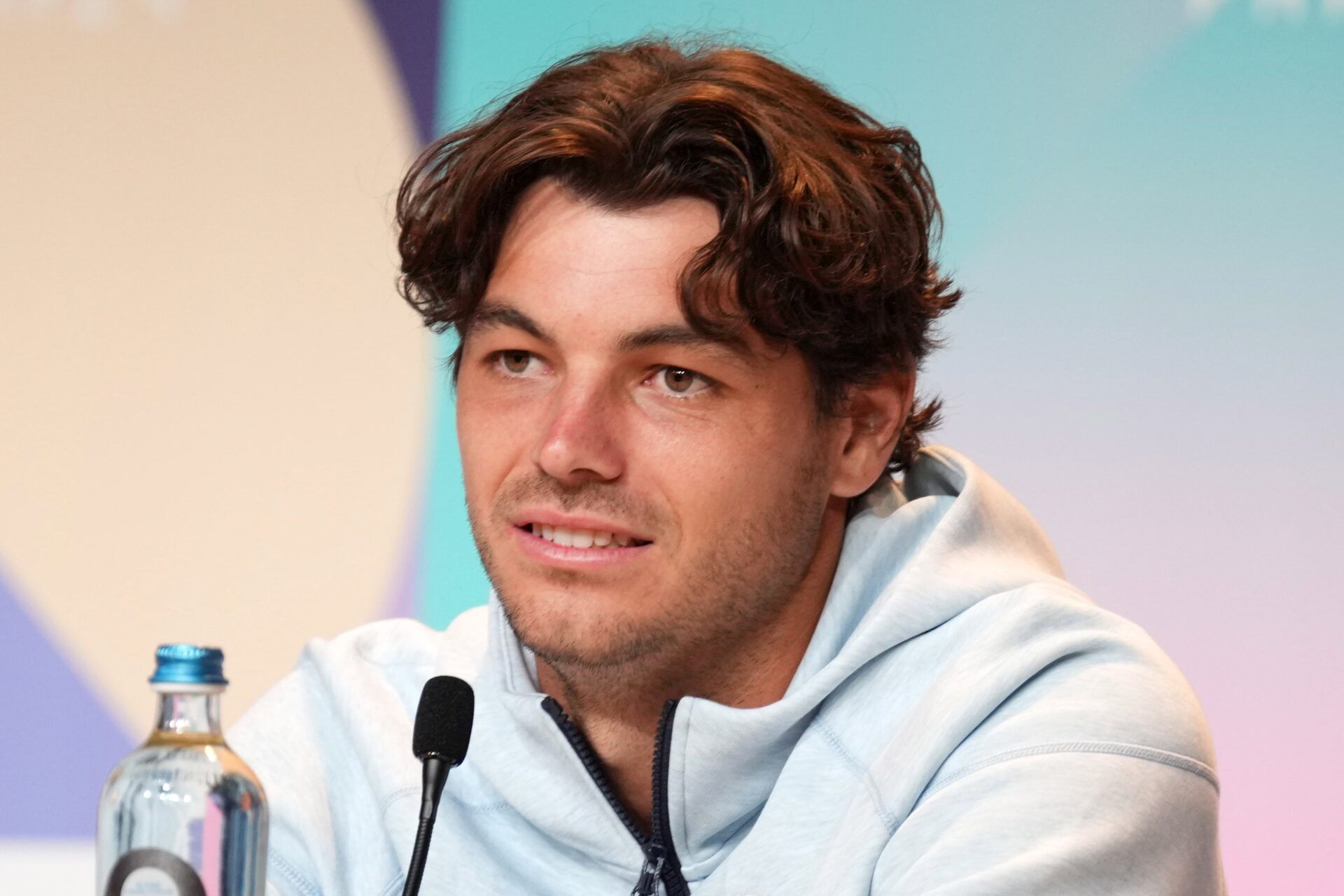
Taylor Fritz did not sugarcoat how match scheduling works at the highest level of men’s tennis. Speaking during a recent Twitch livestream while playing World of Warcraft, the American revealed that when it comes to choosing match times at tournaments, the sport’s biggest stars sit at the top of the food chain.
According to Fritz, if Novak Djokovic, Carlos Alcaraz, or Jannik Sinner want a specific slot, especially under the lights, they usually get it.
Novak Djokovic, Carlos Alcaraz, and Jannik Sinner Drive Prime-Time Decisions As Taylor Fritz Explains
Match scheduling has long been a topic of quiet debate in tennis. Prime-time slots on center court attract larger television audiences, create electric atmospheres, and, in many cases, offer more favorable playing conditions.
Night matches often draw packed crowds and global viewership, making them commercially valuable for tournaments and broadcasters.
For players, the time of day can influence everything from physical recovery to performance rhythm.
Fritz explained that priority largely follows ranking and marquee status. “Mostly the higher-ranked ones. It’s the priority matches,” he said. “At the end of the day, Carlos, Jannik, and Novak, if they’re playing, they’re going to get the time slots they want.”
Taylor Fritz on how priority scheduling works “If I play Novak (Djokovic) and he wants to play me at night…they gonna put my a*s at night” pic.twitter.com/JzDWsp9BAV
— asud (@asud683385) February 27, 2026
He went on to describe how the draw structure affects those choices. “You’re separated in the draw. Carlos and Jannik are going to be split. So one day Carlos is going to get his pick. The next day Jannik is going to get his pick. Then whoever the next highest seeds are will probably get a say.”
But where does Fritz fit in the tournament scheduling hierarchy?
As the top-seeded American at many events, Fritz placed himself a tier below the elite trio. “I probably fall around priority number three on the day that I play,” he said. “Three or four people will have priority one day over the top eight. Because like I said, the draw is split in half. I won’t have to compete with the requests of people on the opposite side of the draw, because they’re not playing on the same day as me.”
Even then, his leverage has limits. “I won’t get to pick the time that I play on center court. But if I want to pick the time that I play on court two, I might be able to say, ‘Hey, don’t put me first, but also don’t put me in the night match.’ That’s about it.”
And if he faces one of the sport’s heavyweights, the choice disappears altogether. “At any point, if I play one of those top guys, then it’s like, forget that. Whatever I want to do is completely out of the question. We do what they want to do. If I play Novak and he wants to play at night, they’re going to put me at night against him. That’s kind of just how it is.”
Fritz recently concluded his Delray Beach Open campaign, where the top seed lost 4-6, 3-6 to the fifth seed Tommy Paul in the quarterfinal. His next stop is Indian Wells, where he will kick off his BNP Paribas Open campaign starting March 4.
