
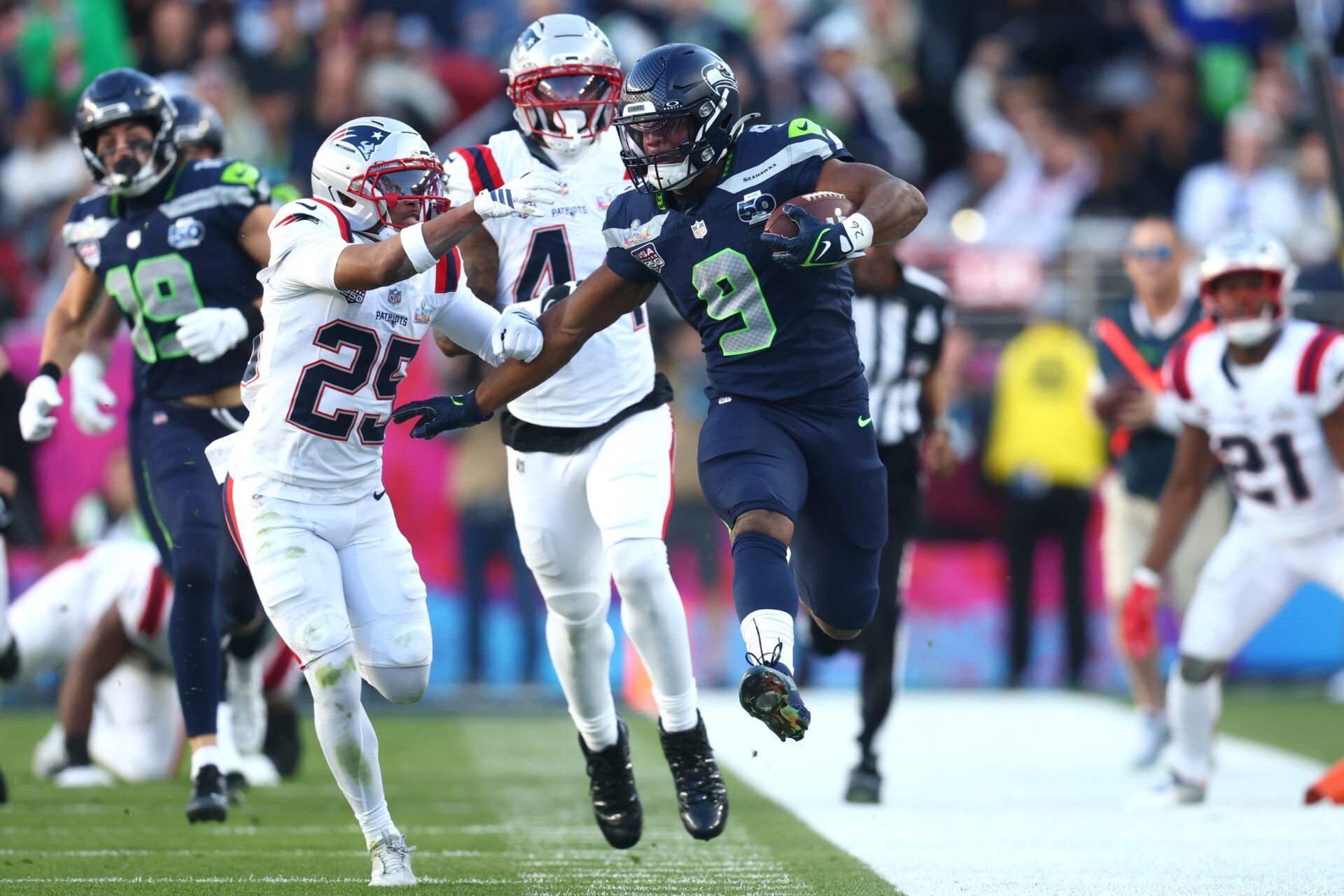
Kenneth Walker III did what no running back had done in 28 years. The Seattle Seahawks’ fourth-year back was named Super Bowl LX MVP after rushing for 131 yards on 25 carries and adding two catches for 26 yards in Seattle’s 29-13 demolition of the New England Patriots at Levi’s Stadium.
Walker is the eighth running back to win the Pete Rozelle Trophy and the first since Terrell Davis did it in January 1998. His 157 total scrimmage yards were nearly double what New England’s entire offense managed through three quarters, and he was the clear engine of a Seahawks attack that controlled the clock for 33:11.
Quarterbacks have claimed 34 of 60 awards. Wide receivers have eight. Running backs now sit at eight, a number that had been frozen at seven for nearly three decades.

Every Running Back to Win Super Bowl MVP
Larry Csonka set the template in Super Bowl 8, bulldozing Minnesota for 145 yards and two touchdowns on 33 carries while Bob Griese completed just six passes in Miami’s 24-7 win.
Franco Harris followed the script one year later in Super Bowl 9, grinding out 158 yards and a score on 34 carries as Terry Bradshaw threw just 14 times in Pittsburgh’s 16-6 victory over the Vikings.
John Riggins took it to the extreme in Super Bowl 17 with a then-record 38 carries for 166 yards and the game-winning fourth-quarter touchdown against Miami. His four-game postseason rushing total of 610 yards remains one of the great playoff runs in NFL history.
Marcus Allen delivered the most electrifying performance of the group in Super Bowl 18, shredding Washington for 191 yards and two touchdowns on just 20 carries. His 74-yard touchdown run, a stunning field reversal, held the Super Bowl record for 17 years.
Ottis Anderson took a different approach in Super Bowl 25, using 21 carries for 102 yards to anchor New York’s ball-control plan that held possession for a record 40:33 in a 20-19 classic over Buffalo. Anderson remains the only back on this list without a Hall of Fame bust.
This run by Kenneth Walker III is exactly why lateral agility & explosiveness are important when I evaluate RBs. Can you jump-cut and exchange gaps when the inside gaps are clogged?
Walker is a stud!pic.twitter.com/i1QlXLzRvd
— Damian Parson💰 (@DP_NFL) February 9, 2026
Emmitt Smith won the award in Super Bowl 28 with 30 carries for 132 yards and two scores against the Bills, becoming the first player to lead the league in rushing, win NFL MVP and take home Super Bowl MVP in the same season.
Terrell Davis held the title of most recent running back MVP for 28 years after posting the best pure stat line of the group: 157 yards and three touchdowns on 30 carries in Denver’s 31-24 upset of defending champion Green Bay in Super Bowl 32.
MORE: Ranking the 5 Best Super Bowls of All-Time: Revisiting the Most Exciting Title Games in NFL History
Kenneth Walker III added the eighth chapter in Super Bowl 60, grinding out 131 yards on 25 carries and catching two passes for 26 yards as Seattle suffocated New England 29-13. Walker was the best offensive player on either side of the ball from the opening snap, racking up 100 scrimmage yards by halftime while the Patriots’ entire offense managed just 71. His performance powered a ball-control attack that held possession for over 33 minutes and set up Jason Myers’ record-breaking five field goals.
Why the Drought Lasted 28 Years and How Walker Broke It
The standard explanation for the drought was that the NFL became a passing league, which was true but incomplete. The deeper issue was structural. Look at the carry totals for the first seven winners: 33, 34, 38, 20, 21, 30, 30.
The average was roughly 29 carries per game. Modern teams rarely hand one back the ball that often in a regular-season game, let alone the Super Bowl. Committees, pass-heavy scripts and the league’s reluctance to overwork running backs had made those kinds of workloads nearly extinct.
Up to 73 total yards already today for Kenneth Walker III
Super Bowl MVP?
pic.twitter.com/H27a9W3RcM— RotoWire (@RotoWire) February 9, 2026
Walker broke through with 25 carries, the fewest by a running back MVP since Marcus Allen’s 20 in Super Bowl 18. But he did it in a way the previous seven winners never had to. Walker won the award without scoring a touchdown, a first for any running back Super Bowl MVP. Six of the previous seven winners scored at least twice, and Davis’ three rushing touchdowns were the difference in a one-score game.
What made Walker’s case undeniable was context. Sam Darnold completed just 19 of 38 passes for 202 yards in the win. Seattle’s defense delivered six sacks and two interceptions, including Uchenna Nwosu’s dagger pick-six. Jason Myers scored a record-tying 17 points on five field goals and two extra points. On a night with that many MVP candidates, the voters still pointed to the running back who had been the Seahawks’ offensive heartbeat from the first quarter forward.
“The really great backs, in my opinion, can catch. And that’s what Ken can do,” Seahawks offensive coordinator Klint Kubiak told NFL.com before the game. “He can run routes. He can affect the game more than just handing the ball off.”
Walker proved Kubiak right on the biggest stage. His 157 scrimmage yards matched Terrell Davis’ rushing total from Super Bowl 32, and his 25 carries continued the ironclad rule that has defined every running back MVP: you have to carry the full weight of the offense. In an era that was supposed to make that impossible, Walker did it anyway and ended the longest positional drought in Super Bowl MVP history.