
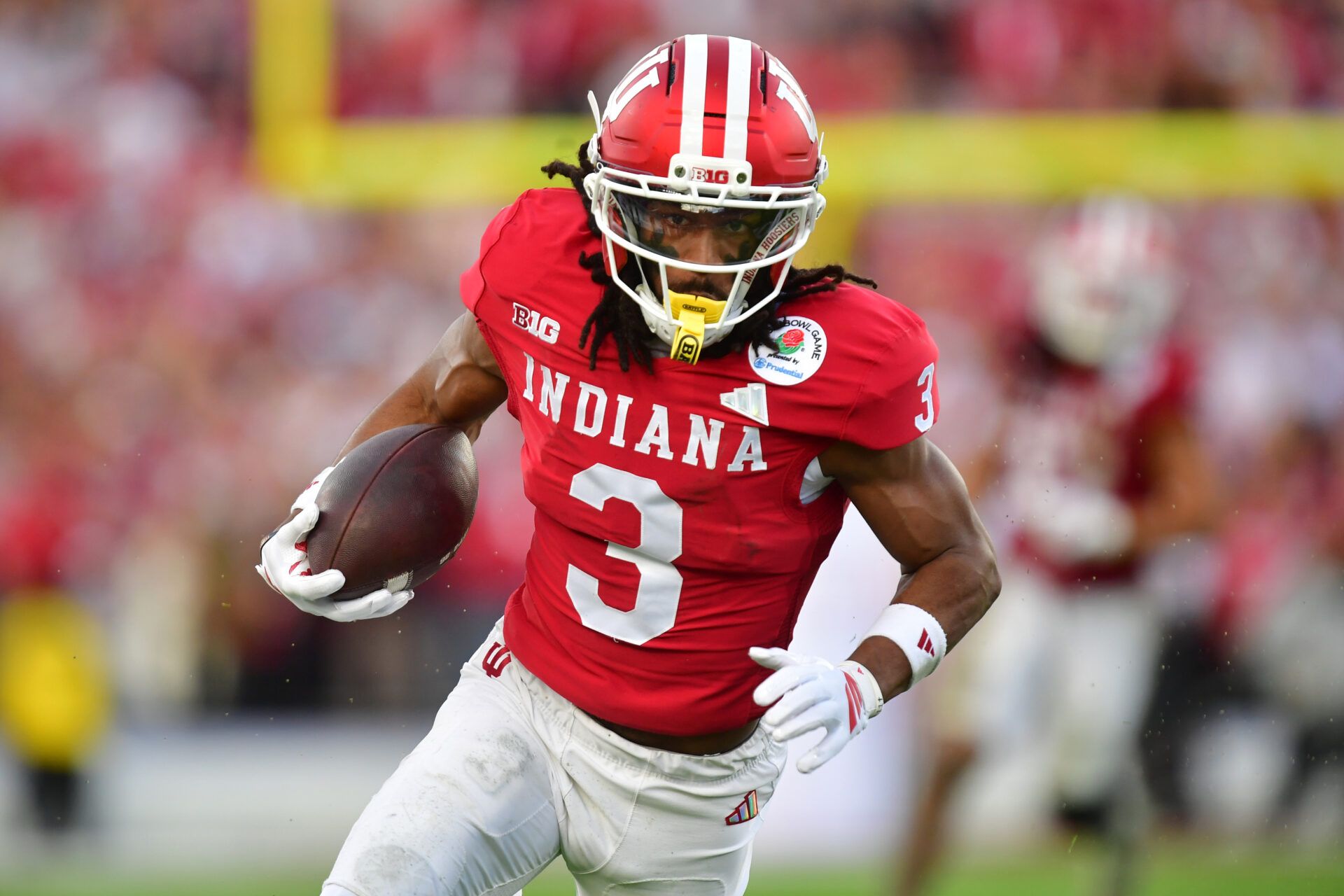
Omar Cooper Jr. offers more than straight-line speed. The Indiana wide receiver brings a well-rounded skill set that makes him an intriguing developmental prospect, consistently proving himself as a reliable vertical threat who demands defensive attention.
Cooper may not fit the traditional mold of an “X” receiver, but his lean physique and quick athleticism make him a good fit for offenses that prioritize spacing and movement. His ability to contribute on special teams, particularly as a gunner or return option, further boosts his chances of carving out an early NFL role.
Here are five teams that should consider drafting Cooper Jr. during the 2026 NFL Draft:
1) Buffalo Bills
The Bills are built around Josh Allen’s arm talent and willingness to challenge defenses vertically, which is exactly why Cooper Jr. makes so much sense as a draft target. Buffalo’s offense has long thrived when it features multiple receivers who can stress coverage deep and punish soft zones, and Cooper checks both boxes.
Cooper would immediately benefit Buffalo as a field-stretching complement opposite a true X receiver. His vertical presence forces safeties to respect the deep ball, opening up space underneath for tight ends and slot receivers. Beyond that, Cooper brings run-after-catch explosiveness that the Bills’ wide receiver room has lacked at times, turning routine completions into chunk gains.
2) Carolina Panthers
From a role standpoint in Carolina, Cooper could begin his career as an early rotational receiver with gadget usage, lining up in motion, in the slot, or on quick-hitting concepts designed to get the ball in his hands. With development, he has a clear starting Z-receiver upside, giving the Panthers a dynamic, versatile weapon who can grow alongside the rest of the offense and help stabilize a rebuilding unit.
One of Cooper’s biggest strengths is his ability to manufacture offense after the catch. His run-after-catch profile enables him to convert quick hitters and schemed touches into meaningful gains, which is crucial for a Panthers offense aiming to simplify reads for Bryce Young.
3) Denver Broncos
Denver’s passing game has often struggled to create easy yards and sustain momentum, and Cooper’s ability to turn short throws into long gains directly addresses that issue. For a Broncos offense that leans on timing concepts and quick reads, he offers a reliable target on screens, crossers, and underneath routes.
Beyond his RAC ability, Cooper adds a vertical threat Denver can deploy to stress coverage. His downfield tracking and speed force defenses to honor the deep ball, creating space for other receivers and tight ends to operate underneath. Even when not heavily targeted, his presence can influence coverage and improve the overall structure of the offense.
4) Kansas City Chiefs
Chiefs remain one of the league’s most creative offenses, consistently prioritizing wide receivers who can generate explosive plays after the catch while also threatening defenses vertically. That approach makes Cooper Jr. an ideal stylistic fit for Andy Reid’s system and a natural complement to Patrick Mahomes.
From a depth standpoint, Cooper could contribute immediately as a WR3 or WR4, rotating based on matchup while learning the nuances of Reid’s offense. His skill set allows him to line up as a Z receiver or motion threat, forcing defenses to communicate and adjust pre-snap. Cooper can offer immediate utility and long-term upside. His explosiveness and adaptability fit seamlessly into an offense that’s always searching for its next dynamic playmaker.
5) New Orleans Saints
Saints have long favored wide receivers who can make plays down the field and finish at the catch point, even when separation is limited. That philosophy makes Indiana Hoosiers wide receiver Cooper Jr. an appealing draft target, especially when paired with Chris Olave as part of the Saints’ future passing attack.
As a developmental wide receiver with immediate situational usage, he offers the Saints a high-upside complement to Olave and a potential long-term building block in their passing game. Cooper’s ability to track the ball and adjust in the air aligns perfectly with an offense that still prioritizes contested catches and downfield opportunities.
NFL Draft Outlook
When the year began, Cooper Jr. flew under the radar. Still, as the Indiana Hoosiers’ stellar season continued to build into what it is now in the playoffs, the 6-foot wideout has made his name known in the NFL Draft scene and on the PFSN Big Board.
While he has no adjusted draft position (ADP) coming into the year, at its regular-season conclusion, Cooper tallied a 75.5 ADP. At this current standing, Cooper could find himself taken in the late second to early third round.
