
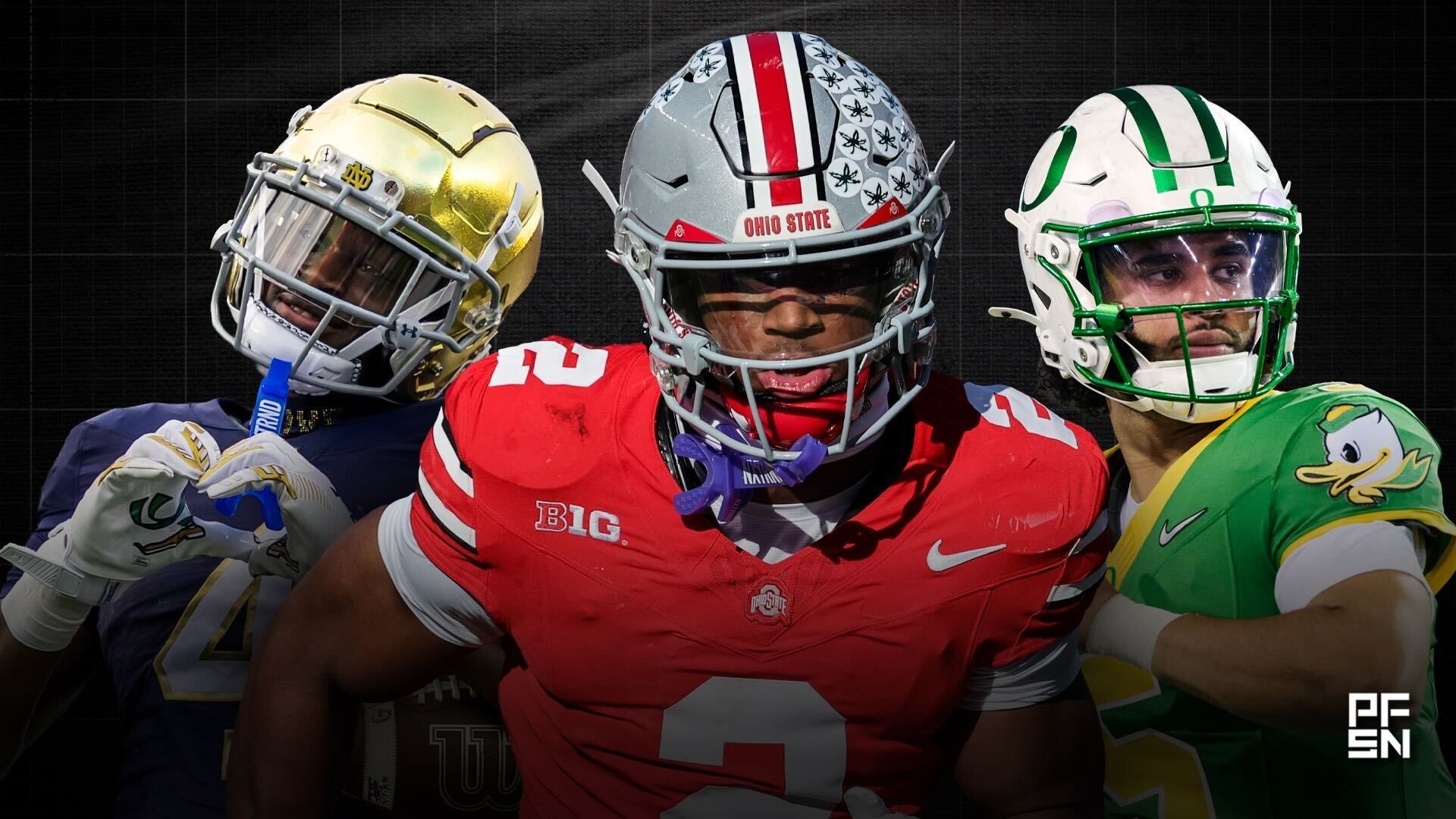
The NFL Draft is where rosters are reshaped, and franchises define their future in a matter of hours. Whether it’s a rebuilding franchise searching for a cornerstone or a contender looking for the final piece, each pick carries ripple effects far beyond draft night.
This mock draft, created on our PFSN NFL Mock Draft Simulator, reflects that tension, blending team needs, schematic fits, and league-wide trends that continue to shape the modern NFL.
1) Las Vegas Raiders
Fernando Mendoza, QB, Indiana
Following the firing of Pete Carroll, it appears that Las Vegas’ next head coach will have the opportunity for a fresh start and can utilize the No. 1 pick to select a new quarterback for the organization. At 6-foot-5, Indiana’s Fernando Mendoza has demonstrated that he is worthy of being the first quarterback selected in the 2026 draft.
Mendoza is remarkably accurate with his throws on all three levels of the field, placing the football in tight windows that most gunslingers in this class wouldn’t even attempt. His football IQ is undeniably elite; he effectively manipulates safeties and reads blitzes at the line of scrimmage like a seasoned veteran.
While he may not impress scouts with his athleticism, he consistently does everything necessary to secure wins, which is precisely what the Raiders need.
2) New York Jets
Dante Moore, QB, Oregon
The Jets should strongly consider drafting Oregon quarterback Dante Moore because he represents a true swing at long-term stability rather than another temporary fix. Moore’s game starts with natural passing talent. For a Jets offense that has struggled to create explosive plays through the air, Moore’s arm talent would immediately raise the ceiling.
He throws with easy velocity and clean mechanics, allowing him to attack all areas of the field without needing to overexert. His ball placement stands out, particularly on intermediate and deep routes, where he consistently gives his receivers a chance to make plays after the catch.
Athletically, Moore brings functional mobility. He isn’t a run-first quarterback, but he moves well enough to evade pressure, extend plays, and throw accurately on the move.
3) Arizona Cardinals
Rueben Bain Jr., EDGE, Miami
Reuben Bain Jr. gives Arizona a foundation piece in the trenches, the kind of defender who makes everything around him work better and helps reshape a defense from the inside out. Bain brings an NFL-ready build with the power to control the line of scrimmage. He isn’t just a space-eater; he plays with intent and violence.
Bain also gives the Cardinals versatility. He can line up in multiple spots along the defensive front, allowing the coaching staff to adjust looks without having to change personnel. Whether Arizona wants him to attack gaps or play a more controlled role to free up teammates, Bain has the skill set to handle both responsibilities.
4) Tennessee Titans
Carnell Tate, WR, Ohio State
Bringing on Carnell Tate as your WR1 gives Cam Ward a bona fide weapon who can win in multiple ways. He can stretch the field vertically, attack the intermediate middle, and make himself available on quick concepts. In a passing game that has lacked consistent explosiveness, Tate elevates the receiver room by day one.
He also brings a competitive edge the Titans need. He plays with toughness and isn’t afraid to work through contact, giving the offense a physical presence it’s been missing on the perimeter. Most importantly, Tate fits the Titans’ long-term vision. He’s young, disciplined, and still ascending as a player, making him an ideal partner for a developing quarterback.
5) New York Giants
Arvell Reese, LB, Ohio State
Arvell Reese possesses all the makings of a franchise defensive chess piece, boasting a significant amount of value, which begins with his unique physical attributes. He has the length and explosiveness to play like an edge defender, but he moves well enough to function as a linebacker. Reese can align in multiple spots across the front seven, forcing offenses to identify protections and adjust assignments.
Whether he is positioned to threaten the A-gap, strategically hovering over the slot, or subtly creeping off the edge, he effectively keeps quarterbacks uncertain. That blend allows him to attack blockers with power on early downs and then seamlessly transition into coverage or pressure roles in passing situations.
6) Cleveland Browns
Francis Mauigoa, OT, Miami
Miami’s Francis Mauigoa offers Cleveland a chance to solidify the most essential foundation of any offense: the offensive line. He stays balanced in his pass sets, keeps his base under him, and uses his hands with purpose rather than panic. That composure allows him to recover when defenders counter, preventing quick losses that can derail drives.
Offensive tackles who can handle both speed and power are hard to find and even harder to replace once you have one. Drafting him would give Cleveland a cornerstone they can build around as the rest of the offense evolves, regardless of who lines up at quarterback. Selecting Francis Mauigoa would be an investment in stability for the offensive line.
7) Washington Commanders
David Bailey, EDGE, Texas Tech
Texas Tech’s David Bailey’s versatility adds real value to the Commanders if selected at No. 7. Against the run, Bailey brings discipline. He sets the edge with physicality, holds his ground, and keeps leverage instead of selling out for sacks. That reliability allows the Commanders to trust him on early downs without sacrificing pass-rush potential on later ones.
He plays with a strong blend of power and flexibility. Bailey converts speed into force, walking tackles back into the pocket, but he also shows the bend to flatten his rush and close quickly on the quarterback. Bailey plays with a relentless motor, staying engaged when the quarterback escapes, and continues to hunt for the ball late in reps.
8) New Orleans Saints
Jordyn Tyson, WR, ASU
Drafting 6-foot-2 Jordyn Tyson pairs one of the best receivers in the class with Chris Olave and would give the Saints offense one of the most dynamic receiver duos in the NFC. From a strategic standpoint, Tyson helps the Saints stress coverage vertically and horizontally.
Beyond the traits, Tyson plays with confidence and energy. He brings a spark that can lift an offense, turning quick throws into chunk gains and forcing defenses to account for him every snap. Adding Jordyn Tyson gives the Saints a balanced passing game, as he brings a different flavor to the passing game than Olave, which is precisely why the combination works.
9) Kansas City Chiefs
Jeremiyah Love, RB, Notre Dame
Kansas City’s running game has been serviceable but rarely threatening. The Chiefs have rotated backs and leaned heavily on the passing game to compensate. Drafting Jeremiyah Love gives their offense something it has been missing for several seasons: a true difference-maker in the backfield.
Love is especially dangerous in Kansas City because of his versatility. He isn’t just a handoff-only back. He can catch the ball naturally, operate in space, and become a significant weapon in the pass game himself. Drafting Love gives them a chance to develop a backup who can grow into a featured role if Mahomes is not back by Week 1.
10) Cincinnati Bengals
Caleb Downs, S, Ohio State
If the Bengals can draft Caleb Downs, they will bring on a high-impact defender who can erase mistakes, the kind of player who helps close the gap between contender and champion. Downs’ most significant strength is his ability to process the game quickly. He diagnoses route concepts, reads quarterback intentions, and closes on the ball with urgency.
He has a rare combination of instincts, athleticism, and discipline that allows him to impact the game on every level. Whether he’s playing deep, in the box, or over the slot, Downs consistently puts himself in position to make plays. That adaptability allows the Bengals to disguise coverages and counter modern offenses.
11) Miami Dolphins
Mansoor Delane, CB, LSU
Mansoor Delane would bring Miami a high-IQ defensive back who excels with intelligence, versatility, and controlled aggression, rather than relying solely on raw athleticism. Athletically, Delane moves with rare fluidity. He changes direction effortlessly, exploding out of his backpedal without wasted steps.
Delane’s coverage-first defensive back mindset is evident against the run. He brings a safety mentality and downhill tackling with conviction. Delane’s mental processing speed is consistently evident on film. Attacking the receiver’s hands rather than panicking, breaking up passes without drawing penalties
12) Dallas Cowboys
Sonny Styles, LB, Ohio State
Sonny Styles’ football intelligence is just as impressive as his physical traits. At over 6-foot-4, he combines elite explosiveness with exceptional strength, placing him among the most physically gifted defenders in college football. He can function as a linebacker in the box, drop back as a safety, or handle responsibilities in the slot.
He also brings real pass-rush value. Styles shows natural hand usage and the ability to bend around the edge, making him effective when deployed on blitzes or as a stand-up rusher. Styles would give the Cowboys a rare defensive weapon who combines freak-level athleticism and true versatility to elevate the entire unit.
13) Los Angeles Rams (via Atlanta Falcons)
Spencer Fano, OT, Utah
Spencer Fano is a true tone-setter in the run game. He generates explosive power at the point of attack, creating immediate movement and finishing blocks with bad intentions. Once Fano gets his hands inside, he makes heavy torque and physically removes defenders from the play.
What makes Fano special is how well he moves for his size. He changes direction with ease and looks almost like a skilled player when climbing to the second level. In pass protection, Fano shows a level of polish uncommon for a young lineman. Mentally, Fano is ahead of the curve. He processes defensive movement quickly, recognizes stunts and games, and adjusts seamlessly.
14) Baltimore Ravens
Makai Lemon, WR, USC
One offense that is in need of a new weapon is Baltimore, and one could be available in the form of Makai Lemon. Once the ball is in his hands, Lemon becomes a problem. His change-of-direction skills are elite, turning routine completions into explosive plays.
At the catch point, Lemon is far more than just a speed receiver. He plucks the ball cleanly away from his body and uses impressive body control to finish difficult grabs. Lemon also shows a refined feel for zone coverage. He naturally finds space between defenders rather than relying purely on speed. His instincts as a returner also give the Ravens another weapon to flip field position and create momentum.
15) Tampa Bay Buccaneers
Keldric Faulk, EDGE, Auburn
Auburn pass rush Keldric Faulk carries one of the highest floors in the class, thanks to his strength and three-down value. Even before reaching his ceiling, he projects as a high-level starter who stabilizes the defensive front.
Faulk brings a rare combination of power and movement skills that make him ideal for a defense that asks its linemen to do more than rush the passer. He plays with the kind of force that changes offensive game plans, forcing teams to account for him in both run and pass concepts. If his technique continues to develop, the upside is much higher.
16) New York Jets (via Indianapolis Colts)
Peter Woods, DT, Clemson
With their second pick in the first round, New York can afford to beef up their depleted defensive line, adding Clemson’s Peter Woods. His rare athletic fluidity for a player north of 300 pounds simply shouldn’t exist.
Woods’ explosiveness off the snap immediately stands out. He consistently moves first, winning leverage before blocking schemes even have a chance to form. His advanced hand usage, including swipes, chops, and counters, speaks to a level of technical refinement that accelerates his transition to the NFL.
17) Detroit Lions
Kadyn Proctor, OT, Alabama
Kadyn Proctor’s sheer size immediately alters the math for the Detroit Lions. Despite his massive build at 6-foot-7, Proctor’s lateral quickness stands out, covering ground efficiently on pulls and climbing to the second level with deceptive ease.
He displaces defensive linemen with alarming ease, creating vertical movement that opens lanes before backs even reach the line of scrimmage. Against top-tier competition, he’s shown the ability to cave in fronts and impose his will snap after snap. Power rushers simply struggle to move him, and when defenders try to convert speed to strength, they’re often met with immovable resistance.
18) Minnesota Vikings
Jermod McCoy, CB, Tennessee
What stands out in Jermod McCoy’s film, and a big reason teams like Minnesota will fall in love, is his route recognition. McCoy rarely bites on double moves or misdirection, showing discipline and mental sharpness beyond his years. He diagnoses route combinations quickly, allowing him to stay a step ahead and play with confidence rather than reaction.
He competes with aggression, fighting through receivers’ hands, and refuses to concede space on deep routes. Even when matched against bigger targets, McCoy’s physicality is evident in press coverage, where he uses well-timed jams to disrupt timing while remaining technically sound.
19) Dallas Cowboys (via Green Bay Packers)
Anthony Hill Jr., LB, Texas
Anthony Hill Jr. would give Dallas an instinctive and high-impact defender who fits the modern NFL, thanks to the Micah Parsons trade with Green Bay. Hill fits perfectly with the Cowboys’ pressure-heavy philosophy, shooting gaps with explosive power and creating chaos up the middle.
His fluidity and burst enable him to match up with tight ends and running backs, providing the Cowboys with flexibility in sub-packages without tipping their hand. He can align as an off-ball linebacker, walk up as a pressure threat, or be used as a spy depending on the matchup.
20) Los Angeles Chargers
Caleb Lomu, OT, Utah
Los Angeles makes a compelling developmental fit for Caleb Lomu, with a clear priority of keeping Justin Herbert upright while maximizing the run game for Omarion Hampton. Lomu’s natural pass protection instincts already approach NFL caliber, giving him immediate value in keeping Herbert clean from edge pressure.
In a zone-heavy run scheme, Lomu’s lateral quickness and range allow him to consistently reach defenders, seal edges, and climb to the second level. There are developmental hurdles, but they come with context. Lomu’s current lack of mass can show up against power, particularly when defenders convert speed to strength.
21) Buffalo Bills
KC Concepcion, WR, Texas A&M
KC Concepcion would give the Bills a smart, versatile, high-IQ playmaker, the type of receiver Buffalo has not had for a few seasons now. Concepcion doesn’t shy away from contact, fighting through traffic on crossers and showcasing a competitive edge that becomes evident in physical moments.
He’s a crafty route artist who creates separation through subtle head fakes, pacing changes, and precise timing rather than relying purely on raw speed. Despite his youth, he plays with the composure and awareness of a veteran, consistently staying one step ahead of defenders. His positional versatility adds another layer of value. Concepcion can line up in the slot or outside, giving the Bills flexibility to dictate matchups.
22) San Francisco 49ers
Denzel Boston, WR, Washington
Denzel Boston is an absolute monster in contested situations, using his frame like a power forward to box out defenders. Technically, Boston is polished as a receiver. He consistently catches the ball with his hands away from his body, avoiding the body-catching habits that plague many bigger wideouts.
Boston creates separation in a way that doesn’t always show up on a stopwatch. At the stem of his routes, he uses subtle body manipulation and deceptive long-stride acceleration to lull corners into a false sense of timing before breaking free. Defenders often think they’re in phase, only to realize too late that Boston has already won the rep.
23) Houston Texans
Emmanuel Pregnon, OG, Oregon
Emmanuel Pregnon brings a powerful, technically refined game that translates cleanly to the NFL, especially for an offense that wants consistency inside. While Pregnon isn’t a multi-position swing lineman, his value as a pure guard is significant.
Once Pregnon locks on, escape becomes a problem. His grip strength is suffocating, clamping down with vise-like control that prevents defenders from countering. Pregnon consistently lands first contact on his terms, delivering precise, jarring strikes that disrupt a defender’s rush plan before it can even develop.
24) Los Angeles Rams
Ty Simpson, QB, Alabama
Rams should view Ty Simpson as an ideal quarterback to develop if Matthew Stafford’s career is nearing its end. His mechanics are clean and efficient, allowing him to defeat pressure before it arrives. The ball comes out quickly, his base stays balanced, and his release is compact enough to function under duress.
Simpson processes information rapidly, cycling through reads quickly enough to make secondary options viable even under intense pressure. What ties it together is leadership. Simpson controls the huddle, communicates with confidence, and brings cohesion to the offense through his presence.
25) Carolina Panthers
Kenyon Sadiq, TE, Oregon
Recent seasons have seen Carolina’s tight end group struggle to threaten defenses and rarely create separation. Oregon’s Kenyon Sadiq doesn’t share those same struggles when you watch his tape. As a receiver, Sadiq is a natural. He tracks the ball effortlessly, catches cleanly outside his frame, and finishes through contact with confidence.
Sadiq has a strong feel for coverage, naturally settling into open space and adjusting routes on the fly. That awareness can help Bryce Young process faster and play with more confidence, knowing his tight end will be where he’s supposed to be. Pairing him with Tetairoa McMillan gives Carolina two explosive, high-upside pass catchers who can grow alongside their quarterback.
26) Pittsburgh Steelers
Zachariah Branch, WR, Georgia
Zachariah Branch offers exactly the kind of dynamic element that can reshape the Steelers’ pass game beyond DK Metcalf. His burst off the line is electric, forcing corners to play with exaggerated cushions and surrendering easy leverage before routes even develop.
He’s more complete at the catch point than expected. Branch adjusts naturally to off-target throws, maintains body control through contact, and finishes plays that many smaller receivers can’t. His hands are trustworthy, even when traffic closes quickly.
27) Philadelphia Eagles
R Mason Thomas, EDGE, Oklahoma
R Mason Thomas impacts plays from the first step. His burst off the line immediately stresses tackles, forcing hurried footwork and flawed angles that unravel protection before it can stabilize. That early disruption fits perfectly in a system that values pressure created by timing and volume rather than constant blitzing.
What stands out most is his effort. Thomas never shuts it down. If his first move stalls, he immediately transitions inside, resets his attack, and continues working until the play is over. That nonstop motor mirrors the Eagles’ philosophy of wearing offenses down snap after snap.
28) Cleveland Browns
Chris Brazzell II, WR, Tennessee
At first glance, Chris Brazzell II looks like a prototype jump-ball specialist. Turn on the tape, and that assumption disappears quickly. For a receiver standing 6-foot-5, his ability to coil, bend, and explode out of his breaks is borderline unnatural. He sinks his hips with ease and snaps routes off with a suddenness that puts defensive backs in survival mode rather than leverage.
When the ball goes vertical, Brazzell becomes a problem. His tracking ability enables him to adjust mid-air without losing speed or balance, and he plays the ball as if it were his own. Contested situations don’t bother him; he elevates, extends, and finishes through contact with strength.
29) Chicago Bears
Avieon Terrell, CB, Clemson
For a Bears team continuing to shape its secondary, Avieon Terrell brings the kind of modern defensive profile that complements any team looking to add talent immediately. Terrell offers Chicago a high-energy, high-IQ corner who impacts games in ways that don’t always show up on the stat sheet.
His movement skills immediately set him apart from most of his classmates. Terrell glides through transitions with rare smoothness and never appears rushed or off-balance. Receivers don’t win cleanly against him because he erases space with timing and body control. He plays with patience, trusting his feet and eyes to keep him in phase.
30) New England Patriots
C.J. Allen, LB, Georgia
New England’s best units have always featured linebackers who combine range, physicality, and mental sharpness, and C.J. Allen’s game mirrors that blueprint. His contact is sudden and forceful, yet controlled, consistently stopping ball carriers cold without sacrificing leverage or balance. It’s the kind of presence that changes how offenses approach the second level.
Allen diagnoses run concepts early, slipping past blocks before they fully form and meeting runners at the point of attack. His instincts keep him ahead of plays rather than reacting late, which is critical in New England’s detail-oriented scheme.
31) Denver Broncos
Kayden McDonald, DT, Ohio State
Kayden McDonald is the kind of interior defender who is a pocket disruptor; he wins with overwhelming force rather than finesse. His lower-body strength and balance allow him to absorb contact from multiple linemen without losing his footing, and he routinely stays involved in plays that should be finished once the double team arrives.
He tracks the ball cleanly through congestion, understands blocking angles, and sheds at precisely the right moment to finish plays. His hands are sudden and violent, ripping blockers off his frame and turning 300-pound linemen into obstacles rather than barriers.
32) Seattle Seahawks
Olaivavega Ioane, OG, Penn State
Turn on the tape, and Olaivavega Ioane looks comfortable in trench warfare. He absorbs power without giving ground, keeps his base wide and stable, and routinely neutralizes defenders who try to win with strength alone.
Scheme fit matters, and Ioane aligns well with Seattle’s desire to play more forceful, downhill football. He has the anchor to handle interior bull rushers and enough mobility to execute pulls. The foundation is already in place; once his technique catches up to his strength, his effectiveness is expected to increase significantly.
Round 2
33) New York Jets
Ja’Kobi Lane, WR, USC
After selecting a new quarterback in Round 1, adding another weapon offensively also makes a ton of sense for the Jets. At the catch point, Ja’Kobi Lane plays with an edge. He attacks the football at its highest point, boxes out smaller defenders with physical intent, and maintains focus through heavy contact.
34) Arizona Cardinals
Austin Siereveld, OT, Ohio State
Austin Siereveld checks a lot of boxes for the Cardinals because he brings dependability and power to a unit that’s in the midst of a rebuild limbo. Siereveld strikes first and strikes hard, gaining control of reps early and keeping rushers at arm’s length. Once he’s engaged, the line of scrimmage tends to stay exactly where he wants it.
35) Tennessee Titans
Colton Hood, CB, Tennessee
Colton Hood would be a smart in-state addition for the Titans because he brings consistency and awareness to a position that demands it. He’s willing to insert himself in run support, battles through contested catch situations, and shows confidence attacking the football at its highest point.
That competitive edge also shows up on special teams, where his return experience adds immediate roster value.
36) Las Vegas Raiders
Isaiah World, OT, Oregon
After selecting a quarterback No. 1 overall, ensuring he is protected should be a top priority. World can jolt defenders on contact and regain control of reps even when timing isn’t perfect. Isaiah World makes a lot of sense for the Raiders as a swing tackle with real starter upside, because you simply can’t teach the kind of dimensions he brings to the position.
37) New York Giants
Chase Bisontis, OT, Texas A&M
Chase Bisontis would be a tone-setting addition for the New York Giants, especially for a team focused on protecting Jaxson Dart and building a more physical offensive identity. What separates him from many maulers is his athleticism. Bisontis moves fluidly when pulling or climbing, consistently locating linebackers and arriving under control.
38) Houston Texans
Parker Brailsford, C, Alabama
If Houston is serious about protecting CJ Stroud, then adding a center like Parker Brailsford should be on their draft card. Despite not being the biggest interior lineman, he plays with leverage and edge. His low center of gravity helps him absorb bull rushes, and his hands stay active in pass protection.
39) Cleveland Browns
Emmanuel McNeil-Warren, S, Toledo
For a taller safety, Emmanuel McNeil-Warren’s movement skills are impressive. He opens and drives smoothly, shows burst breaking on throws, and has the reach to win at the high point when the ball is in the air. Cleveland would be adding a competitive, impact-minded defender who thrives in big moments.
40) Kansas City Chiefs
T.J. Parker, EDGE, Clemson
T.J. Parker plays with a finisher’s mindset and has a rare feel for when the ball is vulnerable, attacking it with purpose and technique rather than reckless swipes. He overwhelms blockers with precision, finding ways to turn solid defense into sudden takeaways.
41) Cincinnati Bengals
Caleb Banks, DT, Florida
Caleb Banks could be a major catalyst for a Bengals defense that has struggled to consistently affect the quarterback. A massive 6-foot-6, 325-pound interior defender who moves surprisingly quickly for that size, Banks can collapse pockets with sheer force, demanding double teams and shrinking space for quarterbacks to operate.
42) New Orleans Saints
Matayo Uiagalelei, EDGE, Oregon
Matayo Uiagalelei would bring a high-upside edge presence to the New Orleans Saints, with traits that are difficult to teach and growth that’s already visible on film. What immediately separates Uiagalelei is how effortlessly he generates pressure. In obvious passing situations, he can be unleashed as a pure disruptor, creating stress on quarterbacks simply by threatening the edge.
43) Miami Dolphins
Carson Beck, QB, Miami
Carson Beck’s rise late in the season has reframed how teams view him, and a landing spot in Miami would feel like a natural continuation of that momentum. Mechanically, his delivery is clean and adaptable. Whether he’s firing from a tight base or altering his arm slot to avoid traffic, the ball comes out with pace and control. Beck’s improved mobility adds another layer, extending drives and punishing man coverage late.
44) New York Jets (via Dallas)
A.J. Haulcy, S, LSU
A.J. Hauly makes a ton of sense for a Jets team desperate to raise the baseline of its secondary. His calling card is awareness. He sees the field a step ahead, reading route combinations and quarterback intent before the ball ever leaves the hand.
45) Tampa Bay Buccaneers
Deontae Lawson, LB, Alabama
At Alabama, Deontae Lawson was the connective tissue of the defense, directing traffic with confidence and urgency while keeping everyone on the same page. That command translates seamlessly to a Buccaneers team that leans heavily on discipline and communication at the second level.
46) Indianapolis Colts
LT Overton, EDGE, Alabama
LT Overton plays with brute authority. He anchors down, locks out blockers, and sets a firm edge that eliminates cutback lanes. When aligned inside, his sudden redirection ability becomes especially dangerous, as interior linemen often struggle to adjust once he changes course and attacks a new angle.
47) Atlanta Falcons
Elijah Sarratt, WR, Indiana
The Atlanta Falcons don’t need another developmental wideout; they need a reliable professional presence next to Drake London, and Elijah Sarratt fits that void cleanly. Where Sarratt truly shines is in the intermediate area. He has an advanced understanding of spacing, routinely settling into soft zones and snapping routes off at the sticks.
Defenses that sell out to bracket London would quickly learn that Sarratt punishes hesitation underneath.
48) Baltimore Ravens
Christen Miller, DT, Georgia
When Christen Miller strikes, blockers feel it. He consistently wins the leverage battle with heavy, violent punches that reset the line of scrimmage and put him in control of the rep. Despite his size, he moves laterally with purpose, tracking plays down the line and finishing outside his immediate area without losing gap integrity.
49) Minnesota Vikings
Jonah Coleman, RB, Washington
The Vikings’ search for backfield stability could lead them to Jonah Coleman, a runner with a decisive mindset, who patiently presses the line of scrimmage before committing downhill. His feet between the tackles consistently turn modest creases into positive gains.
Coleman’s compact build and natural forward lean allow him to fall through arm tackles and grind out yards that don’t show up in highlight reels but matter deeply on second-and-short and late-game drives.
50) Detroit Lions
Kade Pieper, OG, Iowa
With all the injuries Detroit sustained on the offensive line, adding a versatile offensive lineman like Kade Pieper is an excellent pick for the Lions. With a future at the center of the NFL, Pieper gives the Lions athleticism, a high IQ, and a high upside if appropriately developed.
51) Green Bay Packers
A’Mauri Washington, DT, Oregon
Players simply aren’t built like A’Mauri Washington, a 330-pound interior defender with verified explosion, real speed, and movement skills that strain logic. He has a natural feel for where the ball is going, working through congestion with balance and awareness before shedding at the exact moment to finish. His footwork allows him to redirect cleanly, turning stretch runs and cutbacks into dead ends.
52) Los Angeles Chargers
Akheem Mesidor, EDGE, Miami
Akheem Mesidor offers the Chargers a modern defensive lineman built for movement and disruption. Mesidor can align on the edge, reduce inside on passing downs, or operate as a movable chess piece in sub-packages, giving the Chargers freedom to disguise pressure and manufacture favorable matchups.
53) San Francisco 49ers
Kamari Ramsey, S, USC
Kamari Ramsey brings the kind of controlled urgency that seamlessly fits what the 49ers ask of their defensive backs. When he commits, it’s with bad intentions, striking through contact and finishing plays in a way that reinforces San Francisco’s identity as a defense that thrives on physical dominance.
54) Houston Texans
Jake Golday, LB, Cincinnati
Jake Golday is the kind of linebacker profile offenses have to account for before the ball is even snapped. His length and speed combination immediately shows up in space, where he devours ground in a blink and shuts down plays that look open for a split second.
Golday plays every snap like it matters, chasing late into the fourth quarter and bringing consistent energy in high-leverage moments.
55) Los Angeles Rams
Keith Abney II, CB, ASU
Keith Abney II fits the profile of a corner who thrives in zone and match looks where his eyes and communication do the heavy lifting, and that skill set aligns naturally with a Rams defense that asks defensive backs to think as much as react. Abney’s value lies in its reliability and flexibility. He can handle WR2 duties, slide inside in sub-packages, and provide steady depth without forcing a scheme change.
56) Buffalo Bills
Kenyatta Jackson Jr., EDGE, Ohio State
Kenyatta Jackson Jr. plays the run with a mean streak, meeting pullers head-on and compressing lanes so the defense can rally to the football. When it’s time to hunt the quarterback, his blend of speed and flexibility allows him to bend, keeping pressure alive even when linemen get their hands on him early in the rep.
57) Carolina Panthers
Harold Perkins Jr., LB, LSU
When turned loose as a rusher, Harold Perkins Jr. attacks protections with suddenness that forces quarterbacks to react before routes even have time to develop. He bends naturally, closes violently, and has a knack for arriving right as the play is breaking down. Few linebackers cover grass the way he does, turning what looks like daylight into a dead end.
58) Pittsburgh Steelers
Lee Hunter, DT, Texas Tech
With a thick, NFL-ready frame and a lengthy track record of handling heavy workloads against strong competition, Lee Hunter projects as a dependable interior presence who can anchor early downs and wear down offenses over four quarters. His power and hand strength consistently cave in pockets from the inside, forcing quarterbacks to step into chaos even when he isn’t credited with a pressure.
59) Philadelphia Eagles
Blake Miller, OT, Clemson
On film, Miller doesn’t move like a blocker his size is supposed to. His flexibility through the hips and ankles allows him to stay low and balanced in pass protection, giving him the ability to mirror rushers instead of reaching or grabbing. He consistently recognizes stunts, communicates cleanly with interior linemen, and avoids panic when blitz looks shift late.
60) Jacksonville Jaguars
Gennings Dunker, OT, Iowa
Gennings Dunker brings an edge to Jacksonville’s offensive line. Dunker consistently wins with precise hand placement and a powerful lower half, allowing him to overwhelm opponents without sacrificing balance or control. Dunker competes through the whistle and looks to impose his will, wearing defenders down over four quarters.
61) Chicago Bears
Zion Young, EDGE, Missouri
Zion Young hunts the football with nonstop urgency, pursuing from the backside and finishing plays well outside his alignment. He can win standing up or with his hand in the dirt, slide inside on passing downs, and maintain effectiveness without needing protection help.
62) New England Patriots
Michael Trigg, TE, Baylor
Michael Trigg gives New England a tight end profile that’s built to stress modern defenses in uncomfortable ways. Once he secures the football, Trigg becomes a problem. He runs with balance and urgency, absorbing contact while continuing to churn forward, and has shown the ability to turn short throws into explosive gains.
63) Denver Broncos
Chris Bell, WR, Louisville
Chris Bell would arrive in Denver as a tone-setter at the receiver position, bringing a physical profile that immediately alters how defenses match up. At a sturdy 220 pounds, he plays with the demeanor of a power athlete, yet his straight-line speed stretches the field in ways few receivers his size can manage.
64) Seattle Seahawks
Dani Dennis-Sutton, EDGE, Penn State
Dani Dennis-Sutton brings a pro-ready edge profile built on power and consistency. He plays the edge the way coaches demand. Contain responsibilities are handled with patience and awareness, keeping runners boxed in and preventing explosive plays from bouncing outside. Whether chasing from the backside or cleaning up plays late in the rep, Dennis-Sutton consistently shows effort.

Think niners need an OL bad 1st rd and mandatory by 2nd.