
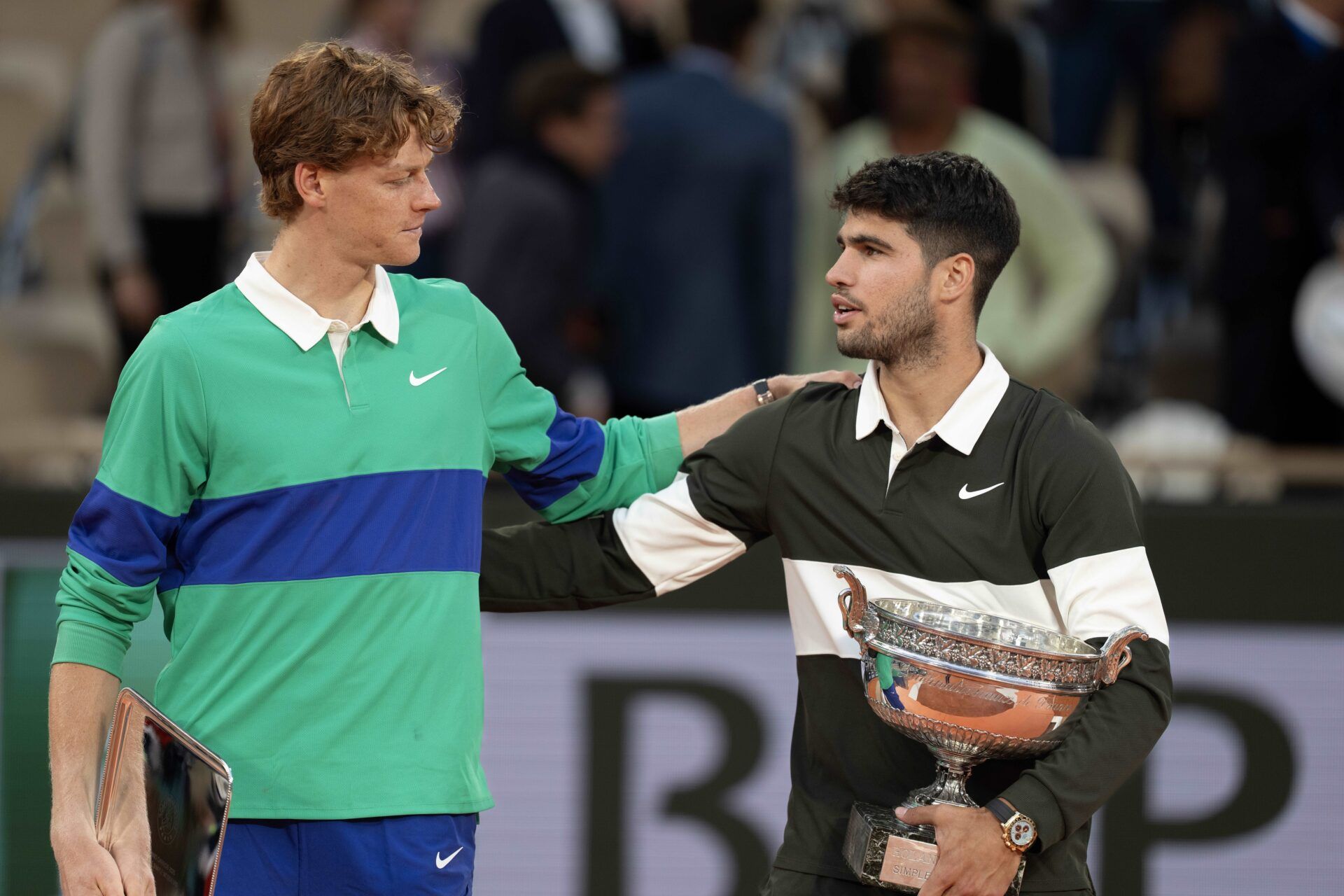
Jannik Sinner came very close to winning the French Open in 2025, holding three match points in the fourth set before Carlos Alcaraz mounted one of the greatest comebacks in Grand Slam history. While Sinner’s loss marked the end of an extraordinary run at Roland Garros, tennis analyst Rennae Stubbs has offered perspective on what that defeat meant for then World No. 1 and his subsequent pursuit of major titles throughout the remainder of the season.

Rennae Stubbs’ Take on French Open Final Between Jannik Sinner and Carlos Alcaraz
Sinner entered the French Open final as the favorite despite facing the defending champion, Alcaraz. The Italian had won the Australian Open in January and was riding momentum heading into Paris. Sinner won the first set 6-4 in 62 minutes and the second set 7-6(4) in a tiebreaker, with Alcaraz winning the third set 6-4.
The fourth set proved to be the pivotal moment, as the Italian held championship points three times, with victory appearing inevitable as the Spaniard struggled to gain momentum. What happened next will remain one of tennis’s most dramatic turning points.
MORE: Jannik Sinner to Carlos Alcaraz: All Players Who Won the Next Gen ATP Finals
Alcaraz saved all three championship points and captured the fourth set 7-6(3) in a tiebreaker, forcing the match into a fifth set. The final lasted five hours and 29 minutes, making it the longest French Open final in the tournament’s history. Alcaraz eventually prevailed 4-6, 6-7(4), 6-4, 7-6(3), 7-6(10-2), saving more championship points in a major final than any other man in the Open Era.
Stubbs, speaking on her podcast, talked about the possibility of a calendar Grand Slam for Sinner. “He was one point away from winning the French Open, so he would’ve had the Australian Open, French Open, then goes and possibly wins Wimbledon – no such thing as if, if, if – potentially could’ve looking at the calendar grand slam, if he does win that French Open,” she stated.
Adding to this, the Australian legend mentioned the confidence boost Sinner would’ve had at the US Open if he had already captured three major titles, saying, “He certainly would’ve been a lot more jacked about the US Open, he looked tired at the US Open to me in the final.”
She did acknowledge the great efforts from the Spaniard, stating, “But having said that, Alcaraz did what he did at the French was remarkable, to come back and win that match.”
Alcaraz’s victory marked only the third instance in the Open Era of a player winning a major championship after facing championship points in the final, joining Gaston Gaudio at the 2004 French Open and Novak Djokovic at the 2019 Wimbledon Championships.
Had Sinner converted one of those three match points, the consequences would have been historic. He already had the Australian Open title from earlier in the season; winning the French Open would have positioned him on the precipice of something that no man has accomplished in the Open Era: a calendar Grand Slam.
The concept of winning all four major championships in a single year represents one of tennis’s most elusive achievements. No male player has accomplished this feat since the Open Era began in 1969, making the opportunity that slipped from Sinner’s grasp an exceptionally rare one.
Beyond the immediate prestige of a calendar Grand Slam, the psychological impact of that French Open victory would have been substantial for the remainder of the season.
