
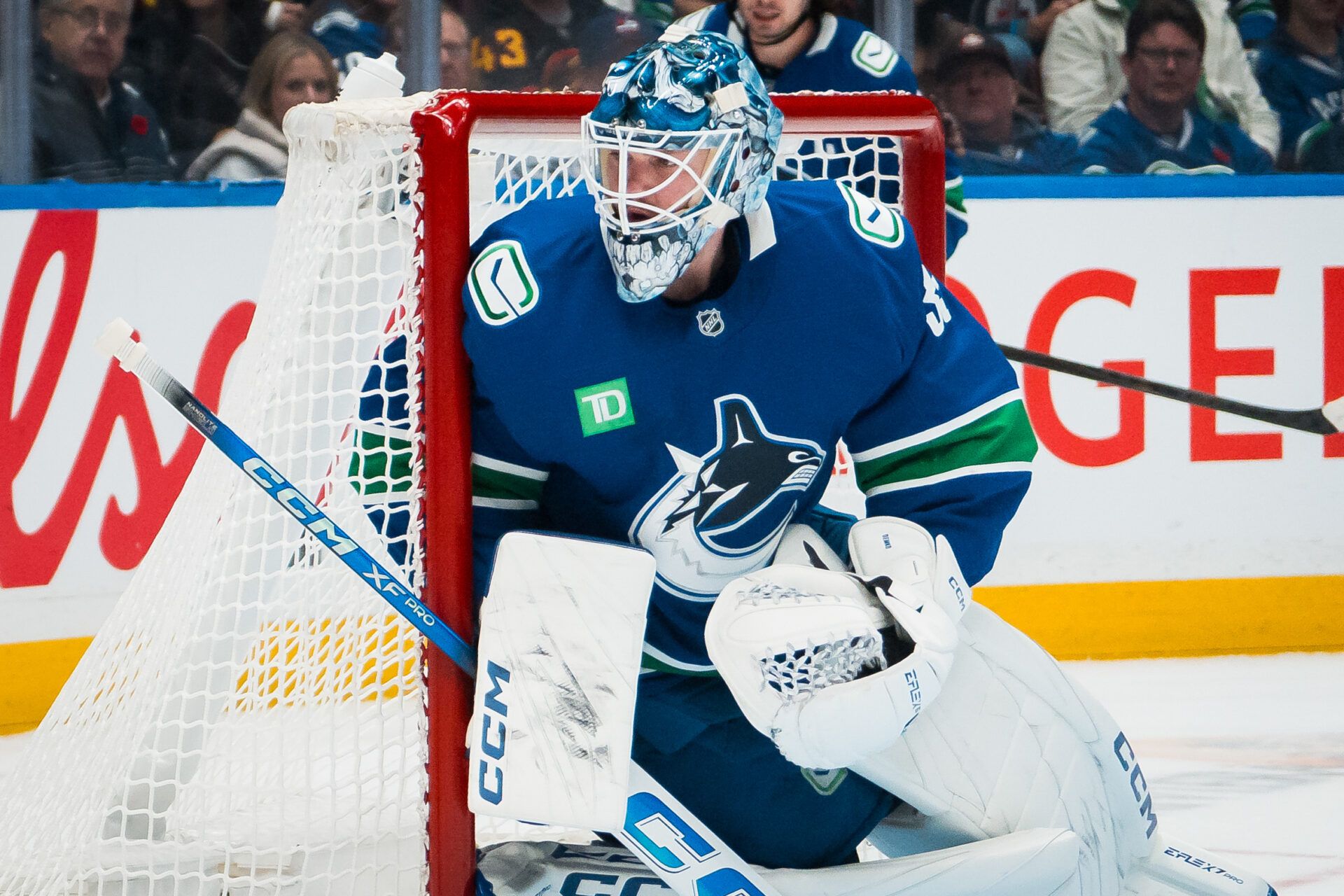
The Vancouver Canucks are trying to navigate another uneven stretch, and their early-season struggles have only made Thatcher Demko’s absence feel even heavier. Every game without him has added tension to a team still searching for momentum, and his situation has become a talking point that extends far beyond Vancouver.
As Demko rejoins the group on their road trip, his return brings a sense of anticipation, but it also reopens an old debate. Contenders continue to wonder whether the Canucks would ever consider moving him. The Edmonton Oilers can show interest in such a situation because their goaltending concerns have reached a familiar level of urgency.

Why Is a Thatcher Demko Trade So Difficult for the Oilers and Other Contenders?
As the Canucks battle through defensive issues and lean heavily on Kevin Lankinen until Demko is cleared, teams such as the Oilers are once again trying to understand whether a deal for Demko is even realistic. His early-season numbers, including a 5-4-0 record and reliable performances under heavy pressure, have only reinforced how valuable he is, which in turn makes the idea of moving him incredibly complicated for Vancouver.
In a recent The Athletic mailbag, NHL insider Chris Johnston responded to a detailed fan question about how a potential Demko trade would work if the Canucks retained salary on both his current contract and the extension that has already been signed. The reader inquired whether the retention would apply only to this season, at his five-million-dollar average annual value, or if it would also extend into the next contract.
Johnston explained the situation by saying, “You’ve highlighted an interesting case because there’s no precedent for this kind of trade and no formal rule covering it in the collective bargaining agreement,” before adding that the league has previously indicated the retention percentage would apply across the current contract and the extension. In simple terms, Vancouver would be responsible for the same percentage of Demko’s cap hit for every remaining year, including the next three seasons at eight and a half million dollars annually.
That interpretation alone illustrates why contenders, especially those already squeezed against the salary cap, struggle to map out a scenario in which acquiring Demko makes financial sense. Vancouver would be locking itself into multiple years of retained salary, which is far different from retaining money on a short-term, expiring deal. Such a commitment becomes extremely difficult to justify for a team still trying to build around its core players.
At the same time, Demko remains at the centre of what the Canucks are trying to fix this season. His .903 save percentage before the injury, combined with his ability to handle difficult shot volumes, has kept Vancouver competitive in games that could have slipped away much earlier. Even during challenging stretches, he provided enough resistance in goal to prevent the standings from looking worse than they do now.
Also read: Oilers Trade Rumors: Canucks Could Offer $25M Solution to Edmonton’s Goaltending Problem
With Demko joining the team on their upcoming road trip, the Canucks are hoping his return can bring stability to a crease that has felt vulnerable since he went on injured reserve. And while other teams will continue to watch the situation closely, Johnston’s explanation makes one thing clear: the idea of a Demko trade may be enticing for contenders, but the mechanics behind such a move are far more tangled than most imagine.
