
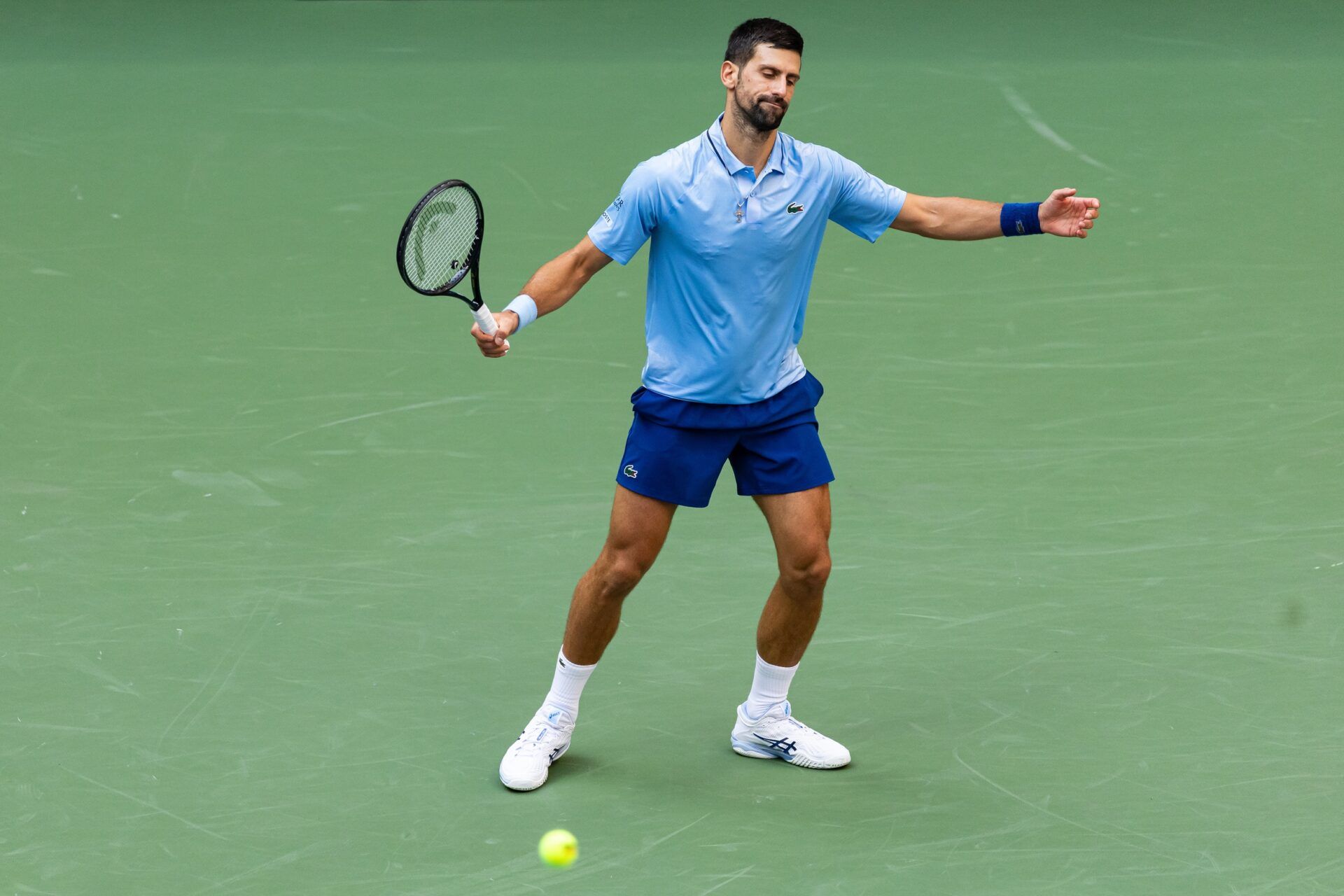
Novak Djokovic has always been honest about the realities behind his success. During a recent conversation with Piers Morgan, the 24-time Grand Slam winner talked about playing through injuries, ignoring pain, and burning out during the peak of his career.
Coach Patrick Mouratoglou later reacted to the video, sharing his own thoughts on how top athletes often push themselves too far in their pursuit of greatness.

Patrick Mouratoglou Breaks Down Novak Djokovic’s Experiences As Lessons
Reacting to Djokovic’s recent interview on “Piers Morgan Uncensored,” Mouratoglou shared some insights on how players should listen to their bodies and minds to avoid overexertion.
Mouratoglou captioned the post, “Djokovic talking about managing injuries and staying strong mentally is always fascinating. At that level, dealing with pain and keeping clarity under pressure is part of the job and he’s one of the best at it!”
During the interview, Djokovic revealed how he once prioritized playing nonstop to chase excellence over taking care of his body.
He said, “Injury was coming slowly step by step and I was kind of masking it and taking tablets and painkillers and you’re like, ‘No I just keep going. I will not address it now.’ Your body sends you signals, you stop those signals, and it’s a vicious cycle in the highest level of sport.”
Djokovic also warned that “the more you delay proper addressing of the injury, the worse it gets.” Mouratoglou added that athletes often feel stuck in this cycle. Skipping tournaments doesn’t just mean rest; it can also cost them ranking points, their spot on tour, and even part of their identity.
In 2016, Djokovic pulled off one of the most significant achievements in tennis by holding all four Grand Slam titles at the same time. However, instead of feeling unstoppable afterward, he was hit by a sense of emptiness. Djokovic revealed that everyone around him told him to take a break.
However, Djokovic was adamant that he would never experience something he had “read or heard other athletes experiencing” regarding a lack of motivation. “I was like, ‘What is this? I’m never going to experience that.’ And I experienced it a few weeks later,” he said.
Mouratoglou pointed out how every great player feels like this at some point, where “the next goal doesn’t represent a motivation that is maybe high enough to feed” the motivation. Moments like these don’t show weakness; they show that even champions are human.
Djokovic also recalled one incident when the burnout hit him. During the round of 32 match vs. Sam Querrey at Wimbledon 2016, the game was stopped twice due to rain. Djokovic was two sets to love down. He then won the third set before the second rain delay happened.
Djokovic then revealed that it was the first time he felt “really empty.”
“I go back to the isolated room and the stadium, and my team comes, and I’m like, ‘Guys, you just have to leave me alone. I just want to be by myself.’ And they’re like, ‘You don’t need, you know, maybe we talk.’ ‘No, I just don’t want to talk.’ And I let the bags, everything. I didn’t want to drink. I just stared at the wall for 20 or 30 minutes. And that’s the first time I felt really empty,” he said.
According to Mouratoglou, such burnout doesn’t happen overnight. It builds up after constantly ignoring minor signs that the mind and body need a break.
For Mouratoglou, burnout isn’t a sudden breakdown. Instead, it’s caused by repeatedly ignoring minor warning signs. “Burnout happens when you don’t listen to yourself. You don’t listen to your body, you don’t listen to your mind. You have mini burnouts. This is how also you learn,” he said.
In today’s tennis, where the pressure never lets up and rankings change weekly, knowing when to stop may be the toughest skill of all. And the 24-time Grand Slam champion has learned it over his two-decade-long career.
Rising Stars Are Also Feeling This Physical Toll
Mouratoglou’s thoughts on injuries and burnout aren’t just about Djokovic. Even today’s top young players are struggling with the pressure and pushing their bodies to the limit.
22-year-old Holger Rune ended his 2025 season early after tearing his Achilles tendon during the Stockholm Open. He announced on social media that his tendon is completely torn and will require surgery and a long recovery. Many players and fans believe that the demanding ATP schedule contributed to the injury.
Grigor Dimitrov has also struggled with injuries this season. The Bulgarian withdrew from Wimbledon after tearing a pectoral muscle. Addressing his injury, Dimitrov wrote on his Instagram post, “Sometimes the heart wants to keep going… but the universe has a different plan for us.”
This mirrors the same mental battle Mouratoglou talked about, which is the fear of stopping even when the body is clearly asking for rest. Dimitrov missed many significant events and tried to return at the Paris Masters. However, he again had to withdraw due to a shoulder injury.
Jack Draper had to struggle as well. The British star has been honest about how pushing too hard can backfire. At the 2025 Australian Open, he called his hip tendinitis a “ticking time bomb,” and revealed that he sometimes relied on painkillers just to keep playing.
Draper said that knowing when to stop is as important as training itself, because sudden jumps in workload can be dangerous. Eventually, a bone bruise in his arm forced him to withdraw from the US Open and end the season.
The 2025 season of many other players, such as Tommy Paul, Hubert Hurkacz, Ben Shelton, and Paula Badosa, was also affected by this relentless pursuit in a hectic schedule.
